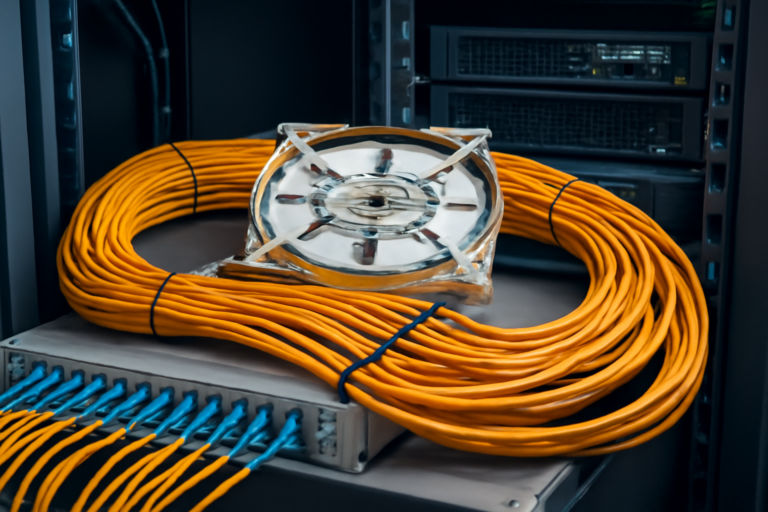
Green Data Centre: Energy-Efficient Fibre Optic Distribution for Sustainable IT Infrastructure
Green Data Centre Fibre Optics, Sustainable Network Infrastructure, Energy-Efficient IT Operations: The Key to Climate-Neutral Digitalisation
Green data centre fibre optics, sustainable network infrastructure, energy-efficient IT operations – these three components form the foundation for climate-neutral data centres, with fibre optic technology reducing power consumption per transmitted data volume compared to copper-based solutions. The explosive growth of AI applications is driving energy consumption in German data centres to over 21 billion kilowatt-hours annually – a challenge that can only be addressed through highly efficient fibre optic infrastructure. While conventional copper cabling generates additional heat and increases cooling requirements, fibre optic cables remain thermally neutral and enable packing densities of up to 96 fibres per 1RU.
Why Green Data Centre Fibre Optics Becomes Critical Infrastructure
The paradigm shift in data centres is fundamental: modern AI clusters require power densities of 40 to 100 kilowatts per rack, while traditional air cooling systems already reach their limits at 15 kilowatts. These extreme requirements make a complete redesign of network infrastructure essential. Fibre optic technology solves multiple problems simultaneously: it reduces the direct energy consumption of data transmission, eliminates heat generation in cabling, and provides the necessary bandwidth for 3.2 terabits per second in AI inference applications.
The carbon footprint tells a clear story: a copper-based network produces twice as much CO₂ as an FTTH fibre optic network. One hour of data transmission over fibre generates approximately 2 grams of CO₂, while VDSL connections produce 4 grams of CO₂ for equivalent performance. For a data centre handling hundreds of petabytes of monthly throughput, these differences add up to several tonnes of CO₂ savings annually.
- Reduction of power consumption compared to copper
- Thermal neutrality – no additional heat generation
- Lifespan of up to 50 years without performance degradation
- Scalability to future bandwidth requirements without replacement
- Space savings through higher fibre density per square metre
Energy Efficiency Regulations as Drivers of Sustainable Network Infrastructure
Germany’s Energy Efficiency Act (EnEfG) sets clear requirements from July 2026: new data centres must achieve a PUE value of maximum 1.2, existing facilities by 2030 a value of 1.3. These regulatory requirements make highly efficient fibre optic infrastructure a requirement, not an option. The European Gigabit Infrastructure Regulation (GIA) further tightens construction standards: from February 2026, all new buildings and major renovations must be equipped with fibre-capable infrastructure.
| Technology | Energy consumption per terabit | CO₂ emission | Cooling requirement |
|---|---|---|---|
| Fibre optic (FTTH) | 100% | 2g/hour | No additional heat |
| VDSL (Copper) | 175% | 4g/hour | Moderate heat |
| Coaxial cable | 280% | 5g/hour | High heat |
The German Federal Network Agency monitors this development using the KPI4DCE metrics system. Field measurements showed that inefficient data centres emit ten times more greenhouse gases per computing operation than technically necessary. These findings underscore the urgency of comprehensive infrastructure modernisation.
Modular Fibre Optic Systems for Maximum Energy Efficiency in IT Operations
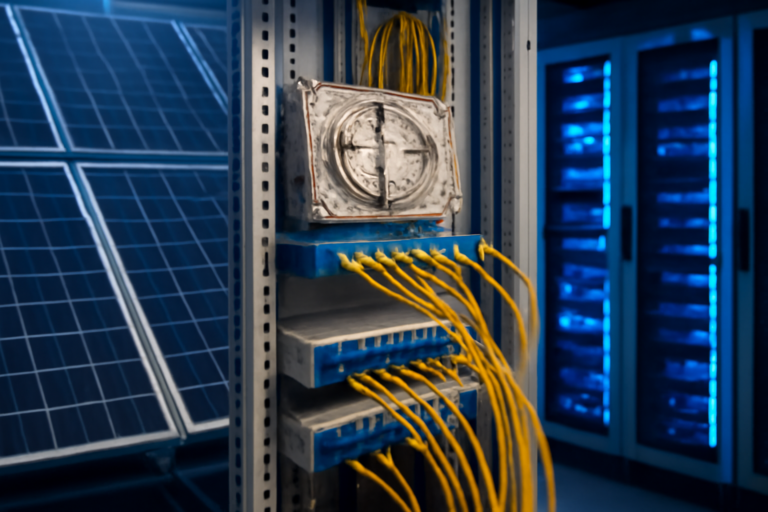
Implementing green data centre fibre optics requires thoughtful system solutions that combine flexibility with efficiency. Modular splice systems such as SlimConnect enable up to 96 fibres in just 1RU – double the packing density of conventional solutions. This high density not only reduces space requirements but also minimises cable routing and associated transmission losses.
Fiber Products Quality Promise: As an official Diamond partner and manufacturer, we produce modular splice systems in Europe. Benefit from Swiss precision and in-house manufacturing.
For larger installations, VarioConnect systems with 3RU provide space for up to 288 fibres. The modular design allows subsequent expansion without operational interruption – a critical factor for data centre availability. All modules comply with IEC 61754-15 for connectors, ensuring maximum compatibility.
- Pre-configured modules reduce installation time
- Front access enables maintenance without rear access
- Colour coding to TIA-598 prevents incorrect connections
- Integrated cable management minimises bend radius below 30mm
- Dust protection shutters extend lifespan of unused ports
AI Workloads and Their Special Requirements for Sustainable Network Infrastructure
Artificial intelligence presents data centres with unprecedented challenges: while training phases require 1.6 terabits per second, inference applications already need 3.2 terabits per second at latencies below 1 millisecond. These requirements are physically unrealisable with conventional copper cabling. Green data centre fibre optics becomes a technical necessity for future-proof AI infrastructure.
The physical proximity of GPU clusters requires special solutions. The optimal radius for GPU servers is approximately 100 metres, which creates extreme demands on cable density. Innovative technologies such as rollable fibre optic ribbons enable up to 3,456 fibres in a single 4-inch conduit – more than double conventional bundles.
| Use case | Bandwidth | Latency | Fibre requirement |
|---|---|---|---|
| AI training | 1.6 Tbit/s | < 5ms | 48–96 fibres |
| AI inference | 3.2 Tbit/s | < 1ms | 96–192 fibres |
| Traditional IT | 100 Gbit/s | < 10ms | 24–48 fibres |
Practical Implementation: From Planning to Energy-Efficient Installation
The transformation to an energy-efficient data centre begins with structured baseline assessment. First, current utilisation must be measured – many data centres operate with efficiency below 30 percent. Consolidation onto modern fibre optic infrastructure can increase utilisation, cutting energy consumption per compute unit by more than half.
Migration ideally occurs in three phases: critical connections are first switched to fibre optic, followed by gradual replacement of copper cabling in less critical areas. Specialised data centre solutions enable seamless transition. The final phase includes optimisation of cable routing and implementation of intelligent patch management.
- Baseline analysis focused on heat sources and bottlenecks
- Capacity planning for 10 years with 40 percent reserve
- Selection of standards-compliant components to ISO/IEC 11801
- Documentation of all connections for efficient management
- Staff training for proper maintenance procedures
Measurable Benefits: ROI and Sustainability in Numbers
Investment in green data centre fibre optics typically pays for itself within 3 to 5 years through energy savings alone. For a mid-sized data centre with 500 racks, switching to fibre optics means annual electricity savings of approximately 2.5 million kilowatt-hours. This corresponds to a CO₂ reduction of 1,250 tonnes annually using German grid mix.
The long-term perspective amplifies these benefits: while copper networks require modernisation every 7 to 10 years, fibre optic infrastructure lasts up to 50 years. Made in Europe quality guarantees maximum reliability and minimal downtime. The 5-year warranty on modular systems provides additional investment security.
Future-Proof Sustainability Through Scalable Fibre Optic Solutions
The evolution toward co-packaged optics (CPO) will set new standards from 2026 onwards. By integrating optical components directly beside the ASIC, energy-intensive signal processors become redundant. Green data centre fibre optics, sustainable network infrastructure, energy-efficient IT operations – this combination becomes even more efficient. Early implementations show additional energy savings of 30 percent with simultaneous higher port density.
Modular systems such as the Diamond product line already enable preparation for these future technologies. With universal MPO interfaces and flexible adapter solutions, data centres are optimally equipped for upcoming standards. Compatibility with all common connector types – LC, SC, E2000, ST and FC – ensures maximum flexibility.
FAQ: Frequently Asked Questions on Green Data Centres and Sustainable Fibre Optic Infrastructure
How much energy does fibre optic save compared to copper?
Fibre optic infrastructure reduces energy consumption per unit of data transmitted. For a typical data centre with 100 Gbit/s throughput, this means annual savings of approximately 500,000 kWh.
Which standards must be observed for green data centre fibre optics?
Key standards include ISO/IEC 11801 for structured cabling, IEC 61754 for connectors, and from 2026 the requirements of the European GIA Regulation. German EnEfG additionally requires a PUE value below 1.3.
Can existing data centres be upgraded to sustainable network infrastructure?
Yes, migration occurs gradually without operational interruption. Modular systems allow successive conversion of individual areas. The investment typically pays for itself within 3 to 5 years.
What packing density is possible with modern fibre optic systems?
Current systems achieve up to 96 fibres per 1RU or 288 fibres per 3RU. With new technologies such as rollable fibre optic ribbons, 3,456 fibres in a single 4-inch conduit are possible.
How does green data centre fibre optics affect cooling?
Fibre optic cable generates no inherent heat and thus reduces cooling load significantly. Combined with modern liquid cooling systems, PUE values below 1.2 can be achieved.
What role does the Diamond partnership play in energy-efficient IT operations?
As an official Diamond partner, Fiber Products guarantees Swiss precision quality with 5 years warranty. The modular systems are specifically optimised for maximum packing density and minimal energy consumption.
Order directly from our shop: fiber-products.de
Request a Quote
Free consultation – personalised quote within 24 hours