


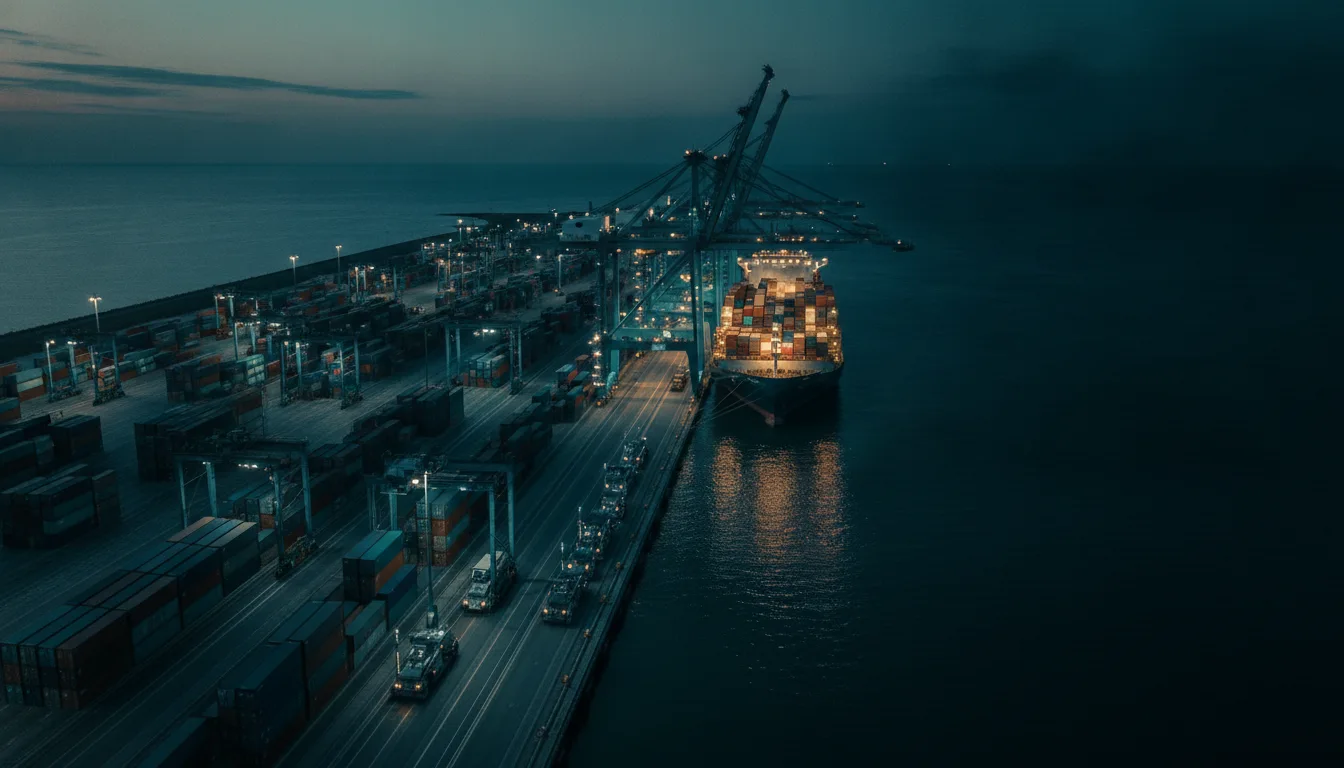
Fiber Optic Solutions for Ports & Logistics
EMI-immune fiber infrastructure for container terminals, cranes and automated logistics hubs — DIN-rail splice boxes for the crane e-house, modular ODF systems for the backbone and Swiss DIAMOND E-2000 connectivity, engineered in Europe.
- DIAMOND E-2000, typ. ≤ 0.1 dB insertion loss
- F4P systems, made in Europe
- EMI-immune & galvanically isolated by design
Terminal networking: three problems standard cabling doesn’t solve
Between crane drives, vessel schedules and constant expansion, a container terminal is one of the toughest places to run a network. Three conditions shape every cabling decision on the quay — and they are exactly where generic components fall short.
Interference where the power is
STS and RMG crane drives, frequency converters and hoist motors flood quay and yard with electromagnetic noise — and long copper runs parallel to power feeds pick it up. Optical fiber removes the problem at the physical layer: completely EMI-immune and galvanically isolated by design, with no ground loops between crane, substation and landside systems.
A failed link stops the berth
In an automated terminal, one dead connection can halt a stacking block, a gate lane or an AGV zone — and vessel schedules don’t wait. High availability has to be planned in from the start: ring topologies with automatic failover, dual-homing, physically separated routes between quay and backbone. Rigid, non-modular infrastructure makes exactly that hard to retrofit.
Salt, weather, vibration — and the terminal keeps growing
Salt-laden air, wind and constant vibration are hostile to sensitive connections, while fiber counts rise with every automation phase: OCR gates, reefer monitoring, new berths. What’s needed is splice technology protected inside cabinets and technical rooms — and a modular system that grows without rip-and-replace.
Fiber optic systems for container terminals — one 7HP module standard
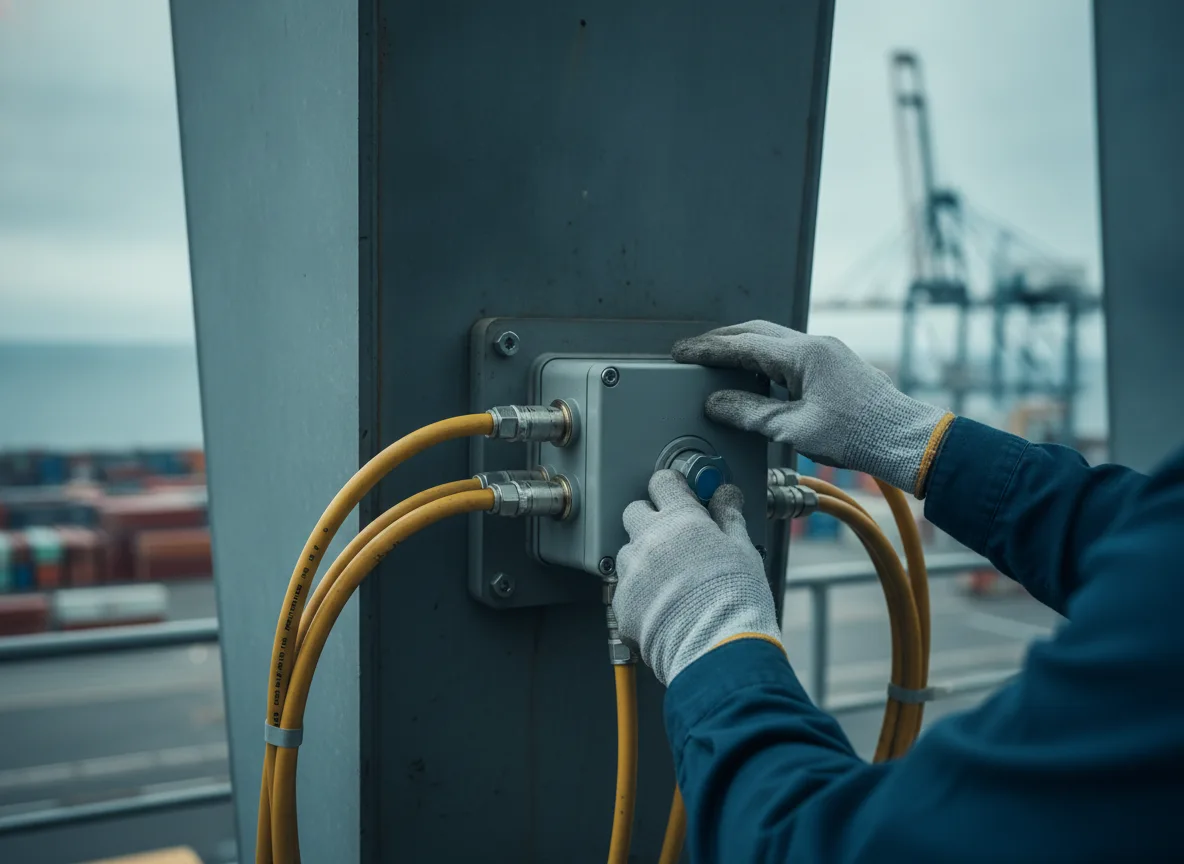
Fiber Products is a European supplier of passive fiber optic systems for ports and logistics hubs: RailConnect DIN-rail splice boxes for the TH35 rail in crane e-houses and automation cabinets, compact 1U splice boxes for gate and edge cabinets, and VarioConnect 3U ODF subracks for the terminal backbone.
All F4P lines are built on one 7HP module architecture — modules are interchangeable between the 1U modular system and VarioConnect — with up to 24 fibers per splice module. As berths, gate lanes and reefer racks come online, you add modules instead of replacing subracks. And the passive layer stays protocol-neutral: it carries whatever your TOS, crane OEM or AGV vendor runs over it.
1U fiber optic splice box
Compact pull-out 19″ splice box for gate lanes, OCR checkpoints and edge cabinets across the yard. The drawer extends fully, keeping splice cassettes and pigtails serviceable without disturbing live links.
1U splice box →VarioConnect 3U ODF system
Modular 19″ subrack for the terminal head-end. 7HP slots accept splice and front modules in any mix, so the distribution frame scales with every expansion phase instead of being replaced.
VarioConnect 3U →Splice modules (7HP)
7HP splice modules with LC, SC or E-2000 fronts and up to 24 fibers per module — the building blocks of the modular system. For vibration-heavy crane links, choose DIAMOND E-2000 variants with a latching, pull-proof design.
Splice modules →All fiber optic components
Browse the complete F4P and DIAMOND range for port and logistics projects — from RailConnect DIN-rail boxes for crane and automation cabinets to subracks, modules and cable management.
All components →1U modular system — grows with every terminal expansion
Splice, patch and breakout technology on a single height unit, populated 7HP module by 7HP module. Modules are interchangeable with the VarioConnect ODF, so what starts in a gate cabinet can scale into the backbone — berth by berth, without rip-and-replace.
The container terminal — explore it live
Quay, gantry cranes, ship, yard: how fiber connects a terminal — while the trolleys lift containers, the hologram rotates as you scroll.
The partner behind port fiber networks that last
Terminal infrastructure is planned in decades, not product cycles. Four reasons why ports and logistics operators build on F4P and DIAMOND.
German engineering, made in Europe
F4P systems are manufactured in Europe under our own quality control — no anonymous trading stock, and a transparent supply chain for critical-infrastructure procurement.
Official DIAMOND partner
Swiss precision connectivity from DIAMOND SA: E-2000 connectors with typically ≤ 0.1 dB insertion loss preserve the optical budget on long terminal runs — plus Fusion Box (rigid) and Future Box (extendable) splice boxes for growth scenarios.
One modular system
The 7HP architecture lets you combine splice and front modules freely and extend capacity later — interchangeable between the 1U modular system and VarioConnect, without re-splicing existing links.
Personal project consulting
Our team supports the planning of your terminal fiber network personally — from requirements analysis to the material list. Project prices and volume discounts on request.
Plan your terminal fiber network online
Three free tools: check your optical budget, then configure your system live in 3D — with real part numbers and prices for your quote request.
Loss budget calculator
Add up connectors, splices and fiber lengths for your quay-to-backbone runs and check the total attenuation against the transceiver budget before anything is ordered.
Calculate loss budget →DIAMOND configurator
Configure DIAMOND Future and Fusion boxes with E-2000 live in 3D — real part numbers per configuration, ready to attach to your inquiry.
Open DIAMOND configurator →Subrack configurator
Populate your 19″ subrack (3U or 1U) slot by slot with splice and front modules in 3D — with a parts list of real part numbers and the total for your project.
Open subrack configurator →Frequently asked questions about port & logistics fiber optics
The questions terminal planners and procurement teams ask most about fiber optic infrastructure in ports and logistics hubs.
Why fiber instead of copper for crane and terminal networks?
Two physical properties decide this. First, EMI immunity: crane drives, frequency converters and hoist motors generate strong electromagnetic fields, and long copper runs parallel to power feeds act as antennas for that noise — optical fiber is completely immune to it. Second, galvanic isolation: fiber creates no conductive path between crane, substation and landside systems, so ground loops and potential differences are eliminated by design. Add the distances — quay, stacking yard, gate and administration are often kilometers apart, which suitable singlemode optics bridge without repeaters — plus the bandwidth headroom for OCR and camera traffic, and fiber becomes the natural physical layer for terminal networks.
Which components fit where — crane e-house, gate, reefer area, backbone room?
A practical mapping: in the crane e-house and automation cabinets, RailConnect DIN-rail splice boxes bring structured fiber management directly onto the standard TH35 rail next to drives and PLCs — inside controlled indoor environments. At gate lanes and edge cabinets, the compact 1U splice box keeps splices front-serviceable on a single height unit. In the backbone room, the VarioConnect 3U ODF concentrates the terminal’s fiber plant in freely combinable 7HP modules with up to 24 fibers each. DIAMOND Fusion Box (rigid) and Future Box (extendable) cover dedicated splice points. And because modules are interchangeable between the 1U modular system and VarioConnect, capacity can move with the terminal as it grows.
How do we plan redundancy for automated operations — stacking blocks, AGV fleets, gates?
Start from the failure you cannot afford: a stacking block, an AGV zone or a gate lane going dark. Ring topologies with automatic failover keep traffic flowing when a single link fails; dual-homing connects critical nodes to two independent distribution points; and physically separated routes make sure one damaged duct cannot take out both paths — two fibers in the same duct are not true redundancy. A modular splice infrastructure makes this realistic to retrofit: additional rings and second routes terminate in added 7HP modules instead of forcing a rebuild of the distribution frame.
How do we verify the optical budget on long runs across the terminal?
Add up every loss the light passes on its way: connectors, splices and fiber attenuation over the run length — then compare the total against the transceiver’s power budget with a sensible reserve. Our free loss budget calculator does exactly this before anything is ordered. Low-loss connectivity pays off here: DIAMOND E-2000 connectors with typically ≤ 0.1 dB insertion loss leave measurably more budget on long quay-to-backbone runs, and for kilometer-scale terminal distances singlemode fiber is the standard choice.
How do we source components — and what about lead times for a terminal project?
All components are available in our online shop with transparent prices, and the configurators output real part numbers you can attach to an inquiry. For terminal projects, our team provides personal project consulting — requirements analysis, solution concept, network planning and material lists. Project prices and volume discounts on request. Delivery time is project-dependent — you receive a binding date with your quote. Contact runs through our contact form, and we get back to you personally.
Datasheets for download
Everything on this page as a PDF — for tenders, planning and sharing within the project.
19″ subracks
Dimensions, configurations, order numbers and connection technology for the 19″ subracks line.
Open PDF (PDF · 1 page) →7HP splice modules
Dimensions, configurations, order numbers and connection technology for the 7HP splice modules line.
Open PDF (PDF · 3 pages) →Full catalogue
The complete range at a glance — splice boxes, modules, subracks, cable management and the DIAMOND product line.
Open PDF (PDF · 20 pages) →
Let’s plan your terminal fiber network
Whether you are automating a single gate lane or cabling a new berth: our team provides personal project consulting — from the first loss budget to the finished parts list.
Project prices and volume discounts on request. Delivery time is project-dependent — you receive a binding date with your quote.
Send your project inquiryInquiries via our contact form — we get back to you personally.
Related fiber optic solutions
The same modular system technology, tailored to other demanding environments.
Industry 4.0 & smart manufacturing
Deterministic, EMI-immune fiber networks for automated production and smart factories.
Explore Industry 4.0 solutions →Transport companies
Fiber system technology for rail and public transit — from depots and interlockings to passenger information.
Explore transport solutions →Network operators
Scalable ODF and splice technology for carriers and access networks — from the central office to the field.
Explore operator solutions →