OM3 vs OM4 vs OM5 vs OS2: Fibre Types Compared
Hardly any planning decision has as long an effect as the choice of fibre type: the installed fibre stays in the network for decades, while the active technology changes every few years. OM3, OM4 and OM5 on the multimode side and OS2 as the single-mode class cover practically all applications today — but with very different reaches, cost profiles and future reserves. This comparison delivers the standard reaches for 10, 40 and 100 Gigabit Ethernet, the colour codes for reliable identification and a clear recommendation as to which fibre type suits which project.
The four fibre types at a glance
| Criterion | OM3 | OM4 | OM5 | OS2 |
|---|---|---|---|---|
| Fibre class | multimode 50/125 µm | multimode 50/125 µm | multimode 50/125 µm (WBMMF) | single-mode 9/125 µm |
| Jacket colour (colour code) | aqua (turquoise) | aqua or erika violet | lime green | yellow |
| 10G Ethernet (10GBASE-SR / -LR) | 300 m | 400 m | 400 m | 10 km |
| 40G Ethernet (40GBASE-SR4 / -LR4) | 100 m | 150 m | 150 m | 10 km |
| 100G Ethernet (100GBASE-SR4 / -LR4) | 70 m | 100 m | 100 m (SWDM4: 150 m) | 10 km |
| Operating wavelength | 850 nm | 850 nm | 850–953 nm (SWDM) | 1310 / 1550 nm |
| Typical use | LAN, smaller DCs (legacy) | data centre, short campus | DCs with an SWDM perspective | FTTH, backbone, long haul |
The reaches correspond to the standard figures of the respective IEEE Ethernet variants; manufacturer-specific optics can exceed them but are not a planning basis.
OM3: the established multimode entry point
OM3 is the laser-optimised 50 µm multimode fibre of the first 10G generation: 300 metres at 10GBASE-SR is enough for most building and floor cabling. At 40G and 100G over parallel optics (SR4), however, the reach shrinks to 100 and 70 metres respectively. For new installations, OM3 only makes sense when the links are short and budget dominates — the premium for OM4 has melted considerably in recent years.
OM4: the data centre standard
OM4 uses the same geometry as OM3 but offers higher modal bandwidth and therefore more reach: 400 metres at 10G, 150 metres at 40G-SR4 and 100 metres at 100G-SR4. OM4 thereby covers the typical distances in data centres and on short campus links and is today the standard for new multimode installations. How OM4 cabling interacts with MPO parallel optics for higher data rates is shown in our article MPO vs LC for 400G in the data centre.
OM5: multimode with wavelength multiplexing
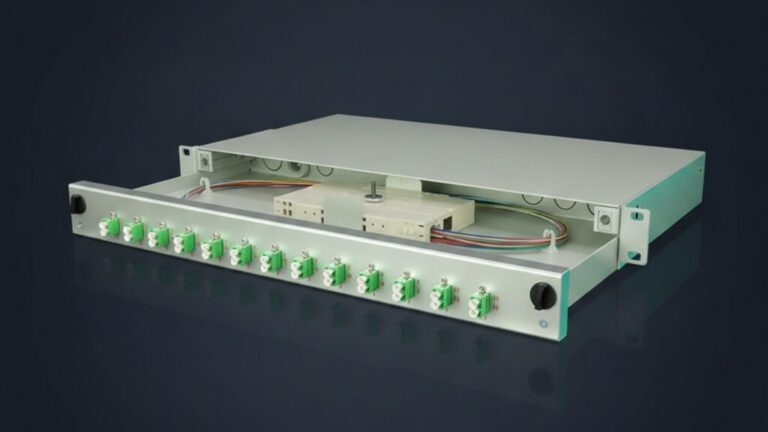
OM5 (wideband multimode fibre) extends the usable window from 850 to 953 nanometres and is designed for SWDM: several wavelengths on one fibre pair instead of eight parallel fibres. With 100G-SWDM4, up to 150 metres over a duplex pair are possible. In the reach of classic SR4 applications, OM5 behaves like OM4 — the added value only materialises with SWDM optics. OM5 is therefore practically relevant for data centres that want to save fibre count and have seriously factored the SWDM roadmap of their transceiver suppliers into their planning. OM5 is available as a variant in our splice box range (recognisable by the lime green colour code).
OS2: single-mode for everything beyond the rack
OS2 is the single-mode class for outdoor applications and long links: with an attenuation of around 0.35 dB/km at 1310 nm (and even less at 1550 nm), it bridges 10 kilometres as standard with 10G/40G/100G LR4 optics — and far more with appropriate optics. In FTTH roll-outs, metro networks and the backbone there is no way around OS2; in new data centres, too, the single-mode share is growing because 400G and 800G shorten multimode reaches further. The fundamental decision is examined in detail in our article single-mode vs multimode.
Practical decision aid
- FTTH, metro network, backbone, building links over 400 m: always OS2 — reach and future-proofing are unrivalled.
- Data centre and campus up to 150 m: OM4 as standard; OM5 only with a concrete SWDM strategy.
- Legacy expansion on OM3: keep operating short links; with 40G/100G plans, check reaches and schedule migration to OM4 or OS2.
- Mixed infrastructure: separate cleanly and document by colour — aqua/violet (OM3/OM4), lime green (OM5) and yellow (OS2) prevent mix-ups at the patch panel.
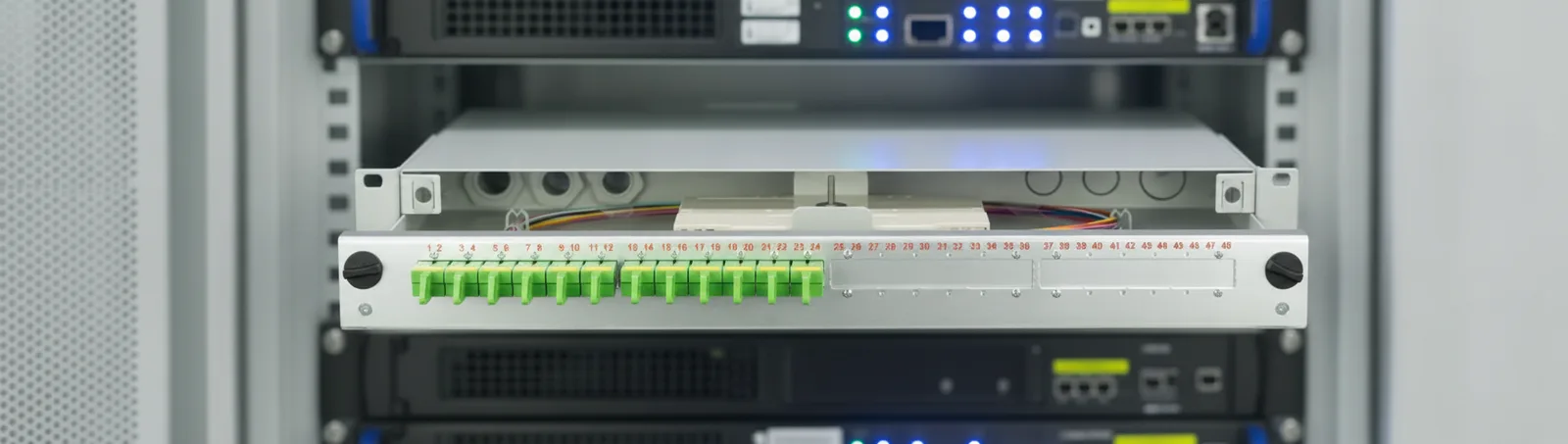
Important: multimode and single-mode components are not compatible — splice boxes, pigtails and patch cords must match the fibre type throughout. Our F4P splice boxes of the SB series manufactured in Europe are therefore available consistently in OM3, OM4, OM5 and OS2 loading, each with LC or SC assembly; you will find the complete range in the online shop. Further fundamentals are bundled in our fibre optic knowledge hub.
Calculate the loss budget per fibre type
Whether a planned link works with the chosen fibre type is decided not by the reach table alone but by the loss budget of fibre attenuation, splices and connectors. With our free planning tool, the loss budget calculator, you check your link in a few minutes; the methodological fundamentals are explained in the practical guide to calculating the loss budget.
Frequently asked questions
What is the difference between OM4 and OM5?
Both are 50 µm multimode fibres with identical reaches in classic SR4 applications. OM5 additionally specifies the wavelength window up to 953 nm and thereby enables SWDM: several wavelengths over one duplex fibre pair, for example 100G-SWDM4 up to 150 metres. The added value of OM5 therefore only materialises with SWDM optics, not with conventional parallel optics.
How far does OM4 reach at 10, 40 and 100 gigabit?
According to the standard figures of the IEEE variants, OM4 reaches 400 metres at 10GBASE-SR, 150 metres at 40GBASE-SR4 and 100 metres at 100GBASE-SR4. That covers typical data centre and short campus distances. For longer links or higher data rates, the path leads to OS2 single-mode with LR optics.
Which colour identifies which fibre type?
The jacket colour code creates order at the patch panel: OM3 is aqua (turquoise), OM4 aqua or erika violet, OM5 lime green and OS2 yellow. The colour coding does not replace labelling, but it prevents the most common source of error in mixed environments — patching between incompatible fibre types.
When is OS2 worthwhile instead of multimode in the data centre?
As soon as links exceed the SR4 reaches or the roadmap calls for 400G and more: with every data rate generation, multimode reaches shrink, while OS2 bridges 10 kilometres as standard with matching optics. Multimode remains attractive where short distances dominate and the cheaper 850 nm optics more than compensate for the fibre premium.
Can I mix OM3 and OM4?
Physically, both can be spliced and patched since geometry and wavelength are identical — but the link then behaves as OM3 overall. For planning, therefore: always calculate reaches according to the weakest link and mark mixed links unambiguously in the documentation.
Planning a cabling project and unsure about the fibre type? We advise you directly as the manufacturer on the right loading — from the OM4 splice box for the data centre to the OS2 system for FTTH roll-outs, manufactured in Europe. Project pricing and volume discounts on request. Send your non-binding enquiry now.