400G and 800G Ethernet: Fibre Optic Solutions for Modern Data Centres
400G and 800G Ethernet: Fibre Optic Solutions for Modern Data Centres
The implementation of 400G fibre optic, 800G Ethernet and high-speed data centre infrastructures defines the new standard for hyperscalers and modern data centres across the DACH region. With growing bandwidth demand driven by AI applications and cloud services, 800G Ethernet connections double transmission capacity while maintaining the same energy consumption per bit. Modular fibre optic systems must support up to 96 fibres per 1RU while enabling migration of existing 400G installations.
Technical Fundamentals: 400G and 800G Ethernet Standards
The IEEE 802.3df standard for 800G Ethernet was ratified in 2023 and transforms data centre architecture through efficient bandwidth utilisation. Compared to 400G systems, the new generation reduces the number of required ports and cables by 50 per cent. This not only simplifies cable management but also significantly lowers operating costs.
Data transmission occurs over various optical interfaces. While 400G primarily uses QSFP-DD and OSFP modules, 800G systems utilise enhanced variants of these form factors. The parallel optics standards SR8 and DR8 operate with eight parallel channels at 100 Gbit/s each.
- 400G-SR8: Range up to 100 metres over Single-Mode vs. Multimode Fibre Optic
- 400G-DR4: Range up to 500 metres over single-mode fibre
- 800G-SR8: Range up to 50 metres over OM4 multimode fibre
- 800G-DR8: Range up to 500 metres over OS2 single-mode fibre
- LPO optics: 50 per cent lower power consumption through DSP elimination
MPO Cabling as the Backbone of High-Speed Networks
Migration to 800G requires adaptation of the cabling infrastructure. While 400G systems often use MPO-12 connectors, 800G implementations increasingly require MPO-16 or dual-MPO-12 configurations. Correct polarity and fibre quality are critical for signal integrity.
| Speed | Connector Type | Fibre Count | Typical Application |
|---|---|---|---|
| 100G | MPO-12 | 8 fibres active | Leaf switches |
| 400G | MPO-12/16 | 8–16 fibres | Spine switches |
| 800G | MPO-16/32 | 16–32 fibres | AI clusters |
Cabling architecture planning must occur early. Modern splice boxes such as the VarioConnect 3RU systems already support the high fibre densities of up to 288 fibres required for future 800G backbones.
Energy Efficiency and Thermal Management in High-Speed Modules
The thermal challenges of 800G modules require innovative cooling concepts. While 400G modules typically consume 12–15 watts, early 800G implementations require 20–25 watts. Linear-drive Pluggable Optics (LPO) reduce this consumption through DSP elimination by up to 30 per cent.
- Optimised airflow through structured cabling
- High-density splice modules with improved thermal dissipation
- Modular systems for easy replacement during upgrades
- Precise attenuation measurements under 0.25 dB per connection
Fiber Products Quality Promise: As an official Diamond partner and manufacturer, we produce modular splice systems in Europe. Benefit from Swiss precision and in-house manufacturing.
Practical Implementation: Migration from 400G to 800G
Step-by-step migration of existing 400G fibre optic, 800G Ethernet and high-speed data centre infrastructures requires strategic planning. Many data centres across the DACH region adopt parallel operating models where 400G serves standard workloads and 800G handles AI-intensive applications.
The migration path typically begins with upgrading passive infrastructure. Existing OM4 multimode fibres support 400G-SR8 over 100 metres, while 800G-SR8 range reduces to 50 metres. This often requires restructuring the cabling topology.
| Migration Phase | Action | Timeline | Investment |
|---|---|---|---|
| Phase 1 | Cabling Inventory | 2–4 weeks | Low |
| Phase 2 | Splice Box/Module Upgrade | 4–8 weeks | Medium |
| Phase 3 | 800G Switch Installation | 8–12 weeks | High |
| Phase 4 | Optimisation and Testing | 2–4 weeks | Low |
Splicing Techniques and Quality Assurance for Ultra-High Speeds
The precision of splice connections becomes critical at 400G and 800G. Every additional 0.1 dB attenuation can compromise transmission quality. Modern fusion splicers achieve attenuation values below 0.02 dB for single-mode fibres.
- Automatic fibre axis alignment for optimal splice quality
- Documentation of each splice connection per IEC 61300-3-35
- OTDR measurements to verify total span
- Cleaning of all connectors before installation
- Use of certified splice cassettes per IEC 61756-1
German Market Perspective: FTTH Rollout Drives Data Centre Modernisation
Accelerated FTTH deployment in Germany creates the foundation for 400G fibre optic, 800G Ethernet and high-speed data centre applications. Municipal utilities and network operators increasingly invest in future-proof fibre optic infrastructure that also meets the rising bandwidth requirements of edge data centres.
The EU’s Gigabit Infrastructure Directive supports this development through funding programmes. German data centres must demonstrably improve energy efficiency by 2027 – a driver for migration to more energy-efficient 800G technologies with improved power-per-bit ratios.
- Frankfurt as Europe’s largest internet hub leads 800G adoption
- Munich and Berlin follow with hyperscaler investments
- Mid-market data centres adopt 400G as a bridge technology
- Municipal data centres benefit from modular expansion concepts
Connector Systems Compared: LC, MPO and E2000 for High-Speed Networks
The choice of connector system significantly influences the performance and maintainability of fibre optic infrastructure. While MPO connectors dominate parallel optics, LC and E2000 offer advantages for single-fibre connections.
| Connector Type | Advantages | Application Area | Attenuation |
|---|---|---|---|
| MPO/MTP | High packing density | 400G/800G backbone | < 0.35 dB |
| LC-Duplex | Flexibility | 10G/25G connection | < 0.25 dB |
| E2000 | Integrated shutter | Industrial environment | < 0.20 dB |
Diamond E2000 connectors stand out for their integrated shutter and high vibration resistance – ideal for demanding data centre environments with high availability requirements.
Modular Splice Systems: Flexibility for Dynamic Requirements
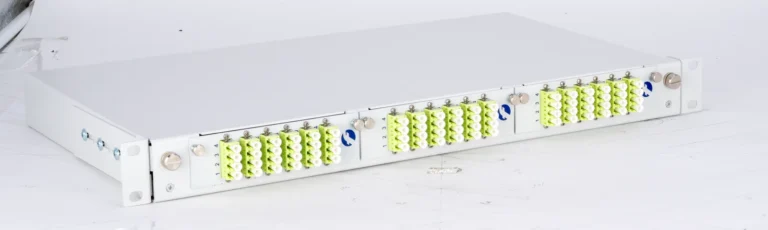
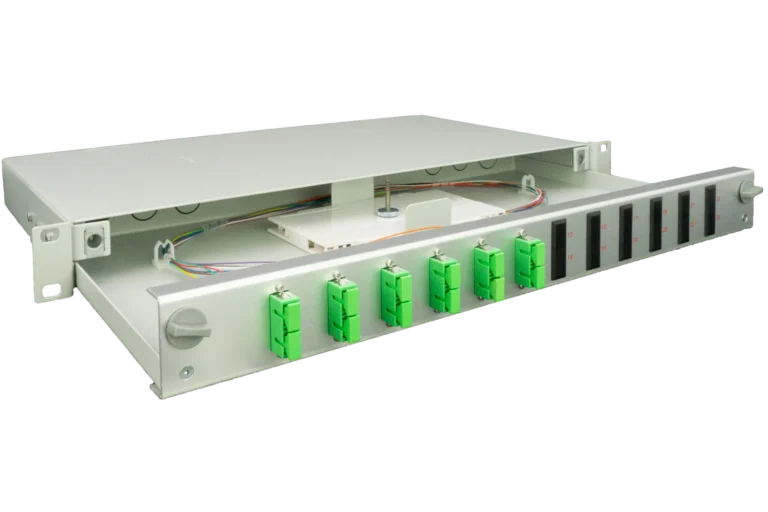
Modern data centres require flexible fibre optic infrastructures that adapt to changing requirements. Modular splice systems such as SlimConnect enable up to 96 fibres per 1RU – double the packing density of conventional solutions.
- Tool-free replacement of front modules
- Pre-configured splice cassettes for rapid installation
- Colour coding per IEC 61754-15 for unambiguous identification
- Integrated cable management for structured routing
- Backward compatibility with existing systems
The modular design reduces installation times by up to 40 per cent and simplifies future upgrades. This is particularly relevant for 400G fibre optic, 800G Ethernet and high-speed data centre projects with tight schedules.
Measurement Technology and Certification for 400G/800G Spans
Verification of high-speed spans requires specialised measurement technology. Beyond classical OTDR measurements, bit error rate (BER) tests are becoming increasingly important. Target values are BER < 10⁻¹² for production environments.
Tier-1 certification per ISO/IEC 14763-3 documents compliance with attenuation budgets. For 400G-SR8, the maximum attenuation budget is 1.9 dB; for 800G-SR8, this reduces to 1.7 dB.
Future Outlook: 1.6 Terabit and Beyond
The Ethernet Alliance is already working on the IEEE 802.3dj standard for 1.6 terabit Ethernet. This next generation is expected to be standardised around 2027 and builds on experience with 400G and 800G. Data centres investing in modular fibre optic systems today lay the foundation for future upgrades.
- Coherent optics for long-haul spans over 10 kilometres
- Co-packaged optics for reduced latency
- Silicon photonics for cost-effective mass production
- Hollow-core fibres for minimal latency
Practical Planning Guidance for Network Operators
Successful implementation of 400G fibre optic, 800G Ethernet and high-speed data centre technologies begins with careful planning. Data centre planners should lay the groundwork today for coming generations.
A structured approach includes inventorying existing fibre spans, defining growth paths and selecting future-proof components. Modular systems provide the flexibility needed for step-by-step upgrades without complete replacement.
| Planning Aspect | 400G Requirement | 800G Requirement | Recommendation |
|---|---|---|---|
| Fibre Type | OM4/OS2 | OM5/OS2 | OS2 for future-proofing |
| Connector Type | MPO-12 | MPO-16/32 | Prepare for MPO-16 |
| Packing Density | 48 fibres/RU | 96 fibres/RU | Modular systems |
| Cooling | Standard | Enhanced | Plan for headroom |
FAQ: Frequently Asked Questions about 400G and 800G Ethernet
When will 800G connections become standard in German data centres?
According to current forecasts, hyperscalers and major colocation providers will establish 800G as the spine standard by 2026–2027. Mid-market data centres typically follow with an 18–24 month delay.
What costs are involved in upgrading from 400G to 800G?
Hardware costs for 800G modules currently range from €600–€1,200 per port. Additional expenses include cabling adjustments (MPO-16 upgrade) and enhanced cooling. Total investments run 30–50 per cent higher than 400G implementations.
Can existing fibres be reused for 800G?
OS2 single-mode fibres support 800G without issue. With multimode fibres, range diminishes: OM4 reaches a maximum of 50 metres at 800G-SR8, while OM5 enables up to 100 metres.
How do LPO and standard optics differ?
Linear-drive Pluggable Optics eliminate digital signal processors and thereby reduce power consumption by 30–50 per cent. They suit short spans up to 2 kilometres with less demanding signal quality requirements.
What role do E2000 connectors play in high-speed networks?
E-2000 connectors reach a typical insertion loss of 0.1 dB (max. 0.3 dB for SM PC and APC) through precise ferrule geometry and active core alignment. Their spring-loaded metal shutter provides laser-eye and dust protection rather than optical performance; combined with splice and termination systems they suit demanding high-speed links.
How does 800G affect network architecture?
800G simplifies spine-leaf architectures by reducing required switches and connections by up to 50 per cent. This lowers complexity, latency and operating costs while doubling bandwidth.
Summary and Recommendations
Migration to 400G fibre optic, 800G Ethernet and high-speed data centre technologies is not a matter of ‘if’ but ‘when’ and ‘how’. German data centres face the challenge of meeting rising bandwidth requirements whilst improving energy efficiency.
Modular fibre optic systems with high packing density form the backbone of this transformation. Investment in future-proof infrastructure with 5 years’ warranty and European manufacturing quality pays dividends through reduced operating costs and simplified migration paths. Plan your fibre optic infrastructure today for tomorrow’s requirements.
Request a Quote
Do you have questions about our fibre optic solutions? Our expert team is happy to advise you – free and without obligation.