


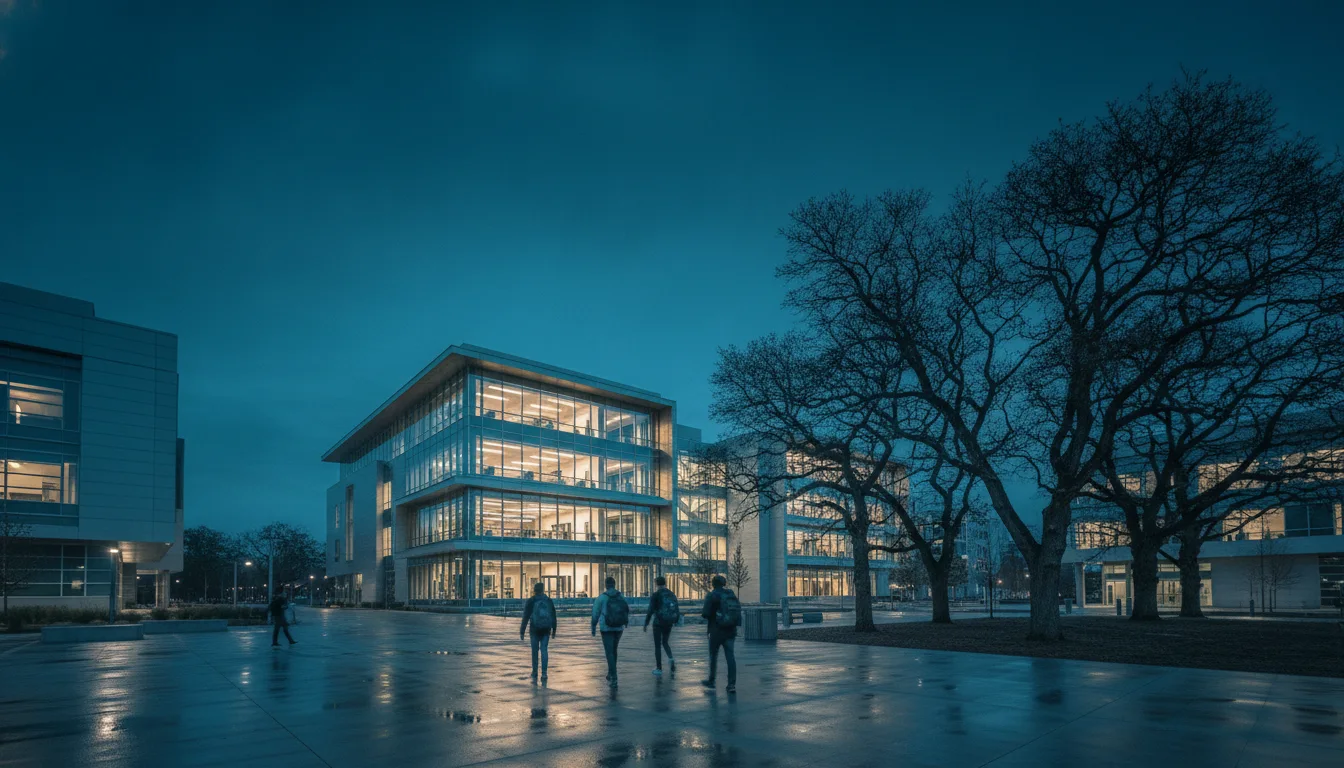
Fiber Optic Solutions for Educational Institutions & Campus Infrastructure
Modular splice boxes, 19″ ODF systems and DIAMOND E-2000 connectivity for university backbones, e-learning infrastructure and smart campus networks — engineered in Europe.
- DIAMOND E-2000, typ. ≤ 0.1 dB insertion loss
- F4P systems, made in Europe
- Modular 7HP architecture — extend instead of replace
Campus networks: three problems standard cabling doesn’t solve
A campus is not an office building. Three conditions shape every campus fiber deployment — and office-grade cabling fails at all three.
Peak loads on a timetable
Registration periods, exam seasons: campus networks face predictable, extreme load peaks. Libraries and lecture halls concentrate hundreds of simultaneous users in single rooms — the fiber backbone behind the Wi-Fi must be sized for the worst quarter hour, not the average day.
Funding cycles, not big-bang budgets
School and university networks grow the way they are funded: in phases. Infrastructure that gets ripped out whenever a new building or funding period arrives destroys capital. Campus fiber must be expandable module by module — with everything already installed running on untouched.
Small IT teams, zero-downtime expectations
Education IT runs large networks with thin staffing — and an outage during online examinations is not an option. Components must be service-friendly enough for small teams and supervised student assistants, and serviceable without taking live links down.
Fiber optic systems for the campus — from data center to lecture hall
Fiber Products is a European supplier of fiber solutions for universities, colleges and school campuses: compact 1U splice boxes for lecture-hall and library distribution points, modular 19″ ODF subracks for the campus data center, and 7HP splice modules that let the fiber count grow with every expansion phase.
The modular F4P systems — the 1U modular system and the VarioConnect subracks — share one 7HP module architecture, and critical backbone links can be specified with DIAMOND E-2000 connectivity. Compact splice boxes for the building IT rooms complete the range.
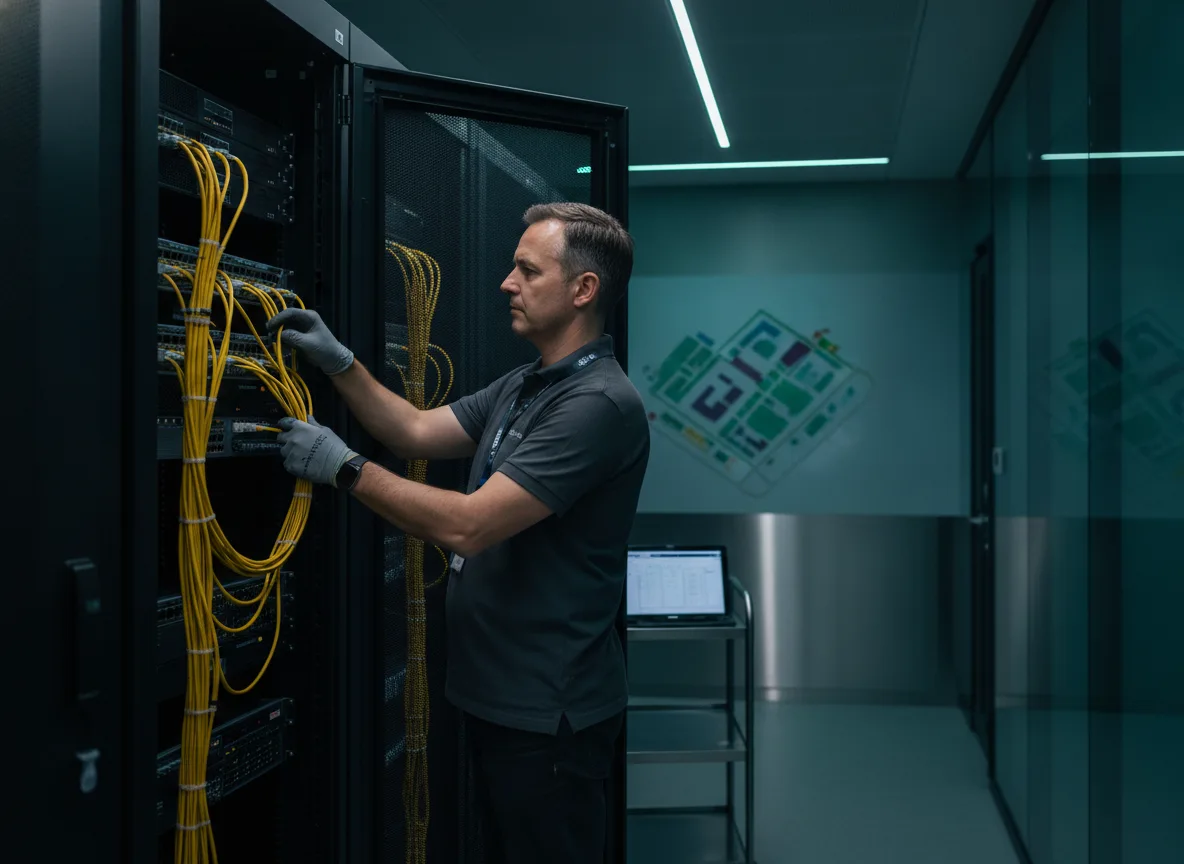
1U fiber optic splice box
Compact pull-out 19″ splice box for building IT rooms: the aggregation point for dense Wi-Fi access point cabling in lecture halls and libraries — serviceable without disturbing live connections.
1U splice box →VarioConnect 3U ODF system
Modular 19″ subrack for the central campus distribution frame. 7HP slots accept splice and front modules in any mix, so the backbone ODF scales with every funding phase instead of being replaced.
VarioConnect 3U →Splice modules (7HP)
7HP splice modules with LC, SC or E-2000 fronts — the building blocks of the modular system. Extend the campus distribution frame module by module; choose DIAMOND E-2000 for critical backbone links.
Splice modules →All fiber optic components
Browse the complete F4P and DIAMOND range for education and campus projects — from subracks and splice boxes to modules and cable management accessories.
All components →VarioConnect 3U — the campus backbone distribution frame
One uniform 7HP module width (35.5 mm): splice and front modules interchange between the 1U modular system and VarioConnect subracks, so capacity grows with each funding phase instead of frames being replaced. RailConnect DIN rail boxes follow the same 7HP architecture.
The campus network — explore it live
Library, lecture halls, institutes, one PoP: scroll and the campus rotates with you while the signals travel the quad.
The partner behind campus fiber networks that last
Education IT plans in decades, not semesters. Four reasons why universities, colleges and school networks build on F4P and DIAMOND.
Manufactured in Europe
F4P systems are made in Europe with German Engineering behind the design — short paths from your campus requirement to the finished assembly, at pricing that fits education budgets.
Official DIAMOND partner
Swiss precision connectivity from DIAMOND SA: E-2000 connectors with typically ≤ 0.1 dB insertion loss, a spring-loaded laser-protection shutter and integrated dust protection.
One modular system
The 7HP architecture combines splice and front modules freely and extends capacity later — without swapping the subrack or re-splicing existing links.
Personal project consulting
Our team supports the planning of your campus fiber network personally — project prices and volume discounts on request.
Plan your campus fiber network online
Three interactive tools: check your optical budget, then configure your system live in 3D — with real article numbers and prices for your quote request.
Loss budget calculator
Add up connectors, splices and fiber lengths for your building-to-building links and check the total attenuation against the system budget before anything is ordered.
Calculate loss budget →DIAMOND configurator
Configure DIAMOND Future and Fusion boxes with E-2000 live in 3D — real article numbers per configuration, ready to attach to your enquiry.
Open DIAMOND configurator →Subrack configurator
Populate your 19″ subrack (3U or 1U) slot by slot with splice and front modules in 3D — with a parts list of real article numbers and the total for your project.
Open subrack configurator →Frequently asked questions about campus fiber networks
The questions education IT teams ask most — from how to implement fiber optics in education networks to redundancy for online examinations.
How do you implement fiber optics in education networks?
A proven campus fiber deployment follows five steps. Record requirements per campus area — lecture halls, libraries, labs, housing and administration all load the network differently. Design the hierarchy: central distribution frame in the campus data center, one distributor per building, access cabling to floors and Wi-Fi access points. Connect the buildings with singlemode fiber — campus distances are far beyond the 100 m copper Ethernet can bridge. Deploy in phases aligned with funding cycles: a modular ODF starts with today’s fiber count and extends module by module. And migrate in parallel operation, with cut-overs outside teaching periods, so lectures and online examinations are never interrupted.
How do a fiber optic LAN and campus backbone work together?
They are two layers of one campus fiber optic network. The backbone is the fiber layer between buildings: it connects every building distributor to the central ODF in the campus data center, in a ring or star topology. The LAN is the layer inside each building — Ethernet and Wi-Fi serving end devices, fed from the building distributor. Fiber increasingly reaches into the LAN itself: in libraries and lecture halls, access points are aggregated over fiber because hundreds of simultaneous users exceed what copper runs handle. Splice boxes, ODF subracks and splice modules keep both layers expandable.
What do different campus areas need from the fiber network?
Lecture halls and seminar rooms need bandwidth for streaming, hybrid teaching and interactive displays. Libraries need dense Wi-Fi for hundreds of simultaneous users, fed by fiber-connected access points. Research laboratories need dedicated high-capacity links to national research networks. Student housing needs symmetrical bandwidth for e-learning. Administration needs strict segmentation to protect student records; dining halls and common areas need guest networks and signage. One modular distribution frame maps all of it onto a single system.
How do you protect online examinations against network failures?
Redundancy is layered. Ring topologies between campus buildings let traffic fail over automatically if a cable is cut during construction work. Examination centers get dual uplinks to separate core switches, ideally over physically diverse cable paths. Internet access is secured with more than one ISP connection. And at component level, a pull-out splice box lets a single link be serviced without taking neighboring connections down — maintenance stops being a risk to running operations.
How do you plan for smart campus, IoT and network security?
Plan the hierarchy first: core in the campus data center, building distribution, then the access layer for sensors, cameras, access control and building management — with IoT traffic aggregated per building. Security rests on strict segmentation: research, teaching, administration and guest networks stay separated, so student records and research data are isolated from public traffic — and optical fiber is significantly harder to tap than copper. Reserve fiber for what is coming: private 5G campus networks, AR/VR teaching and AI tools all rely on fiber backhaul. A modular 7HP system keeps those reserves affordable — leave slots free today, add modules later.
Are campus fiber projects eligible for education funding programs?
Frequently, yes — many digital-education and state funding programs cover passive network infrastructure. Two properties of a modular system help in practice: phased deployment matches the project scope to a funding period, and the online configurators produce parts lists with real article numbers and prices — the cost basis a funding application needs. Always confirm the rules of the specific program with your funding body.
What support does Fiber Products offer for campus projects?
Personal project consulting: Our team personally supports you with planning and dimensioning your campus network.
Project pricing: Project prices and volume discounts on request.
Datasheets for download
Everything on this page as a PDF — for tenders, planning and sharing within the project.
19″ subracks
Dimensions, configurations, order numbers and connection technology for the 19″ subracks line.
Open PDF (PDF · 1 page) →7HP splice modules
Dimensions, configurations, order numbers and connection technology for the 7HP splice modules line.
Open PDF (PDF · 3 pages) →Full catalogue
The complete range at a glance — splice boxes, modules, subracks, cable management and the DIAMOND product line.
Open PDF (PDF · 20 pages) →
Let’s plan your campus fiber network
Whether you connect a single school building or roll out a university-wide backbone: our team provides personal project consulting — from the first loss budget to the finished parts list.
Project prices and volume discounts on request. Delivery time is project-dependent — you receive a binding date with your quote.
Send your project enquiryEnquiries via our contact form — we come back to you personally.
Related fiber optic solutions
The same modular system technology, tailored to other demanding environments.
Clinics & healthcare
Segmented, fail-safe fiber networks for hospitals, laboratories and medical campuses.
Explore healthcare solutions →Municipal utilities
From FTTH roll-out to network modernization: system technology for municipal operators.
Explore utility solutions →Data centers
High-density 19″ systems for 400G/800G migration and maximum port density per height unit.
Explore data center solutions →