Green Data Centre: Energy-Efficient Fibre Optic Infrastructure
Green Data Centre: Energy-Efficient Fibre Optic Infrastructure for Sustainable Operations
Green data centres, sustainable infrastructure, and fibre optic energy savings are central to modern data centre planning – energy-efficient fibre optic infrastructure reduces power consumption compared to copper cabling while delivering higher bandwidth and rack density. The combination of modular fibre systems with up to 96 fibres in 1U and intelligent thermal management enables PUE values below 1.2 according to German energy efficiency legislation (EnEfG).
German data centres currently consume 21 billion kWh of electricity annually – a figure that could double by 2030 due to AI applications. Fibre optic infrastructure forms the backbone of sustainable data centres, as it combines minimal energy consumption with maximum transmission capacity.
Why Fibre Optics Form the Foundation for Green Data Centres
The physical properties of fibre optic cables make them the ideal choice for sustainable data centres. Unlike copper cables, optical fibres require no active cooling and generate no electromagnetic radiation. A single fibre optic cable with 12 fibres can replace up to 144 Category 6A copper cables.
- Power consumption: 0.1 watts per fibre port versus 4–6 watts for copper
- Reach without repeaters: up to 40 km with singlemode fibres
- Bandwidth: 100 Gbit/s and higher per fibre possible
- Space requirement: less volume than comparable copper installations
- Lifespan: 25+ years without performance degradation
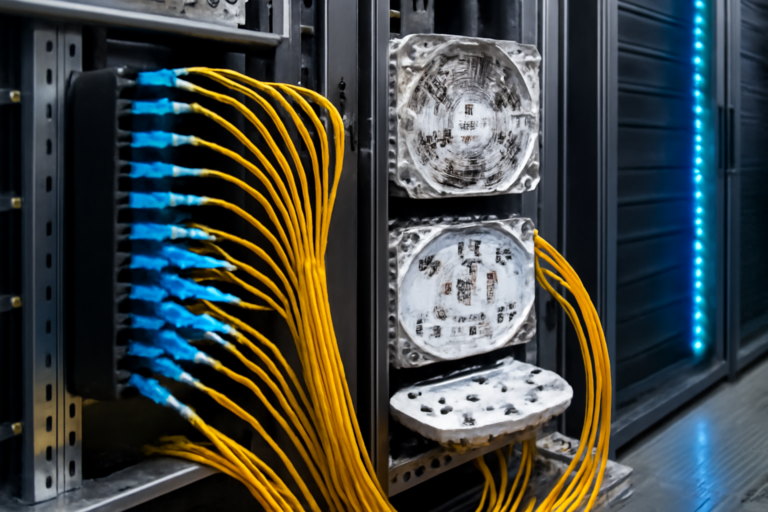
Heat generation in cable trays is drastically reduced by fibre optics. While copper cables generate significant heat dissipation at high data rates, fibre optic cables remain thermally neutral. This significantly reduces the data centre’s cooling load.
Modular Fibre Systems for Maximum Energy Efficiency
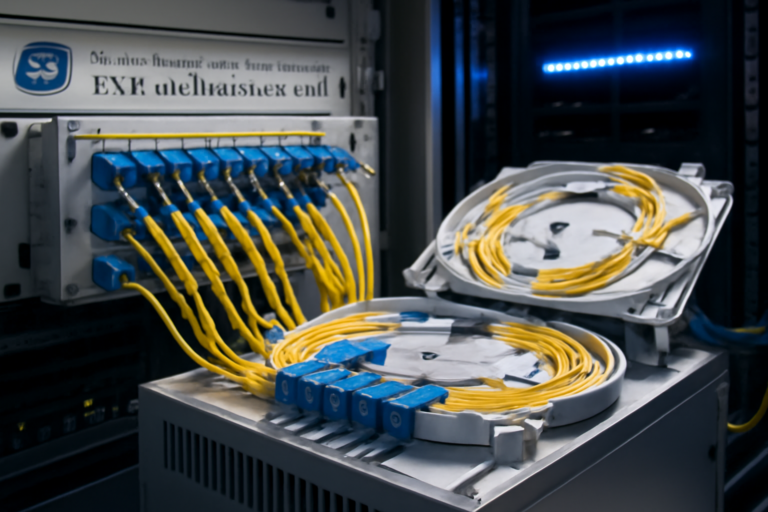
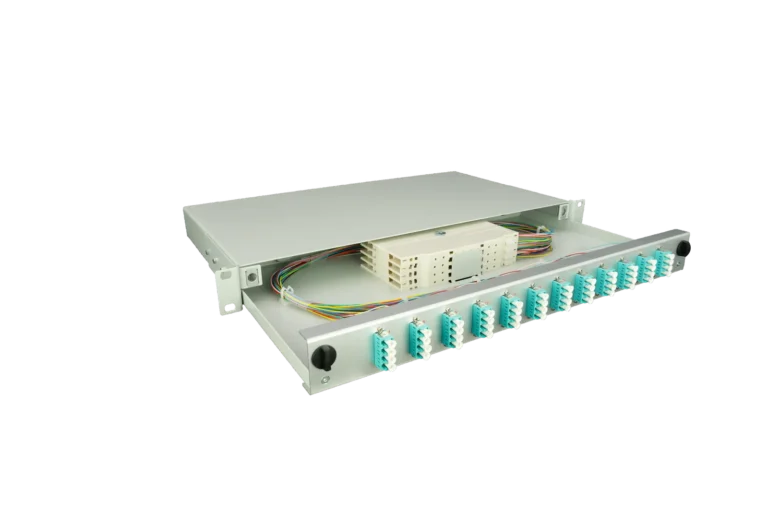
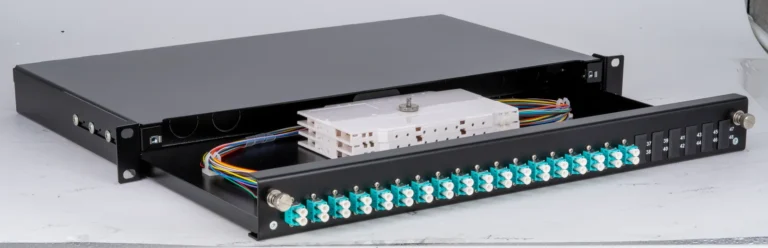
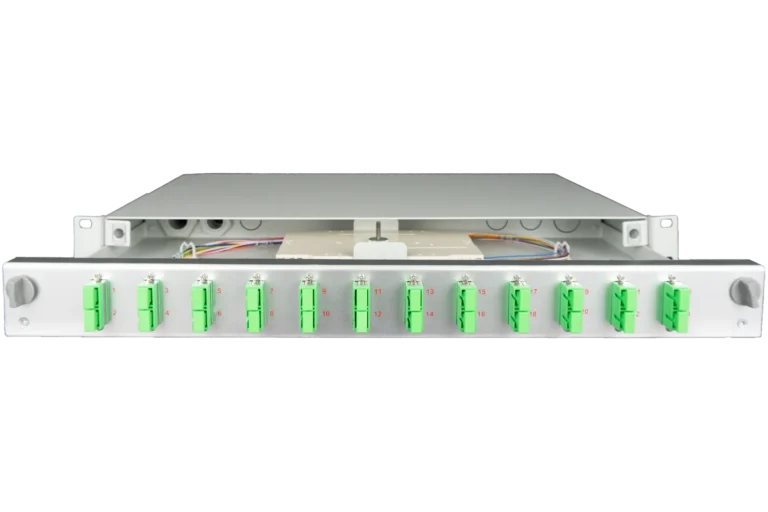
Modern data centres deploy modular fibre systems that enable flexible adaptation to growing requirements. SlimConnect systems achieve a packing density of 96 fibres in just 1U, while conventional solutions accommodate a maximum of 48 fibres.
| System Type | Height Units | Max Fibres | Power Consumption | PUE Contribution |
|---|---|---|---|---|
| SlimConnect | 1U | 96 Fibres | 9.6 W | 0.02 |
| VarioConnect | 3U | 288 Fibres | 28.8 W | 0.03 |
| Standard Box | 2U | 48 Fibres | 19.2 W | 0.04 |
| Copper Cat6A | 2U | 48 Ports | 240 W | 0.15 |
Modular design also enables demand-driven expansion without operational downtime. Splice cassettes can be changed or expanded during operation, raising data centre availability to 99.999 percent.
Green Data Centres and EnEfG Compliance
German energy efficiency legislation (EnEfG) requires from July 2026 that new data centres achieve a maximum PUE of 1.2. Existing facilities must reach 1.3 by 2030. Fibre optic infrastructure contributes directly to meeting these targets.
- Reduction of cooling loads through thermally neutral transmission
- Minimisation of active network components
- Extension of maintenance intervals to 5 years
- Simplified waste heat recovery through concentrated heat sources
- Compliance with IEC 61754-15 for sustainable connectors
EnEfG documentation requirements also demand comprehensive energy consumption tracking. Modern fibre systems with integrated management interfaces automatically capture all relevant parameters and generate mandated reports.
Fiber Products Quality Promise: As an official Diamond partner and manufacturer, we produce modular splice systems in Europe. Benefit from Swiss precision and in-house manufacturing.
MPO/MTP Technology for AI Data Centres
Artificial intelligence and machine learning are driving bandwidth requirements to new dimensions. GPU clusters require connections of 400 Gbit/s and higher between individual nodes. MPO/MTP connectors with 12, 24, or 72 fibres per connector enable these high data rates with minimal space requirements.
A single MPO-24 connector replaces 24 individual LC-duplex connections and reduces installation time. Pre-termination in controlled production environments also guarantees insertion loss values below 0.25 dB per connection.
| Connector Type | Fibres | Bandwidth | Space Requirement | Installation Time |
|---|---|---|---|---|
| LC-Duplex | 2 | 20 Gbit/s | 100% | 100% |
| MPO-12 | 12 | 120 Gbit/s | 25% | 35% |
| MPO-24 | 24 | 400 Gbit/s | 25% | 25% |
| MPO-72 | 72 | 1.2 Tbit/s | 30% | 20% |
Liquid Cooling and Fibre Optic Integration
The new generation of data centres combines direct liquid cooling (DLC) with high-density data center cabling strategies. At power densities exceeding 40 kW per rack, air cooling is no longer sufficient. Fibre optic cables are ideal because they are insensitive to moisture and temperature fluctuations.
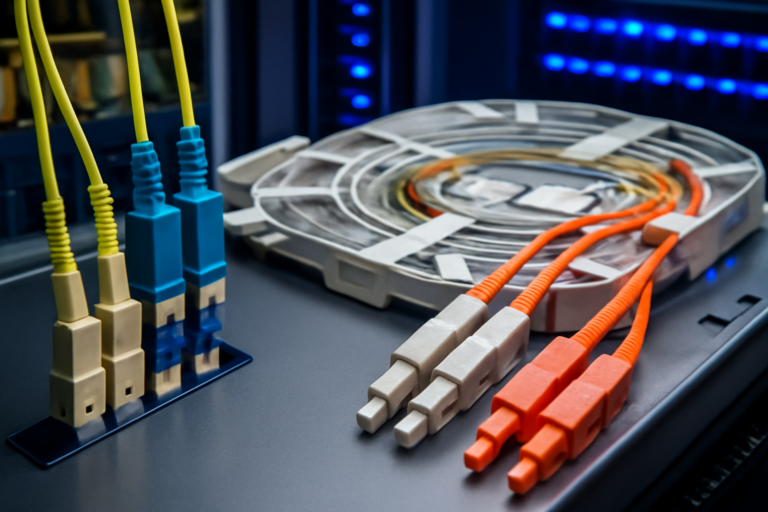
Integration occurs via specialised IP65-rated feedthroughs that accommodate both coolant lines and fibre bundles. E2000 connectors with their robust design and Diamond quality are particularly suited to these demanding environments.
- Temperature resistance: −40°C to +85°C without performance loss
- Vibration resistance per IEC 61300-2-1
- Protection class IP65 when connection is closed
- Guaranteed insertion loss: < 0.1 dB with E2000 APC
- Lifespan: > 1000 mating cycles
Sustainable Data Centres Through Intelligent Fibre Utilisation
Optimal utilisation of existing fibres significantly reduces material consumption. Modern wavelength division multiplexing (WDM) transmits up to 96 channels over a single fibre. This corresponds to total bandwidth of 9.6 Tbit/s per fibre pair.
Through deployment of singlemode OS2 fibres, distances up to 40 kilometres can be bridged without intermediate repeaters. This enables connection of remote sites and utilisation of renewable energy sources at optimal locations.
Life Cycle Assessment and Carbon Footprint of Fibre Systems
Manufacturing fibre optic cables produces less CO2 than production of comparable copper cables. Over an entire lifespan of 25 years, a CO2 saving of 2.5 tonnes is achieved per 1000 metres of cable run.
- Raw material extraction: Silicon dioxide locally available
- Production: Made in Europe reduces transport distances
- Operation: lower energy consumption
- Recycling: fibres recyclable
- Warranty coverage: 5 years on modular systems
The modular design of VarioConnect systems enables targeted replacement of individual components without complete renewal. This extends service life and significantly reduces resource consumption.
Practical Implementation: Realising Green Data Centres with Fibre Optics
Transformation to a sustainable data centre occurs in several phases. The current state is first documented and savings potential through fibre migration calculated. A typical 1 MW data centre can improve its PUE value by 0.2 points through consistent fibre deployment.
| Measure | Investment | Savings/Year | Payback Period |
|---|---|---|---|
| Copper to Fibre | €150,000 | €45,000 | 3.3 years |
| Modular Systems | €80,000 | €18,000 | 4.4 years |
| MPO Migration | €120,000 | €35,000 | 3.4 years |
| WDM Technology | €200,000 | €52,000 | 3.8 years |
Implementation ideally occurs during planned maintenance windows. Modular systems enable staged migration without total outage. Specialised fibre optic solutions for data centres provide pre-terminated components for minimal downtime.
Certifications and Standards for Sustainable Fibre Infrastructure
Green data centres require proven sustainability through recognised certifications. The Blue Angel for data centres demands a PUE below 1.3 and use of renewable energy. Fibre systems must additionally meet the following standards:
- ISO 14001 — Environmental management system of manufacturer
- IEC 61300 — Test methods for optical fibres
- EN 50173 — Generic cabling for customer premises
- IEC 61754-15 — Connectors for E2000
- DIN EN 50600 — Data centre infrastructure
Production in Europe guarantees compliance with European environmental standards and short transport routes. As a Diamond partner, we additionally deliver proven Swiss precision quality in connectors.
Future Outlook: Green Data Centres in 2030
The next generation of sustainable data centres will be based entirely on fibre optics. Quantum computers and neuromorphic processors require transmission rates in the petabit range. Only fibre can meet these requirements with reasonable power consumption.
By 2030, 100 GW of new data centre capacity will be deployed globally. Consistent deployment of fibre optic infrastructure could save 15 TWh of electricity annually – equivalent to the annual output of 5 nuclear power plants.
FAQ: Frequently Asked Questions About Green Data Centres and Fibre Optics
How much energy does fibre optics save compared to copper cabling?
Fibre optics reduce the energy consumption of data transmission. Per 10 Gbit/s connection, consumption drops from 5 watts (copper) to 0.5 watts (fibre). With 1000 ports, that yields a saving of 4500 watts continuous power.
Which modular fibre systems are suitable for sustainable data centres?
SlimConnect systems with 96 fibres in 1U offer the highest packing density. For larger installations, VarioConnect 3U systems with up to 288 fibres are recommended. Both feature replaceable splice cassettes and 5 years warranty.
How does EnEfG legislation affect existing data centres?
Existing facilities must achieve a maximum PUE of 1.3 by 2030. Replacing copper with fibre optic cabling can lower PUE by 0.1–0.2 points and is often the most cost-effective measure for regulatory compliance.
Which connector types are optimal for green data centres?
For high-speed connections, MPO/MTP connectors with 12–72 fibres are suitable. In industrial environments, E2000 connectors with Diamond quality provide the highest reliability. Standard LC-duplex remains the most economical solution for individual connections.
How long does migration to fibre optic infrastructure take?
Migration of a 500-rack data centre with modular design takes approximately 6–8 weeks. Through pre-terminated systems and staged migration, 99 percent of services remain available during the upgrade.
What role does Made in Europe play in sustainable fibre systems?
Local production reduces transport emissions compared to Far Eastern imports. Additionally, European manufacturing guarantees compliance with ISO 14001 environmental standards and enables custom adaptations with short lead times.
Conclusion: Green Data Centres with Future-Proof Fibre Infrastructure
Green data centres, sustainable operations, and fibre optic energy savings form the foundation of modern digital infrastructure. The combination of modular fibre systems, intelligent fibre utilisation, and well-planned cable management enables PUE values below 1.2 while increasing power density.
As a manufacturer of modular fibre solutions and official Diamond partner, Fiber Products supports data centres in their sustainable transformation. From initial consultation through system planning to implementation, we provide the complete system solution from a single source – with 5 years warranty on all modular systems.
Request a Quote
Do you have questions about our fibre optic solutions? Our expert team is happy to advise you – free of charge and without obligation.