LC vs SC vs E-2000 vs ST: Which Fibre Connector for What?
Four connector types dominate European fibre optic practice: LC, SC, E-2000 and — above all in legacy installations — ST. Anyone planning network infrastructure fixes packing density, loss budget, maintenance comfort and procurement costs for decades with the connector choice. Yet the decision is often made out of habit. This comparison assesses the four connector types soberly: form factor and ferrule diameter, typical insertion loss, packing density in the 19″ distributor and the application areas in which each type plays to its strengths.
The four connector types at a glance
| Criterion | LC | SC | E-2000 | ST |
|---|---|---|---|---|
| Ferrule diameter | 1.25 mm | 2.5 mm | 2.5 mm | 2.5 mm |
| Locking | latch (push-pull) | push-pull | push-pull with locking | bayonet |
| Integrated protective shutter | no | no | yes (dust and laser protection) | no |
| Typical insertion loss | 0.1–0.3 dB | 0.1–0.3 dB | ≤ 0.1 dB (Swiss precision manufacturing) | approx. 0.3 dB, legacy technology |
| Packing density in the 19″ panel | very high (half the space of the 2.5 mm class) | medium | high (Compact RJ: 2 fibres per port) | low (turning clearance for bayonet) |
| Polish variants | UPC, APC | UPC, APC | UPC, APC (APC dominates) | mostly UPC/PC |
| Typical use | data centre, transceivers, building LAN | FTTH subscriber connection, ONT, distributor | operator, government and critical-infrastructure networks | legacy plants, industrial multimode |
LC: the density champion for data centre and LAN
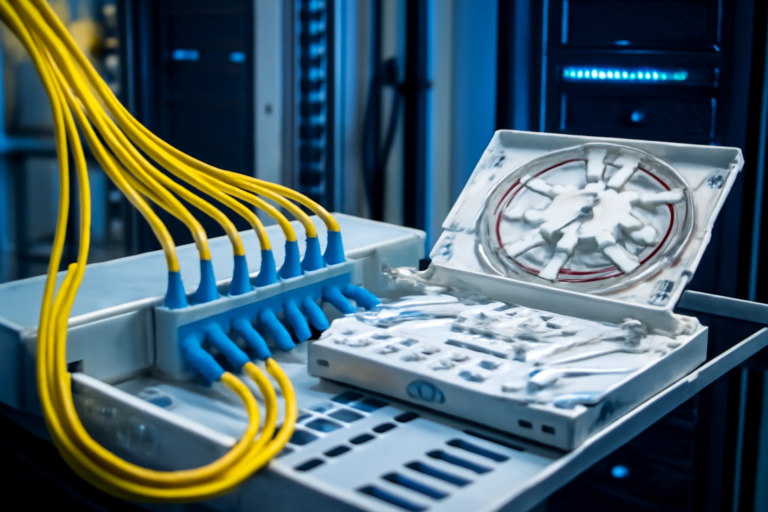
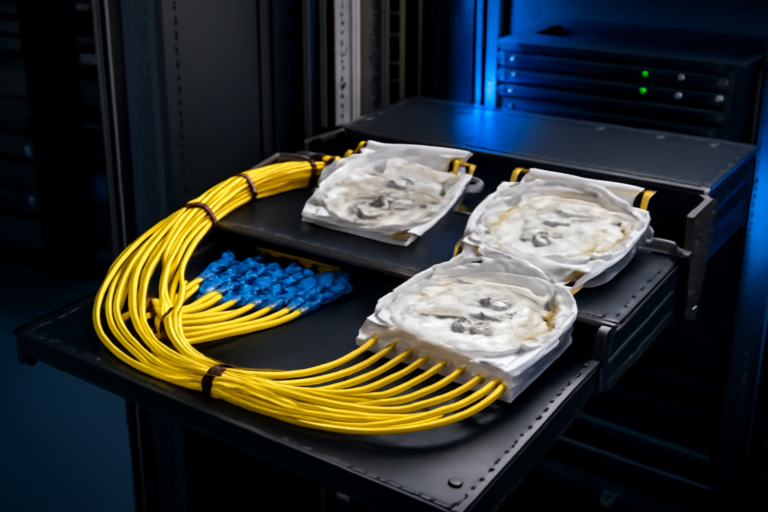
With its 1.25 mm ferrule, the LC connector needs half the space of the 2.5 mm class and is today the de facto standard at transceivers (SFP/SFP+/QSFP breakouts) and in structured building cabling. In high-density splicing systems such as our SlimConnect series, up to 96 fibres can be terminated in one height unit. Its strengths: maximum port density, a huge selection of patch cords and components, low procurement cost. Its limit: the delicate latch is less robust than a locked all-metal mechanism — in patch panels with frequent mating cycles, handling discipline counts.
SC: the proven FTTH standard
The SC connector with its 2.5 mm ferrule and simple push-pull principle is robust, forgiving in handling and ubiquitous in the FTTH subscriber area: practically every ONT and many building handover points rely on SC/APC. The APC angled polish (8°) provides the high return loss required in the access network. When APC and when UPC is the right choice is covered in detail in our article SC/APC vs SC/UPC in the FTTH network.
E-2000: the premium class for operator and government networks
The E-2000 (standardised as LSH) is the only one of the four connector types with an integrated, spring-loaded protective shutter: it closes automatically on unplugging, protects the end face from dust — and the technician’s eyes from emerging laser radiation. Add a mechanical lock against accidental unplugging and optional colour and key coding against mismating. In the Swiss precision manufacturing of DIAMOND, whose systems we carry as an official partner, the E-2000 achieves typical insertion losses of ≤ 0.1 dB — headroom that goes straight into the loss budget. The Compact RJ variant carries two fibres per connector housing, doubling density in the distributor. Why public authorities and critical-infrastructure operators often even mandate the E-2000 is explained in our article E-2000 connectors in government networks.
ST: the legacy classic
The ST connector with its bayonet lock was the standard in multimode LANs and industrial networks in the 1990s and is encountered by planners today mainly in existing installations. Its bayonet needs turning clearance, which limits packing density, and duplex applications require two individual connectors. For new planning, ST plays practically no role any more; for expansions in existing plants the pragmatic solution is usually a hybrid patch cord (ST to LC) or step-by-step migration in the course of work that is due anyway.
Do not forget the polish: PC, UPC, APC
Regardless of connector type, the end-face polish determines the return loss — a critical value in analogue video and PON environments. As a rule of thumb: UPC for multimode and non-critical single-mode links, APC (green, 8° angled polish) wherever reflections must be minimised, especially in the FTTH access network. The technical background is explained in our comparison of the polish grades PC, UPC and APC.
Decision aid: which connector for which project?
- Data centre, campus backbone, building LAN: LC duplex — maximum density, transceiver compatibility, broad component selection.
- FTTH access network and subscriber connection: SC/APC — device compatibility at the ONT, robust handling, high return loss.
- Operator PoPs, public authorities, critical infrastructure, measurement links: E-2000/APC — laser protection shutter, locking, coding options and the best typical insertion loss.
- Legacy networks with ST: do not roll out anew; connect via hybrid patch cords and migrate during rebuilds.
In practice, many networks combine several connector types — what matters is that splice boxes and splice modules cleanly support the chosen loading. Our F4P systems manufactured in Europe are available with LC and SC loading, the DIAMOND system technology in Swiss precision with E-2000 in all variants; you will find the complete range in the online shop.
Configure your subrack directly
The fastest way to see how the connector choice concretely affects port density and module layout in the 19″ subrack is to try it yourself: with our free planning tool, the subrack configurator, you assemble subracks and modules interactively and instantly see how many fibres your configuration accommodates per height unit.
Frequently asked questions
Which fibre optic connector has the lowest insertion loss?
In precision manufacturing, the E-2000 achieves typical insertion losses of ≤ 0.1 dB, putting it at the top of the four types compared. High-quality LC and SC connectors typically range between 0.1 and 0.3 dB. Besides the connector type, the manufacturing quality of ferrule and polish is always decisive.
What is the difference between LC and SC?
The LC uses a 1.25 mm ferrule and thereby achieves roughly double the packing density of the SC with its 2.5 mm ferrule. LC dominates at transceivers and in the data centre, SC in the FTTH subscriber area. In terms of attenuation, both types are on a par at comparable manufacturing quality; the difference is primarily mechanical and economic.
Why do public authorities and network operators often mandate E-2000?
The E-2000 combines three properties that count in security-critical networks: an automatic protective shutter against dust and emerging laser radiation, a mechanical lock against accidental unplugging, and colour and key coding against mismating. Add the very low typical insertion loss of DIAMOND’s Swiss precision manufacturing.
Is the ST connector still up to date?
Not for new planning: the bayonet limits packing density, duplex requires two individual connectors, and the component selection is shrinking. In existing installations, however, ST links continue to work reliably. The economical strategy: connect via hybrid patch cords (ST to LC) and migrate to LC or E-2000 during rebuilds that are due anyway.
Can I combine different connector types in the same network?
Yes — in networks that have grown over time this is the norm: E-2000 in the operator PoP, SC/APC at the subscriber connection, LC in the data centre. What matters are clean transitions via matching patch panels or hybrid patch cords and a consistently calculated loss budget, so that the sum of the connections does not eat up the link margin.
Unsure which loading is right for your project? We advise you directly as the manufacturer on LC, SC and E-2000 systems — from the F4P splice box made in Europe to DIAMOND system technology in Swiss precision. Project pricing and volume discounts on request. Send your non-binding enquiry now.