FTTH Market Germany 2026: Current Figures, BREKO Analysis and Forecasts
FTTH Market Germany 2026: Current Figures, BREKO Analysis and Forecasts for Fibre Deployment
The FTTH market Germany 2026 shows dynamic development according to the latest BREKO fibre analysis: the fibre deployment rate reached 52.8 percent by mid-2025 with 24.3 million households connected, while current fibre statistics show a subscription rate of 27.3 percent. Telecommunications competitors are driving 61 percent of the entire deployment and rely on modular splice systems for efficient network expansion.
For telecommunications providers, this development presents tangible challenges: doubling connections by 2026 requires scalable fibre solutions with high port density and standards-compliant documentation. Particularly in urban metropolitan areas, demand is growing for 1U rack-height splice systems with up to 96 fibres.
Current BREKO Market Analysis: Fibre Deployment Reaches Critical Mass
The latest BREKO fibre analysis from November 2025 documents a turning point in the German FTTH market: with 12.55 million active fibre connections, the number of users has doubled within 18 months. Telecommunications providers alone invested over 8.2 billion euros in network expansion in the first half of 2025.
| Metric | June 2024 | June 2025 | Forecast 2026 |
|---|---|---|---|
| Homes Passed | 22.5 million | 24.3 million | 28.1 million |
| Deployment Rate | 48.8% | 52.8% | 61.0% |
| Homes Connected | 9.8 million | 12.55 million | 17.2 million |
| Subscription Rate | 21.3% | 27.3% | 37.4% |
Competitors of Deutsche Telekom are expanding particularly aggressively: they are connecting an average of 320,000 new households monthly with FTTH connections. This deployment speed calls for splice systems that are qualified for the environment they sit in — IEC 61753-1 provides the performance framework and defines those environmental categories — and for a modular design that scales without replacement.
Regional Distribution: City States Lead, Rural Areas Catch Up
Fibre statistics reveal significant regional differences in the FTTH market Germany 2026. Hamburg leads with a deployment rate of 89.7 percent, followed by Schleswig-Holstein with 72.3 percent. Baden-Württemberg fibre rollout 41.2 percent and 38.9 percent respectively, still below the national average.
- Northern Germany: Above-average coverage through municipal providers
- Eastern Germany: Rapid deployment through government support schemes, already achieving 58.4 percent coverage
- Southern Germany: Need for catch-up despite economic strength
- Ruhr Area: Dense development requires specialised micro-duct installation
- Rural Regions: Growth rate of 42 percent annually through federal funding
Technical Requirements for Telecommunications Providers in FTTH Deployment
The massive expansion presents network operators with technical challenges. The BREKO fibre analysis identifies three critical areas: splice capacity, documentation effort and maintenance efficiency. Modern splice systems have to combine high port density in one rack unit with fibre management that keeps bend radii under control. DIN EN 50173-1 covers the design of the cabling itself; the fibre count per rack unit follows from the route, not from the standard..
For efficient network deployment, telecommunications providers increasingly rely on pre-terminated splice modules with LC-APC and SC-APC connectors. Average attenuation must remain below 0.25 dB, with return loss of at least 60 dB.
Fiber Products Quality Promise: As an official Diamond Partner and manufacturer, we produce modular splice systems in Europe. Benefit from personal project consultation by our team — project pricing and volume discounts on request.
Investment Volume and Economics in FTTH Market Germany 2026
Fibre statistics forecast a total investment volume of 18.5 billion euros for the German FTTH market in 2026. Network operators calculate average costs of 1,850 euros per household connection in urban areas and up to 4,200 euros in rural regions.
| Cost Item | Share Urban | Share Rural |
|---|---|---|
| Civil Works | 45% | 62% |
| Passive Infrastructure | 28% | 21% |
| Active Technology | 18% | 12% |
| Planning/Documentation | 9% | 5% |
Economics improve significantly through standardised components. Modular splice systems reduce installation time. Telecommunications providers report amortisation periods between 7 and 12 years with a calculated network lifespan of 40 years.
Standards Compliance and Certifications for Network Operators
The BREKO fibre analysis emphasises the importance of standards-compliant installations for long-term network reliability. All components must comply with IEC 61300 series and bear CE marking. For public tenders, manufacturers must also hold ISO 9001:2015 certification.
- Fire Safety: Cables per CPR Class Dca for building installations
- Mechanical Strength: Minimum 500 mating cycles per IEC 61300-2-2
- Environmental Resistance: Temperature range -40°C to +85°C for outdoor installations
- Attenuation Values: Maximum 0.35 dB for single-mode connections
- Documentation: Complete test records per DIN EN 61280-4-2
Splicing Technology and Cable Management for High Port Densities
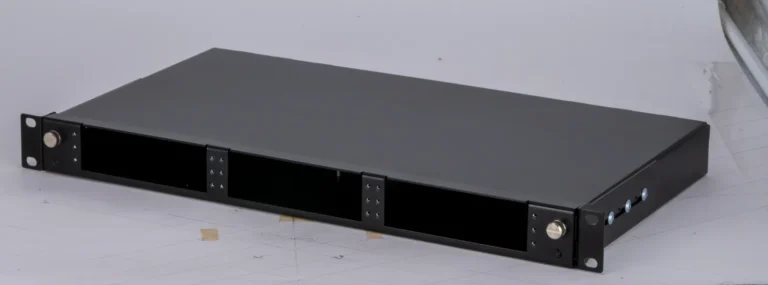
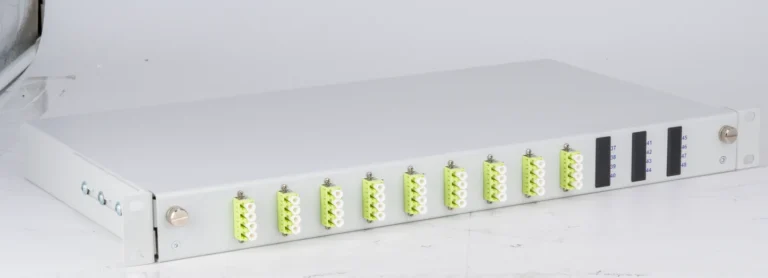
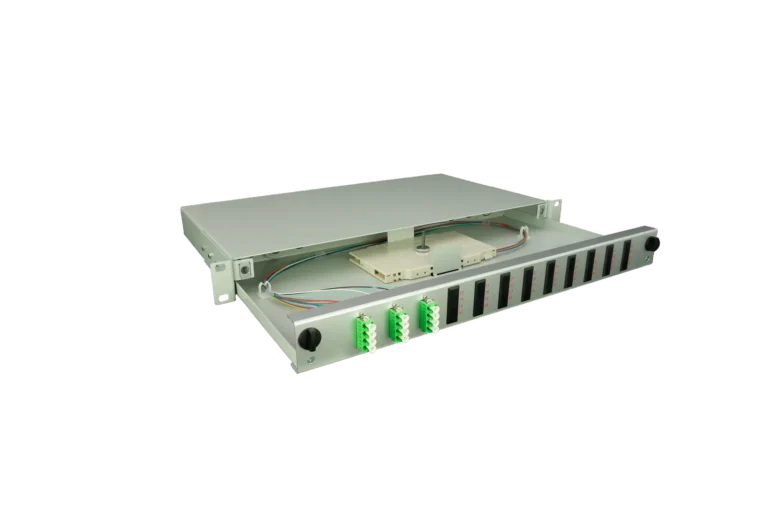
The FTTH market Germany 2026 demands maximum port density in distribution cabinets. Modern 1U rack-height splice systems accommodate up to 96 fibres with full front accessibility. Modular design enables subsequent expansion without service interruption.
Telecommunications providers increasingly adopt pre-terminated splice modules with integrated fibre routing. Bend radii must be at least 30 mm to maintain attenuation losses below 0.01 dB. Colour coding per DIN VDE 0888 simplifies fibre identification during maintenance.
For backbone connections, MPO/MTP connectors are gaining importance. They enable parallel transmission of 12 or 24 fibres in a single mating cycle. Fibre statistics show MPO share rising from current 8 percent to forecast 22 percent by 2026.
Quality Assurance and Test Equipment in FTTH Network Deployment
The BREKO fibre analysis documents rising quality requirements in network deployment. Each fibre connection must be documented with OTDR measurements at 1310 nm and 1550 nm. Maximum total attenuation of a subscriber line must not exceed 1.5 dB.
- Splice Attenuation: Maximum 0.05 dB per fusion splice
- Connector Attenuation: Maximum 0.25 dB for APC connections
- Macrobends: Additional attenuation below 0.1 dB at 10 mm radius
- Chromatic Dispersion: Below 17 ps/(nm·km) for single-mode
- Polarisation Mode Dispersion: Maximum 0.2 ps/√km
Future Technologies and Migration Paths for Network Operators
The FTTH market Germany 2026 is preparing for new transmission standards. XGS-PON with 10 Gbit/s symmetrical becomes the new standard, while initial pilot projects are already testing 50G-PON. These technology leaps require high-quality connectors with return loss exceeding 65 dB.
Migration of existing GPON networks occurs through wavelength multiplexing. Telecommunications providers use specialised WDM filters in distribution cabinets. Parallel operation of 1490/1310 nm for GPON and 1577/1270 nm for XGS-PON enables non-disruptive upgrades.
Funding Programmes and Regulatory Framework
Fibre statistics show the significant impact of government support on deployment. The federal fibre funding 2026 12 billion euros through 2026 for underserved areas. Funded connections require minimum 1 Gbit/s symmetric bandwidth.
Telecommunications providers must provide detailed technical evidence for funding applications. This includes network plans per GIS standard, attenuation budgets and redundancy concepts. Required network availability is minimum 99.5 percent annually.
Practical Implementation: From Planning to Installation
The BREKO fibre analysis recommends structured project workflows for efficient network deployment. The planning phase includes site inspection, permitting and procurement. Modern fibre optic solutions significantly reduce installation time through pre-termination.
- Phase 1: Inventory and network planning with CAD software
- Phase 2: Civil works and duct installation per DIN 18220
- Phase 3: Cable pulling with controlled tension below 2700 N
- Phase 4: Splicing work in climate-controlled installation vehicles
- Phase 5: Acceptance testing and documentation per ISO/IEC 14763-3
FAQ: Technical Questions on FTTH Market Germany 2026
Which splice systems are suitable for high packing densities in FTTH deployment?
For maximum port density, 1U rack-height splice systems with up to 96 fibres are recommended. Modular systems like SlimConnect offer flexible configuration with various connector types (LC, SC, E2000) and enable subsequent expansion without service interruption. Front accessibility greatly simplifies maintenance work.
How do APC and PC connectors differ in use?
Per IEC 61755-2-1, APC connections meet return loss grade 1 (>=60 dB), while non-angled PC connections are graded 2 (>=45 dB), 3 (>=35 dB) or 4 (>=26 dB). APC is standard in FTTH because it holds reflections far below the ODN minimum of 32 dB that ITU-T G.984.2 requires.
Which standards apply to fibre installations in Germany?
DIN EN 50173-1 covers structured cabling, DIN VDE V 0888-100-1-1 marking and fibre colour coding, and the IEC 61300 series the test procedures for components. Connection loss is classified by the attenuation grades in IEC 61755-1 rather than by a single universal figure. The limit that actually binds a project is the one the network operator writes into its specification — take it from the tender documents, not from a rule of thumb.
What is the real lifespan of fibre optic networks?
No standard sets a fixed lifespan in years for fibre cable; manufacturers characterise mechanical reliability through proof stress rather than a year count. Connector durability is tested to IEC 61300-2-2, which defines mating cycles as selectable severity levels — the number that applies is the one specified for the product, not a universal value. Minimum bend radii follow ITU-T G.657: 10 mm for A1, 7.5 mm for A2 and B2, 5 mm for B3; the frequently quoted 30 mm applies to standard G.652 fibre.
What test equipment do installers need for acceptance?
Acceptance of single-mode installed cable plant follows IEC 61280-4-2, which sets out both reference-cord methods using a light source and power meter and a separate OTDR method. In practice you need a calibrated light source and power meter for the attenuation measurement, an OTDR to characterise the link and locate events, and a video microscope for end-face inspection. Which method is required is stated in the client's specification.
How is migration from GPON to XGS-PON carried out?
Both standards can operate in parallel through wavelength multiplexing. GPON uses 1490/1310 nm, XGS-PON operates on 1577/1270 nm. WDM filters in distribution cabinets enable non-disruptive upgrades of individual customers.
Outlook: FTTH Market Germany Beyond 2026
The BREKO fibre analysis forecasts near-complete FTTH coverage in Germany by 2030. Subscription rate is expected to rise from current 27.3 percent to over 65 percent. Technologically, coherent transmission methods and 400G Ethernet move into focus for network operators.
For telecommunications providers, this means continuous investment in scalable infrastructure. As a manufacturer of modular fibre solutions, Fiber Products supports deployment with innovative splice systems in Diamond quality. The European manufacturing quality on all systems underscores confidence in manufacturing quality.
The German FTTH market is developing into a European leader—with cutting-edge technology and sustainable business models for the digital future. Municipal utilities and regional network operators particularly benefit from the modular design of contemporary fibre optic systems.
''
Request a Quote
Do you have questions about our fibre optic solutions? Our expert team is happy to advise you—free of charge and without obligation.