Fibre Rollout Baden-Württemberg 2026: Broadband Strategy and Municipal Utilities
Fibre Rollout Baden-Württemberg 2026: Status of BW Fibre and FTTH BaWü Broadband Strategy
The fibre rollout in Baden-Württemberg, BW Fibre and FTTH BaWü reach a critical milestone in 2026: over 65% of households in south-west Germany have direct fibre-optic connections, whilst the state government is accelerating full-coverage deployment by 2030 with its revised broadband strategy. Municipal utilities play a key role as local network operators in serving underserved areas.
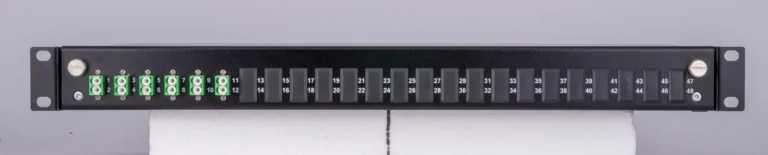
Current market consolidation is particularly evident in rural areas: whilst conurbations such as Stuttgart FTTH deployment FTTH coverage rates above 75%, regional municipal utilities are increasingly investing in their own backbone infrastructure. Technical implementation requires well-designed splice concepts with up to 96 fibres per 1U to efficiently handle rising bandwidth demands.
Current Rollout Figures: BW Fibre and FTTH BaWü in Regional Comparison
Baden-Württemberg ranks in the upper third of German states for fibre rollout. FTTH coverage rose from 28% (2023) to currently 65% of households. Mid-sized municipalities with 20,000 to 100,000 residents are developing particularly dynamically, with municipal utilities building their own fibre networks.
| Region | FTTH Coverage 2026 | Key Players | Deployment Focus |
|---|---|---|---|
| Stuttgart/Ludwigsburg | 78% | Telekom, NetCom BW | Existing network densification |
| Rhine-Neckar District | roughly one third | Fibernet, MVV | Industrial estates |
| Black Forest-Baar | 52% | Stadtwerke VS | Rural expansion |
| Lake Constance District | 68% | Stadtwerke Konstanz | Lakeside communities |
Technical implementation predominantly uses single-mode fibres to ITU-T G.652.D standard. Municipal utilities increasingly adopt modular splice systems that enable flexible scaling from 12 to 288 fibres.
Broadband Strategy 2.0: Support Criteria for Municipal Network Operators
The revised state funding scheme focuses on three pillars: gigabit-capable infrastructure, municipal self-management and sustainable operator models. Municipal utilities benefit from simplified application procedures and funding rates up to 90% in underserved areas.
- Minimum bandwidth for funding: 1 Gbit/s symmetrical
- Priority for municipal operation and municipal utility cooperations
- Technology neutrality with clear FTTH focus
- Mandatory open-access models for funded networks
- Accelerated approval procedures via digital application portals
DIN VDE V 0888-100-1-1 covers the marking, transport and storage of optical cables including fibre colour coding — it is not a documentation standard. What has to be documented is set by the client’s specification.. Splice protocols with OTDR measurements and comprehensive fibre documentation are prerequisites for funding disbursement.
Municipal Utilities as Drivers: Successful FTTH Projects in Baden-Württemberg
Municipal operators are developing into full-service telecommunications providers. Stadtwerke Tübingen, for example, is connecting 45,000 households by 2027, whilst Stadtwerke Heidelberg is expanding its network to 60,000 FTTH connections.
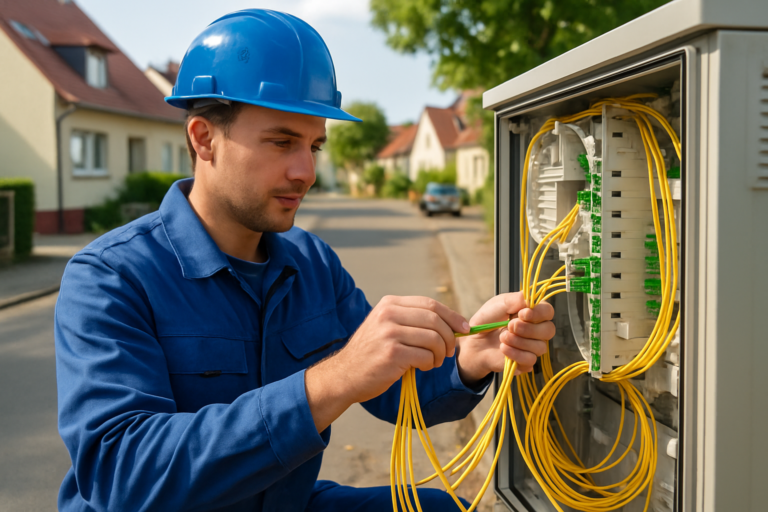
The technical standard features point-to-point architectures with central distribution points. Per distribution cabinet, 288 to 576 fibres are terminated, with modular 19-inch systems simplifying later expansion.
Fiber Products Quality Promise: As an official Diamond partner and manufacturer, we produce modular splice systems in Europe. Benefit from Swiss precision and in-house manufacturing.
Case Study: Stadtwerke Villingen-Schwenningen
With an investment volume of 120 million euros, SVS is realising comprehensive FTTH rollout. Technical implementation is based on a three-tier network concept:
- Backbone ring with 144 fibres (redundancy)
- Distribution cabinets with SlimConnect 1U splice modules
- Household connections via micro-duct technology (7x Ø10mm)
- End-user termination with SC/APC or LC/APC connectors
Technical Infrastructure: Splice Concepts for BW Fibre Networks
Modern FTTH network architecture requires carefully designed splice solutions. Municipal utilities employ 19-inch technology to DIN 41494 with high packing density. At typical PoP sites, 2,000 to 4,000 fibres are terminated in just a few rack units.
| Network Layer | Fibre Count | Splice System | Connector Type |
|---|---|---|---|
| Backbone | 96-288 | VarioConnect 3U | E2000/APC |
| Distribution | 48-96 | SlimConnect 1U | LC/APC |
| Household | 4-12 | Compact box | SC/APC |
Attenuation values must remain < 0.25 dB per splice point. Modern fusion splicers with core centring achieve typical values of 0.02 to 0.05 dB.
Challenges in Baden-Württemberg Fibre Rollout 2026
Despite positive progress, municipal utilities face significant hurdles. Skills shortages in civil works delay projects by an average of 6 to 12 months. Meanwhile, material costs for fibre optic cable and splices are rising 15-20% compared to 2024.
- Civil works capacity: only 60% of required teams available
- Approval procedures take 3-6 months despite digitalisation
- Competitive pressure from parallel overbuild in profitable areas
- Refinancing challenges in scattered settlements with < 50 households/km²
- Integration of existing copper and coaxial networks
Market Consolidation: Collaborations Between Municipal Utilities and Carriers
The complexity of FTTH rollout is driving strategic alliances. Municipal utilities pool resources in regional fibre companies, whilst established carriers open their networks to open access. These cooperation models reduce investment risk and accelerate full-coverage deployment.
Technically, this means unified standards: IEC 61754-15 for E2000 connectors, IEC 61754-20 for LC connectors and consistent colour coding to DIN VDE 0888-320. Modular splice systems for municipal utilities enable vendor-independent network expansion.
Future Outlook: FTTH BaWü by 2030
The state government is targeting 95% FTTH coverage by 2030. This requires annual investments of 2.5 billion euros and connecting a further 1.8 million households. Municipal utilities are already planning with overcapacity for future bandwidth requirements.
- Migration to XGS-PON with 10 Gbit/s symmetrical
- Preparation for 25G-PON and 50G-PON standards
- Redundant route design for critical infrastructure
- Integration of 5G mobile via fibre-optic backhaul
Quality Assurance: Standards and Measurement Procedures for BW Fibre
Technical handover follows strict requirements. OTDR measurements document total attenuation for each section, whilst connectors are inspected for cleanliness using video microscopes. Return loss must exceed > 60 dB for APC connectors.
Municipal utilities increasingly use automated documentation systems that transfer measurement protocols directly into GIS systems. High-density splice boxes with integrated labelling simplify traceability.
FAQ: Frequently Asked Questions on Baden-Württemberg Fibre Rollout
What funding programmes support municipal utilities in FTTH rollout?
The state of Baden-Württemberg funds municipal projects via its broadband support scheme with up to 90% of the economic shortfall. In addition, federal fibre funding programmes 50% grants.
How many fibres should municipal utilities plan per household?
Best practice shows: 2 fibres per residential unit plus 30% reserve. For multi-family buildings, typically 4+2 fibres (4 active, 2 reserve) are deployed.
What splice systems are suitable for municipal network operators?
Modular 19-inch systems with interchangeable cassettes offer maximum flexibility. Packing density should enable at least 48 fibres per 1U, ideally up to 96 fibres.
How long does FTTH rollout take for a 50,000-resident city?
Under optimal conditions, municipal utilities need 3-5 years for complete coverage. The critical factor is civil works capacity, averaging 2-3 km of trench per week.
What connector types are becoming standard in FTTH?
The trend favours LC/APC for high packing density and SC/APC for end-user connections. Premium networks use E2000/APC with integrated protective shutter.
How do municipal utilities ensure network availability?
Redundant route design, ring topologies and pre-installed spare fibres ensure 99.95% availability. Critical routes receive additional diverse routing.
Conclusion: Baden-Württemberg Fibre Rollout as a Model for Germany
The fibre rollout in Baden-Württemberg, BW Fibre and FTTH BaWü successfully demonstrate how municipal stakeholders drive digital transformation. With 65% FTTH coverage and ambitious expansion plans, the state is setting benchmarks. Municipal utilities benefit from their infrastructure expertise and local embeddedness.
Technical implementation requires carefully designed concepts with scalable splice systems. As a manufacturer of modular fibre-optic solutions and official Diamond partner, Fiber Products supports municipal utilities with precision system solutions – from the compact SlimConnect 1U splice box to high-density VarioConnect systems with Swiss precision quality and 5 years warranty.
Interested in Modular Fibre-Optic Solutions?
Fiber Products GmbH – official DIAMOND SA Partner. Made in EU, 5 years warranty.