Fibre Rollout Freiburg 2026: badenova and FTTH Deployment
Fibre Rollout Freiburg 2026: badenova and FTTH Deployment – Technical Requirements for Municipal Utilities
The fibre rollout Freiburg reaches a critical milestone in 2026, as badenova and other utility providers redefine their role in the FTTH Baden-Württemberg infrastructure. With over 17,450 households in Freiburg alone and a state-wide fibre deployment rate of 52.8 percent, municipal utilities face substantial technical challenges in network integration.
Deutsche Telekom launches comprehensive rollout in Freiburg’s city centre in the second quarter of 2026, while regional providers such as badenova develop their own fibre strategy. For municipal utilities, this means concrete investments in high-density splice modules, standardisation on 1RU splice boxes, and integration of modular distribution systems.
Technical implementation requires systems capable of managing up to 96 fibres within a single rack unit – double the capacity of conventional solutions.
Deployment Goals 2026: Technical Milestones for Fibre Rollout Freiburg
Telekom plans a three-phase rollout strategy for the fibre rollout Freiburg that places specific demands on passive infrastructure. From Q2 2026 onwards, deployment begins in the south-west city centre, followed by Neuburg and Herdern.
- South-west city centre: area south of Wallstraße and west of Rotteckring
- Neuburg and Herdern: rollout extending south of Richard-Wagner-Straße (excluding slopes)
- Vauban: commencement in Q3 2026
- Unterwiehre: first-time coverage east of Merzhauser Straße
- Brühl gap closure: Berta-Ottenstein and Zita-Kaiser streets by winter 2025/2026
These deployment phases require modular splice modules adaptable to varying fibre counts. Municipal utilities must plan capacity for 24 to 288 fibres per distribution point.
| District | Timeline | Fibre Requirement | Recommended Splice Box |
|---|---|---|---|
| City Centre South-West | Q2/2026 | 48–96 fibres | 1RU High-Density |
| Neuburg/Herdern | Q2/2026 | 24–48 fibres | 1RU Standard |
| Vauban | Q3/2026 | 72–144 fibres | 3RU Modular |
| Unterwiehre | Q4/2026 | 48–96 fibres | 1RU High-Density |
badenova Strategy: Integration of Energy and Fibre Infrastructure
badenova positions itself as a central actor in the FTTH Baden-Württemberg rollout and demands concrete support from state government. The company emphasises the necessity of integrated infrastructure planning, where fibre, power, and heat networks are developed jointly.
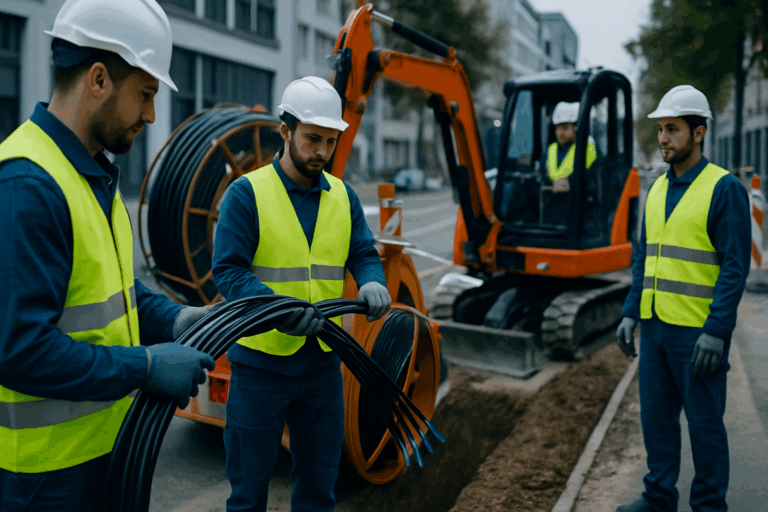
Technical requirements for municipal utilities include implementation of IEC 61754-compliant connectors and preparation for wavelength division multiplexing. Particularly critical: simultaneous installation of fibre during civil works for other utility networks.
Municipal utilities must dimension splice capacity to handle both internal operational communication and commercial fibre services. This means in practice redundant fibre reserves of at least 30 percent.
Fiber Products Quality Commitment: As an official Diamond Partner and manufacturer, we produce modular splice systems in Europe. Benefit from Swiss precision and in-house manufacturing.
Technical Specifications for FTTH Distribution Points in Baden-Württemberg
The fibre rollout Freiburg requires standardised distribution points meeting the elevated demands of the FTTH Baden-Württemberg rollout. The German Federal Network Agency defines clear requirements for passive infrastructure.
- Minimum capacity: 48 fibres per distribution point in urban areas
- Attenuation values: Maximum 0.25 dB per connector
- Bend radius: Minimum 30 mm for single-mode fibre
- Connector types: LC/APC for end-user feeder, SC/APC for backbone
- Documentation: Complete OTDR measurement protocol per IEC 61280-4
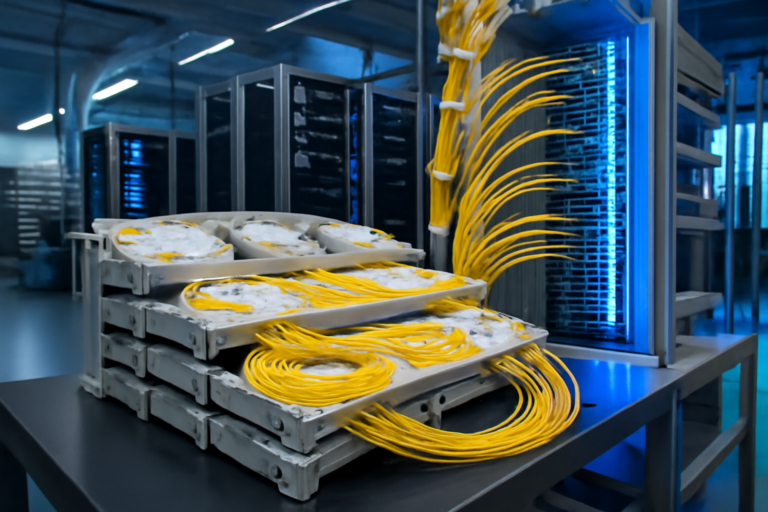
The 1RU splice box has established itself as the standard for distribution points, combining optimal packing density with straightforward maintenance. Municipal utilities should adopt pre-configured splice cassettes to reduce installation time.
Regulatory Requirements: Gigabit Infrastructure Directive from 2026
The EU Gigabit Infrastructure Directive introduces binding changes from 12 February 2026 for all new buildings and major renovations. Every new building must be equipped with fibre-ready infrastructure, and multi-unit buildings must have dedicated access points.
For the fibre rollout Freiburg, this means badenova and other providers must digitalise their planning procedures. From 12 May 2026, all approvals process through a central information office with a maximum processing time of four months.
| Regulatory Requirement | Effective from | Impact for Municipal Utilities |
|---|---|---|
| Fibre Mandate for New Buildings | 12.02.2026 | Mandatory Co-Installation |
| Digital Approval | 12.05.2026 | Online Application Process |
| 4-Month Deadline | 12.11.2025 | Accelerated Procedures |
| Approval Presumption | 12.11.2025 | Automatic Approval |
Splice Technology and Distribution Systems: Requirements for Modern Infrastructure
Technical implementation of the FTTH Baden-Württemberg rollout requires high-density splice systems meeting growing fibre demands. Modern 1RU systems must accommodate 96 fibres within just 44 mm height.
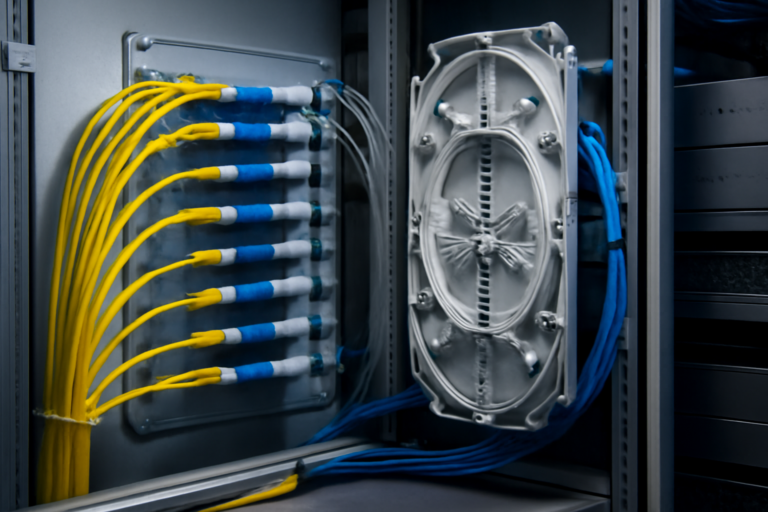
Municipal utilities face the challenge of retrofitting existing distribution cabinets. The solution: modular splice cassettes with standardised dimensions per DIN 41494. These enable phased expansion without complete infrastructure replacement.
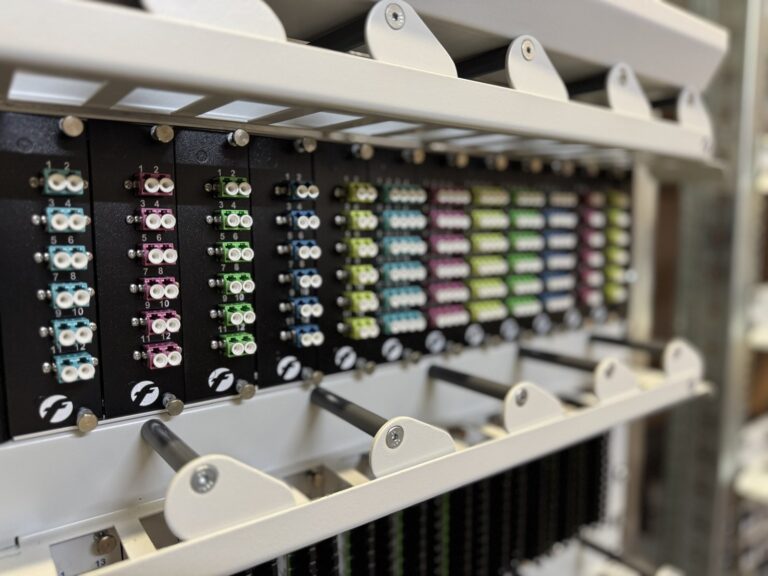
- Packing density: Up to 8 splice cassettes per rack unit
- Fibre capacity: 12 fibres per cassette (96 fibres total)
- Connector slots: Optional LC-duplex or SC-simplex
- Cable management: Integrated strain relief for 12 individual cables
- Documentation: QR-code-based fibre assignment
Cost Optimisation through Standardised System Components
Economic success of the fibre rollout Freiburg depends significantly on standardisation of deployed components. Municipal utilities can substantially reduce operating costs through deployment of modular systems.
Investment in pre-configured solutions not only reduces installation time but also minimises error sources. A standardised 1RU splice module can be installed and documented in a short time – a considerable time saving compared to conventional solutions.
Particularly important for cost-effectiveness: the ability to exchange splice cassettes independent of manufacturer. This ensures long-term investment security and simplifies inventory management.
Quality Assurance and Measurement Procedures per IEC Standards
Quality control during the FTTH Baden-Württemberg rollout requires standardised measurement procedures per IEC 61280-4. Every fibre route must be fully documented and certified.
- OTDR measurement: Bidirectional at 1310 nm and 1550 nm
- Attenuation measurement: Maximum 0.35 dB/km at 1310 nm
- Return loss: Minimum 50 dB for APC connectors
- Chromatic dispersion: Maximum 3.5 ps/(nm·km)
- Polarisation mode dispersion: Below 0.2 ps/√km
Modern splice systems integrate automated measurement devices documenting every splice operation. This significantly reduces documentation workload and ensures complete traceability.
Future-Proofing through Scalability: From 1RU to 3RU Systems
Long-term planning of the fibre rollout Freiburg requires scalable systems that grow with network expansion. badenova and other providers therefore deploy modular architectures expandable from 1RU to 3RU.
The technical challenge involves installing systems today that remain expandable in five years. The solution: unified splice cassettes compatible with both 1RU and 3RU systems.
| System Size | Fibre Capacity | Use Case | Expandability |
|---|---|---|---|
| 1RU SlimConnect | Up to 96 fibres | Distribution points | Modular to 2RU |
| 3RU VarioConnect | Up to 216 fibres | Main distribution | Expandable to 288 fibres |
| 4RU DIAMOND subrack | Up to 144 fibres | Data centres | Full deployment |
FAQ: Technical Questions on Fibre Rollout for Municipal Utilities
What splice box sizing does the fibre rollout Freiburg require?
For the fibre rollout Freiburg, 1RU splice boxes with 96 fibre capacity are recommended for distribution points and 3RU systems with up to 216 fibres for main distribution. This sizing accounts for the 30 percent reserve capacity demanded by badenova.
Which connector types are specified for FTTH Baden-Württemberg?
The FTTH Baden-Württemberg standard primarily specifies LC/APC connectors for end-user connections and SC/APC for backbone links. For industrial applications, E2000/APC connectors with enhanced mechanical robustness are additionally deployed.
How do badenova requirements differ from other providers?
badenova demands integrated planning with other utility networks in the fibre rollout Freiburg and emphasises Diamond quality for connectors. Technical specifications align with IEC 61754-15 with stricter attenuation values below 0.20 dB.
Which measurement procedures are mandated for FTTH rollout?
For the FTTH Baden-Württemberg rollout, OTDR measurements per IEC 61280-4 at 1310 nm and 1550 nm are mandatory. Additionally, attenuation, return loss, and for routes exceeding 10 km, dispersion must also be measured.
How long does installation of a 96-fibre splice box take?
With pre-configured modules, installation of a 96-fibre splice box takes little time including documentation. Conventional systems require considerably longer. The time saving results from factory-assembled splice cassettes and QR-code-based documentation.
What warranty coverage is typical for splice systems?
Premium providers such as Fiber Products offer 5 years warranty on modular systems, justifying higher initial investment through reduced operational risk.
Action Recommendations for Municipal Utilities in FTTH Deployment
Successful fibre rollout Freiburg requires municipal utilities to adopt a strategic approach. Integration of badenova standards with FTTH Baden-Württemberg initiative requirements demands modular, future-proof systems.
Municipal utilities should adopt manufacturer-independent splice cassettes and invest early in high-density 1RU systems. Additional costs of approximately 15 percent versus standard solutions are recovered through doubled fibre capacity within 24 months.
As manufacturer of modular fibre-optic solutions and official Diamond Partner, Fiber Products provides complete system architecture – from splice box to E2000 connector in Swiss precision quality. The 5 years warranty on all splice systems ensures long-term investment security for your FTTH rollout.
Order directly from our shop: fiber-products.de
Request a Quote Today
Free consultation – personalised quote within 24 hours