FTTH Deployment Bavaria 2026: Bavarian Broadband Programme and Splice Technology
FTTH Bavaria, the Bavarian Broadband Programme and fibre optic funding create optimal conditions in 2026 for comprehensive rollout of gigabit-capable networks – with modern splice technology delivering up to 96 fibres in 1U becoming a decisive acceleration factor. With subsidy rates of 60 to 90 per cent, the Bavarian state supports municipalities in closing the economic viability gap in rural areas. Simultaneously, modular splice systems such as SlimConnect and VarioConnect enable a doubling of port density with half the installation time.
The current deployment situation shows clear progress: Bavaria records one of the highest FTTH rollout rates nationwide through continuous funding and technical innovation. Utilities particularly benefit from the combination of state support and technological advances in splice technology.
Funding Structure of the Bavarian Broadband Programme: Differentiated Support for Municipal Network Operators
The Bavarian Broadband Programme pursues a structured approach to promoting fibre optic deployment. The basic logic is founded on the principle of economic viability gap funding: the state supports municipalities in closing the difference between investment costs and projected revenue of network operators.
Subsidy rates are graduated according to demographic and geographic criteria. Municipalities receive 60 per cent, 70 per cent or 80 per cent of eligible costs depending on their structural indicator. In special cases of hardship, the subsidy rate rises to 90 per cent. This differentiation accounts for the substantial differences between urban densification areas and sparsely populated regions in the pre-Alps or central mountain ranges.
- Maximum subsidy amounts between €500,000 and €950,000 per municipality
- Additional farm bonus for scattered settlements with doubled subsidy allocation
- Bonus funding of €50,000 for inter-municipal cooperation
- Minimum 80 per cent FTTB coverage as quality criterion
- Competitive tendering requirement to ensure market competition
Technical Requirements 2026: From Funding Guidelines to Practical Implementation
Technical realisation of subsidised FTTH projects in Bavaria places specific demands on splice technology. Modern distribution cabinets must organise at least 288 fibres in minimal space whilst remaining maintenance-friendly. Compliance with standards IEC 61754 and IEC 61753 is non-negotiable.
Utilities as municipal network operators require robust outdoor distribution units with IP65 protection class for street installation. Temperature resistance of −40°C to +70°C ensures year-round operation without interruptions. Systems must simultaneously be flexible enough to accommodate future expansions without complete replacement.
| System Type | Capacity | Rack Height | Application |
|---|---|---|---|
| SlimConnect | up to 96 fibres | 1U | Distribution points, PoP |
| VarioConnect | up to 288 fibres | 3U | Main distribution, backbone |
| Outdoor distribution unit | up to 144 fibres | variable | Street distribution |
| DIN rail enclosure | up to 48 fibres | DIN standard | Industrial installations |
Modular Splice Systems as Acceleration Factor in Bavarian FTTH Deployment
Modularity of modern splice systems transforms installation practice in fibre optic deployment. Instead of monolithic enclosures, network operators deploy exchangeable modules that are factory-preconfigured and tested. This approach reduces on-site installation time by up to 60 per cent.
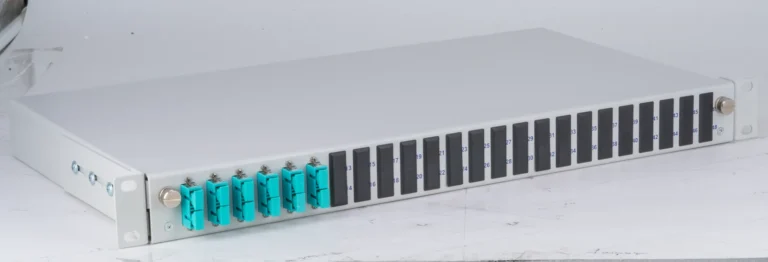
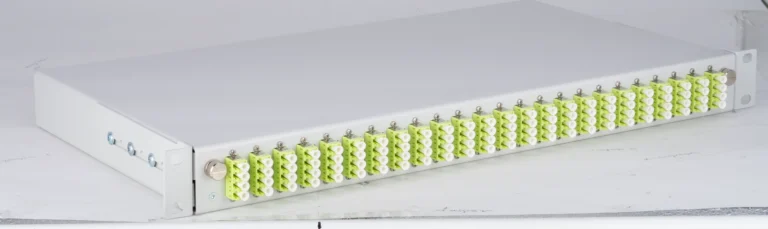
The SlimConnect 1U systems enable organisation of 96 fibres in a single rack unit – a doubling of standard density. This space efficiency is particularly critical in existing distribution cabinets where every centimetre matters. Front modules support all common connector types: LC, SC, E2000, ST and FC.
Fiber Products Quality Promise: As an official Diamond Partner and manufacturer, we produce modular splice systems in Europe. Benefit from Swiss precision and 5 years warranty on our systems.
Splice Cassettes and Fibre Organisation: Structured Cabling for Maximum Availability
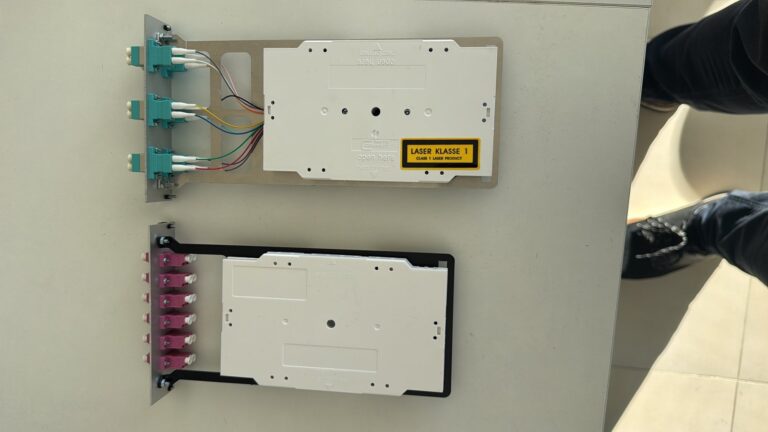
Fibre organisation within splice modules follows strict standards. Each splice cassette accommodates 24 individual fibre splices with defined bend radii of minimum 30 mm. Colour-coded identification according to DIN VDE 0888 enables rapid identification of individual fibres.
Modern cassette systems feature integrated splice protection holders for 45 mm and 60 mm heat shrink tubing. Excess fibre routing occurs in separate channels to prevent microbending. In a typical 144-fibre installation this means six cassettes per distribution point – organised in two SlimConnect modules.
- Tool-free cassette installation via snap locks
- Spare fibre routing with 1.5 metre excess length per fibre
- Splitter compartments for 1:32 and 1:64 PLC splitters
- Insertion loss below 0.1 dB with proper installation
- Return loss above 60 dB for disturbance-free signal transmission
Connector Technology Evolution: E2000 as New Standard for FTTH Networks
Connector system selection significantly influences network quality and maintenance efficiency. Whilst LC duplex connectors excel through compact design, the E2000 standard increasingly establishes itself as premium solution for demanding FTTH installations.
The E2000 connector provides automatic contamination protection via integrated shutter cap – a decisive advantage for outdoor installations. APC polishing (Angled Physical Contact) with an 8-degree angle reduces reflections below −65 dB. This enables disturbance-free transmission even at highest data rates.
| Connector Type | Insertion Loss | Return Loss | Characteristic |
|---|---|---|---|
| LC-UPC | < 0.25 dB | > 50 dB | High packing density |
| LC-APC | < 0.30 dB | > 65 dB | Reduced reflection |
| E2000-APC | < 0.20 dB | > 65 dB | Integrated protection |
| SC-APC | < 0.35 dB | > 60 dB | Robust design |
Economic Feasibility: Investment Costs versus Operating Efficiency
Total FTTH project costs comprise various components. Civil works account for 75 per cent of the largest portion. Passive network infrastructure including splice technology amounts to approximately 15 per cent, whilst active components comprise a further 10 per cent.
In a typical Bavarian deployment project serving 500 households, average costs total €1,600 per household connection in rural areas. Modular splice technology reduces installation costs by up to 20 per cent through time savings and reduced error rates. This corresponds to savings of €160,000 in a medium-sized project.
Operating costs benefit long-term from modularity: defective modules can be exchanged within minutes without system downtime. Mean time to repair (MTTR) decreases markedly. With guaranteed availability of 99.95 per cent this represents a decisive competitive advantage.
Quality Assurance and Documentation: Standards-Compliant Acceptance Protocols
Fibre optic installation documentation follows DIN EN 50173 and ISO/IEC 11801. Each splice connection is verified and documented via OTDR measurement (Optical Time Domain Reflectometry). Maximum loss per splice must not exceed 0.1 dB.
- Bidirectional OTDR measurements at 1310 nm and 1550 nm
- Splice loss documentation for each individual fibre
- Photographic documentation of cassette population
- Digital network plans with GPS coordinates of distribution points
- Handover protocol according to VDE 0888-101
Modern splice devices automatically store measurement data and transmit via WLAN to the central documentation platform. This ensures complete traceability and simplifies future expansions or fault resolution.
Future Perspective: FTTH Bavaria 2027 and Beyond
Fibre optic technology continues advancing. For 2027, new standards are emerging: MPO/MTP connectors with 12 or 24 fibres per connector will further increase installation speed. Packing density rises to up to 144 fibres per rack unit.
The Bavarian Broadband Programme will likely adjust funding criteria and increasingly focus on sustainable, future-proof solutions. Integration of 400G Ethernet and beyond requires singlemode fibres of OS2 category with minimal loss. Modular splice systems are already designed for these requirements today.
Utilities investing now in modular, expandable systems establish the foundation for decades of operation without complete system replacement. The 5-year warranty on high-quality splice modules provides additional investment security in a dynamic market environment.
FAQ: Frequently Asked Questions on Technical Implementation of Fibre Optic Funding Bavaria
Which splice modules are optimal for subsidised FTTH projects in Bavaria?
For Bavarian FTTH projects modular systems with at least 96 fibres on 1U are recommended. The SlimConnect series offers required flexibility with various connector types and permits future expansion without complete replacement. Compliance with IEC 61754 standard is mandatory for funding applications.
How do technical requirements differ between urban and rural areas?
Rural areas require robust outdoor distribution units with IP65 protection class and extended temperature resistance of −40°C to +70°C. Urban installations benefit from high-density systems with up to 288 fibres on 3U. Splice reserves should be minimum 2 metres in rural areas.
What role does connector selection play in network quality?
Connector choice directly influences signal quality. APC-polished connectors reduce return reflections below −65 dB and are mandatory for video overlay services. E2000 connectors provide additional contamination protection through integrated shutters and are particularly suitable for outdoor installations.
How long does installation of a modular splice system take?
A pre-configured SlimConnect module with 96 fibres can be installed and tested in a short time. Factory preconfiguration saves up to 60 per cent installation time compared with conventional systems. OTDR acceptance measurement requires little additional time.
What documentation does the Bavarian Broadband Programme require?
The funding programme mandates complete acceptance protocols according to DIN EN 50173. This includes bidirectional OTDR measurements at 1310 nm and 1550 nm, loss documentation for each splice point and digital network plans with GPS coordinates. Maximum splice loss must not exceed 0.1 dB.
How is future-proofing of funded infrastructure ensured?
Future-proof installations are based on singlemode fibres of OS2 category and modular splice systems. Systems should be prepared for 400G Ethernet and offer expansion options for MPO/MTP connectors. A 5-year manufacturer warranty additionally secures the investment.
Interested in Modular Fibre Optic Solutions?
Fiber Products GmbH – official DIAMOND SA Partner. Made in EU, 5 years warranty.