Fibre Optic Military Networks – Requirements for Defence Communications
Fibre Optic Military Networks – Requirements for Defence Communications and Technical Implementation
Military fibre networks and defence communications demand the highest reliability, eavesdropping protection, and bandwidth for modern defence infrastructure. With a 14,000 km wide-area fibre optic network and connections to over 800 military facilities, the German Armed Forces operate one of Europe’s largest military fibre networks. Special requirements range from VG-standard-compliant steel-armoured cables through vibration-resistant connectors to modular splice modules with IP65 protection.
During 2025/2026, the Armed Forces are modernising their tactical communications infrastructure with an investment of €7 million for 35 network service troop systems. These systems are based on field-deployable fibre optic solutions suitable for both stationary and mobile operations.
Technical Specifications for Military Fibre Networks
Military fibre networks are subject to stringent technical requirements far exceeding civilian standards. Attenuation values for single-mode fibres must be below < 0.25 dB at 1550 nm. For tactical operations, specialised steel-armoured cables certified to VG 95218 are deployed.
- Temperature resistance from -40°C to +85°C
- Vibration endurance to MIL-STD-810G
- Electromagnetic compatibility per MIL-STD-461
- Cable tensile strength up to 5000 N
- Bend radius under load: minimum 20× cable diameter
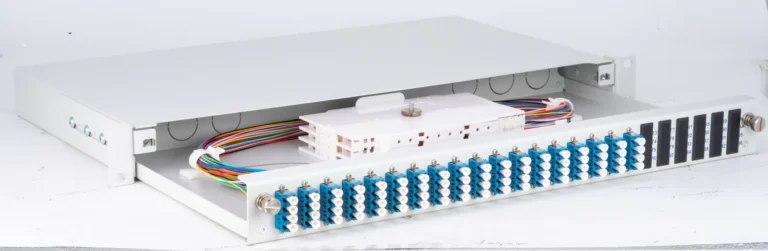
Modular design enables rapid reconfiguration in the field. Systems such as SlimConnect achieve up to 96 fibres per 1U – a packing density critical for mobile command centres.
Resilience and Redundancy in Military Fibre Networks
Military fibre networks employ multiple redundant network architectures. Every critical link is routed via at least two physically separate paths. In case of cable breakage, automatic switchover occurs in less than 50 milliseconds per ITU-T G.8032.
| Network Layer | Redundancy Concept | Switchover Time | Availability |
|---|---|---|---|
| Core Network (Backbone) | Dual Ring Architecture | < 50 ms | 99.999% |
| Access Network | Mesh Topology | < 200 ms | 99.99% |
| Tactical Networks | Mobile Redundancy | < 500 ms | 99.9% |
Modern monitoring systems with DAS (Distributed Acoustic Sensing) and DTS (Distributed Temperature Sensing) detect physical tampering attempts on cables in real time. This sensing infrastructure is implemented along the entire 33,000 km planned ring structure.
Connector Types and Termination Technology for Military Applications
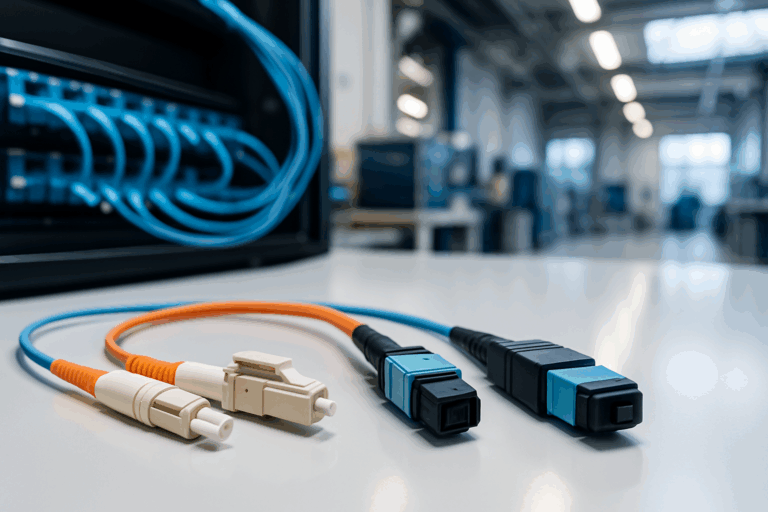
Military defence communications utilise different connector systems depending on the deployment context. The E2000 connector with integrated shutter dominates stationary installations, whilst field operations employ robust LC-Duplex and MPO/MTP connections.
- E2000 APC: Return loss > 60 dB, ideal for long-distance links
- LC-Duplex: Compact form factor for high port density
- MPO-12/24: Parallel transmission for data centres
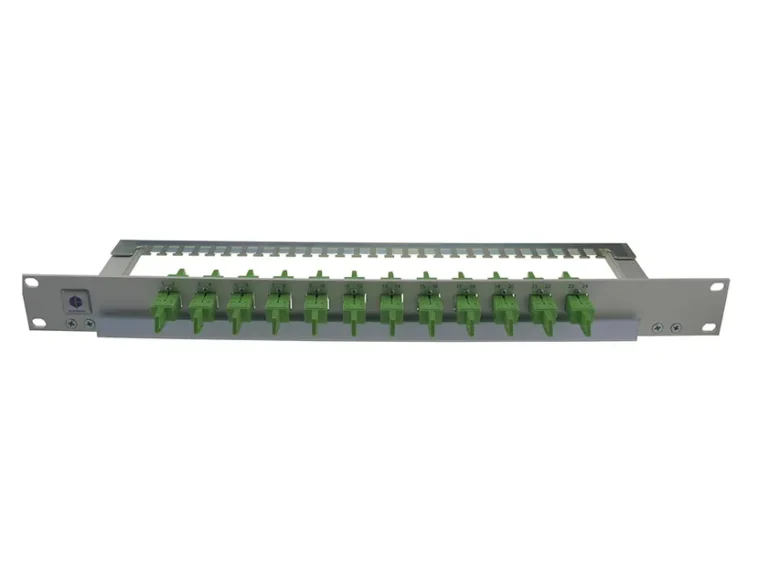
- SC-APC: Robust alternative for outdoor installations
- Hybrid Connectors: Combination of fibre and power delivery
Fiber Products Quality Promise: As an official Diamond partner and manufacturer, we produce modular splice modules in Europe. Benefit from Swiss precision engineering and in-house manufacturing.
Splicing Technology and Modularity in Military Fibre Networks
Military fibre networks employ pre-terminated splice modules that enable installation time reduction. Splice modules are measured with the procedures of the IEC 61300 series; the acceptance value for a fusion splice comes from the project specification, not from the standard.
Modular systems like VarioConnect offer up to 288 fibres per 3U and enable tool-free module replacement during live operations. Made in Europe manufacturing guarantees compliance with military quality standards.
| Splice Module Type | Fibre Density | Rack Height | Application |
|---|---|---|---|
| SlimConnect | 96 Fibres | 1U | Mobile Command Centres |
| VarioConnect | 288 Fibres | 3U | Stationary Data Centres |
| Diamond Module | 144 Fibres | 2U | Field Camps / Containers |
Field-Deployable Fibre Systems for Military Operations
Military networks utilise specialised field-deployable fibre systems with IP65 protection and NATO certification. These systems withstand extreme conditions from arctic cold to desert heat.
- Steel-armoured cables with stainless steel tube sheathing
- Range over 30 km at > 1 Gbit/s
- Backpack-deployable configuration for temporary installations
- Integrated strain relief up to 5000 N
- Rodent and UV protection per IEC 60794-1-22
Digital field communications (DFK) enable interference-free and eavesdropping-resistant connections between mobile units. Modern splice boxes with DIN rail mounting allow rapid integration into existing field infrastructure.
Integration into Existing Military Infrastructure
Military fibre communications must integrate seamlessly into existing systems. This requires compatibility with legacy infrastructure whilst providing future readiness for emerging technologies such as 100G Ethernet and beyond.
Integration is achieved via defined interfaces per STANAG standards for unmanned systems and MIL-STD-2045-47001 for tactical networks. Splice modules must accommodate both single-mode and multi-mode fibres.
- Support for OS2 Single-Mode for long-distance links
- Compatibility with OM4/OM5 Multi-Mode for data centres
- Hybrid solutions for copper-to-fibre migration
- Wavelength division multiplexing (DWDM) for maximum bandwidth
Security Considerations in Military Fibre Networks
Military networks implement multi-layered security architectures. Physical security begins with eavesdropping-resistant fibre cables featuring jacket stress monitoring and extends to encrypted transmission per BSI standards.
Every network node is equipped with redundant splice boxes ensuring 99.999% availability. Modular design enables rapid replacement of compromised components without service interruption.
Maintenance and Documentation of Military Fibre Networks
Military communications require comprehensive documentation of all fibre connections. Each fibre is recorded with OTDR measurement protocols per IEC 61280-4-1 and managed in digital systems.
- Automated attenuation measurement every 24 hours
- Preventive maintenance after 5000 operating hours
- Digital twins for network simulation
- Georeferenced route documentation
- Emergency procedures for each network segment
Modern splice systems with QR code identification enable mobile documentation directly on-site. The 5-year warranty on modular systems significantly reduces total cost of ownership.
Future Outlook for Military Fibre Networks
Military fibre networks will be fully transitioned to all-optical by 2030. New programmes such as the F-35 fighter jet programme and networked vehicles require terabit-scale bandwidth.
Integration of quantum communications over fibre is already being piloted. Modular splice modules with E2000 connectors provide the precision required for these next-generation technologies.
FAQ on Military Fibre Networks
Which standards apply to military fibre networks?
Military fibre networks in Germany are built to VG standards (Verteidigungsgeraetenormen, e.g. the VG 96927 series covering electrical and fibre optic cable assemblies), issued where civil DIN, EN or ISO standards cannot cover the military requirement. NATO STANAGs and US MIL-STD specifications (e.g. MIL-STD-1678) apply where a programme or contract calls them out. Civil standards remain the technical basis: fibre optic cables to DIN EN IEC 60794 (VDE 0888-100) and fixed building cabling to EN 50173 (VDE 0800-173).
How do military fibres differ from civilian cables?
Military cables feature steel armour, extended temperature ranges (-40°C to +85°C), higher tensile strength (up to 5000 N), and specialised coatings against chemical and biological agents.
Which connectors are suitable for tactical deployments?
Field operations benefit from LC-Duplex with protective cap, E2000 with automatic shutter, and robust MPO/MTP connectors for parallel transmission. All must be IP65-rated.
What availability do military fibre networks achieve?
The core network reaches 99.999% availability (5.26 minutes downtime per year) through redundant ring architecture and automatic switchover in less than 50 ms.
What bandwidth do modern military networks support?
Current systems support 100 Gigabit Ethernet, with provisioning for 400G and future terabit transmission via wavelength division multiplexing (DWDM).
How are military fibre networks protected against sabotage?
Protection is achieved through DAS/DTS sensing for real-time monitoring, redundant route diversity, jacket stress monitoring, and encrypted transmission per BSI standards. Critical sections receive additional physical security.
Military fibre networks set the highest standards for technology and reliability. As a manufacturer of modular splice modules and official Diamond partner, Fiber Products provides complete system solutions for government and security organisations – from splice boxes to E2000 connectors in Swiss precision quality with Made in Europe manufacturing.
Request a Quote
Have questions about our fibre optic solutions? Our expert team is here to advise you – free and without obligation.