Fibre Rollout Erfurt 2026: TEAG and Thuringia FTTH
Fibre Rollout Erfurt 2026: TEAG and Thuringia FTTH – Technical Requirements for Modular Splice Systems in Regional Broadband Deployment
The fibre rollout Erfurt, TEAG, FTTH Thuringia is accelerating in 2026 through cooperation between TEAG subsidiary Thüringer Netkom and multiple network operators, with €4.4 million invested alone in Erfurt-West for FTTH deployment to 1,400 households. Technical implementation requires high-density splice systems with up to 96 fibres per 1U to handle planned deployment speeds of approximately 10,000 connections daily.
As Thuringia’s state capital with 214,000 residents, Erfurt is positioned at the centre of regional FTTH deployment. TEAG Thüringer Energie AG drives fibre expansion through its subsidiary Thüringer Netkom GmbH, operating a network of over 7,500 kilometres of fibre optic cables. In parallel, five additional telecommunications companies operate in Erfurt, including Deutsche Glasfaser, Telekom Deutschland and OXG Glasfaser.
Current Status: TEAG and Thüringer Netkom as Regional FTTH Leaders
Thüringer Netkom GmbH, as a 100% TEAG subsidiary, operates the second-largest fibre network in Thuringia after Deutsche Telekom. With over 450,000 fibre kilometres, this infrastructure forms the backbone for regional FTTH deployment.
- Operation of 7,500 kilometres of fibre optic cables
- Coverage of over 450,000 fibre kilometres across the overall network
- Self-funded deployment without subsidies in Erfurt-West
- Strategic partnership with OXG Glasfaser from 2026
- Connection speeds up to 1 gigabit per second
Technical realisation is achieved through modular splice systems that must comply with IEC 61300-3-35 for optical attenuation and IEC 61753-1 for environmental conditions. Municipal utilities fibre rollout trends require robust systems with 5-year warranty for long-term investment security.
Erfurt-West: 28 Kilometres of New Fibre Optic Routes for 1,400 Households
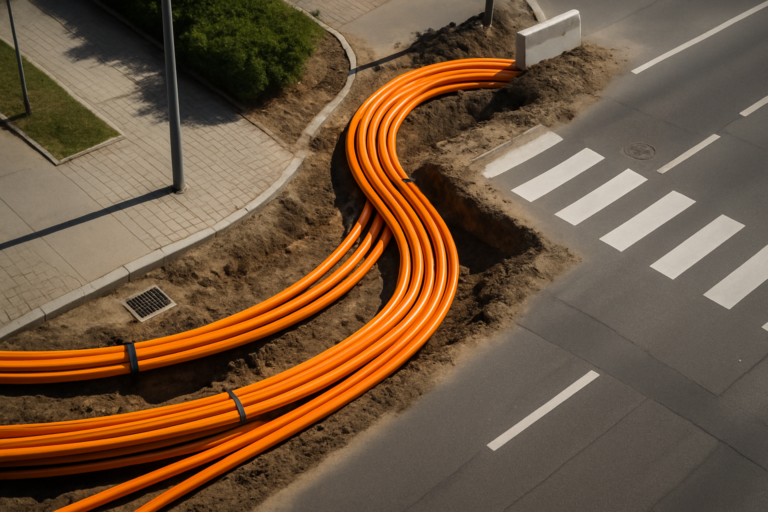
The current deployment project by Thüringer Netkom in Erfurt-West covers the districts of Ermstedt, Schaderode, Töttelstädt and Gottstedt. Technical planning provides for 28 kilometres of new civil works routes to deploy FTTH to 1,400 households.
| Project Parameter | Erfurt-West Values |
|---|---|
| Investment Volume | €4.4 million |
| Civil Works Distance | 28 kilometres |
| Number of Households | 1,400 |
| Bandwidth | up to 1 Gbit/s |
| Construction Start | Mid 2025 |
| Completion | Q1 2026 |
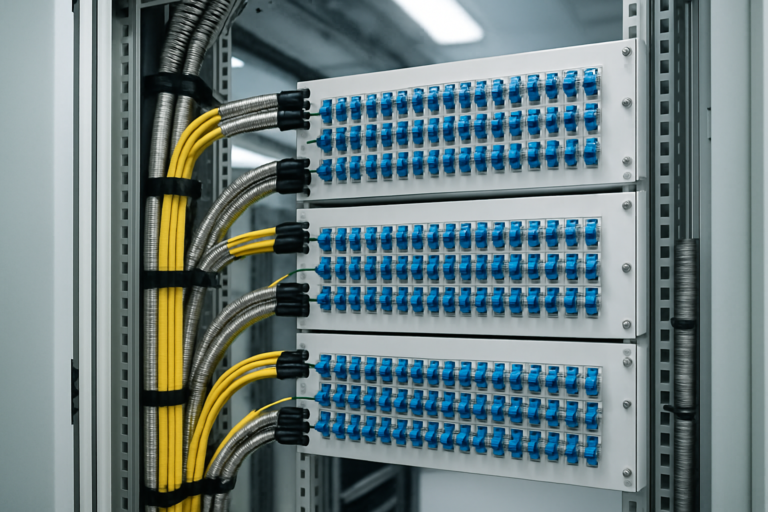
Overall planning was undertaken by engineering firm PPHT mbH for passive network infrastructure. Technical implementation uses splice boxes with 1U form factor, capable of terminating up to 96 fibres in minimal space.
Technical Requirements for Splice Systems in Municipal FTTH Deployment
The fibre rollout Erfurt, TEAG, FTTH Thuringia sets specific requirements for splice technology. Municipal utilities require modular systems that cover both current and future deployment phases.
Modern splice modules must comply with IEC 61754-15 for E2000 connectors, which are increasingly used in professional environments. Optical attenuation must not exceed 0.25 dB for singlemode fibres per IEC 61300-3-4.
- Port density of at least 48 fibres per 1U, optimally 96 fibres
- Support for LC, SC, E2000 and MPO connectors
- Return loss > 50 dB with APC connectors
- Temperature range -40°C to +75°C per IEC 61753-1
- Protection rating at least IP54 for outdoor installations
Fiber Products Quality Promise: As official Diamond Partner and manufacturer, we produce modular splice systems in Europe. Benefit from Swiss precision and in-house manufacturing.
FTTH Funding in Thuringia: €187.8 Million for Underserved Areas
The Federal Government and the State of Thuringia provide a total of €187.8 million for nine broadband deployment projects. This funding addresses 25,558 address points in 85 locations across eight districts.
Erfurt itself receives funding for approximately 1,800 addresses classified as uneconomical for self-funded deployment. These so-called “grey spots” have less than 30 Mbit/s and will be deployed by Telekom Deutschland GmbH by end of 2026.
| Funding Criterion | Threshold | Erfurt Status |
|---|---|---|
| Minimum Bandwidth for Funding | < 30 Mbit/s | 1,800 addresses |
| Target Speed | > 1 Gbit/s | FTTH Standard |
| Completion Funded Areas | 31.12.2026 | Implementation |
Multiple Network Operators in Erfurt: Coordination Rather Than Competition
The fibre rollout Erfurt, TEAG, FTTH Thuringia proceeds through five different telecommunications companies in parallel. The City of Erfurt acts as coordinator without direct operational involvement in deployment.
- Deutsche Glasfaser Wholesale GmbH
- Telekom Deutschland GmbH
- OXG Glasfaser GmbH
- SWE Digital GmbH
- Thüringer Netkom GmbH (TEAG subsidiary)
This market diversity drives accelerated deployment but requires standardised splice systems for compatibility between different networks. Municipal utilities and local providers therefore rely on modular systems with interchangeable components.
Gigabit Infrastructure Regulation: New Standards from November 2025
EU Regulation 2024/1309 (Gigabit Infrastructure Regulation) establishes a uniform legal framework for FTTH deployment from November 2025. Approval procedures may take a maximum of four months, after which automatic approval applies.
From February 2026, all new buildings and comprehensively renovated structures must be equipped with fibre-ready infrastructure. This applies to renovations exceeding 25 per cent of building value or building envelope.
For splice systems, this means increased scalability requirements. Systems with 96 fibres per 1U enable efficient use of limited equipment rooms in existing buildings.
Technical Implementation: High-Density Splice Modules for Efficient Deployment
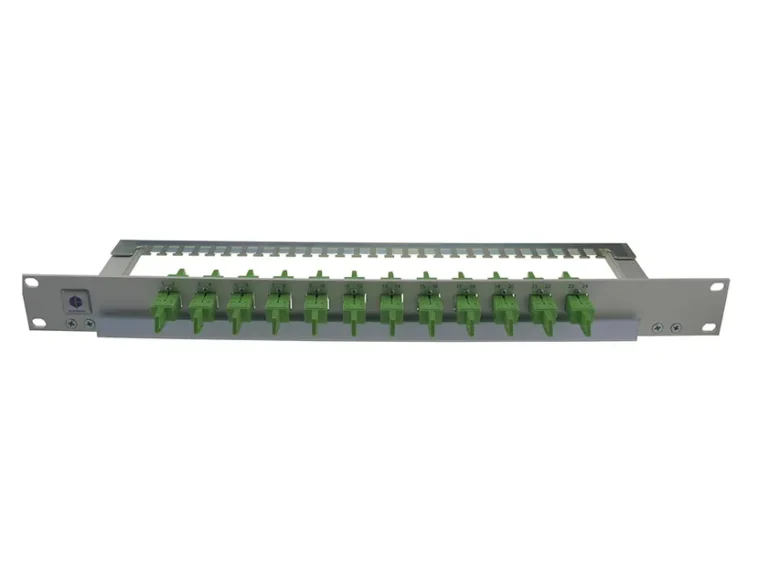
Practical fibre rollout Erfurt, TEAG, FTTH Thuringia requires splice systems with maximum port density. Modern SlimConnect systems achieve 96 fibres per 1U, representing a 47 per cent increase over conventional 48-port systems.
- Space savings of up to 50 per cent in equipment rooms
- Installation time reduction of 35 per cent
- Pre-configured modules with factory-mounted pigtails
- Colour coding per DIN VDE 0888
- Integrated cable management for structured routing
When terminating 10,000 fibres, network operators using 96-port systems require only 55 rack units instead of 105 units with conventional systems. This equates to saving one complete 42U cabinet including cooling and power supply.
E2000 Connectors: The Standard for Professional FTTH Networks
E2000 connectors per IEC 61754-15 dominate professional FTTH environments. The integrated protective shutter prevents ferrule contamination and ensures consistently low attenuation below 0.25 dB.
| Connector Type | Attenuation | Return Loss | Application |
|---|---|---|---|
| E2000/APC | < 0.25 dB | > 60 dB | FTTH, Test Equipment |
| LC/APC | < 0.30 dB | > 50 dB | Data Centres |
| SC/APC | < 0.30 dB | > 50 dB | Legacy Networks |
As the only German full-service provider, Fiber Products supplies both splice modules and matching E2000 connectors from a single source – manufactured to Swiss precision standards with 5-year warranty.
Copper-to-Fibre Migration: Shutdown at 80 Per Cent FTTH Coverage
The Federal Network Agency determined in January 2026 that copper networks may be discontinued once 80 per cent of households in an area receive FTTH service. Marketing of copper-based connections must cease 24 months before shutdown.
For the fibre rollout Erfurt, TEAG, FTTH Thuringia, this means accelerated migration processes. Network operators must maintain scalable splice systems enabling rapid capacity expansion.
- Modular expansion from 48 to 96 fibres without system replacement
- Interchangeable front modules for different connector types
- Backward compatibility with existing installations
- Documentation per DIN EN 50173-1
Outlook 2027: One Million New FTTH Connections Annually
Deutsche Telekom plans one million new active fibre optic connections for 2027. The fibre rollout Erfurt, TEAG, FTTH Thuringia benefits from this momentum through increased investment and accelerated approval processes.
Thuringia positions itself as a dynamic FTTH market with 17 active fibre companies. Cooperation between Thüringer Netkom and OXG Glasfaser from 2026 creates synergies for comprehensive deployment.
Technically, this deployment speed requires pre-configured splice systems with short installation times per module. The VarioConnect series with slide-out 3U modules enables maintenance work without service interruption.
FAQ: Technical Questions on FTTH Deployment in Erfurt and Thuringia
Which splice systems suit municipal FTTH deployment?
For municipal utilities, modular 1U systems with 96-fibre capacity are recommended. These offer optimal port density with minimal space requirements and enable staged expansion. Systems should comply with IEC 61300 and provide at least 5-year warranty.
How many fibres does TEAG plan per household?
Thüringer Netkom calculates 2 to 4 fibres per residential unit for future-proofing. Multi-family buildings receive distribution panels with 48 to 96 ports, enabling later expansion without civil works.
Which connector types dominate FTTH?
Professional FTTH deployment is dominated by E2000/APC and LC/APC connectors. E2000 offers advantages in outdoor installations through its protective shutter, while LC enables higher port densities in distribution equipment.
How long does 96-port splice module installation take?
With pre-configured systems, trained technicians require only a short time for a complete 96-port module. This includes installation, splicing and documentation per DIN EN 50173.
What environmental requirements apply to FTTH splice boxes?
Outdoor installations require minimum protection rating IP54, preferably IP65. Temperature range must cover -40°C to +75°C. Mechanical durability follows IEC 61753-1 for harsh environments.
When will Erfurt achieve comprehensive FTTH coverage?
At current deployment pace and planned investment by five network operators, 80 per cent coverage by end of 2027 is expected. Complete FTTH coverage could be achieved by 2030.
Conclusion: Erfurt as a Model Region for Coordinated FTTH Deployment
The fibre rollout Erfurt, TEAG, FTTH Thuringia demonstrates successful cooperation between municipal providers and private network operators. With investment exceeding €4.4 million in Erfurt-West alone and nationwide funding of €187.8 million, the region’s digitalisation is accelerating sustainably.
Technical implementation requires modern splice systems with high port density and modularity. Systems with 96 fibres per 1U and 5-year warranty ensure long-term investment security for municipal utilities and regional energy suppliers. The new Gigabit Infrastructure Regulation provides reliable framework conditions for accelerated deployment.
For detailed advice on modular splice systems and technical implementation of your FTTH project, we are available as an experienced partner. Benefit from our expertise as Diamond Partner and manufacturer of high-quality fibre optic solutions made in Europe.
Order directly from our shop: fiber-products.com
Request a Quote Today
Free consultation – personalised quote in 24 hours