Fibre Rollout Münster 2026: Municipal Utilities and FTTH-Westfalen
Fibre Rollout Münster 2026: Municipal Utilities Deploy Modular Splice Modules for FTTH Network
The fibre rollout in Münster by Stadtwerke Münster is progressing rapidly under the FTTH NRW programme and is set to supply over 45,000 households with gigabit speeds by 2026. The municipal network operators rely on modular splice modules in 1HE design with up to 96 fibres per rack unit to achieve ambitious rollout targets cost-effectively. As an official Diamond Partner and manufacturer of modular fibre optic solutions, Fiber Products supports Stadtwerke with space-saving splice boxes and pre-terminated modules for rapid FTTH deployment.
Stadtwerke Münster Advances Fibre Rollout with 500 km of Route Length
Stadtwerke Münster has set an ambitious target: by the end of 2026, all households in the city are to gain access to genuine fibre optic connections. With planned route lengths of over 500 kilometres and investments of around €180 million, the project ranks among the largest municipal FTTH initiatives in North Rhine-Westphalia.
The fibre rollout in Münster is proceeding in three phases. Following successful completion of pilot areas in Hiltrup and Amelsbüren, densely populated city-centre zones are now being served. Space constraints in existing distribution cabinets present particular challenges.
- Phase 1 (completed): 8,500 households in outer districts
- Phase 2 (ongoing): 22,000 households in districts such as Gievenbeck and Kinderhaus
- Phase 3 (from 2025): 15,000 households in city centre and commercial areas
- Parallel deployment of 120 network distribution points
- Installation of over 850 fibre distribution boxes
Technical Requirements for FTTH NRW Rollout in Münster
The fibre rollout in Münster presents Stadtwerke Münster with specific technical challenges in the FTTH NRW deployment. High building density requires space-saving solutions with maximum fibre density. Network distribution points must accommodate splicing and managing up to 288 fibres in confined spaces.
| Requirement | City Centre | Outer Districts | Commercial Areas |
|---|---|---|---|
| Fibre density per distributor | 96–144 fibres | 48–96 fibres | 144–288 fibres |
| Space requirement | Minimal (1–2 HE) | Standard (2–3 HE) | Flexible (3–4 HE) |
| Connector types | LC-APC, SC-APC | SC-APC | LC-APC, MPO |
| Protection class | IP54 | IP65 | IP54 |
Stadtwerke rely on modular splice modules to IEC 61753-1 and DIN EN 50173-1 standards, enabling flexible expansion. Pre-terminated modules reduce installation time by up to 60 per cent compared with conventional splicing solutions.
Modular Splice Boxes: Key to Efficient Fibre Rollout
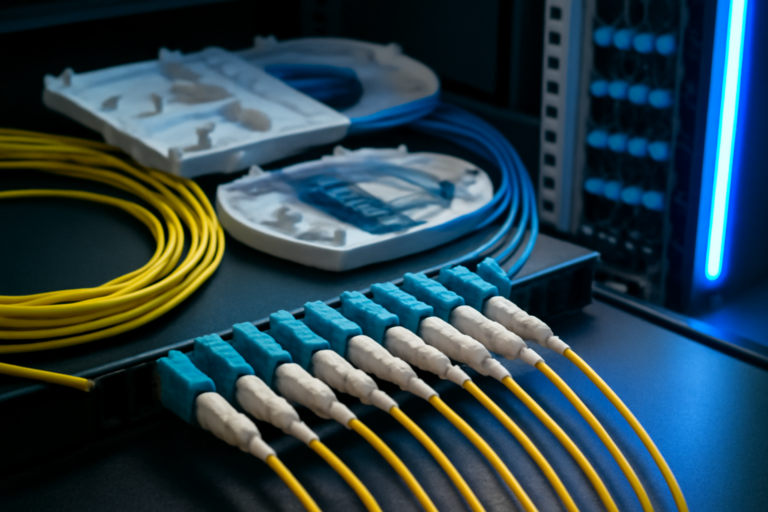
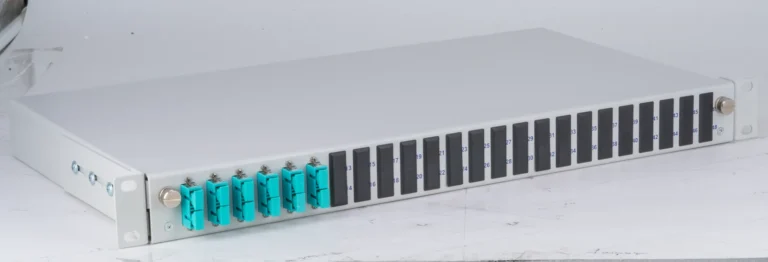
The fibre rollout in Münster increasingly uses modular splice boxes in 1HE design. These compact systems accommodate up to 96 fibres in a single rack unit – twice as much as conventional solutions. Stadtwerke Münster benefits from tool-free installation and flexible cassette architecture.
- Space saving of 50 per cent through high packing density
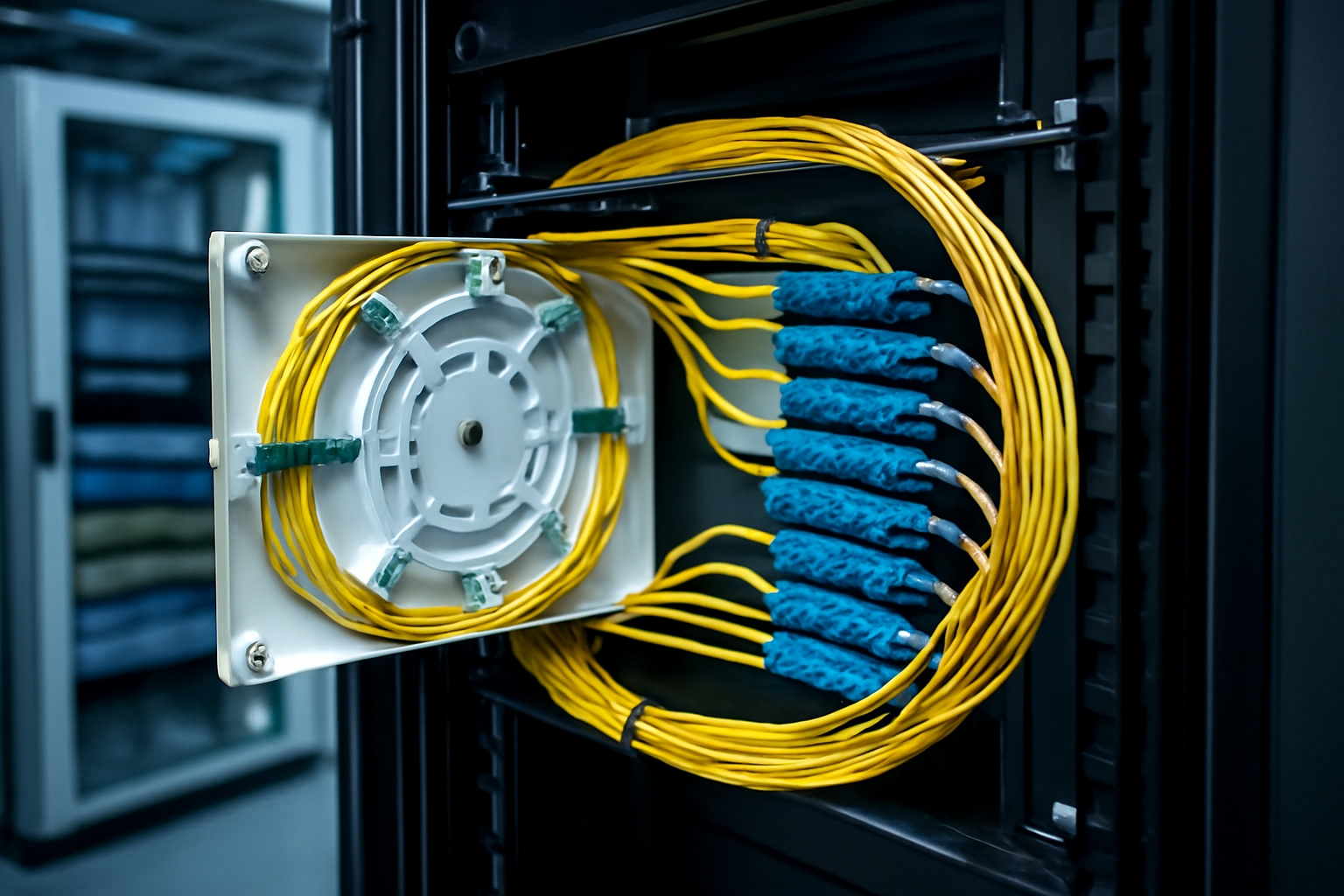
- Splice cassettes with 12 or 24 fibres per unit
- Front modules for LC, SC, E2000 and ST connectors
- Bend-radius management per IEC 61756-1
- Colour coding to DIN VDE 0888
- Backward compatible with existing 19-inch racks
Fiber Products Quality Promise: As an official Diamond Partner and manufacturer, we produce modular splice systems in Europe. Benefit from Swiss precision engineering and 5-year warranty on all systems.
FTTH Network Architecture of Stadtwerke Münster in Detail
The network architecture for the fibre rollout in Münster is based on a point-to-point topology with central distribution points. From main distributors, bundle fibre cables containing 144 to 432 fibres extend to district-level distributors. From there, fine distribution via micro cables with 12 to 48 fibres reaches individual buildings.
Stadtwerke Münster deploys single-mode fibres of category OS2 per ITU-T G.652.D for the FTTH NRW rollout. These offer minimum attenuation values of < 0.35 dB/km at 1310 nm and < 0.25 dB/km at 1550 nm. For connector terminations, only APC-polished connectors with return loss values of > 60 dB are deployed.
| Network Level | Fibre Count | Cable Type | Installation Method |
|---|---|---|---|
| Backbone | 288–432 fibres | Universal cable | Conduit installation |
| Distribution network | 96–144 fibres | Mini cable | Micro-duct |
| Access network | 12–48 fibres | Micro cable | Fibre-blowing |
| Premises connection | 2–4 fibres | Drop cable | Direct installation |
Funding and Economic Viability of Fibre Rollout in Münster
The fibre rollout in Münster is supported by various funding programmes. Stadtwerke Münster draws on federal and state funds from the FTTH NRW programme for underserved areas. In total, €42 million in grant funding flows into passive infrastructure development.
- Federal funding: €28 million for white spots
- North Rhine-Westphalia state funding: €14 million co-financing
- Stadtwerke own contribution: €138 million
- Repayment period: 15 years
- Break-even point at 35 per cent take-up rate
Project viability rests on long-term analysis. With modular splice systems, Stadtwerke reduce installation costs by up to 30 per cent. Operating costs fall simultaneously through streamlined fibre management and rapid fault localisation.
Timeline and Milestones for FTTH Rollout until 2026
The fibre rollout in Münster follows a tight schedule. Stadtwerke Münster has defined clear milestones for the FTTH NRW deployment. On average, 3,500 households per quarter are to be newly connected.
- Q2/2024: Completion of civil works capacity in NRW
- Q4/2024: Installation of 400 network distribution points completed
- Q1/2025: City-centre deployment begins
- Q3/2025: 30,000 households connected
- Q4/2025: Commercial areas fully deployed
- Q2/2026: Final network closure with 45,000 households
Availability of qualified installation teams is critical for schedule compliance. By deploying pre-terminated modules, less specialised technicians can perform installations. Splice times reduce noticeably per fibre.
Quality Assurance and Testing in Münster Fibre Network
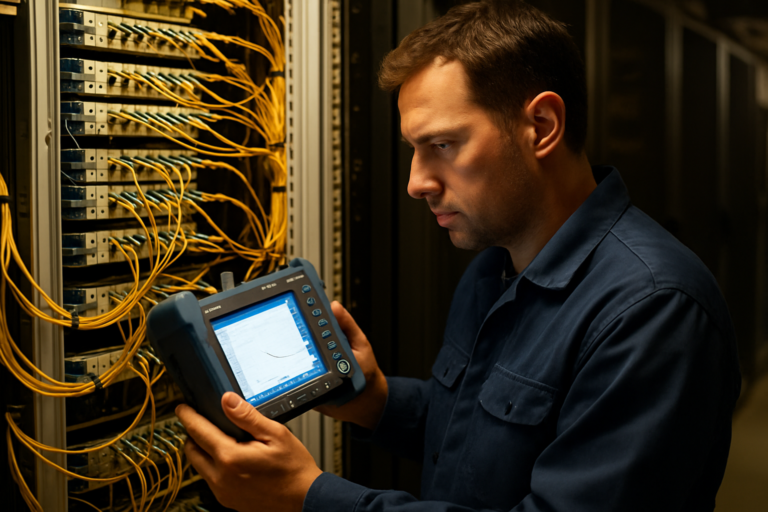
Stadtwerke Münster places highest emphasis on quality assurance during the fibre rollout. Every route segment is documented using OTDR testing equipment per IEC 61280-4-2. Maximum attenuation per connector must not exceed 0.5 dB.
| Parameter | Limit | Typical Value | Standard |
|---|---|---|---|
| Insertion loss LC-APC | < 0.5 dB | 0.2 dB | IEC 61755-3-1 |
| Return loss APC | > 60 dB | 65 dB | IEC 61755-3-1 |
| Splice loss | < 0.1 dB | 0.05 dB | ITU-T L.12 |
| Macro-bending | < 0.5 dB | 0.1 dB | IEC 60793-1-47 |
As a Diamond Partner, Fiber Products supplies splice modules with guaranteed optical specifications. Factory final inspection uses interferometric measurement per IEC 61300-3-35. Each module receives an individual test report.
Challenges in Urban Fibre Rollout
Fibre rollout in Münster’s historic old town presents special requirements. Stadtwerke Münster must respect listed building designations in the FTTH NRW project. Trenchless techniques such as directional drilling are increasingly deployed.
- Coordination with 15 other utility operators
- Minimum trench depth of 60 cm under pavements
- Crossings under major roads via HDD method
- Night-time construction to minimise traffic disruption
- Micro-ducting 7/5.5 mm diameter in existing conduits
- Compact joint boxes with maximum 400 mm diameter
In confined basement shafts, DIN rail-mounted enclosures with IP65 protection prove effective. These robust housings protect splice connections against moisture and mechanical stress. Modular design allows later expansion without service interruption.
Sustainability Aspects of Municipal Fibre Network
Stadtwerke Münster pursues a sustainable strategy in fibre rollout. Fibre optic networks consume up to 80 per cent less energy than copper-based networks. The new FTTH network saves approximately 2,800 tonnes CO2 annually.
Fiber Products supports these objectives with long-lived products from European manufacture. Modular splice systems are engineered for a service life of at least 25 years. Defective modules can be replaced individually without affecting overall system function. With 5-year warranty, we offer the longest product guarantee in the industry.
Outlook: Fibre Rollout Münster beyond 2026
Following completion of the current fibre rollout, Stadtwerke Münster is already planning the next expansion phase. The FTTH NRW backbone will be prepared for future bandwidth requirements up to 400 gigabit. Today, conduits with 20 per cent spare capacity are being installed.
- Network densification in new development areas
- Connection of 5G mobile base stations
- Redundant ring topologies for critical infrastructure
- Preparation for XGS-PON with 10 Gbit symmetrical
- Integration of edge computing locations
FAQ on Fibre Rollout by Stadtwerke Münster
Which splice box types suit municipal FTTH rollout?
For municipal utilities, modular 1HE splice boxes with 96 fibre capacity are recommended. These deliver optimal balance between packing density and ease of handling. Systems to IEC 61756-1 guarantee compatibility with all common connector types.
How many fibres should a splice cassette hold for city networks?
Standard splice cassettes with 12 or 24 fibres have proven effective in municipal applications. They enable structured management aligned with street segments or building clusters. Higher fibre counts benefit from multiple cassettes for improved visibility.
Which connector types are used in the Münster fibre rollout?
Stadtwerke Münster primarily deploys LC-APC and SC-APC connectors. LC connectors offer double packing density, while SC connectors prove more robust in handling. All connectors must meet requirements per IEC 61754.
How long does installation of a pre-terminated splice box take?
A pre-terminated 1HE splice box with 48 fibres can be fully installed in a short time. This includes mounting, splicing and documentation. Against conventional solutions, this saves up to 60 per cent of time.
What spare capacity should municipal utilities plan for during FTTH rollout?
Experts recommend minimum 30 per cent spare capacity on splice boxes and 20 per cent on conduits. This allows later densification without costly civil works. Modular systems expand flexibly as needed.
Are E2000 connectors worthwhile for municipal fibre networks?
E2000 connectors with integrated shutters suit critical infrastructure and exterior distribution cabinets particularly well. Higher protection class justifies premium pricing for backbone connections with demanding availability requirements.
The Münster fibre rollout exemplifies how municipal utilities efficiently deploy FTTH networks using modern splice systems. As a manufacturer of modular fibre optic solutions, Fiber Products supports municipal operators with thoughtfully engineered systems in Swiss quality – from compact splice box to robust industrial enclosure.
“
Order directly from shop: fiber-products.de
Request a Quote
Free consultation – personalised offer within 24 hours