Fibre Rollout Kiel 2026: Stadtwerke SH and FTTH Northern Germany
Fibre Rollout Kiel 2026: Stadtwerke Kiel and FTTH Schleswig-Holstein – Technical Requirements and Modular Splice Systems for Successful Network Deployment
The fibre rollout in Kiel exemplifies how Stadtwerke Kiel and regional network operators advance FTTH trends for municipal operators deployment through coordinated strategies and modular fibre-optic technology. With fibre coverage reaching 84 percent of all households, Schleswig-Holstein leads nationwide and demonstrates how municipal utility FTTH strategy, private operators, and state funding work efficiently together. The state capital Kiel benefits from multiple competing providers such as TNG Stadtnetz, Deutsche Telekom, and GlobalConnect, collectively serving over 100,000 households with Bavarian fibre deployment standards.
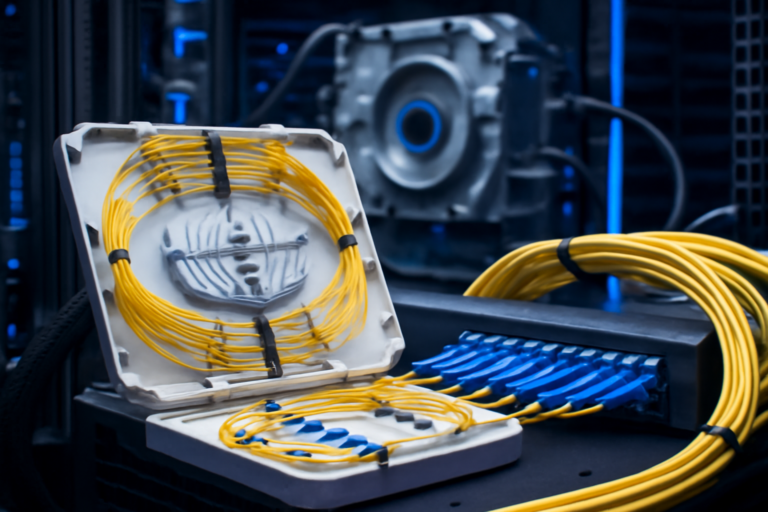
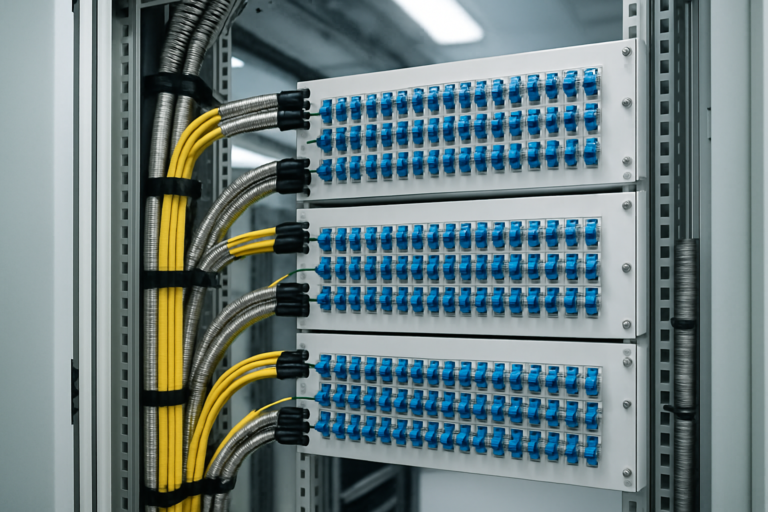
Technical challenges in urban fibre deployment require precisely coordinated splice systems and high-density distribution solutions. Modern 1U splice boxes with up to 96 fibres per rack unit enable space-efficient installation in confined distribution cabinets – a critical requirement in Kiel’s existing building stock.
Technical Infrastructure in Kiel Fibre Rollout: From Main Distribution to Customer Premise
Kiel’s structured network build follows the classical three-tier architecture of fibre-optic networks. Network tier 1 comprises the backbone network between main distribution frames, whilst tier 2 establishes connections to cabinet distribution points. Critical network tier 3 finally routes the fibre from the cabinet distribution point to the building termination point (BTP) in individual properties.
- Main distribution frames Kiel: Central technical sites with thousands of fibre connections
- Cabinet distribution points: Decentralised distribution hubs serving 200–500 households each
- Building termination points: Property-specific connection points with 4 to 96 fibres
- Apartment distribution panels: Floor-level distribution units in multi-family buildings
Technical implementation requires standards-compliant components per IEC 61754 for connectors and IEC 60794 for fibre-optic cables. Particularly in Kiel’s dense urban environment, splice connections must achieve insertion loss of less than 0.1 dB to ensure required transmission rates up to 10 Gbit/s in symmetrical operation.
Stadtwerke Kiel Requirements for Modular Fibre-Optic Systems
Stadtwerke Kiel and municipal network operators across FTTH Schleswig-Holstein establish specific requirements for deployed fibre-optic technology. Robustness, ease of maintenance, and future-proofing take precedence. Systems must perform reliably both in harsh outdoor conditions and confined spaces within existing buildings.
| System Requirement | Technical Specification | Relevance for Stadtwerke |
|---|---|---|
| Fibre Density | up to 96 fibres per 1U | Maximum utilisation of existing cabinets |
| Connector Types | LC, SC, E2000 APC | Compatibility with existing networks |
| Insertion Loss Values | < 0.25 dB per connection | Range optimisation without amplifiers |
| Protection Class | IP54 to IP65 | Outdoor deployment in distribution cabinets |
| Temperature Range | -40°C to +70°C | Year-round operation without climate control |
Another critical aspect is system documentation capability. Modern splice boxes feature integrated labelling systems and QR-code-based documentation enabling complete traceability of every individual fibre.
Splice Technology and Fibre Distribution in Urban Fibre Deployment
Splice technology represents the core of every fibre-optic installation. The Kiel fibre rollout predominantly employs fusion splice techniques achieving insertion loss values of under 0.05 dB. This precision proves critical, as a typical 5-kilometre connection span with 15–20 splice points must maintain cumulative loss below 2 dB.
Fiber Products Quality Promise: As an official Diamond Partner and European manufacturer, we produce modular splice systems in Europe. Benefit from Swiss precision and in-house manufacturing.
Fibre distribution in main distribution frames uses high-density splice modules ensuring structured fibre storage and accessibility. Modular design has proven the preferred approach, with pre-configured splice cassettes enabling very short installation times per cassette.
- Splice cassettes with 24 individual fibre positions
- Slack management for 1.5 metres reserve
- Colour coding per DIN VDE 0888
- Integrated loss measurement per splice
- Backward compatibility with existing systems
FTTH Deployment in Schleswig-Holstein: Success Factors and Best Practices
FTTH Schleswig-Holstein deployment benefits from coordinated strategies among state, municipalities, and network operators. The Broadband Competence Centre Schleswig-Holstein (BKZ.SH) serves as central coordination hub and has significantly contributed to the leading position with 84 percent fibre coverage. Systematic mapping of deployment areas, avoidance of duplicate builds, and efficient use of public funding represent core strategy elements.
Technically, Schleswig-Holstein implements future-proof point-to-point connections (P2P) and passive optical networks (PON) with splitter ratios of 1:32 or 1:64. Technology choice depends on settlement density: whilst Kiel predominantly employs PON, rural areas feature P2P connections.
Standardisation of technical components across all operators significantly reduces operating costs. Uniform 1U format splice boxes with identical connector types enable cross-manufacturer compatibility and simplify inventory management.
Modular Splice Systems for Stadtwerke: Requirements and Solutions
Stadtwerke Kiel’s specific requirements for modular splice systems stem from the necessity to utilise existing infrastructure efficiently whilst enabling future-proof expansion. Modular systems offer decisive advantages over monolithic solutions.
| System Type | Fibre Density | Application Area | Scalability |
|---|---|---|---|
| SlimConnect 1U | up to 96 fibres | Main distribution, PoP | Modular expansion to 288 fibres |
| VarioConnect 3U | up to 288 fibres | Data centres, backbone | Cascadable |
| DIN Rail Enclosure | up to 24 fibres | Industrial installations | Individual modules expandable |
Modular design enables demand-driven scaling. Municipal utilities can begin with smaller units and expand as demand grows without interrupting existing connections. This reduces initial investment whilst maintaining future-proofing.
Standards Compliance and Certifications in Fibre Deployment
Standards compliance is essential for the Kiel fibre rollout. All deployed components must conform to current industry standards and carry appropriate certifications. The new VDE Standard 0800-730 regulates fibre-optic cable installation in buildings from 2025 onwards and significantly simplifies deployment.
- IEC 61300-3-35: Test procedures for connectors
- IEC 61753-1: Performance standards for single-mode connections
- EN 50173-1: Generic cabling for customer premises
- ISO/IEC 14763-3: Testing of fibre-optic cabling
- VDE 0888: Colour coding of optical fibres
Particularly relevant for municipal operators is CE marking and compliance with the Low Voltage Directive, even though fibre-optic systems themselves carry no electrical voltage. Integration with existing power supply infrastructure requires these certifications.
Economic Viability and TCO Assessment for Municipal Operators
Total cost of ownership (TCO) of fibre infrastructure comprises capital expenditure (CAPEX) and operating expenditure (OPEX). For Stadtwerke Kiel and other municipal operators in the FTTH Schleswig-Holstein rollout, long-term assessment over 20–30 years proves essential.
High-quality modular splice systems with 5-year manufacturer warranty significantly reduce operating costs. Higher initial investments recover through lower failure rates and reduced maintenance within 3–5 years. Pre-configured systems further reduce installation times.
Connector type selection also influences economics. The E2000 APC standard offers long-term advantages through automatic dust shutters and excellent optical properties (return loss >60 dB) compared to simpler LC or SC connections.
Future Perspectives of Fibre Rollout in Northern Germany
The Kiel fibre rollout and Stadtwerke Kiel’s activities set the direction for the entire northern German region. With planned full coverage by 2028 and integration of new technologies such as XGS-PON (10 Gbit/s symmetrical), emerging infrastructure meets requirements for decades to come.
- Migration to 25G-PON and 50G-PON from 2027
- Integration of 400G Ethernet in backbone areas
- Convergence of mobile (5G/6G) and fibre networks
- Quantum communication over existing fibre infrastructure
- Sustainability through energy-efficient passive networks
Technical preparation for these developments requires deployment of future-proof components today. Splice systems must support latest-generation single-mode fibres (G.657.A2) and provide capacity for future expansion.
FAQ: Technical Questions on Fibre Deployment for Municipal Utilities
What fibre density is optimal for municipal operator main distribution frames?
96 fibres per 1U represents the minimum standard for main distribution. This enables service to 48 households with redundant routing or 96 households with single-fibre connections. Larger distribution points should be modularly designed for 288 fibres in 3U.
How do APC and PC connectors differ in practical deployment?
APC connectors (8° angled polished) achieve return loss of >60 dB, whilst PC connectors reach only 45–50 dB. For FTTH applications with high data rates, APC is mandatory to minimise signal reflections.
What fibre slack reserve should be maintained in distribution cabinets?
At least 1.5 metres fibre slack per splice should be planned. This permits up to three re-splices if damage occurs. Main distribution frames should maintain 3 metres slack for maximum flexibility.
How many splice cassettes fit into a 1U box?
Modern 1U systems accommodate up to 4 splice cassettes at 24 fibres each, totalling 96 fibres capacity. Cassettes are individually removable and allow work on adjacent fibres without service interruption.
What loss budgets apply for urban FTTH networks?
For urban networks with spans up to 5 km, maximum loss budget of 15 dB applies for trouble-free operation. This includes span loss (0.35 dB/km), splice loss (0.1 dB), and connector loss (0.25 dB).
When do pre-configured systems prove worthwhile?
Pre-configured systems pay for themselves from 20 connections through time savings. For projects exceeding 100 connections, total costs reduce despite higher material costs.
Conclusion: Successful Fibre Deployment Through Modular System Technology
The Kiel fibre rollout powerfully demonstrates how Stadtwerke Kiel and partners advance FTTH Schleswig-Holstein deployment through thoughtful technical concepts. Modular splice systems with high fibre density, standards-compliant components, and future-proof architectures form the technical foundation for Northern Germany’s digital transformation.
Investment in high-quality fibre-optic technology with extended warranty periods pays dividends through reduced operating costs and higher network availability. For municipal utilities and operators building sustainable fibre infrastructure, Fiber Products as Diamond Partner and European manufacturer provides tailored solutions – from compact 1U splice boxes to complete network concepts.
Contact our fibre-optic specialists for individual consultation on your FTTH project and benefit from our extensive experience in municipal network deployment.
Order directly from our shop: fiber-products.de
Request a Quote
Free consultation – personalised quotation on request