Fibre Optic Solutions for Government: Secure and Modular Systems
Fibre Optic Solutions for Government: Secure and Modular Systems for Public Networks
Government fibre optic systems, secure splice boxes, public procurement – these three factors define infrastructure projects of public authorities in 2024. Specific requirements for data security, physical wiretap protection measures and long-term availability demand specialised fibre optic solutions that go beyond standard telecommunications products. With the new VDE Standard 0800-730 and tightened security requirements for critical infrastructure, government agencies must fundamentally rethink their networks.
Regulatory Requirements for Government Fibre Networks
Current legislation presents public authorities with new challenges. Since November 2023, the EU Gigabit Infrastructure Regulation (GIA) applies directly in all member states. It stipulates that permits for fibre deployment must be issued within a maximum of four months.
- Digital permit procedures become mandatory
- Deemed approval upon deadline expiry
- Standardised technical documentation required
- Uniform quality criteria according to VDE 0800-720
In parallel, requirements for critical infrastructure protection are tightening. The Federal Ministry of the Interior requires decentralised network architectures with redundant splice points and physically separate transmission paths. These specifications make modular splice systems a fundamental prerequisite for government procurement.
Technical Security Requirements for Government Splice Boxes
Secure splice boxes for government networks differ fundamentally from commercial solutions. Mechanical security starts with housing construction: steel sheet housings with 2mm wall thickness and tamper-proof closures are the minimum standard. Additionally, security authorities require sealable access points and documented opening protocols.
| Security Feature | Standard Splice Box | Government Splice Box |
|---|---|---|
| Housing Material | Plastic/Aluminium | Steel 2mm |
| Closure | Standard Lock | Security Lock + Seal |
| Protection Class | IP20 | IP54 or higher |
| Documentation | Optional | Mandatory with Audit Trail |
| Redundancy | None | Dual Fibre Routing |
Electrical safety requires continuous grounding of all metallic components. Installation in government buildings is additionally subject to DIN VDE 0100-540, which mandates an equipotential bonding rail.
Modular Systems for Flexible Government Infrastructure
The dynamic nature of government structures demands adaptable fibre optic solutions. Modular splice systems enable subsequent expansion without operational interruption – a critical factor for 24/7 availability in security agencies. Modularity manifests at three levels:
- Primary level: Exchangeable splice cassettes for 12 or 24 fibres
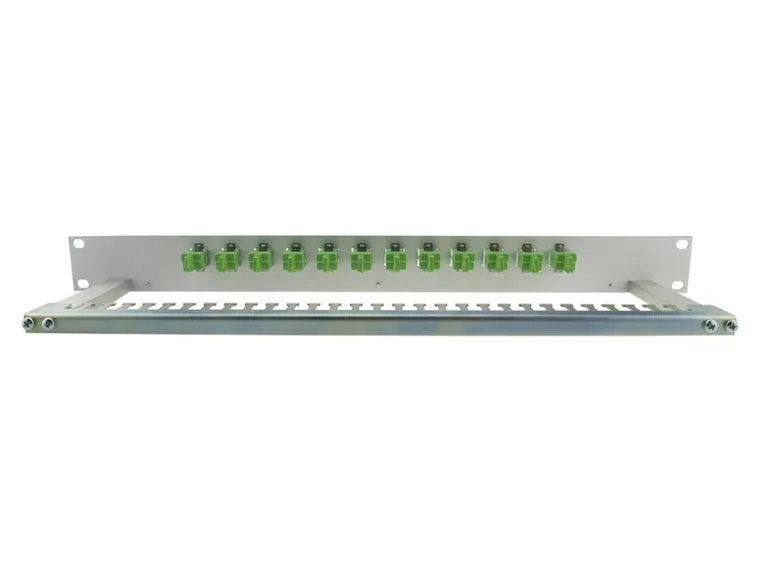
- Secondary level: Expandable front panels with various connector types
- Tertiary level: Scalable housing systems from 1RU to 4RU
Fiber Products Quality Promise: As an official Diamond Partner and manufacturer, we produce modular splice systems in Europe. Benefit from Swiss precision and 5 years warranty on our systems.
A practical example illustrates the advantage: a state authority initially plans 48 fibres but must provide expansion options to 96 fibres. With modular SlimConnect systems, upgrade is achieved simply by inserting additional cassettes – without re-cabling.
Standards Compliance and Certifications for Public Procurement
Government fibre optic systems, secure splice boxes, public procurement are subject to strict standards. Compliance with IEC 61754 for connectors and IEC 61300 for test procedures is mandatory. Furthermore, public tenders requirements:
- CE marking per Low Voltage Directive
- RoHS compliance for environmentally responsible procurement
- ISO 9001 manufacturer certification
- VDE test mark for electrical safety
- Evidence of Made in EU production
Documentation obligations extend to every splice operation. Authorities require complete protocols with OTDR measurements (Optical Time Domain Reflectometry) for each individual fibre. Attenuation values must remain below 0.25 dB per splice.
Redundancy and Fault Tolerance in Government Networks
Critical government infrastructure. The redundancy concept begins with physical separation: primary and backup paths run in separate fire compartments, ideally in different building sections. Splice boxes themselves offer dual cable entries for separate feeds.
| Redundancy Level | Technical Implementation | Availability |
|---|---|---|
| Fibre Redundancy | Dual Fibre Count | 99.9% |
| Route Diversity | Separate Cable Paths | 99.95% |
| Component Redundancy | Dual Splice Boxes | 99.99% |
| Site Redundancy | Distributed Equipment Rooms | 99.999% |
Practical implementation requires thoughtful patching strategies. Modern splice boxes with crossconnect panels enable rapid switchover on failure – without on-site manual intervention.
Special Requirements for Sensitive Government Areas
Security agencies and military facilities impose additional requirements. Here, wiretap-secure fibre systems with intrusion detection are deployed. These continuously monitor optical attenuation and report minute changes.
- Permanent attenuation monitoring with < 0.01 dB resolution
- Alarm on mechanical tampering
- Encrypted transmission of monitoring data
- Integration with existing security management systems
Physical protection is achieved through specially coated fibres that immediately break under bending or tapping attempts. These “alarm fibres” surround the data-carrying fibres and form an optical security perimeter.
Project Planning and Procurement Criteria
Public contracts for government fibre optic systems, secure splice boxes, public procurement follow procurement law. Technical specifications must be product-neutral but precisely define security requirements. Functional performance descriptions with measurable criteria have proven effective.
A typical government splice box procurement profile includes: minimum capacity of 48 fibres in 1RU, exchangeable front panels for various connector types, support for OS2 single-mode and OM4 multimode fibres, and manufacturer warranty of at least 5 years. Suppliers must demonstrate reference projects in the public sector.
Integration into Existing Government Infrastructure
Migration from copper to fibre networks in government agencies occurs incrementally. Hybrid splice boxes with media converters enable parallel use of both technologies during transition. Backward compatibility with existing systems is critical.
- Support for legacy protocols over fibre
- Power-over-fibre for remote sensors
- Integration into existing 19-inch racks
- Compatibility with government IT standards
Our specialised government solutions address these requirements through modular design. Existing cabling remains intact while new fibre routes are progressively added.
Maintenance and Lifecycle Management
Government networks are subject to strict maintenance regulations. DIN EN 50173 mandates regular attenuation measurements. Modern splice boxes integrate permanent monitoring systems that detect deterioration early. Preventive maintenance reduces unplanned outages considerably.
Lifecycle management also encompasses documentation of all changes. Digital twins of fibre infrastructure enable virtual planning of expansions. Every fibre, splice and connection is recorded in a centralised database – encrypted and access-controlled.
FAQ: Common Questions on Government Fibre Solutions
What security standards apply to government splice boxes?
Government splice boxes must meet BSI baseline protection requirements, be mechanically secured to RC3 standard, and enable complete access documentation. Additionally, requirements of the respective state authority apply.
How many fibres should a government agency provision?
Minimum provision is 48 fibres for smaller agencies. Medium authorities plan for 96 to 144 fibres, large administration centres often require 288 fibres or more. Reserve capacity of at least 30% is important.
Which connector types suit government networks?
The LC duplex connector has become the standard. For highest security requirements, the E2000 connector with integrated shutter is used. MPO/MTP connectors enable high-density cabling with 12 or 24 fibres per connector.
How is protection against wiretapping achieved?
Beyond encrypted data transmission, physical measures secure the fibre: bend-sensitive fibres detect tampering, permanent attenuation monitoring alerts to tap attempts, and special jacketing complicates access.
What warranty periods are common in public contracts?
Authorities demand minimum 5 years manufacturer warranty on passive components. For active components, 3 years is the minimum. Maintenance contracts typically run 10 years with guaranteed response times.
Can existing multimode networks continue to be used?
Yes, parallel use is possible through hybrid solutions. OM3/OM4 fibres support 10 Gigabit over short distances. For new installations, OS2 single-mode fibres are recommended for future-proof 100 Gigabit connections.
Interested in Modular Fibre Solutions?
Fiber Products GmbH – official DIAMOND SA Partner. Made in EU, 5 years warranty.
Order directly in our shop: fiber-products.de