FTTH Rollout 2026: Trends for Municipal Network Operators
FTTH Rollout 2026: Trends for Municipal Network Operators
FTTH trends 2026, municipal utilities fibre, municipal deployment – these topics dominate strategic planning for utility companies across the DACH region. Deutsche Telekom opened the year with a record: 120,000 new connections were activated despite winter weather in January 2026, representing growth of over 40 percent year-on-year. With 12.7 million available fibre connections and an announcement to add at least 2.5 million connections annually, a structural shift in German broadband infrastructure is underway.
Market Dynamics and Deployment Speed in the Municipal Sector
The German fibre market has fundamentally transformed. Between 2021 and 2024, households with fibre access grew by an average of 33 percent annually. By end of 2024, 21.3 million households had fibre availability, with forecasts for 2025 indicating over 50 percent of all German households will be reachable.
- Over 540 BREKO member companies account for more than half of German fibre deployment
- 2024 investment volume: €4.9 billion from alternative network operators alone
- Germany ranks 36th of 38 OECD countries in fibre adoption, with only 13.7 percent of broadband connections as fibre
- Comparable figures: South Korea 90.5 percent, Iceland 93.2 percent, Spain 89 percent
Activation rate emerges as the real bottleneck. While 12.7 million households can book Deutsche Telekom fibre service, actual fibre connections in use numbered approximately 5.3 million by end of 2024.
EU Gigabit Infrastructure Regulation: New Framework for Municipal Utilities
The EU Gigabit Infrastructure Regulation (GIR) came into effect in phases from 12 November 2025. For FTTH trends 2026, municipal utilities fibre, and deployment strategy, this creates fundamental changes. Most relevant is the expanded permit fiction provision: all required permissions are granted automatically if authorities do not respond within four months, extendable by another four months.
| Regulatory Change | Impact for Municipal Utilities | Timeline |
|---|---|---|
| Permit Fiction | Automatic approval after deadline expires | Max. 8 months |
| Full Build-Out Right in Multi-Unit Buildings | Deployment without complete consent possible | From 2026 |
| VDE Guideline 0800-730 | Simplified in-building deployment | February 2026 |
| TKG Amendment Act 2026 | Reduced bureaucratic barriers | March 2026 |
Cooperation Models as Key to Municipal Success
Partnerships between municipal utilities, local telecommunications operators, and major national providers become the central scaling mechanism for FTTH trends 2026, municipal utilities fibre, and municipal deployment. The most prominent example is the cooperation between Munich Utilities (SWM), its telecommunications subsidiary M-net, and Deutsche Telekom.
Fiber Products Quality Promise: As an official Diamond partner and European manufacturer, we produce modular splice systems in Europe. Benefit from Swiss precision and in-house manufacturing.
This partnership covers approximately 550,000 connections over time and demonstrates an innovative model: each apartment receives a wall outlet with two ports – one each for M-net and Telekom. This open FTTH network infrastructure architecture significantly reduces trenching work.
- NordConnect in Schleswig-Holstein: Neumünster Utilities and Schleswig-Holstein Utilities consolidate telecommunications activities
- Deutsche GigaNetz and Lotenik media: Specialised partnership for network level 4
- Platform models: Operations and sales without loss of local network ownership
Technical Innovations: Passive and Active Network Architectures
The contrast between active and passive fibre networks becomes more nuanced in 2026. Passive Optical Networks (PON) such as GPON, XGS-PON, and the emerging NG-PON2 enable multiple customers to be served via passive splitters on a single fibre. Point-to-Point (P2P) architectures assign each customer a dedicated fibre.
| Technology | Bandwidth | Deployment | Benefits for Utilities |
|---|---|---|---|
| GPON | 2.5/1.25 Gbit/s | Standard supply | Cost-effective, proven |
| XGS-PON | 10/10 Gbit/s symmetric | High-performance | Future-proof |
| P2P | Variable to 100 Gbit/s | Business customers | Dedicated bandwidth |
High-Density Splice Technology for Municipal Network Operators
Modern splice technology revolutionises installation speed for FTTH trends 2026, municipal utilities fibre, and municipal deployment. Ribbon splice technology enables simultaneous splicing of 12 or more fibres in the same time required for a single fibre. This delivers up to twelve-fold faster splice speeds.
Modular high-density systems such as the SlimConnect series accommodate up to 96 fibres in just one rack unit (1U) – representing more capacity than conventional solutions. For smaller municipalities and decentralised network nodes where space is constrained, this technology offers decisive advantages.
- VarioConnect Systems: Up to 288 fibres across 3U
- Modular 7-slot Architecture: Scalable from 12 to 72 fibres
- Sliding Modules: Simplified maintenance and expansion
- Swiss Precision: Diamond quality with 5-year warranty
Connector Technology and Standards Compliance for FTTH Solutions
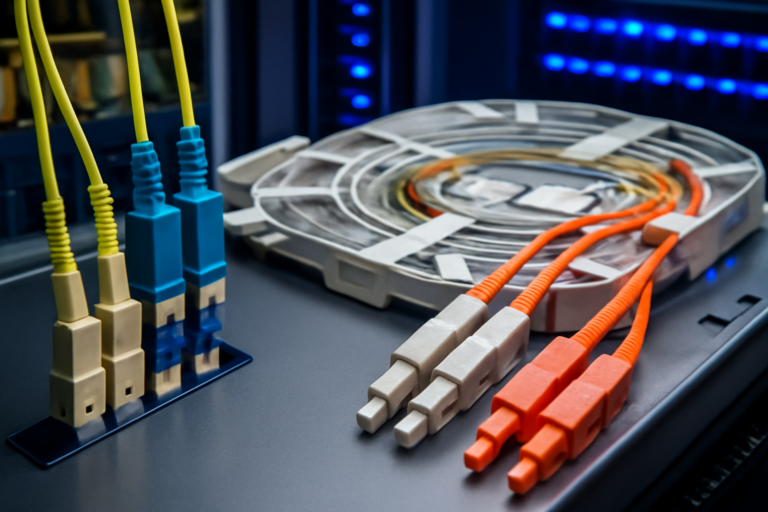
Connector type selection in 2026 reflects different network requirements and regional standards. For FTTH trends 2026, municipal utilities fibre, and municipal deployment, the following connector types are relevant:
- LC Connector: Dominant in high-density environments, IEC 61754-20 compliant
- SC Connector: Standard in telecommunications networks, IEC 61754-4
- E2000 Connector: Push-pull mechanism with automatic metal shutter, IEC 61754-15
- MPO/MTP Connector: For high-density applications with up to 72 fibres per connector
Funding and Financing Models 2026
For FTTH trends 2026, municipal utilities fibre, and municipal deployment, various funding instruments are available. The Federal Broadband Programme was restructured in 2026 and focuses on underserved areas with less than 100 Mbit/s available bandwidth.
Funding covers up to 50 percent of eligible costs, rising to 70 percent in structurally disadvantaged regions. State-level funding can additionally increase federal support to 90 percent. Important for utilities: the new funding directive explicitly permits modular splice systems and pre-terminated solutions to accelerate deployment.
Future Outlook for Municipal Fibre Networks
The 2026 transformation of the fibre market shows clear trends for FTTH trends 2026, municipal utilities fibre, and municipal deployment. Municipal utilities increasingly position themselves as regional digital providers, leveraging local roots as competitive advantage. The combination of regulatory streamlining, technological innovation, and new cooperation models creates optimal conditions for accelerated rollout.
As a manufacturer of modular fibre solutions and official Diamond partner, Fiber Products delivers the complete system – from splice box to E2000 connector in Swiss precision quality. Our SlimConnect and VarioConnect systems are purpose-built for municipal network operator requirements and enable maximum flexibility with minimal space footprint.
FAQ: Frequently Asked Questions on FTTH Trends 2026 for Municipal Utilities
Which PON technology should municipal utilities deploy in 2026?
XGS-PON with symmetric 10 Gbit/s becomes the standard in 2026. The technology provides sufficient bandwidth reserve for the next 10–15 years and is backward-compatible with GPON. For new projects, XGS-PON is recommended directly to avoid later upgrades.
What is the optimal splice reserve for municipal networks?
Plan for a minimum of 20–30 percent splice reserve. With modular systems like SlimConnect, you can expand flexibly. For 1,000 households, approximately 1,200–1,300 fibres should be allocated, including reserve for business customers and public facilities.
Which connector types are standard for FTTH rollouts in 2026?
LC and SC connectors — standardised in IEC 61754-20 and IEC 61754-4 — dominate subscriber outlets, predominantly in APC polish. For backbone links the MPO interface per IEC 61754-7 is established; MPO is the standardised designation, MTP is a brand name for it. E-2000 connectors (type LSH, IEC 61754-15) protect the ferrule with an automatic spring-loaded metal shutter, which is why they are found in critical infrastructure.
How long does installation of a 96-fibre splice module take?
With modern ribbon splice equipment and pre-terminated modules, an experienced technician requires a comparatively short time for a complete 96-fibre module including documentation. Single-fibre splicing would require considerably longer.
Which standards must municipal network operators observe in 2026?
Key standards are DIN EN IEC 60794 (VDE 0888-100) for fibre cables, IEC 61754 and IEC 61753 for connector interfaces and performance, and the new VDE Guideline 0800-730 (2026) for in-building deployment. Regulation (EU) 2024/1309 (Gigabit Infrastructure Act) additionally defines regulatory requirements.
How much space do modern splice systems require per fibre?
High-density systems like SlimConnect need only 0.01 U per fibre (96 fibres per 1U). Conventional systems require approximately 0.015–0.02 U per fibre. This equals space savings.
Interested in Modular Fibre Solutions?
Fiber Products GmbH – official DIAMOND SA partner. Made in Europe, 5-year warranty.
Order directly from our shop: fiber-products.de