Fibre Optic Solutions for Automotive Manufacturing – Factory Network Systems
Fibre Optic Automotive Manufacturing – Precision Factory Network Solutions for Connected Production
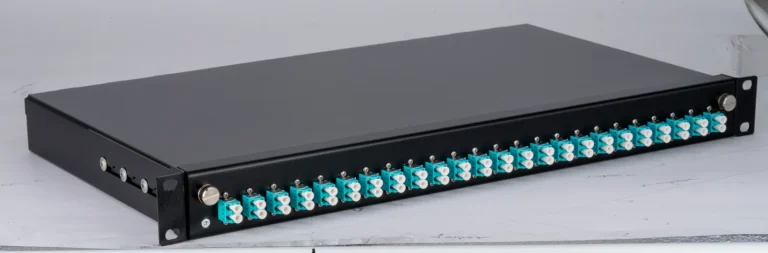
The automotive manufacturing sector increasingly relies on robust fibre optic factory network infrastructure to meet the demands of connected production environments using advanced automotive fibre technology. Modern production lines require vibration-resistant optical fibre systems that ensure uninterrupted data transmission with < 0.2 dB attenuation despite dust, moisture, and mechanical stress. As a manufacturer of modular fibre solutions and official Diamond partner, Fiber Products provides specialised splice systems with up to 96 fibres in 1U, precisely engineered for the unique challenges of automotive plants.
Digital transformation in automotive production demands reliable network infrastructure enabling real-time communication between robots, control systems, and quality inspection stations. Automotive fibre optic solutions must deliver maximum availability while remaining flexible enough to accommodate production line reconfiguration.
Technical Requirements for Fibre Optic Factory Networks in Automotive Plants
The specific environmental conditions in automotive manufacturing impose demanding requirements on deployed fibre optic technology. Factory network fibre systems must withstand extreme conditions whilst maintaining continuous high transmission rates.
- Vibration resistance > 10g for continuous operation adjacent to presses and welding robots
- IP65 rating against oils, coolants, and metal shavings
- Temperature resistance from −40°C to +85°C for paint shops
- Electromagnetic compatibility per DIN EN 50173-4
- Rapid reconfiguration during model changes through modular design
Modern automotive fibre networks employ redundant ring topologies ensuring uninterrupted communication even during cable breaks. Implementation utilises modular splice systems enabling structured distribution across production areas.
Modular Splice Systems for Flexible Factory Networks
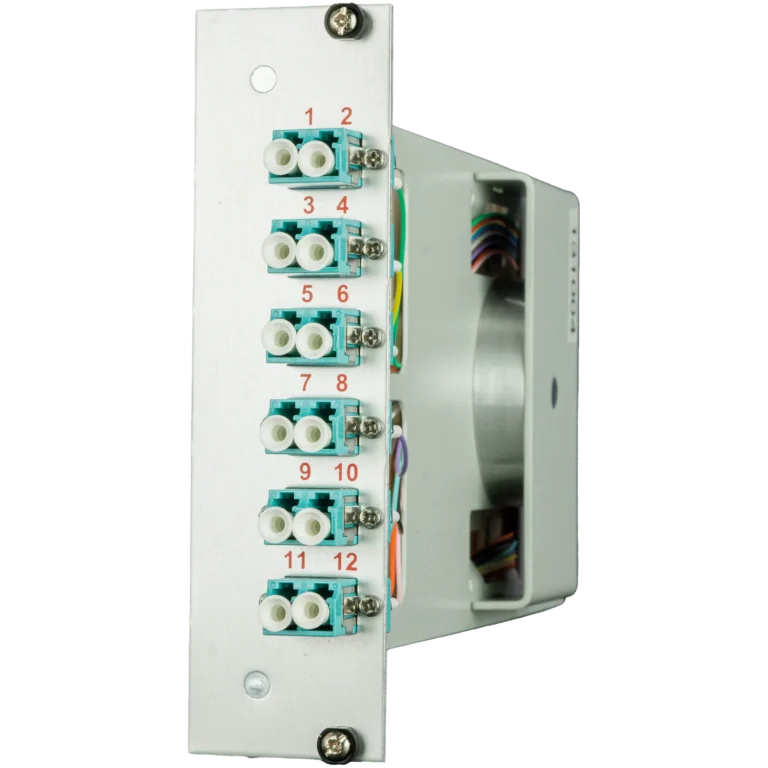
Modularity plays a critical role in automotive fibre manufacturing infrastructure adaptability. Systems such as SlimConnect and VarioConnect enable tool-free fibre capacity expansion without production interruption.
| System Type | Height | Fibre Capacity | Application Area |
|---|---|---|---|
| SlimConnect | 1U | up to 96 fibres | Production lines, robot cells |
| VarioConnect | 3U | up to 288 fibres | Production halls, backbone |
| DIN rail box | variable | 24–48 fibres | Control cabinets, machine connections |
These modular splice modules reduce installation time noticeably compared to fixed installations. Pre-configured modules can be exchanged quickly, a critical advantage during time-sensitive reconfigurations in automotive production.
E2000 Connectors for Maximum Reliability in Factory Network Systems
The deployment of E2000 connector range has become the industry standard for critical connections in automotive fibre networks. The integrated protective shutter prevents ferrule contamination and guarantees long-term stable optical performance.
Fiber Products Quality Commitment: As an official Diamond partner and European manufacturer, we produce modular splice systems with Swiss precision. Benefit from European engineering and in-house manufacturing.
The technical advantages of E2000 technology are particularly evident in demanding production environments. With return loss exceeding 55 dB for APC finish and insertion loss below 0.25 dB, these connectors meet the highest quality standards per IEC 61754-15.
- Automatic ferrule cleaning during mating via protective shutter
- Colour coding for unambiguous fibre identification
- Locking mechanism preventing accidental disconnection
- Compatibility with singlemode and multimode fibres
- 10,000 mating cycles without performance degradation
High-Density Cabling with MPO/MTP in Automotive Fibre Networks
For bandwidth-intensive applications such as machine vision and quality control, automotive manufacturers increasingly adopt MPO/MTP technology. These multi-fibre connectors enable parallel transmission over 12, 24, or 48 fibres in a single mating operation.
The advantages of MPO technology in factory network systems are particularly evident when connecting high-speed cameras and sensor systems. Supporting transmission rates of 400 Gigabit per second, these systems enable real-time analysis of production data.
| MPO Variant | Fibre Count | Transmission Rate | Typical Application |
|---|---|---|---|
| MPO-12 | 12 fibres | up to 100G | Robot control |
| MPO-24 | 24 fibres | up to 200G | Machine vision |
| MPO-48 | 48 fibres | up to 400G | Backbone connections |
DIN Rail Boxes for Decentralised Industrial Connectivity
Integration of fibre optic technology into existing control cabinets is accomplished via specialised DIN rail boxes. These compact distribution units mount directly on DIN rails and accommodate up to 48 fibre splices.
In automotive manufacturing networks, these boxes primarily connect production equipment and control units. The robust construction with IP54 rating ensures reliable operation even in dusty environments.
- Tool-free mounting on 35 mm DIN rail
- Integrated strain relief for 12 cables
- Splice cassettes for 24 individual fibre splices
- Front-facing label fields for documentation
- Operating temperature range −25°C to +70°C
Standards Compliance and Certifications for Automotive Fibre Systems
Adherence to industry-specific standards is essential for factory network fibre installations in automotive production. Fiber Products systems comply with all relevant standards for industrial deployment.
Notably, standard DIN EN 50173-4 defines requirements for structured cabling systems in industrial environments. Conformity with ISO/IEC 11801-3 additionally ensures international compatibility of deployed components.
Certification to IATF 16949 confirms suitability of our fibre systems for automotive manufacturers. This quality standard ensures all products meet the stringent requirements of vehicle producers.
Practical Implementation: Factory Network Planning for Automotive Fibre Systems
Successful deployment of an automotive fibre network requires a systematic approach. From initial assessment through dimensioning to final installation, all phases must be precisely planned.
- Phase 1: Requirements analysis and bandwidth calculation per production area
- Phase 2: Topology planning with redundant paths
- Phase 3: Selection of appropriate fibre and connector types
- Phase 4: Installation of industrial fibre systems
- Phase 5: Measurement acceptance per DIN EN IEC 61280-4-1 (multimode) or DIN EN IEC 61280-4-2 (single-mode)
During dimensioning, reserve capacity of at least 30 percent should be planned to accommodate future expansion without re-cabling. Fiber Products modular systems support this scalability through flexible design.
Maintenance and Service of Factory Network Fibre Systems
The longevity of automotive fibre installations depends significantly on regular maintenance. A structured maintenance programme minimises downtime and ensures production availability.
Modern monitoring systems enable continuous measurement of optical attenuation. When defined thresholds of > 0.5 dB are exceeded, maintenance personnel receive automatic alerts.
| Maintenance Interval | Activity | Duration |
|---|---|---|
| Monthly | Visual inspection of connectors | 30 minutes |
| Quarterly | Cleaning of critical connections | 2 hours |
| Annually | Measurement verification | 8 hours |
| Every 5 years | Preventive component replacement | 16 hours |
Future Outlook: Factory Networks for Connected Mobility
The automotive fibre sector continues to evolve. The transition to electric vehicles and autonomous driving increases data infrastructure requirements in manufacturing facilities exponentially.
Future factory network architectures must support transmission rates in the terabit range. Integration of artificial intelligence into production processes demands low-latency connections with < 1 millisecond latency.
- Preparation for 800G Ethernet by 2027
- Integration of edge computing nodes
- Convergence of IT and OT networks
- End-to-end physical layer encryption
- Self-healing network topologies
Frequently Asked Questions on Fibre in Automotive Manufacturing
Which fibre types suit automotive fibre networks?
For automotive fibre installations, OS2 singlemode fibres are recommended for long-distance runs over 550 metres, and OM4/OM5 multimode fibres for shorter distances up to 400 metres. Selection depends on transmission distance and bandwidth requirements.
How vibration-resistant are E2000 connectors in factory networks?
Diamond-grade E2000 connectors withstand vibrations to 10g at 10–500 Hz. The integrated protective shutter prevents particle ingress, ensuring long-term stability in production environments.
What advantages do modular splice systems offer over fixed installations?
Modular systems such as SlimConnect reduce installation time and enable tool-free replacement of failed modules within a short time. Flexibility during production reconfiguration and simple scalability are additional key advantages.
What is the maintenance burden for automotive fibre networks?
With professional installation, annual maintenance typically requires only limited effort. Preventive maintenance per manufacturer guidelines extends system lifespan to over 25 years.
What funding is available for factory network upgrades in 2026?
The EU Gigabit Infrastructure Regulation allocates €2.5 billion for fibre rollout. National programmes such as GigaFibreDE specifically support industrial factory networks with funding up to 50 percent of investment costs.
What is the ROI calculation for 96 fibres in 1U?
Doubling port density compared to standard systems reduces space requirements and cooling costs. In typical installations, the investment pays for itself within 3.5 years through operational savings.
Request a Quote
Have questions about our fibre optic solutions? Our expert team is happy to advise you – free and without obligation.