Fibre Rollout Nuremberg 2026: N-ERGIE and FTTH in the Franconia Metropolitan Region
The fibre rollout in Nuremberg reaches a critical turning point in 2025/2026: while Deutsche Telekom is deploying FTTH on a commercial basis in Nuremberg-Hasenbuck, connecting 3,200 households, N-ERGIE Fibre positions itself as a regional infrastructure partner with an investment volume of €1.3 billion through 2030. Fibre availability across Germany has nearly doubled from 18.2 percent (2022) to 35.7 percent (2024), with FTTH Franconia driven forward by a combination of private investment and municipal participation.
Market Situation: Telekom and N-ERGIE as Key Players in Nuremberg’s Fibre Deployment
The Nuremberg–Fürth–Erlangen metropolitan region, home to over 800,000 residents, is undergoing a major infrastructure transformation. Deutsche Telekom has announced that from April 2026 it will deploy fibre to the Hasenbuck district on a commercial basis—a clear signal of the viability of urban FTTH projects.
N-ERGIE Netz GmbH, as a regional network operator, brings decisive advantages: existing cable routes, municipal anchoring, and synergies with the power grid. The Munich model demonstrates how successful such partnerships can be.
- 550,000 fibre connections will be installed in Munich by 2030 jointly by municipal utilities and Telekom
- Municipal utilities provide passive infrastructure and lease cable routes
- Telekom and regional providers operate the networks as active operators
- Investment risk is shared across multiple partners
- Faster deployment through parallel rollout of different districts
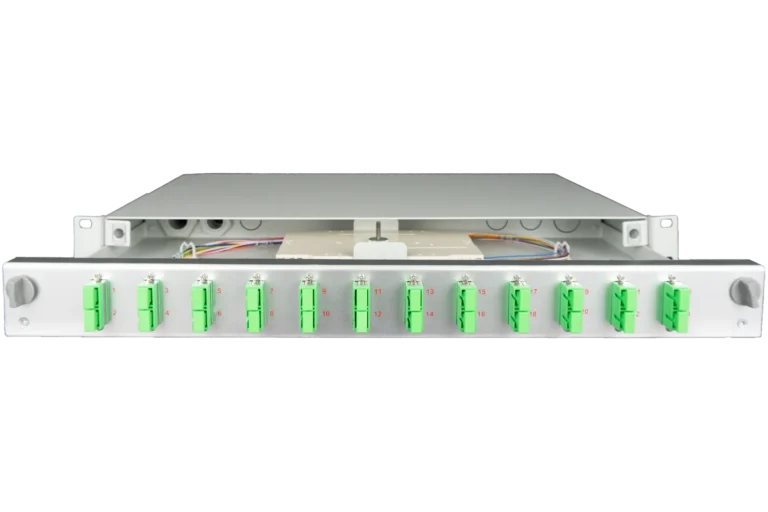
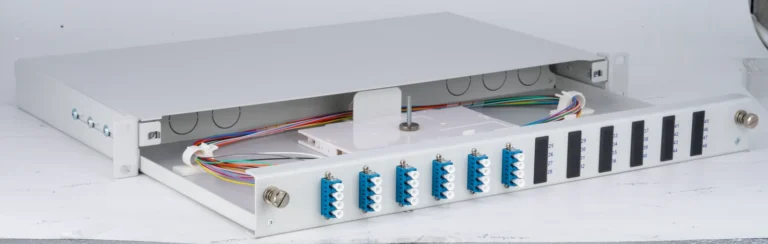
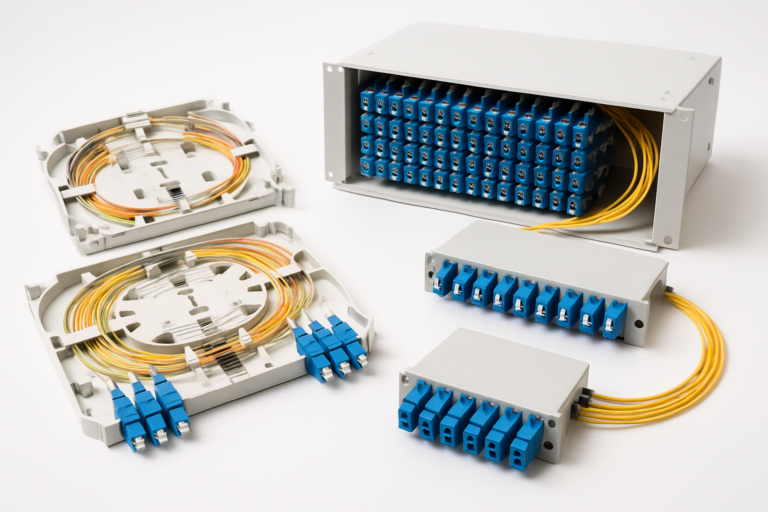
Technical Requirements for FTTH Franconia: Modular Splice Systems as the Key
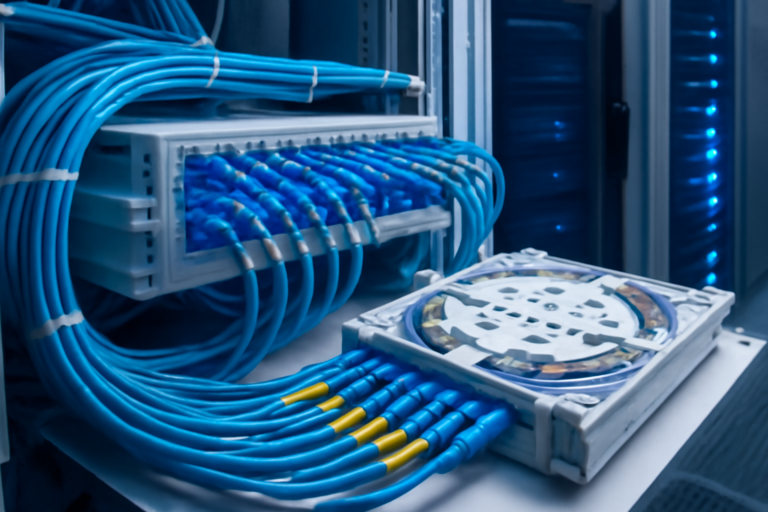
The fibre rollout in Nuremberg requires high-density, scalable network distribution solutions. In a typical FTTH project serving 10,000 households, at least 20,000 fibres must be spliced and managed—double that with redundant design.
| System Type | Fibre Density | Height | Space Required for 10,000 Fibres |
|---|---|---|---|
| Standard 1U | 48 Fibres | 44.45 mm | 209 Height Units |
| SlimConnect 1U | 96 Fibres | 44.45 mm | 105 Height Units |
| VarioConnect 3U | 288 Fibres | 133.35 mm | 35 Height Units |
The choice of the right splice system directly affects profitability: a telecommunications cabinet with 42 height units, including cooling and security systems, costs approximately €15,000. High-density systems can quickly save six-figure amounts on larger projects.
Regulatory Framework: EU Gigabit Infrastructure Regulation Transforms the Market
From 12 November 2025, the new EU Gigabit Infrastructure Regulation applies, bringing drastic simplifications for N-ERGIE Fibre and other network operators. The maximum approval period for FTTH projects is now only four months—after which automatic approval is granted.
- New buildings must be equipped with fibre optic cables from February 2026 (not just ducts)
- Notification procedures instead of approval for standard installations
- Digital application submission becomes mandatory
- Unified technical standards per IEC 61754 and IEC 60793
FTTH Deployment Strategies for Municipal Utilities: Lessons from Successful Projects
The fibre rollout in Nuremberg can benefit from proven concepts of other municipal utilities. For example, Bochum municipal utilities built their own FTTH network serving 150,000 households and consistently employed modular infrastructure.
Success factors for municipal FTTH projects centre primarily on the right technical architecture and well-planned partnerships. The choice between point-to-point and PON architecture has long-term consequences for operations and profitability.
Fiber Products Quality Promise: As an official Diamond partner and manufacturer, we produce modular splice systems in Europe. Benefit from Swiss precision and in-house manufacturing.
Technical Specifications for N-ERGIE Fibre Infrastructure
Technical requirements for FTTH Franconia differ significantly from classical telecommunications networks. Whilst backbone links typically use Singlemode OS2 fibres with low splice densities, FTTH networks require high-density distribution points with hundreds of fibres per site.
| Parameter | Backbone Network | FTTH Distribution Network | Standard/Norm |
|---|---|---|---|
| Fibre Type | OS2 Singlemode | OS2 Singlemode G.657.A2 | ITU-T G.657 |
| Attenuation | < 0.35 dB/km | < 0.25 dB/km | IEC 60793-2-50 |
| Connector Type | LC/UPC, SC/APC | SC/APC, E2000/APC | IEC 61754 |
| Splice Attenuation | < 0.1 dB | < 0.05 dB | IEC 61300-3-4 |
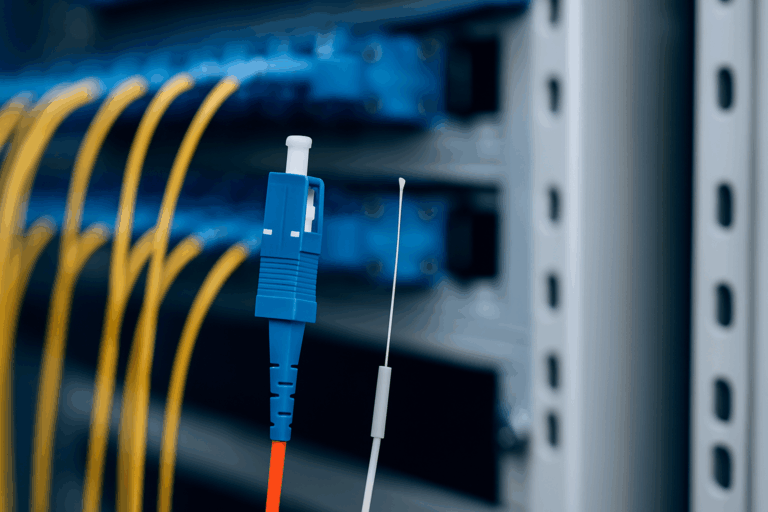
Particularly critical for N-ERGIE Fibre is the selection of the right connectors. Whilst LC duplex dominates in data centres, FTTH networks increasingly use SC/APC due to superior return loss of > 60 dB.
Investment Planning for Nuremberg’s Fibre Rollout: Cost Factors and Profitability
Investment costs for the fibre rollout in Nuremberg comprise several components. Network operators typically budget €800 to €2,500 per household passed, depending on building density and existing infrastructure.
- Civil Works: 60–70% of total investment
- Passive Infrastructure (cables, termination points): 15–20%
- Active Equipment (OLT, ONT): 10–15%
- Planning and Documentation: 5–10%
- Splice Work and Testing: 3–5%
Using modular splice modules can reduce infrastructure costs. Higher packing density enables smaller technical rooms and lower rental costs.
Quality Assurance for FTTH Franconia: Testing and Documentation
Every fibre section in the Nuremberg fibre rollout must be measured and documented per IEC 61280-4-2. Attenuation measurement is performed bidirectionally at 1310 nm and 1550 nm; for PON networks, additionally at 1490 nm.
Critical measurement parameters for handover include total section attenuation, reflection losses at connectors, and optical return loss. Modern OTDR test equipment captures these values automatically and generates standards-compliant reports.
Future Outlook for N-ERGIE Fibre: Deployment Phases Through 2030
The strategic development of N-ERGIE Fibre follows a phased approach. Phase 1 (2025–2026) focuses on deploying high-density business areas, followed by Phase 2 (2027–2028) covering residential areas with high connection density.
- 2025–2026: Business areas and new-build districts (estimated 15,000 connections)
- 2027–2028: High-density residential areas (estimated 40,000 connections)
- 2029–2030: Comprehensive area coverage (estimated 80,000 connections)
Technical infrastructure must be designed from the outset to support future bandwidth requirements. XGS-PON at 10 Gbit/s symmetrical will become the standard medium-term; 25G-PON and 50G-PON are already in standardisation.
Practical Implementation: From Planning to Completed FTTH Installation
The fibre rollout in Nuremberg requires precise coordination between civil works, splice technicians and network activation. A typical FTTH project follows distinct phases with quality control checkpoints at each stage.
In the planning phase, cable routes are defined and permits obtained. The choice of installation method—trenching, ploughing, or micro-trenching—significantly affects cost and schedule. For FTTH Franconia, micro-trenching with only 10–15 cm slot width is often ideal in urban areas.
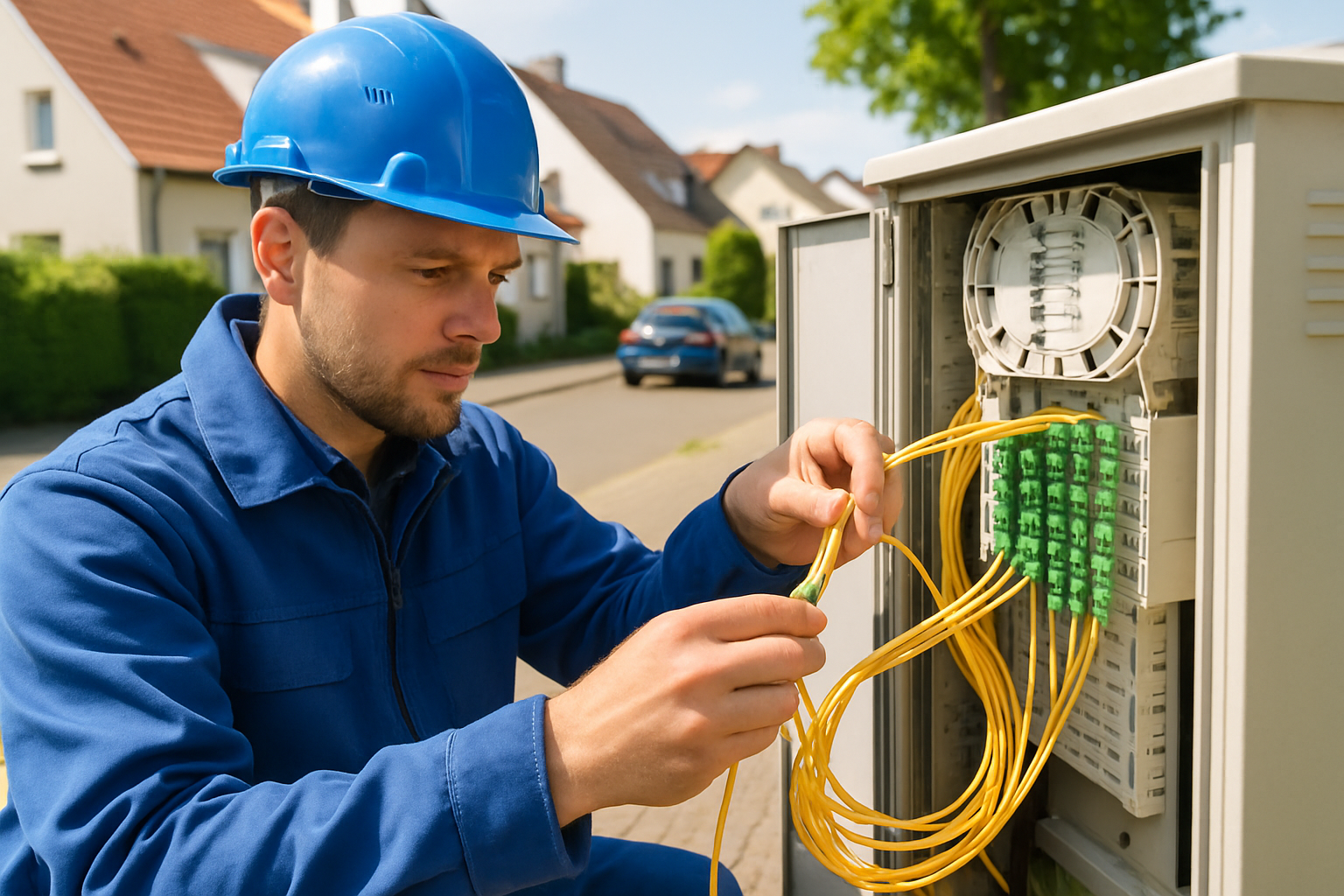
Passive infrastructure installation includes cable laying, termination point mounting and splicing. Modern fibre solutions for municipal utilities use pre-configured modules, reducing installation time.
FAQ: Frequently Asked Questions on Nuremberg’s Fibre Rollout and N-ERGIE Fibre
What role does N-ERGIE play in Nuremberg’s fibre deployment?
As a regional infrastructure operator, N-ERGIE Netz GmbH can build its own FTTH networks or lease existing cable routes to other network operators. With an investment volume of €1.3 billion through 2030, the company has the resources for major infrastructure projects.
What technical standards apply to FTTH Franconia?
All FTTH installations must comply with standards IEC 61754 for connectors and ITU-T G.657 for bend-insensitive fibres. Maximum attenuation is 0.25 dB/km; splice connections must not exceed 0.05 dB.
What is the difference between commercial and grant-funded deployment?
In commercial deployment, network operators invest without state support in profitable high-density areas. Grant-funded projects connect underserved “white spots” using federal funding of up to 50 percent of investment costs.
What advantages do modular splice systems offer for Nuremberg’s fibre rollout?
Modular systems enable staged expansion without complete infrastructure replacement. At 96 fibres per 1U, space requirements drop significantly, which is critical in confined technical rooms.
What bandwidths are achievable over FTTH networks?
Current GPON networks deliver 2.5 Gbit/s downstream and 1.25 Gbit/s upstream. XGS-PON already enables 10 Gbit/s symmetrical; future standards like 50G-PON will reach 50 Gbit/s.
How long does complete fibre rollout of a city like Nuremberg take?
With consistent deployment across multiple parallel crews, experts estimate 5–8 years for comprehensive coverage. Munich, for example, plans 550,000 connections by 2030, a comparable scale.
Interested in Modular Fibre Solutions?
Fiber Products GmbH – Official Diamond Partner. Made in EU, 5-year warranty.