Optical Fibre in Automotive Manufacturing: Networking for Industry 4.0
The integration of optical fibre automotive systems, Industry 4.0 fibre optics, and factory fibre networks revolutionises modern manufacturing through transmission rates of up to 100 Gbit/s, electromagnetic immunity, and real-time data processing for networked production lines. In the German automotive industry, fibre-optic infrastructure enables seamless connection of robots, sensors, and control systems across distances of several kilometres without signal loss.
The transformation to a networked factory requires robust network architecture capable of withstanding the extreme demands of automotive production. Modern fibre-optic networks form the backbone for real-time communication between production islands and enable the implementation of concepts such as predictive maintenance and digital twins.
Why optical fibre automotive and Industry 4.0 fibre optics are essential
The automotive industry today produces up to 1,500 vehicles daily on a single production line. This production speed generates data volumes in the terabyte range that can only be managed through high-performance fibre-optic networks. A modern factory fibre network transmits sensor data from over 30,000 measurement points in real time to central control systems.
- Latency under 1 millisecond for time-critical robot control
- Immunity to electromagnetic fields from welding robots and high-voltage systems
- Bandwidth reserves for future expansion and AI applications
- Failsafe redundancy through dual fibre routing per IEC 61754-15
- Temperature resilience from -40°C to +85°C for production environments
Networking production equipment through fibre optics eliminates typical problems of copper-based Ethernet cabling. Whilst copper cables are limited to a maximum of 100 metres and vulnerable to electromagnetic interference, optical fibres easily span distances of up to 40 kilometres without signal amplifiers.
Technical requirements for optical fibre in automotive manufacturing
Automobile production places special demands on network infrastructure. Vibration, temperature fluctuations, and aggressive chemicals require specially designed fibre-optic systems with IP65 protection rating for industrial environments.
| Requirement | Standard network | Automotive fibre network | Standard/specification |
|---|---|---|---|
| Temperature range | 0°C to +40°C | -40°C to +85°C | IEC 60793-2-50 |
| Vibration resilience | Not specified | 10–500 Hz, 5g | IEC 61300-2-1 |
| Protection rating | IP20 | IP65/IP67 | EN 60529 |
| Attenuation | < 0.5 dB/km | < 0.25 dB/km | ITU-T G.652.D |
| Bend radius | 30 mm | 15 mm | IEC 60793-2-50 |
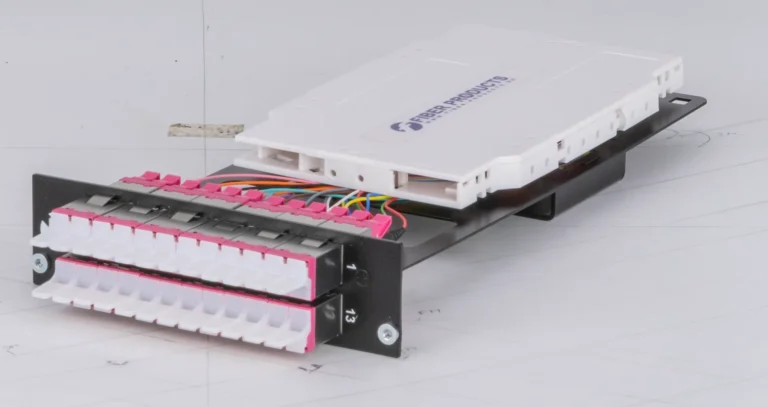
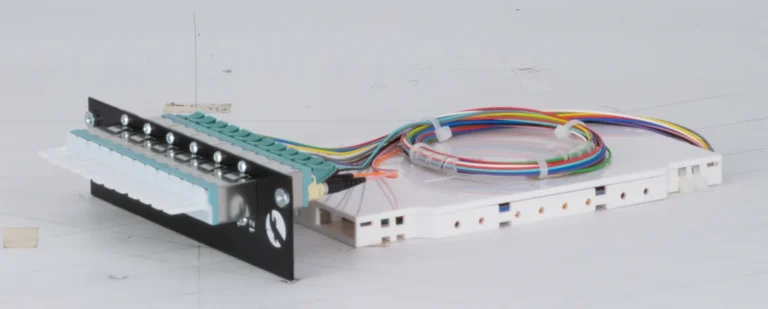
Modular splice systems SlimConnect 1HE enable structured management of up to 96 fibres in just one rack unit. This packing density is critical for space-constrained installations in control cabinets and production areas.
Implementing Industry 4.0 fibre optics in existing production lines
Migration from existing copper cabling to optical fibre typically occurs in three phases. First, critical backbone connections between production halls are equipped with singlemode fibres to OS2 standard. These enable transmission rates of 400 Gbit/s over distances up to 10 kilometres.
- Phase 1: Backbone networking of production halls with OS2 singlemode
- Phase 2: Connection of production islands via OM4/OM5 multimode
- Phase 3: Integration of individual machines and sensors
- Parallel operation of copper and fibre during transition phase
- Gradual decommissioning of old copper infrastructure
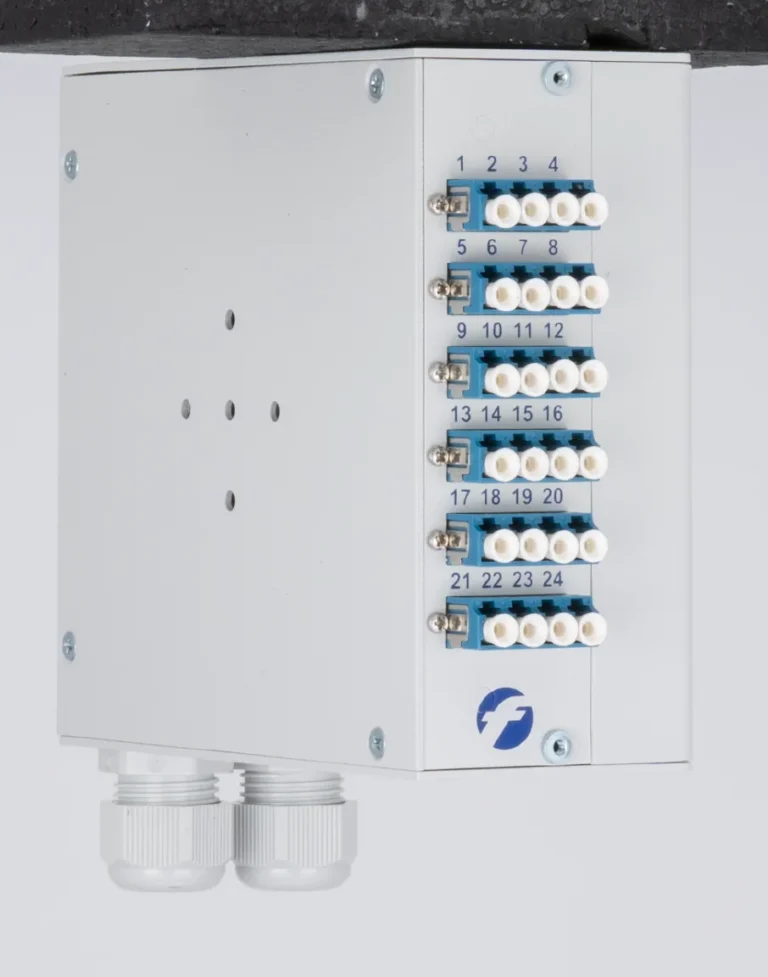
Installation requires specialist DIN rail mounting systems for integration into existing industrial control cabinets. These compact enclosures protect sensitive splice connections from environmental factors and enable quick module replacement during maintenance windows.
Fiber Products Quality Promise: As an official Diamond partner and manufacturer, we produce modular splice systems in Europe. Benefit from Swiss precision and in-house manufacturing.
Connector types and connection technology for factory fibre networks
The choice of the right connector system significantly influences the reliability of the entire network. In the automotive industry, E2000 connectors have become the standard for critical applications because their protective shutter offers optimum protection against contamination.
| Connector type | Application area | Attenuation | Advantages | Disadvantages |
|---|---|---|---|---|
| E2000/APC | Critical controls | < 0.1 dB | Protective shutter, low return loss | Higher cost |
| LC duplex | Standard networking | < 0.3 dB | High packing density | No contamination protection |
| MPO/MTP | Backbone, high density | < 0.5 dB | 12–24 fibres per connector | Demanding cleaning requirements |
| SC/APC | Outdoor applications | < 0.3 dB | Robust, cost-effective | Larger footprint |
Modern production lines increasingly use pre-terminated MPO connections for fast installation. A single MPO-24 connector replaces up to 24 individual LC connections and reduces installation time by up to 70 per cent.
Real-time data processing and latency optimisation
Synchronisation of robots in automotive assembly requires latency under 100 microseconds. Fibre-optic networks with singlemode technology achieve these values through direct light transmission without electrical conversion. A typical optical fibre automotive network connects over 500 industrial robots with central control units.
- Timestamp synchronisation per IEEE 1588v2 for precise motion sequences
- Redundant ring topologies with failover times under 50 ms
- Prioritisation of critical data packets through quality of service
- Bandwidth reservation for safety systems and emergency shutdowns
- Continuous signal quality monitoring with OTDR instruments
The implementation of Time-Sensitive Networking (TSN) over optical fibre enables deterministic communication for time-critical applications. Welding robots coordinate their movements with accuracy of under one millisecond, significantly improving product quality.
Security aspects and redundancy concepts
Production downtime in the automotive industry costs an average of €22,000 per minute. Redundant fibre-optic infrastructure minimises this risk through multiple safeguarding of critical connections. The Industry 4.0 fibre optics concept specifies at least two independent fibre paths for each critical connection.
Ring topologies per IEC 62439-6 enable automatic failover upon fibre break. Modern splice systems support this redundancy through pre-configured patch panels that activate alternative routes within seconds. Physical separation of redundant fibre paths prevents simultaneous failure from mechanical damage.
- Separate cable routing for primary and backup connections
- Automatic failover on signal loss exceeding 1 dB
- Continuous monitoring of backup links
- Alerting when defined attenuation thresholds are exceeded
- Documentation of all failover events for fault analysis
Integration of AI and machine learning via fibre-optic networks
Artificial intelligence in quality control generates data streams of up to 10 Gbit/s per camera system. High-resolution image processing with 8K resolution detects paint defects at the micrometre scale and transmits analysis results in real time to downstream processing stations.
The factory fibre network carries not only production data but also training data for machine-learning models. Edge computing nodes at strategic network points reduce latency for AI inference to under 10 milliseconds. This distributed intelligence enables autonomous decision-making directly on the production line.
Maintenance and fault diagnostics in automotive fibre networks
Proactive maintenance prevents unplanned outages and ensures availability of 99.999 per cent (Five Nines). Modern OTDR (Optical Time Domain Reflectometer) instruments locate faults in fibre routes to within one metre and enable targeted repairs without complete replacement.
- Quarterly attenuation measurements of all critical links
- Documentation of measurements in digital network twins
- Preventive replacement when attenuation increases beyond 0.1 dB
- Connector cleaning per IEC 61300-3-35
- fibre-optic technology training
The use of modular systems such as VarioConnect enables quick replacement of failed components. Pre-terminated spare modules reduce mean time to repair (MTTR) substantially. Structured spare parts management ensures availability of critical components.
Future perspectives: 6G and quantum communication
The next generation of mobile technology will enable data rates up to 1 Tbit/s. Optical fibre automotive infrastructure already forms the foundation for these future technologies today. Hollow-core fibres reduce signal propagation time by 30 per cent and enable even faster response times in networked production.
Quantum communication via optical fibre promises absolutely secure data transmission for sensitive production data. Early pilot projects in German automotive plants are testing quantum key distribution over distances up to 100 kilometres. Integration into existing Industry 4.0 fibre optics networks occurs via dedicated wavelengths in the C-band.
Economic evaluation and investment protection
Investment in modern fibre-optic infrastructure typically pays for itself within three to five years. Reduced downtime, higher production speeds, and improved quality justify the initial costs of approximately €150,000 per production line.
| Cost item | Copper network | Fibre network | Annual saving |
|---|---|---|---|
| Energy consumption | €45,000 | €12,000 | €33,000 |
| Maintenance/repair | €28,000 | €8,000 | €20,000 |
| Downtime | €156,000 | €22,000 | €134,000 |
| Expansion | €35,000 | €15,000 | €20,000 |
| Total | €264,000 | €57,000 | €207,000 |
Modular systems with 5 years warranty offer additional investment protection. The scalability of fibre-optic networks allows gradual expansion without complete renewal. Standardised components to international standards ensure spare parts availability for decades.
Practical example: networking an assembly line
A typical final assembly line in automotive production comprises 45 work stations over a length of 800 metres. Each station requires at least four fibre-optic connections for control, visualisation, safety systems, and quality control. The resulting factory fibre network connects 180 active endpoints with redundant connections.
Implementation occurs via central distribution cabinets every 100 metres, equipped with modular splice boxes holding 96 fibres in 1HE each. Pre-terminated patch cables reduce installation time per station to under two hours. Total installation including commissioning and documentation typically requires four weeks.
- Main distribution panel with 288 fibres in 3HE VarioConnect system
- Eight sub-distribution panels with 96 fibres each in SlimConnect 1HE
- MPO trunk cables for backbone connections between distribution points
- LC duplex connections for end devices per TIA-568-C.3
- Reserve fibres of 30 per cent for future expansion
FAQ: Frequently asked questions on optical fibre in automotive manufacturing
What transmission speeds are required in automotive production?
Modern production lines require at least 10 Gbit/s for real-time applications. Backbone connections between production halls should support 100 Gbit/s to ensure future-proofing. Critical control connections benefit from dedicated 1 Gbit/s links with guaranteed bandwidth.
How do singlemode and multimode differ in factory environments?
Singlemode fibres (OS2) are suitable for distances over 500 metres and offer virtually unlimited bandwidth. Multimode fibres (OM4/OM5) are cost-effective for short runs up to 400 metres and sufficient for most machine connections with 10–40 Gbit/s.
What standards apply to Industry 4.0 fibre-optic installations?
Relevant standards include EN 50173-3 for industrial cabling, IEC 61754 for connectors, and ISO/IEC 11801-3 for industrial sites. Additional sector-specific requirements apply such as automotive-grade specifications.
Order directly from our shop: fiber-products.com
Request a quote now
Free consultation – Personalised quote within 24 hours