How to Choose the Right Splice Module for Data Centres
The Right Splice Module for Data Centres: Decision Guide for High-Density Infrastructure
Selecting the right splice module for data centres is critical to port density, scalability and long-term cost-effectiveness — modern high-density splice modules now achieve up to 288 fibres in just 4 rack units, setting new standards for data centre infrastructure. As a technical decision-maker, you face the challenge of balancing between traditional 48-port systems and innovative high-density solutions to find the optimal mix of capital expenditure, future-proofing and operational efficiency.
Port density as a critical success factor: From 48 to 288 fibres per system
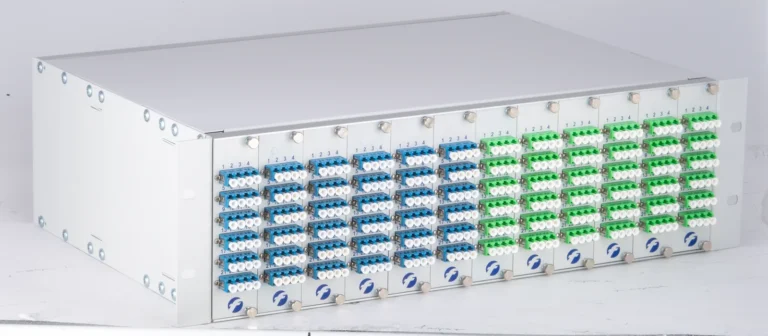
Port density evolution in data centres follows an exponential growth trajectory. While standard splice modules with 48 fibres per 1RU were long considered sufficient, modern hyperscale data centres and colocation providers now demand systems with at least 96 fibres per rack unit. The latest generation of high-density splice modules, such as the 7HP splice modules, achieves up to 288 fibres in the VarioConnect 3RU — a threefold increase in port density compared to conventional solutions.
This development is not a technical gimmick but a direct response to space constraints in German data centres. With average rack costs of €800–1,500 per RU per year at premium locations such as Frankfurt, investment in high-density systems pays for itself within 18–24 months.
- Space requirement reduction
- Reduced cooling costs through optimised cable management
- Simplified documentation through modular design
- Future-proof migration from 100G to 400G standards
Modular vs. monolithic architectures: The strategic choice
A modern splice module for data centres must do more than just terminate fibres. The choice between modular and fixed systems determines how flexibly you can respond to technological changes. Monolithic splice boxes with permanently installed modules offer low acquisition costs but quickly become barriers to technological upgrades.
| Criterion | Modular systems | Monolithic solutions |
|---|---|---|
| Initial cost | Somewhat higher | Lower |
| Scalability | Infinitely scalable | Only through replacement |
| Connector exchange | LC ↔ SC ↔ E2000 possible | Fixed |
| TCO over 5 years | Significantly lower | Higher due to replacement investments |
| Maintenance time | Full access required |
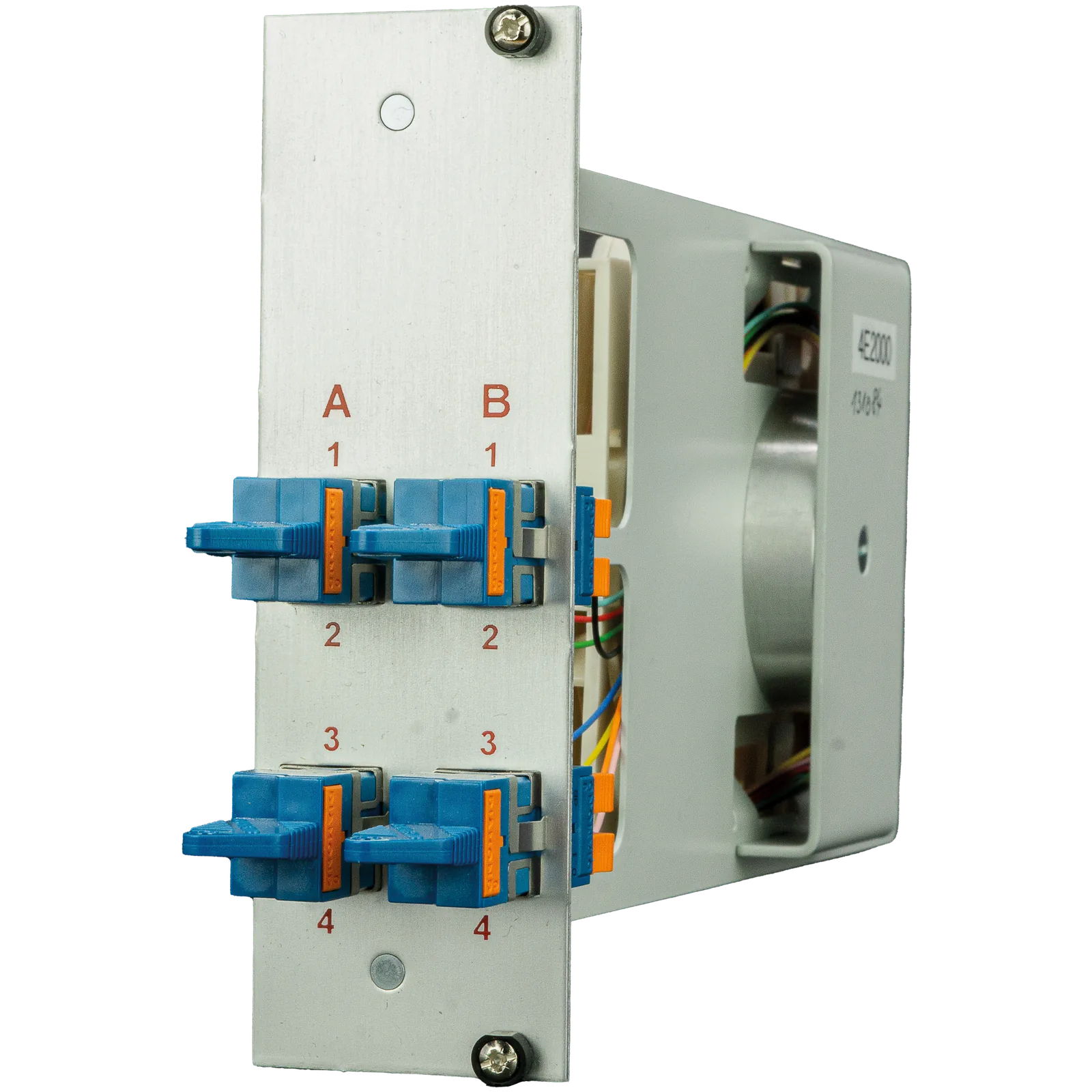
Modern modular systems such as the VarioConnect family use standardised 7TE modules (35mm Eurocard format) that can be deployed in various housing sizes from 1RU to 4RU. This flexibility enables data centres to start with small configurations and grow as needed.
Connector types for different requirements: LC, SC, E2000 and MPO
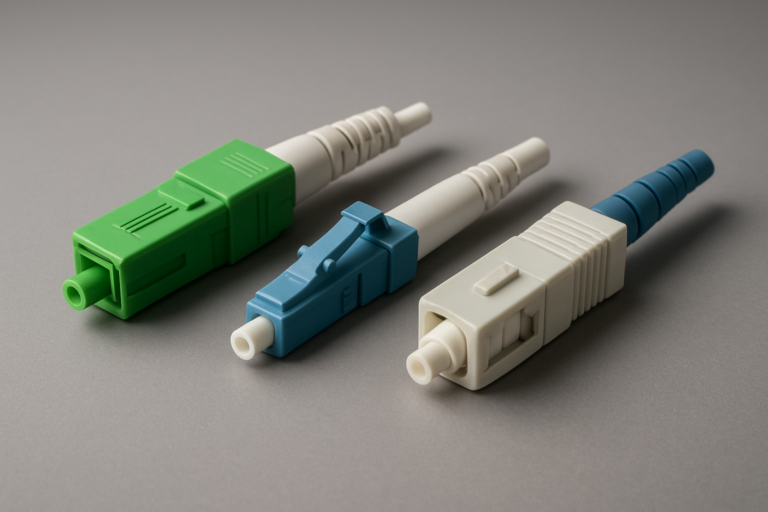
The LC vs SC vs E2000 connector comparison depends directly on your data centre’s specific requirements. While LC connectors with their 1.25mm ferrule enable maximum port density, E2000 systems with integrated dust caps offer highest reliability for critical connections.
- LC connector: Standard for high-density applications, up to 96 ports per 1RU
- SC connector: Robust backbone connections, 2.5mm ferrule
- E2000 connector: Automatic dust cap, ideal for sensitive environments
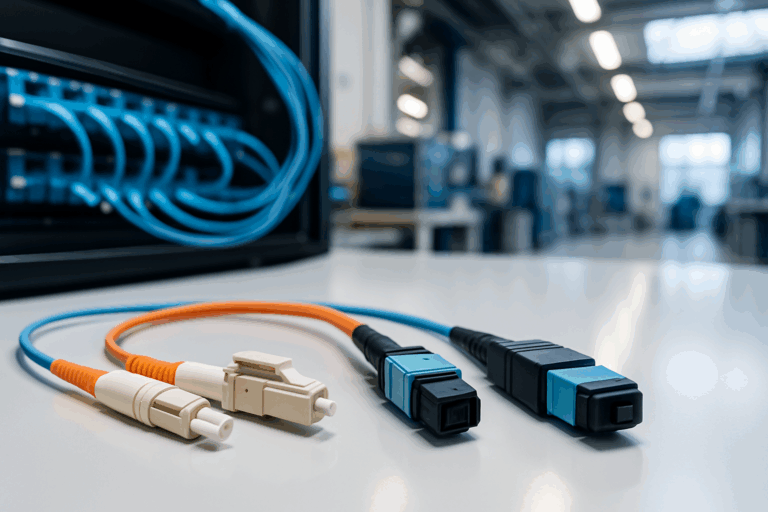
- MPO/MTP: 8–24 fibres per connector for 400G applications
Fiber Products Quality Promise: As an official Diamond partner and manufacturer, we produce modular splice systems in Europe. Benefit from Swiss precision and in-house manufacturing.
Technical specifications: The critical parameters for high-density splice modules
When selecting high-density splice modules for 288 fibres, precise technical requirements are essential. Attenuation values must be below 0.25 dB for single-mode and below 0.35 dB for multi-mode according to IEC 61300-3-4. Modern systems achieve typical values of 0.15 dB, providing additional margin for longer transmission spans.
Packing density is determined by the splice cassette architecture. High-quality systems use stacked cassettes with 12 or 24 fibres per level, with each cassette individually removable. This enables maintenance work without interrupting adjacent fibres.
| Parameter | Standard modules | High-density modules |
|---|---|---|
| Fibres per RU | 48–72 | 96 |
| Fibres per 3RU | 216 | 288 |
| Installation depth | 300–350mm | 250–300mm |
| Bend radius | 30mm standard | 15mm optimised |
| Standards compliance | EN 50173 | EN 50173 + ISO/IEC 11801 |
Cable management and airflow optimisation in high-density environments
An often underestimated aspect of splice modules for data centres is splice box integrated cable management. With 288 fibres in confined space, structured cable routing becomes a critical success factor. Modern systems feature multi-layer cable channels with 4mm, 5mm or 13mm diameters that not only maintain order but actively support cooling.
Thermal optimisation is achieved through perforated rear panels and side ventilation slots that support airflow according to the hot-aisle/cold-aisle principle. Testing shows that optimised high-density splice modules can improve cooling efficiency.
- Integrated cable routing rings every 50mm
- Colour-coded cassette systems per TIA-606-B
- Removable modules for front access
- Radius limiters to prevent overbending
- Equipotential bonding per EN 50310
Legacy system migration: The structured upgrade path
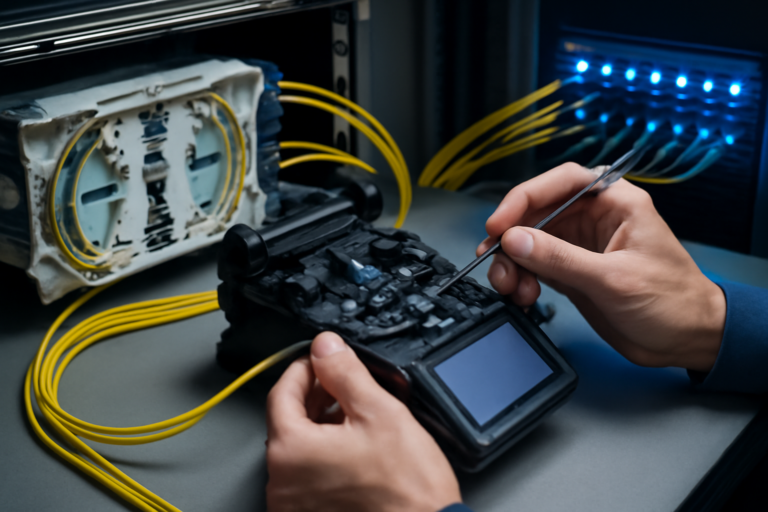
Many data centres face the challenge of migrating existing 48-fibre systems to modern high-density splice modules with 288 fibres. A structured migration path minimises downtime and protects existing investments.
Phase 1 begins with an inventory: documentation of all active connections, identification of unused capacity and planning of the new topology. Phase 2 involves parallel installation of the new modules, with critical connections switched at night or at weekends.
The Fiber Products SlimConnect series enables particularly efficient migration: thanks to the modular design, existing LC or SC connections can be transferred 1:1 to the new systems. The 5 years’ warranty protects your investment for the long term.
ROI calculation: When high-density systems pay off
Investment in a splice module for data centres with high port density pays for itself through several factors. At average rack costs of €1,000 per RU per year, a 288-fibre system saves at least 2 rack units compared to conventional solutions — equivalent to €2,000 annually.
- Rack space saved: 2–3 RU per 288 fibres
- Reduced cooling costs through optimised airflow
- Lower maintenance time through faster access
- Avoided replacement investments: Modular expansion instead of replacement
- Higher availability: Fewer connection points = fewer potential failures
FAQ: Common technical questions about high-density splice modules
What fibre types are suitable for 288-fibre systems?
Modern high-density splice modules support both single-mode (OS2) and multi-mode fibres (OM3/OM4/OM5). For data centres, we recommend OM4 fibres for spans up to 400m at 100G, or OM5 for extended wavelength-division multiplex applications.
How is documentation managed with 288 fibres?
Structured cabling per EN 50173 is essential. Modern systems use QR codes per module, digital documentation systems and colour-coded cassettes per TIA-606-B standard.
Can MPO connectors be integrated into high-density modules?
Yes, modular systems such as VarioConnect support MPO/MTP modules with 12 or 24 fibres. A single 7TE module can accommodate up to two MPO-12 connectors.
What bend radii must be maintained at high port density?
Despite high density, minimum bend radii of 15mm for single-mode and 30mm for multi-mode must be observed. High-quality modules feature integrated radius limiters.
How does port density affect attenuation?
With professional installation, attenuation remains below 0.25 dB per connection regardless of port density. Connector quality and expert termination are decisive.
Can existing patch cables be reused?
Yes, provided the connector types are compatible. Modular systems allow the reuse of existing LC, SC or E2000 patch cables without replacement.
Choosing the right splice module for data centres requires a holistic view of port density, modularity and future-proofing. With high-density splice modules for up to 288 fibres, you create the foundation for scalable, cost-effective data centre infrastructure. Contact our experts for bespoke advice on your specific requirements.
All modular fibre-optic components are available directly in the Fiber Products Shop — with 5 years’ manufacturer warranty.
Request expert guidance
Our experts will advise you on modular fibre-optic solutions for your specific application — fast, personal and without obligation.