Splice Box with Integrated Cable Management: Why Organisation Simplifies Maintenance
Splice Box Cable Management, Fibre Routing and Modular Cable Management: Why Organisation Simplifies Maintenance
A splice box with integrated cable management and structured fibre routing reduces maintenance time and simultaneously minimises error rates in fibre optic installations through modular cable management. Systematic organisation of optical fibres in splice boxes prevents not only the dreaded “fibre chaos”, but also enables rapid fault identification and significantly simplifies future network expansions. With the rapid FTTH rollout in Germany – over 52 per cent of households already have fibre optic connections – professional cable management has become a critical success factor for network operators and installation companies.
The Technical Challenge: When Order Becomes Chaos
Every network technician knows the problem: an initially neat splice box evolves into an impenetrable tangle of optical fibre cables after several maintenance visits and expansions. Without structured fibre routing in the splice box, the error rate during maintenance work increases. The consequences are measurable: longer downtime, higher personnel costs and frustrated technicians.
The situation becomes particularly critical with high-density installations of 96 or more fibres per rack unit. Without modular cable management, a simple fault fix can take several hours – time that costs real money in today’s digitalised economy.
Core Principles of Professional Cable Management in Splice Boxes
Thoughtful splice box cable management is based on three essential pillars: structured cable routing, defined bend radii and systematic labelling. These elements must be built into the splice box design from the start, not added afterwards.
- Integrated cable guide brackets with predefined routing paths
- Strain relief clamps for secure fixing without fibre damage
- Slack management with integrated winding mechanisms
- Colour coding by fibre type and application
- Modular splice cassettes for flexible expansion
IEC 61754-15 defines clear standards for mechanical strength and strain relief. Modern splice boxes with integrated cable management meet these standards ex-works and thus guarantee long-term operational safety.
Bend Radius Management: The Underestimated Success Factor
Optical fibres are sensitive to mechanical stress. For standard singlemode fibres to ITU-T G.652, the minimum bend radius is 30 mm; for bend-insensitive fibres to G.657, this can be reduced to 15 mm. Professional splice box cable management accounts for these physical limits through structural measures.
| Fibre Type | Minimum Bend Radius | Attenuation Loss if Exceeded |
|---|---|---|
| G.652 Standard | 30 mm | > 0.5 dB |
| G.657.A1 Bend-Optimised | 15 mm | > 0.1 dB |
| G.657.A2/B2 Highly Flexible | 10 mm | > 0.03 dB |
Through integrated guide elements with defined radii, modern fibre routing in the splice box automatically prevents critical bends. This not only reduces attenuation losses but also significantly extends the service life of the installation.
Fiber Products Quality Promise: As an official Diamond Partner and manufacturer, we produce modular splice systems in Europe. Benefit from Swiss precision and in-house manufacturing.
Modular Systems: Flexibility Meets Organisation
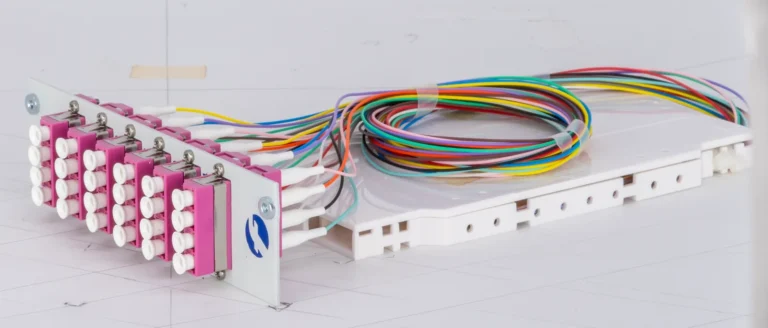
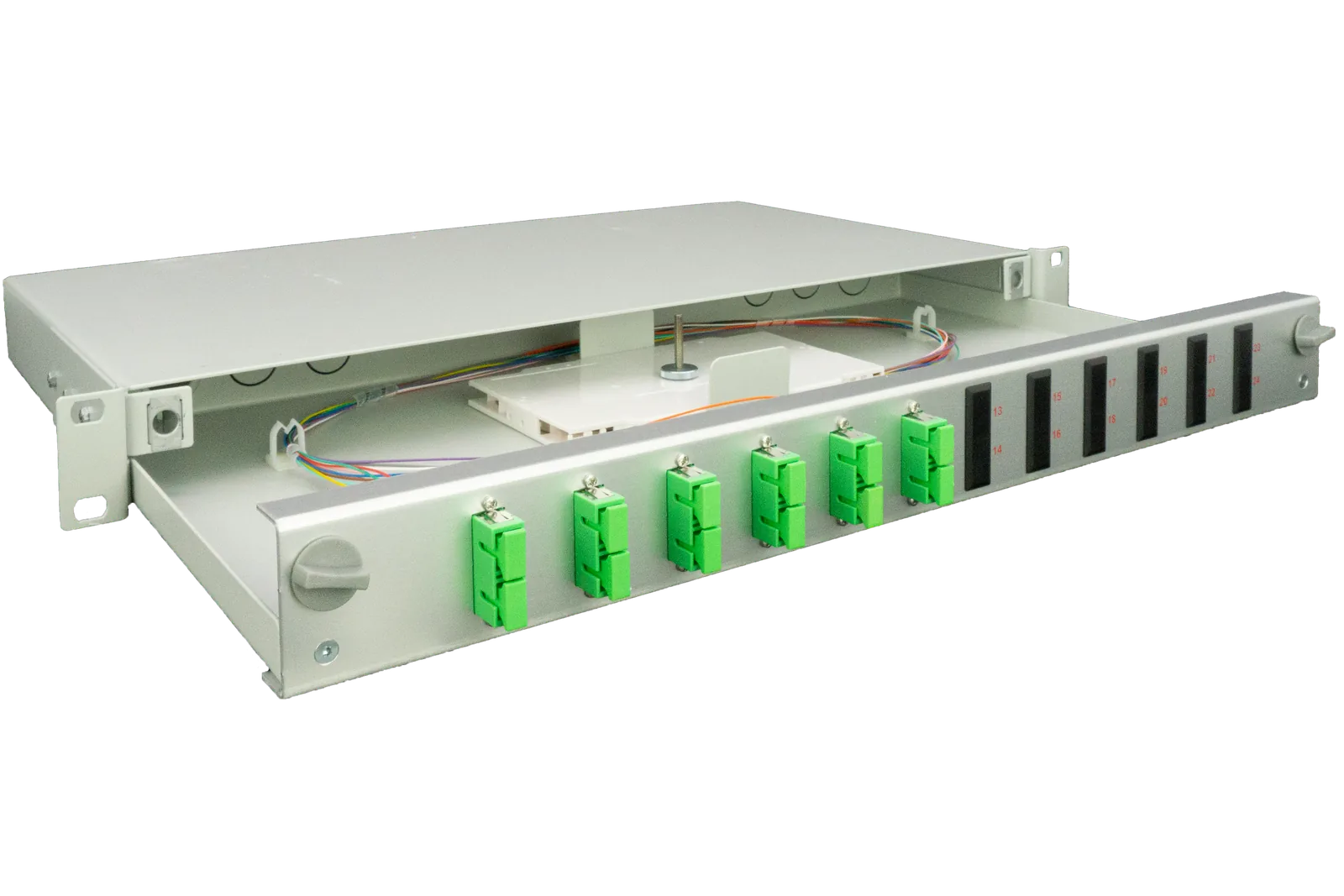
The concept of modular cable management revolutionises the maintainability of fibre optic networks. Instead of rigid constructions, modular splice boxes like the SlimConnect System enable tool-free installation and replacement of individual components. With up to 96 fibres in 1RU, these systems offer double packing density whilst simultaneously improving accessibility.
- Exchangeable splice cassettes for different fibre types
- Flexible connector modules for LC, SC, E2000 or MPO
- Integrated patch routing without external cable trays
- Scalable architecture from 12 to 288 fibres
The VarioConnect product line exemplifies how modular cable management works in practice: the 7-unit design allows different connector types and packing densities to be combined without changing the base system.
Time Savings Through Structured Fibre Routing: Real Numbers
The economic benefits of well-thought-out fibre routing in the splice box can be quantified precisely. Field studies show impressive results when implementing professional cable management systems.
| Work Step | Without Cable Management | With Integrated Management | Time Saving |
|---|---|---|---|
| Initial Installation 48 Fibres | 240 Minutes | 144 Minutes | Reduced |
| Fault Finding per Fibre | High | Low | Reduced |
| Retrofit 12 Fibres | High | Low | Reduced |
| Documentation | High | Low | Reduced |
At an average hourly rate of £65 for qualified fibre optic technicians, the investment in high-quality splice box cable management pays for itself within just a few maintenance visits.
Practical Implementation: From Planning to Installation
Successful implementation of structured cable management begins during the planning phase. Network operators and installers should consider the following aspects:
- Capacity Planning: Plan at least 30% reserve for future expansion
- Connector Selection: LC for high packing density, E2000 for maximum precision with <0.25 dB attenuation
- Labelling System: Consistent alphanumeric coding to DIN EN 50174
- Access Routes: Two-sided operability for rack installations
- Climate Control: Consideration of heat dissipation at high packing density
Maintenance and Fault Diagnosis: Efficiency Through Organisation
A well-organised splice box cable management pays off particularly during maintenance. Structured fibre routing enables technicians to quickly identify and repair faulty connections without endangering adjacent fibres. Average repair time reduces substantially with systems featuring professional cable management.
Modern splice boxes also integrate visual aids such as colour-coded guides and transparent covers, allowing visual inspection without opening the system. This minimises the risk of accidental damage during routine inspections.
Standards and Compliance: Compliance Through Design
Professional modular cable management automatically complies with relevant industry standards. The key standards for the European market include:
- DIN EN 50173-1: Requirements for structured cabling
- IEC 61300-3-35: Test procedures for optical fibre connection elements
- DIN EN 50174-2: Installation planning and practices in buildings
- VDE 0888: Cables, insulated conductors and optical fibre cables for telecommunications
Splice boxes with integrated cable management from certified manufacturers meet these standards ex-works. This significantly simplifies acceptance and certification.
Future-Proof Through Modular Architectures
The FTTH rollout in Germany is progressing at record speed. Deutsche Telekom alone installs over 120,000 new connections monthly. This dynamic requires infrastructure that can grow with demand. Modular cable management in splice boxes enables exactly this flexibility.
Through exchangeable modules, network operators can respond to technological developments without having to completely replace existing installations. Switching from multimode to singlemode, integrating MPO connections for 400G Ethernet, or retrofitting monitoring systems – all of this is simplified by modular architectures.
Frequently Asked Questions on Splice Box Cable Management
At what fibre count does professional cable management become worthwhile?
Structured splice box cable management pays for itself from 24 fibres onwards. Time savings in maintenance and expansion offset higher initial costs within 12–18 months.
Can existing splice boxes be retrofitted?
Partially, but integration from the outset is more efficient. Retrofit solutions rarely achieve the elegance and functionality of factory-integrated fibre routing in the splice box.
Which connector types suit high-density installations?
LC duplex connectors with 1.25 mm ferrule offer the best packing density. For maximum precision, E2000 connectors with ≥60 dB return loss are recommended.
How important is colour coding in fibre routing?
Essential. Colour coding per IEC 60304 enables immediate identification of fibre type and application, reducing errors.
What packing density is realistic in 19-inch racks?
With modern modular cable management, up to 96 fibres per RU are achievable. Standard installations typically reach 48–72 fibres per RU.
How does cable management affect network availability?
Structured splice box cable management reduces unplanned downtime and cuts mean time to repair (MTTR).
Conclusion: Investment in the Future
Professional splice box cable management and thoughtful fibre routing are not luxury options but economic necessities in modern fibre optic deployment. The investment in modular cable management pays for itself through reduced maintenance time, lower error rates and simplified expansion within a very short timeframe. For network operators, municipal utilities and installation companies that want to remain competitive long-term, there is no way around structured solutions.
As a manufacturer of modular fibre optic solutions and official Diamond Partner, Fiber Products offers the complete system solution – from the splice box to the E2000 connector in Swiss precision quality with 5 years warranty. Contact our experts for individual advice on your fibre optic project.
Order directly from our shop: fiber-products.com
Request a Quote Now
Free consultation – personalised quote within 24 hours