Fibre Optic in Wind Parks: Communications Infrastructure for Renewable Energy
Fibre optic wind parks, wind energy networks and SCADA wind farms form the technical backbone of modern wind parks – robust fibre optic infrastructure enables uninterrupted transmission of critical operational data between wind turbines, substations and control centres across distances of several kilometres. The particular environmental conditions in wind parks with electromagnetic interference, vibrations and temperature fluctuations from -40°C to +70°C require specialised fibre optic solutions with IP65 protection and vibration-resistant connectors to IEC 61754-15.
As energy operators and planners, you face the challenge of implementing a failsafe communications infrastructure that withstands harsh conditions in onshore and offshore wind parks. The choice of the right fibre optic components determines the availability of your SCADA systems and thus the profitability of the entire wind park.
Why Fibre Optic is the Only Future-Proof Solution for Wind Park Networks
The electromagnetic fields in wind turbines make copper cables unsuitable for data transmission. Fibre optic offers the only medium with complete EMC immunity and transmits control signals and measurement data at 10 Gbit/s without interference over distances of up to 40 kilometres.
- No influence from lightning strikes and ground loops
- Galvanic isolation between turbines and control centre
- Bandwidth reserves for future expansion
- Low weight for tower cabling (4 kg/km vs 40 kg/km for copper)
- No signal attenuation due to temperature fluctuations
Modern wind turbines generate a complex electromagnetic environment through their control systems, frequency converters and generators. Fibre optic cables are completely immune to these disturbances and guarantee uninterrupted communication between the SCADA system and turbine controller.
SCADA Architecture in Wind Parks: Redundant Ring Structures with Fibre Optic
The typical SCADA architecture of a wind park is based on redundant fibre optic ring structures with singlemode OS2 fibres. Each wind turbine has a local control unit connected to the park-wide network via two independent fibre optic paths.
| Network Level | Fibre Type | Transmission Rate | Typical Distance |
|---|---|---|---|
| Turbine Ring | OS2 Singlemode | 1-10 Gbit/s | 0.5-2 km |
| Park Backbone | OS2 Singlemode | 10-40 Gbit/s | 2-20 km |
| Control Centre Connection | OS2 Singlemode | 10-100 Gbit/s | 5-50 km |
| Tower Cabling | OM3/OM4 Multimode | 1-10 Gbit/s | 100-150 m |
The ring structure ensures that if one connection link fails, the system automatically switches to the alternative path. This self-healing function is essential for achieving the required availability of 99.5% in modern wind parks.
Outdoor Splice Boxes for Harsh Environmental Conditions
The distribution and consolidation of fibre optic runs occurs in specialised outdoor splice boxes that withstand the extreme conditions in wind parks. These boxes must not only be watertight to IP65, but also resist temperature fluctuations, UV radiation and mechanical loads.
- Robust enclosures made from glass-fibre reinforced plastic or stainless steel
- Integrated cable glands with strain relief
- Splice cassettes for up to 96 fibres
- Vibration-resistant mounting
- Temperature range -40°C to +70°C
Fiber Products Quality Promise: As an official Diamond Partner and manufacturer, we produce modular splice systems in Europe. Benefit from Swiss precision and in-house manufacturing.
For installation within the wind turbine tower, DIN rail-mounted systems have proven effective. These compact splice boxes can be integrated space-efficiently into existing control cabinets and accommodate 12 to 24 fibres per module.
Connectors for Wind Energy: LC-APC vs E2000-APC
The choice of the right connector is crucial for long-term stability of the fibre optic network. In wind parks, two connector types with APC polishing (Angled Physical Contact) dominate, both guaranteeing particularly low return loss of >60 dB.
| Property | LC-APC | E2000-APC |
|---|---|---|
| Insertion Loss | < 0.25 dB | < 0.15 dB |
| Return Loss | > 60 dB | > 65 dB |
| Shutter Cap | Optional | Integrated |
| Vibration Resistance | Good | Very Good |
| Packing Density | Very High | Medium |
The E2000 connector with its integrated shutter cap offers additional protection against contamination and is therefore particularly suitable for outdoor applications. Its higher mechanical stability makes it the first choice for vibration-critical environments.
Modular 19-Inch Systems for Wind Park Substations
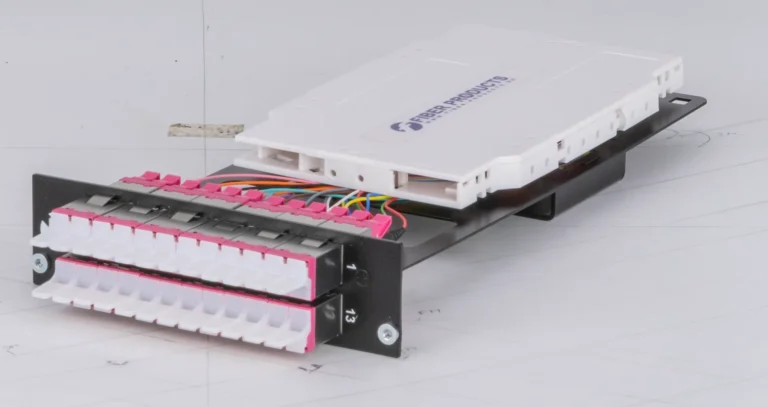
At the wind park substation, all fibre optic runs converge in centralised 19-inch distribution systems. High packing densities are required to achieve maximum flexibility in minimal space. Modern splice modules enable up to 96 fibres in 1U – double the density of conventional systems.
- SlimConnect Systems: 96 fibres in 1U
- VarioConnect Systems: up to 288 fibres in 3U
- Interchangeable front modules for LC, SC or E2000
- Integrated cable management with bend radius protection
- Colour coding to TIA-606-B for unambiguous identification
The modular design allows subsequent expansion without operational downtime. When a wind park with 50 turbines averaging 3.5 MW capacity fails, hourly losses amount to several thousand pounds – making fibre optic infrastructure readily maintainable at all times is therefore essential.
Condition Monitoring of Wind Turbines: Data Streams and Bandwidth Requirements
Modern wind turbines are equipped with numerous sensors that continuously capture operational data. A typical SCADA system processes more than 500 data points per turbine in real time – from wind speed via generator temperature to vibration measurements on rotor blades.
Bandwidth requirements are continuously increasing due to new technologies such as predictive maintenance and AI-driven optimisation. While 1 Gbit/s per turbine is sufficient today, forward-thinking operators are already planning for 10 Gbit/s for future requirements.
- SCADA baseline data: 10-50 Mbit/s continuously
- Video cameras: 25-100 Mbit/s per camera
- Vibration analysis: 100-500 Mbit/s on demand
- Thermography data: 50-200 Mbit/s periodically
- Reserves for expansion: minimum 50% of total capacity
Installation and Maintenance: Best Practices for Fibre Optic in Wind Parks
Installing fibre optic infrastructure in wind parks requires specialised knowledge and tools. Transitions between different environmental conditions are particularly critical – for example, from underground cable to tower cabling or from outdoor to indoor areas.
Underground cables must be laid at minimum 60 cm depth with additional mechanical protection. In areas subject to possible mechanical stress, protective conduit to DIN EN 61386 is mandatory. Documentation of all cable routes is important not only for later maintenance work but is also legally required.
- Use of outdoor cables with rodent and UV protection
- Blowing cables into conduit for mechanical relief
- Measurement protocol for each fibre (OTDR measurement)
- Redundant cable routing for critical connections
- Annual inspection of connectors
Standards and Regulations for Wind Park Fibre Optic Networks
Fibre optic infrastructure in wind parks is subject to strict standards and regulations. Beyond general telecommunications standards, specific requirements apply to the energy sector. IEC 61850, for example, defines communication standards for substations and is also relevant for wind parks.
For municipal utilities as operators of their own wind parks, compliance with VDE-AR-N 4110 is mandatory for network connection. This technical connection standard defines, among other things, requirements for remote control technology and thereby indirectly for fibre optic infrastructure.
| Standard | Application Area | Relevance for Wind Parks |
|---|---|---|
| IEC 61850 | Substation Communication | SCADA Protocols |
| IEC 61400-25 | Wind Turbine Communication | Data Models |
| EN 50173-1 | Building Cabling | Control Room |
| EN 50174-3 | Outdoor Cabling | Park Cabling |
| VDE-AR-N 4110 | Network Connection | Remote Control Technology |
Economics: ROI Through Professional Fibre Optic Infrastructure
Investment in high-quality fibre optic components pays for itself through reduced downtime and optimised turbine control within a few years. A wind park with 20 turbines at 3 MW each achieves annual output of approximately 150 GWh with optimal availability. Each additional percentage of availability corresponds to annual additional revenue of £200,000 to £300,000.
Fibre optic infrastructure typically accounts for only 0.5 to 1% of a wind park’s total investment but is crucial for operations management. Modular systems with 5 years warranty further reduce lifecycle costs through simplified maintenance and scalability.
Future Trends: 5G and Edge Computing in Wind Parks
The next generation of wind parks will combine classical fibre optic cabling with 5G technology for mobile maintenance teams and drone inspections. Fibre optic infrastructure forms the backbone for 5G base stations and edge computing units located directly in the wind park.
- Edge servers for AI-driven real-time analysis
- 5G connectivity for mobile maintenance teams
- Drone-based inspection with live data transmission
- Digital twins for predictive maintenance
- Blockchain-based energy certificates
These technologies require bandwidths in the range of 40 to 100 Gbit/s per wind park. Early planning of corresponding fibre reserves and selection of scalable splice systems are therefore essential for future-proof wind park infrastructure.
Practical Example: Offshore Wind Park with Redundant Fibre Optic Connection
An offshore wind park in the North Sea with 80 turbines demonstrates the complexity of modern fibre optic networks. Park cabling uses armoured submarine cables with <strong>48 singlemode fibres</strong> routed in loops through the wind turbines. Each turbine uses 4 fibres for redundant connection.
The substation platform features a high-density fibre optic management system with VarioConnect 3U modules for a total of 384 fibres. Land connection is via two independent submarine cables with 96 fibres each, of which currently only 24 fibres are occupied – reserves are planned for future expansion and additional services.
FAQ: Common Technical Questions About Fibre Optic in Wind Parks
Which fibre types are suitable for extreme temperature fluctuations in wind turbines?
For wind turbines, singlemode fibres OS2 to ITU-T G.652.D with extended temperature range are recommended. These fibres maintain their optical properties at -60°C to +85°C and are immune to hydrogen embrittlement. For short distances within the tower, OM3/OM4 multimode fibres can also be used.
How is lightning protection implemented for fibre optic installations in wind parks?
Optical fibres themselves conduct no electrical current and therefore require no direct lightning protection. However, protection of metallic cable armouring and strain reliefs is important. These must be grounded to IEC 62305. In practice, grounding clamps are installed every 500 metres as well as at all building entry points.
Which splicing methods are suitable for wind park installations?
For permanent connections, only fusion splicing with typical loss of <0.05 dB is permitted. Mechanical splices or connectors are only used for temporary test setups. Splices must be housed in sealed splice cassettes with heat-shrink tube protection.
How many spare fibres should be planned for initial installation?
Industry practice recommends at least 50% spare fibres in addition to current requirements. For a wind park with 20 turbines and 2 active fibres each, at least 60 fibres should be installed. The additional cost for extra fibres at initial installation is only approximately 5-10% of total cost.
What documentation requirements apply to wind park fibre optic networks?
Documentation must meet the requirements of EN 50174-1 and includes: cable route maps with GPS coordinates, OTDR measurement protocols for all fibres, splice plans with loss values, connector assignments and colour coding, and maintenance logs. For network connection, the network operator additionally requires a
Order directly from the shop: fiber-products.de
Request a Quote
Free consultation – personalised quote within 24 hours