Fibre Optic Storage and Inventory Management: Strategy for Network Operators
Fibre Optic Storage and Inventory Management: Strategy for Network Operators
Strategic stockpiling of fibre optic materials is a decisive competitive advantage in 2026: network operators with a well-thought-out storage concept for splice boxes and optical fibre cables protect their rollout projects against supply chain disruptions.
Regulatory pressure increases requirements for fibre optic storage
The concept published by the German Federal Network Agency on 19 January 2026 calls for a minimum FTTH coverage of 80 per cent to initiate copper switch-off. This requirement puts network operators under enormous time pressure. BREKO criticises this threshold as too high and recommends 85 per cent homes passed for realistic implementation timeframes.
For storage management, this means concretely: municipal utilities and regional network operators must significantly increase their stocks of splice boxes, modules and connectors. The average project duration is reduced from 18 to 12 months, while the required material quantities double.
- Increased demand for modular splice systems for flexible project adaptation
- Stockpiling of E2000 connectors for industrial applications
- Storage of different fibre types (OS2, OM3, OM4)
- Strategic reserve for MPO/MTP components in high-density projects
Optimal sizing of splice box inventory for different rollout areas
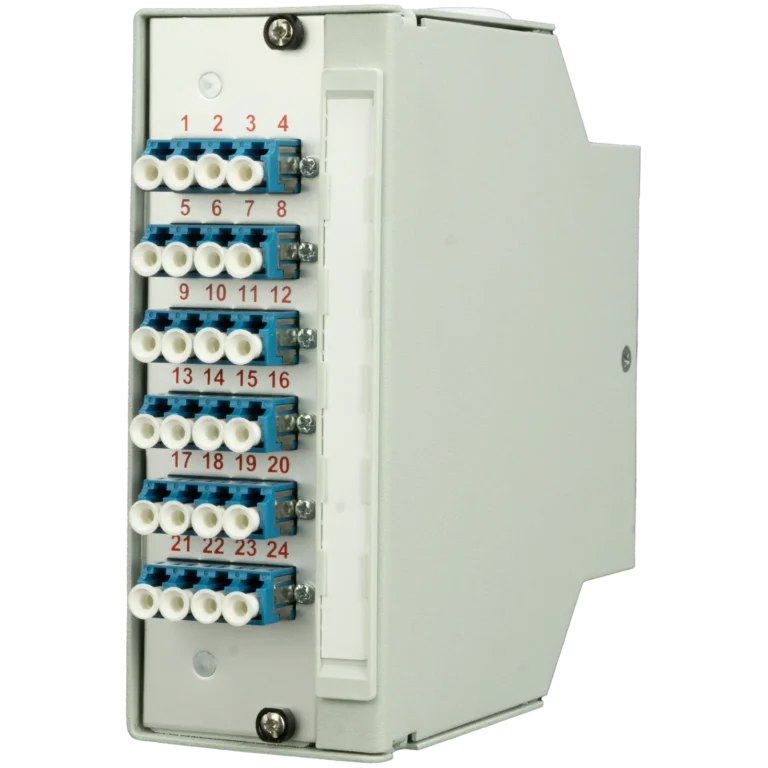
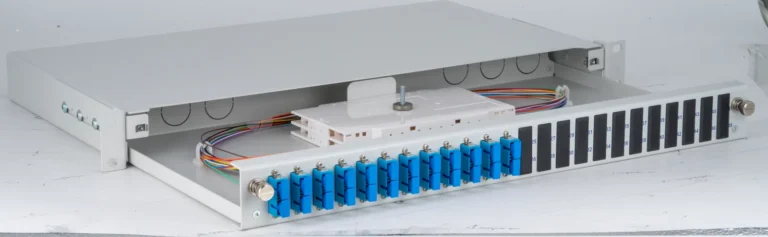
The correct sizing of splice box inventory depends largely on the rollout area. Urban areas require high-density systems with up to 96 fibres per 1U, while rural regions often manage with smaller units. Network operators should build their storage stocks according to a three-tier system.
| Rollout area | Recommended port density | Stock level | Replenishment time |
|---|---|---|---|
| Metropolitan area | 96 fibres/1U | 15–20% of annual requirement | 4–6 weeks |
| Mid-sized city | 48 fibres/1U | 10–15% of annual requirement | 3–4 weeks |
| Rural area | 24 fibres/1U | 5–10% of annual requirement | 2–3 weeks |
Modular systems reduce capital lock-up in optical fibre inventory for network operators
The shift to modular splice systems fundamentally transforms optical fibre inventory management for network operators. Instead of fully preconfigured boxes, modern network operators stock individual modules that can be combined for project-specific requirements. This strategy reduces capital lock-up while increasing flexibility.
A real-world example: a mid-sized municipal utility in Baden-Württemberg reduced its inventory from 450 to 280 units by switching to modular systems. Project implementation also accelerated by three weeks per construction phase.
- Reduction of storage space through more compact design
- Simplified inventory management through standardised module sizes
- Minimisation of excess stock through flexible configuration
- Optimised replenishment through uniform components
Technical requirements for professional fibre optic storage
Proper storage of fibre optic components requires specific environmental conditions. Temperature fluctuations, humidity and mechanical stress can compromise the quality of these sensitive components. DIN EN 61300-3-4 defines clear requirements for the storage of optical connectors.
Fiber Products quality promise: As an official Diamond Partner and manufacturer, we produce modular splice systems in Europe. Benefit from Swiss precision and in-house manufacturing.
Critical parameters for storage include a constant temperature between 5 and 35 degrees Celsius, relative humidity of maximum 85 per cent, and protection from direct sunlight. E2000 connectors in particular, with their precision ferrules, require dust-free environments.
Inventory management strategies for different connector types
The variety of connector types presents a particular challenge for storage management. While LC connectors dominate with a market share of 65 per cent, E2000 connectors are gaining importance in industrial environments. The right stocking strategy accounts for both trends.
| Connector type | Application | Recommended stock level | Special features |
|---|---|---|---|
| LC/APC | FTTH/Data centres | 40% of total stock | Green ferrule, < 0.25 dB loss |
| SC/APC | Distribution networks | 25% of total stock | Robust, IEC 61754-4 compliant |
| E2000/APC | Industry/Municipal utilities | 20% of total stock | Vibration-resistant, IP65 protected |
| MPO/MTP | High-density applications | 15% of total stock | 12/24 fibres, < 0.35 dB per channel |
Cost-benefit analysis for splice box inventory
The optimal stock level for splice box inventory can be determined through total cost of ownership analysis. This includes capital lock-up costs, storage costs and potential failure costs due to supply shortages. For a typical regional network operator with 50,000 households to connect, the following key figures result.
The capital lock-up with an average stock of 200 splice boxes at €450 each amounts to €90,000. At an interest rate of 4 per cent, this results in annual costs of €3,600. Against this are potential delay costs of €5,000 per day in the event of material shortage.
- Optimal safety stock: 6 weeks stock
- Maximum inventory turnover: 8 times per year
- Reorder point at 30 per cent of maximum stock
- Emergency reserve for critical projects: 10 per cent
Quality assurance and goods receiving in fibre optic storage
Systematic incoming goods inspection prevents costly failures in the field. Every delivery should be inspected according to a standardised test protocol. IEC 61300-3-35 defines the test procedures for connectors, while IEC 61753-1 specifies the performance requirements.
Modern network operators use digital goods receiving systems with QR code capture and automatic batch tracing. This enables complete traceability and simplifies warranty claims. For high-quality systems with 5 years warranty, documentation is particularly important.
Digitalisation of optical fibre inventory management for network operators
Digitalisation is revolutionising optical fibre inventory management for network operators through intelligent warehouse management systems. Modern inventory management software enables real-time stock monitoring, automatic reordering and precise consumption forecasting based on project data.
- Integration into ERP systems for seamless process execution
- Predictive analytics for forward-looking inventory planning
- Mobile apps for inventory and picking
- Automatic alerts when minimum stock levels are undercut
- Dashboards with KPIs for storage optimisation
A municipal network operator in North Rhine-Westphalia reduced stock-outs by 78 per cent and shortened average picking time from 45 to 12 minutes by implementing a digital warehouse management system.
Emergency concepts and crisis preparedness in fibre optic storage
Supply chain issues in recent years have underlined the importance of robust emergency concepts. Network operators should maintain extended safety stock for critical components such as 1U splice boxes. Diversification of suppliers and establishment of local partnerships minimise failure risks.
A proven concept is the division of storage into three levels: working stock for daily needs, reserve stock for large projects and emergency stock for critical repairs. This structure ensures 99.5 per cent availability even in unforeseen circumstances.
Sustainability in fibre optic storage
Sustainable inventory management is becoming increasingly important for fibre optic components. The use of modular systems reduces packaging waste. Reusable transport containers and optimised supply chains significantly reduce the carbon footprint.
- Preference for manufacturers with European production
- Use of recyclable packaging
- Optimisation of delivery frequencies to reduce transport
- Implementation of circular systems for packaging
FAQ: Frequently asked questions on fibre optic storage
What minimum stock levels should network operators maintain for splice boxes?
As a rule of thumb, minimum stock should cover 6 to 8 weeks based on average consumption rate. With modular systems such as SlimConnect with up to 96 fibres per 1U, this can be reduced to 4 weeks because flexible configuration prevents bottlenecks.
How long do fibre optic components last with proper storage?
When storage conditions in accordance with DIN EN 61300-3-4 are maintained, fibre optic components have a virtually unlimited shelf life. Only components with adhesives or seals are critical and should be checked after 5 to 7 years.
Which connector types should be prioritised for stocking?
Focus should be on LC/APC connectors (40% of stock), followed by SC/APC (25%) and E2000/APC (20%). For industrial applications, E2000 connectors are essential, while MPO/MTP is gaining importance for data centre cabling.
How is the optimal reorder point calculated?
The reorder point is calculated from average daily consumption multiplied by replenishment time plus safety stock. With a lead time of 4 weeks and daily consumption of 5 units, the reorder point is 140 units plus a 30 per cent safety buffer.
What documentation is required for storage management?
In addition to legally required batch documentation, test reports in accordance with IEC 61300-3-35, calibration certificates for measuring equipment and supplier evaluations should be systematically archived. For systems with manufacturer warranty, complete documentation is essential for warranty claims.
How can storage costs be reduced while maintaining availability?
Through the use of modular systems, digital stock optimisation and framework agreements with flexible call-off, storage costs can be reduced. Standardisation to a few high-quality system families additionally simplifies storage management.
Outlook: Fibre optic storage in 2027
With ongoing FTTH rollout and stricter regulatory requirements, the strategic importance of fibre optic storage, splice box inventory and optical fibre inventory management for network operators will continue to grow. Investments in intelligent storage systems and modular components pay off through reduced project timelines and optimised capital lock-up. Partnership with experienced manufacturers who offer both high-quality products and logistics expertise will become a decisive competitive advantage in the dynamic fibre optic market.
Request a quote
Do you have questions about our fibre optic solutions? Our expert team is happy to advise you – free of charge and without obligation.