Splice Module Comparison: LC vs SC vs E2000
The splice module comparison between LC, SC and E2000 fibre optic connectors shows: LC duplex connectors deliver the best compromise for modern data centres with higher port density, while SC connectors excel in robustness, and E2000 connectors provide the highest optical performance with < 0.25 dB insertion loss. The choice of the right connector type directly determines the packing density, scalability and future-proofing of your fibre optic infrastructure.
In data centres, IT managers face the challenge of optimising available rack space as bandwidth demands increase. The decision between different connector types directly affects the maximum fibre density per rack unit – a critical factor given average rack costs of €500–1,200 per RU in major colocation facilities.
Technical fundamentals: LC, SC and E2000 compared side-by-side
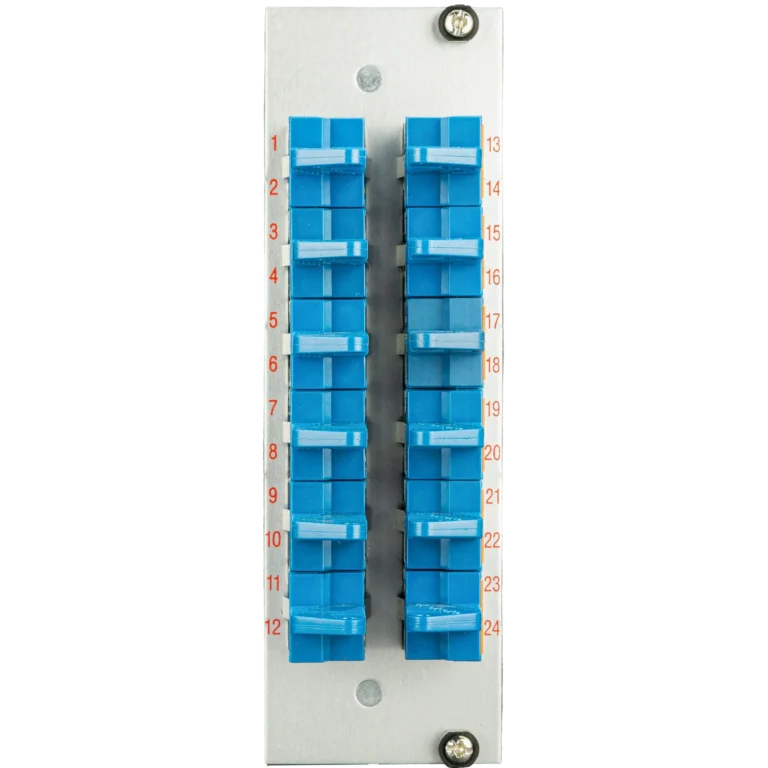
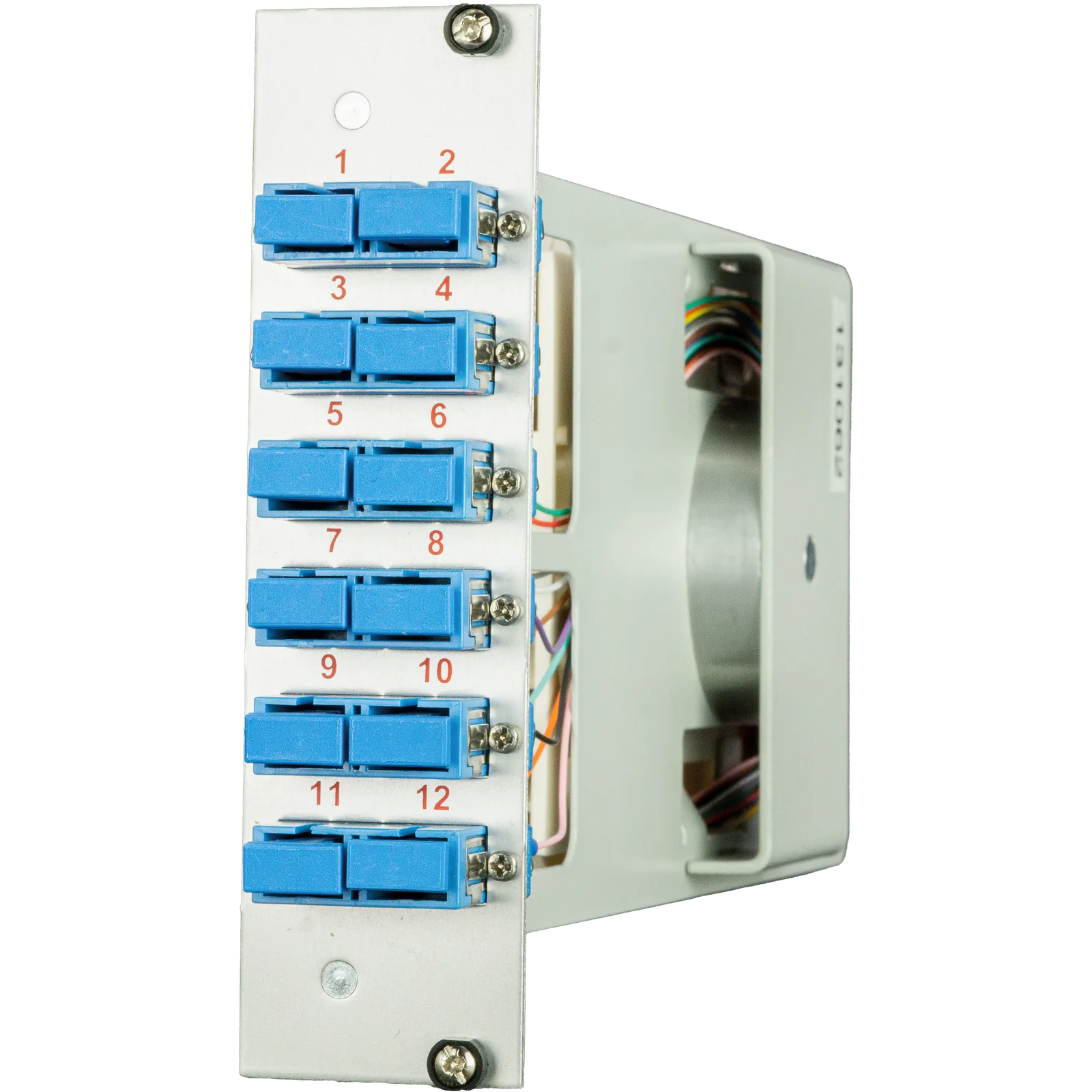
In the splice module comparison of LC, SC and E2000 fibre optic connectors, fundamental differences emerge in form factor and performance. The LC connector uses a 1.25 mm ferrule and requires only half the front panel area of an SC connector. SC connectors operate with a 2.5 mm ferrule and offer tool-free installation via push-pull mechanism.
E2000 connectors set the standard for safety-critical applications with an integrated protective shutter and laser safety class 1 protection. The automatic closure cap not only protects against contamination but also prevents eye damage from escaped laser radiation – a decisive advantage in high-density environments.
| Connector type | Ferrule diameter | Insertion loss (typ.) | Return loss APC | Ports per RU (max.) |
|---|---|---|---|---|
| LC duplex | 1.25 mm | < 0.3 dB | > 60 dB | 96 |
| SC simplex | 2.5 mm | < 0.3 dB | > 60 dB | 48 |
| E2000 APC | 2.5 mm | < 0.25 dB | > 65 dB | 36 |
Port density and scalability in data centre environments
Port density fundamentally determines the cost-effectiveness of modern splice modules in the data centre. With LC connectors, you achieve up to 96 fibres per rack unit – double that of SC connectors. This increased density not only reduces space requirements but also lowers total cost of ownership through more efficient rack utilisation.
- LC modules: Ideal for high-density applications with up to 4,608 fibres per 42RU rack
- SC modules: Proven in legacy installations and robust industrial environments
- E2000 modules: First choice for safety-critical backbone connections
- Hybrid modules: Combine different connector types for maximum flexibility
When migrating existing SC infrastructure to LC technology, conversion costs typically pay for themselves within 18–24 months through saved rack space. Modern modular systems allow phased migration without service interruptions.
Performance features for 40/100G Ethernet and beyond
The splice module comparison of LC, SC and E2000 fibre optic connectors shows significant differences at higher transmission rates. For 40/100G Ethernet connections, LC has become the de facto standard, while E2000 excels in single-mode applications with distances exceeding 40 kilometres.
The lower insertion loss of E2000 connectors (< 0.25 dB) enables longer link budgets and reduces the number of required signal repeaters. In backbone connections between data centres, this can lead to substantial cost savings.
Fiber Products quality promise: As an official Diamond partner and manufacturer, we produce modular splice systems in Europe. Benefit from Swiss precision engineering and in-house manufacturing.
Standards compliance and certifications to IEC standards
All three connector types comply with international standards, but differ in specific certifications. LC connectors conform to IEC 61754-20, SC connectors to IEC 61754-4 and E2000 systems to IEC 61754-15. For the European market, compliance with EN 50173-1 for structured cabling systems is additionally relevant.
- Grade B performance: All high-quality connectors achieve < 0.25 dB insertion loss
- Dust protection: IP65 certification for E2000 with protective shutter
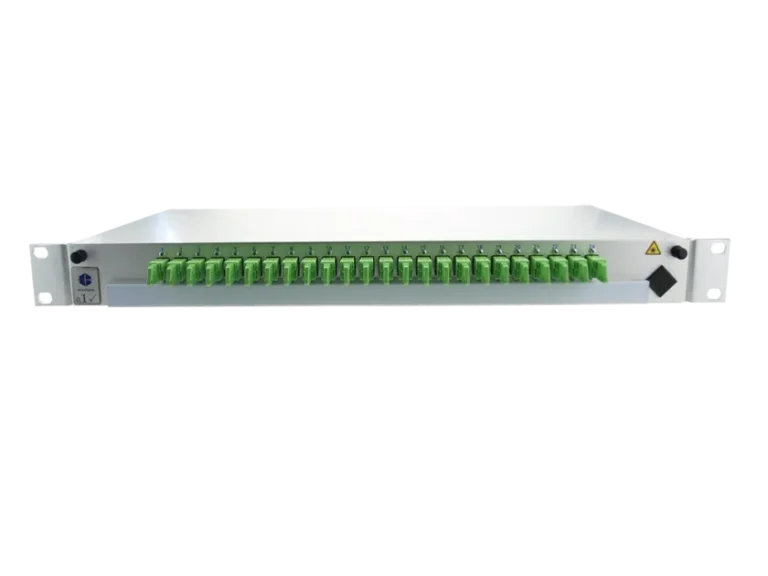
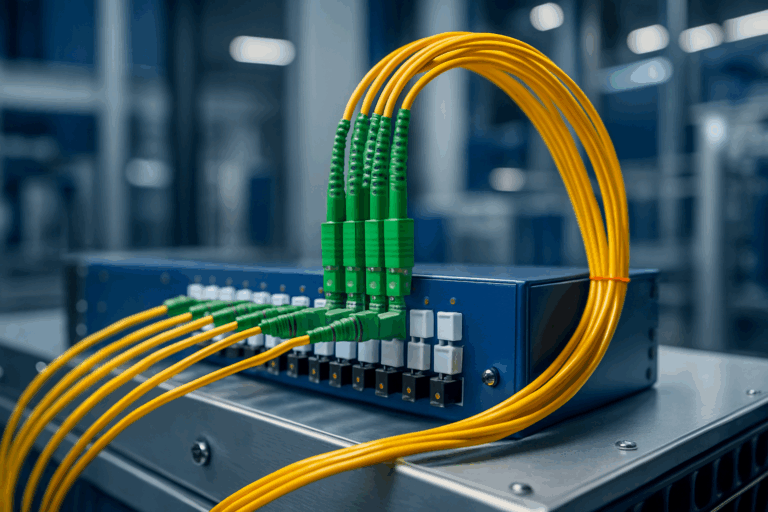
- Colour coding: Green for APC, blue for PC finish according to IEC standard
- Flame retardant: UL94-V0 for all housing components
Cost analysis: acquisition vs. operating costs in the data centre
When assessing total cost of ownership, the splice module comparison of LC, SC and E2000 fibre optic connectors reveals significant differences. LC connectors have higher unit costs per duplex adapter but pay for themselves through saved rack space. SC connectors cost less initially but require double the space.
| Cost item | LC system (96 ports/RU) | SC system (48 ports/RU) | E2000 system (36 ports/RU) |
|---|---|---|---|
| Rack space for 1,000 ports | 11 RU | 21 RU | 28 RU |
| Annual rack costs* | €6,600 | €12,600 | €16,800 |
*Based on average €600/RU/year in tier-3 data centres
Future-proofing and migration to 400G/800G Ethernet
The roadmap for future Ethernet standards clearly favours LC-based solutions. IEEE 802.3 specifies LC connectivity for 400GBASE-SR8 and forthcoming 800G standards, primarily in combination with MPO trunks. SC connectors remain limited to 10G, whilst E2000 has its primary future in telecom backbone networks.
Modular splice systems like Diamond-certified solutions enable a flexible mix of different connector types. This allows phased migration of existing SC installations to LC without complete rewiring requirements.
- LC roadmap: Full support through 800G Ethernet planned
- SC legacy: Continues to be relevant for 1G/10G connections
- E2000 niche: Specialisation in ultra-long-haul connections
- MPO integration: Breakout cassettes enable flexible port configurations
Maintenance and cleaning: practical aspects in data centre operations
Maintenance requirements differ significantly between connector types. E2000 with automatic protective shutter reduces cleaning intervals compared to open LC/SC systems. The smaller ferrule of LC connectors requires more precise cleaning tools, whilst SC connectors are more robust against mishandling.
Modern data centres employ preventive maintenance strategies with automated loss measurements. LC systems show an advantage through their higher connector density: testing 96 ports per RU occurs in a single work session, shortening maintenance windows.
Use cases: when each connector type is optimal
The choice between LC, SC and E2000 depends largely on the specific use case. For hyperscale data centres with tens of thousands of connections, LC is essential. Mid-sized data centres with mixed legacy and new installations benefit from modular systems supporting both standards.
- Core switching (spine-leaf): LC duplex for maximum port density
- Storage networks: LC or MPO for high bandwidth
- WAN connections: E2000 for maximum loss margin
- Management networks: SC for robust, infrequently plugged connections
- Disaster recovery sites: E2000 for secure dark fibre connections
Best practices for data centre implementation
Successful implementations follow proven design principles. Structuring into zones with uniform connector types reduces failure points. Planning should include 20–30% spare capacity for future expansion. Colour coding per TIA-606-B simplifies documentation and reduces wiring errors.
The use of pre-terminated modules reduces installation times compared to individual fibre splicing. Quality manufacturers supply their splice modules with factory measurement documentation, accelerating commissioning and simplifying troubleshooting.
FAQ: Frequently asked questions about splice module comparison LC SC E2000
Can I mix LC and SC connectors in one splice module?
Yes, modern modular systems like SlimConnect support hybrid configurations with different connector types in one housing. This enables flexible migration scenarios without complete rewiring.
What loss values are acceptable for 100G Ethernet?
For 100GBASE-SR4, IEEE 802.3 caps the channel insertion loss at 1.9 dB over 100 m of OM4 (1.8 dB over 70 m of OM3). The link runs on MPO-12 connections, and that 1.9 dB has to cover every connector and splice – the budget leaves no spare margin.
How do PC and APC finishes differ in practice?
APC uses an endface polished at an 8 degree angle; that geometry is specified in IEC 61755-3-2. In return-loss terms, IEC 61755-2-1 grades non-angled PC connections as grade 2 (>= 45 dB), grade 3 (>= 35 dB) or grade 4 (>= 26 dB), while grade 1 (>= 60 dB) is reserved for angled, physically contacting fibres specified in IEC 61755-2-2. APC is therefore standard wherever reflections are critical — PON, DWDM, RF video overlay; multimode connections use a flat PC finish.
Are E2000 connectors compatible with LC/SC?
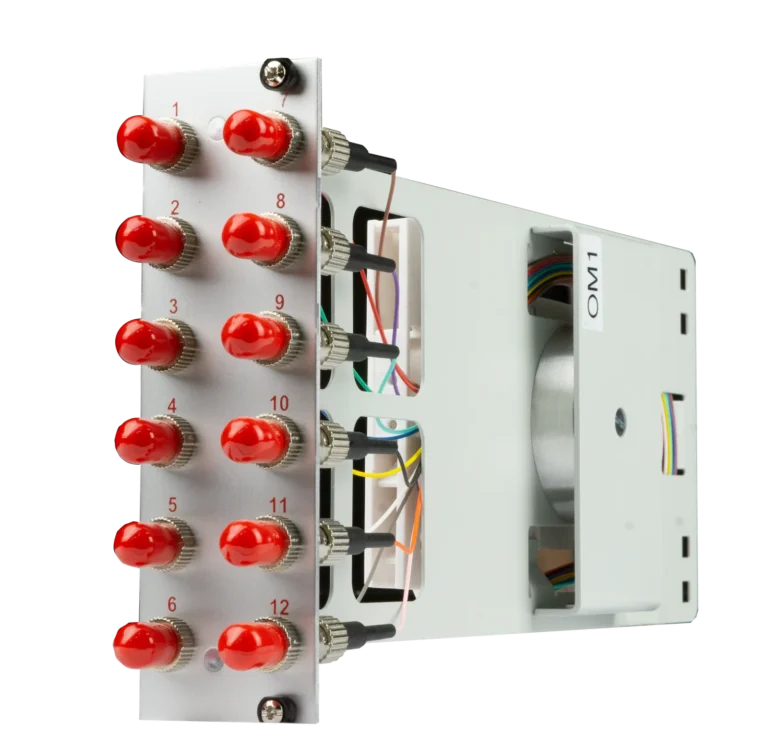
No, E2000 uses a proprietary bayonet closure system and is mechanically incompatible. Transitions occur via hybrid adapters or patch cables with different connector types.
What is the service life of the different connector types?
High-quality connectors achieve 500–1,000 mating cycles without measurable degradation. E2000 with protective shutter exhibits the best long-term stability, as the ferrule is protected from contamination.
How does connector choice affect cooling performance?
LC modules with higher packing density can restrict air circulation. Modern designs with optimised airflow fully compensate for this, however. SC modules offer better convection through larger spacing.
Conclusion: selecting the optimal connector for your data centre
The splice module comparison of LC, SC and E2000 fibre optic connectors shows: LC dominates through superior port density and future-proofing for high-speed Ethernet. SC remains relevant for robust legacy installations, whilst E2000 finds its niche in safety-critical long-haul connections. Your decision should be based on a holistic assessment of port density, performance requirements and total cost of ownership.
For modern data centres, a modular strategy is recommended: LC for new high-density areas, retention of functioning SC infrastructure, and E2000 for critical backbone connections. As a manufacturer of modular fibre optic solutions, Fiber Products offers the complete system range – from 1RU SlimConnect modules with up to 96 LC ports to VarioConnect systems for 288 fibres in 3RU, all with 5 years’ warranty and Swiss precision engineering through our official Diamond partnership.
All modular fibre optic components are available directly in the Fiber Products Shop – with 5 years’ manufacturer warranty.
Request expert consultation
Our experts advise you on modular fibre optic solutions for your specific application – quickly, personally and with no obligation.