Fibre Optic Networks for Care Facilities – High-Availability Solutions for Care Homes and Clinics
Fibre Optic Networks for Care Facilities – High-Availability Solutions for Care Homes and Clinics
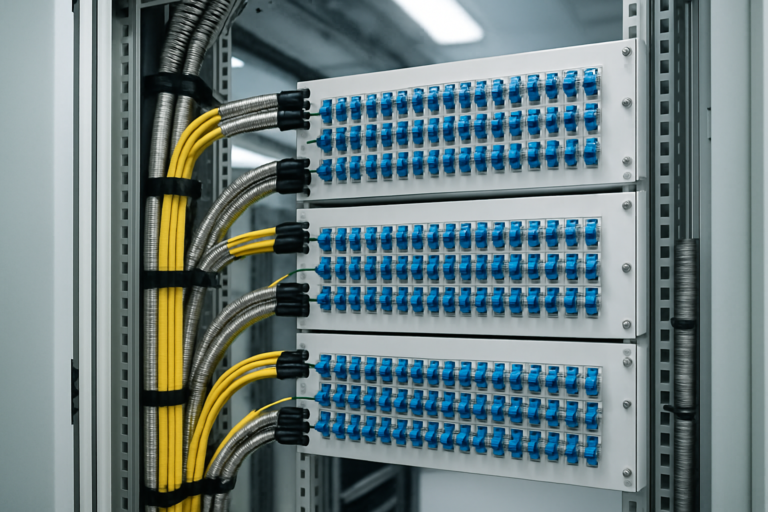
Fibre optic care homes, care facility networks and social institution optical fibre solutions deliver the technical foundation for digital health services with bandwidths up to 10 Gbit/s, availability above 99.9% and latency under 1ms for telemedical applications. Modular splice modules with up to 96 fibres in 1U enable space-saving installations in cramped server rooms of care facilities. The current EU Gigabit Infrastructure Regulation (GIA) mandates from February 2026 onwards that all new buildings must have fibre-ready infrastructure – a critical factor for modern social institutions.
Why fibre optics becomes essential in care facilities
Demographic change is driving digitalisation in healthcare. Care facilities today require symmetric bandwidths of at least 1 Gbit/s for electronic patient records, video consultations and networked medical technology. Traditional copper lines offering maximum 250 Mbit/s can no longer meet these demands.
| Application | Required bandwidth | Latency requirement | Availability |
|---|---|---|---|
| Telemedical HD video | 25–50 Mbit/s | < 20ms | 99.95% |
| Patient records system | 100–500 Mbit/s | < 50ms | 99.9% |
| Imaging diagnostics | 1–10 Gbit/s | < 5ms | 99.99% |
| Emergency call systems | 10–100 Mbit/s | < 10ms | 99.999% |
Deutsche Telekom reported in January 2026 record fibre deployment with 120,000 new fibre connections – a 40% increase year-on-year. Rural regions in particular, which host many social institutions, benefit from Gigabit subsidy 2.0 with €1.8 billion allocated for underserved areas.
Technical requirements for fibre optic networks in social institutions
Fibre optic care home and care facility networks require specialist technical solutions. Cabling must comply with IEC 61754-15 for connectors and EN 50173-1 for structured cabling. Critical systems require redundant fibre routing with automatic switchover within 50 milliseconds.
- Minimum 48 fibres for medium-sized facilities (50–100 beds)
- 96 to 144 fibres for large complexes over 100 beds
- Singlemode OS2 fibres to ITU-T G.652.D for future-proofing
- Loss budget below 0.25 dB per connector
- Bend-optimised fibres G.657.A2 for tight routing
Modular splice modules for space-saving installation
Social institution optical fibre installations benefit from modular splice systems that deliver maximum port density in minimal space. Modern 1U systems accommodate up to 96 fibres – double conventional splice boxes. Modular design enables future expansion without operational interruption.
Pre-configured modules reduce installation time. A complete 24-fibre module can be installed and documented in under one hour. For care facilities, this means minimal disruption to daily operations.
Fiber Products Quality Promise: As an official Diamond partner and manufacturer, we produce modular splice systems in Europe. Benefit from Swiss precision and in-house manufacturing.
Connector types and their applications in health institutions
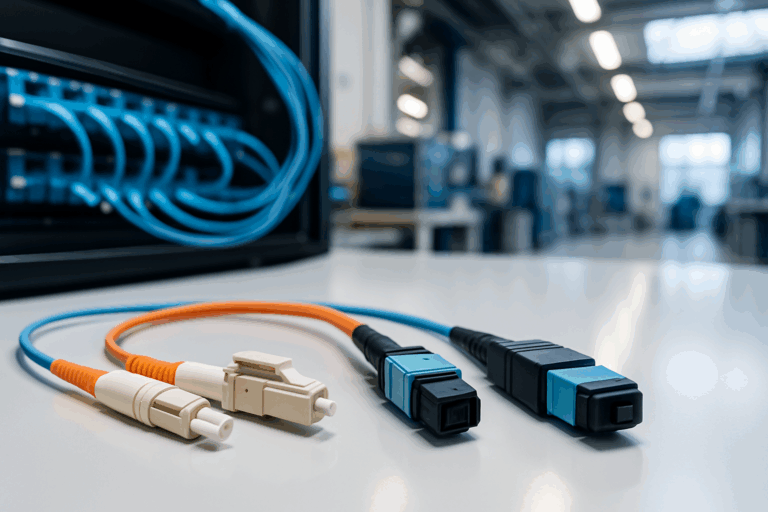
Selecting the right connector determines reliability and maintainability. Fibre optic care home installations increasingly use LC duplex for high port density and E2000 connectors for critical applications with integrated protective shutter.
| Connector type | Loss | Application area | Special feature |
|---|---|---|---|
| LC-APC | < 0.2 dB | Standard cabling | Highest port density |
| E2000-APC | < 0.15 dB | Critical systems | Integrated protective shutter |
| SC-APC | < 0.25 dB | Legacy networks | Robust construction |
| MPO/MTP | < 0.35 dB | Backbone | 12/24 fibres in parallel |
Network architecture for care facility networks
A structured fibre optic network in social institutions follows a three-tier model: primary cabling from the house handover point, secondary cabling between buildings and tertiary cabling to end devices. Primary cabling uses singlemode OS2 fibres with reserves of at least 30% for future expansion.
- Main distribution frame with 288 fibres for large complexes
- Floor distribution with 48–96 fibres depending on bed count
- Redundant fibre routing for emergency systems
- Separate networks for medical technology and administration
- Documentation per EN 50174-1 for operator obligations
Integration into existing infrastructure
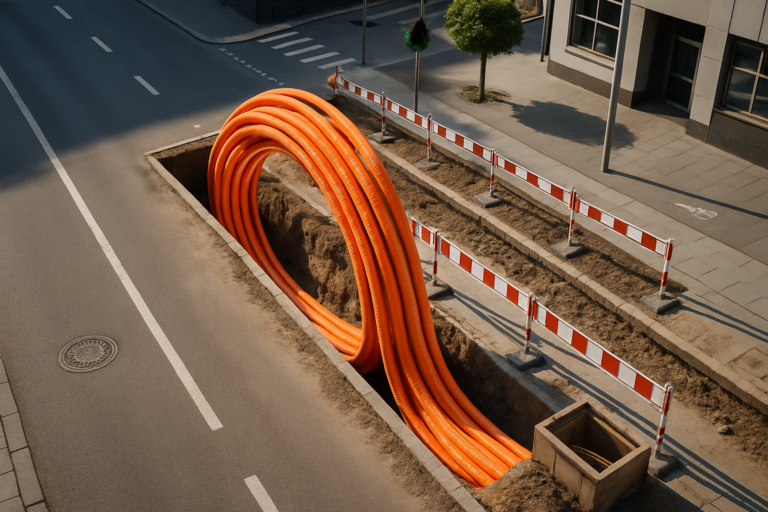
Modernising existing buildings requires careful planning. Fibre optic care home projects often utilise existing cable trays and ducts. In confined spaces, microcables with 2–4mm diameter and jet-tube installation are employed. New DIN rail-mount boxes enable integration into existing electrical distribution cabinets.
Municipal utilities as regional providers drive expansion forward. In Regensburg, for example, a new care home was connected directly to the municipal fibre optic network. Combining fibre optics with other utility lines reduces civil works costs.
Security and redundancy in social institution optical fibre networks
Care facilities require the highest availability for life-critical systems. Fibre optic networks offer inherent advantages: no electromagnetic interference, no ground loops and galvanic isolation. Redundancy via separate fibre routing and automatic switchover achieves 99.999% availability.
- Physically separated route diversity for A/B paths
- Automatic switchover in < 50ms
- Monitoring via OTDR systems (Optical Time Domain Reflectometry)
- Hardware-level encryption for data protection
- Uninterruptible power supply for active components
Economics and funding
Investment in fibre optic care home infrastructure pays for itself through reduced operating costs and new digital services. Gigabit subsidy 2.0 covers up to 90% of deployment costs in underserved areas. Additionally, non-profit operators benefit from dedicated funding programmes at state level.
Modular systems such as the SlimConnect 1U solution reduce space requirements and lower rack rental and cooling costs accordingly. The 5-year warranty on Fiber Products systems minimises unplanned maintenance expenses.
Future outlook for care facility networks
Digitalisation in healthcare is accelerating. Artificial intelligence for diagnostics, robotics in care and networked sensors require high-capacity fibre optic networks. With 400 Gbit/s transmission rates and wavelength multiplexing, modern optical fibres are future-ready for decades.
The EU Gigabit Infrastructure Regulation mandates from 2026 onwards that all new buildings must have fibre-ready infrastructure. Social institution optical networks become standard. Existing buildings must be upgraded by 2030 to remain competitive.
FAQ: Frequently asked questions about fibre optics in care facilities
What bandwidth does a care home with 100 beds require?
A care home with 100 beds needs at least 1 Gbit/s symmetric, ideally 10 Gbit/s with scaling capability. Plan for 10–20 Mbit/s per bed for standard applications plus reserve for peak loads and future services.
How long does installation of a fibre optic network take?
Pure installation with pre-configured modules takes 2–4 weeks for a 100-bed facility. Including planning and civil works, 3–6 months is realistic. Modular systems enable staged rollout without operational disruption.
Which connector types are suitable for medical devices?
E2000 connectors with automatic protective shutter prevent contamination and offer the highest loss values below 0.15 dB. For standard applications, LC-APC connectors with losses below 0.2 dB suffice.
Can existing cable routes be reused?
Yes, modern microcables with 2–4mm diameter fit into existing conduit. Jet-tube installation enables distances up to 2000 metres without intermediate vaults. Existing routes must be surveyed for suitability beforehand.
What funding is available for non-profit operators?
Gigabit subsidy 2.0 provides up to 90% of deployment costs. Additionally, federal states offer dedicated programmes for social institutions. Applications are submitted via the respective state broadband offices.
How is redundancy guaranteed?
Via redundant fibre routing on separate paths, automatic switchover in < 50ms and continuous monitoring with OTDR systems. Critical systems thus achieve 99.999% availability (maximum 5 minutes downtime per year).
Request a quote
Have questions about our fibre optic solutions? Our expert team is happy to advise you – free and with no obligation.