Civil Works Capacity for Fibre Rollout in Lower Saxony 2026
Civil Works Capacity for Fibre Rollout in Lower Saxony 2026
Lower Saxony faces one of northern Germany’s most ambitious fibre civil works programmes in 2026: whilst deployment demand is estimated at over 38,000 km, network operators and main contractors struggle with limited civil works capacity.
Lower Saxony’s Economy Minister Olaf Lies emphasises the urgency: “Our agreement demonstrates: we are open to alternative installation techniques, transparency in deployment and support enterprises and Lower Saxon municipalities in collaboration.” This partnership between the state and fibre providers establishes the foundation for accelerated approval procedures and optimised civil works capacity.
Current Deployment Status: Fibre Civil Works in Lower Saxony in Focus
Deutsche Glasfaser has already realised 450,000 fibre connections in Lower Saxony and is currently building a further 110,000 connections. In parallel, Vodafone, together with OXG, is launching a deployment offensive for 300,000 new FTTH connections by 2026 with an investment volume of €300 million.
- Current status: 75% of households with gigabit coverage
- Fibre coverage: 41% of households directly connected
- Target by 2026: over 80% gigabit, over 60% fibre optic
- Funded projects: €1 billion state investment
- Civil works capacity: bottlenecks in rural regions of the north
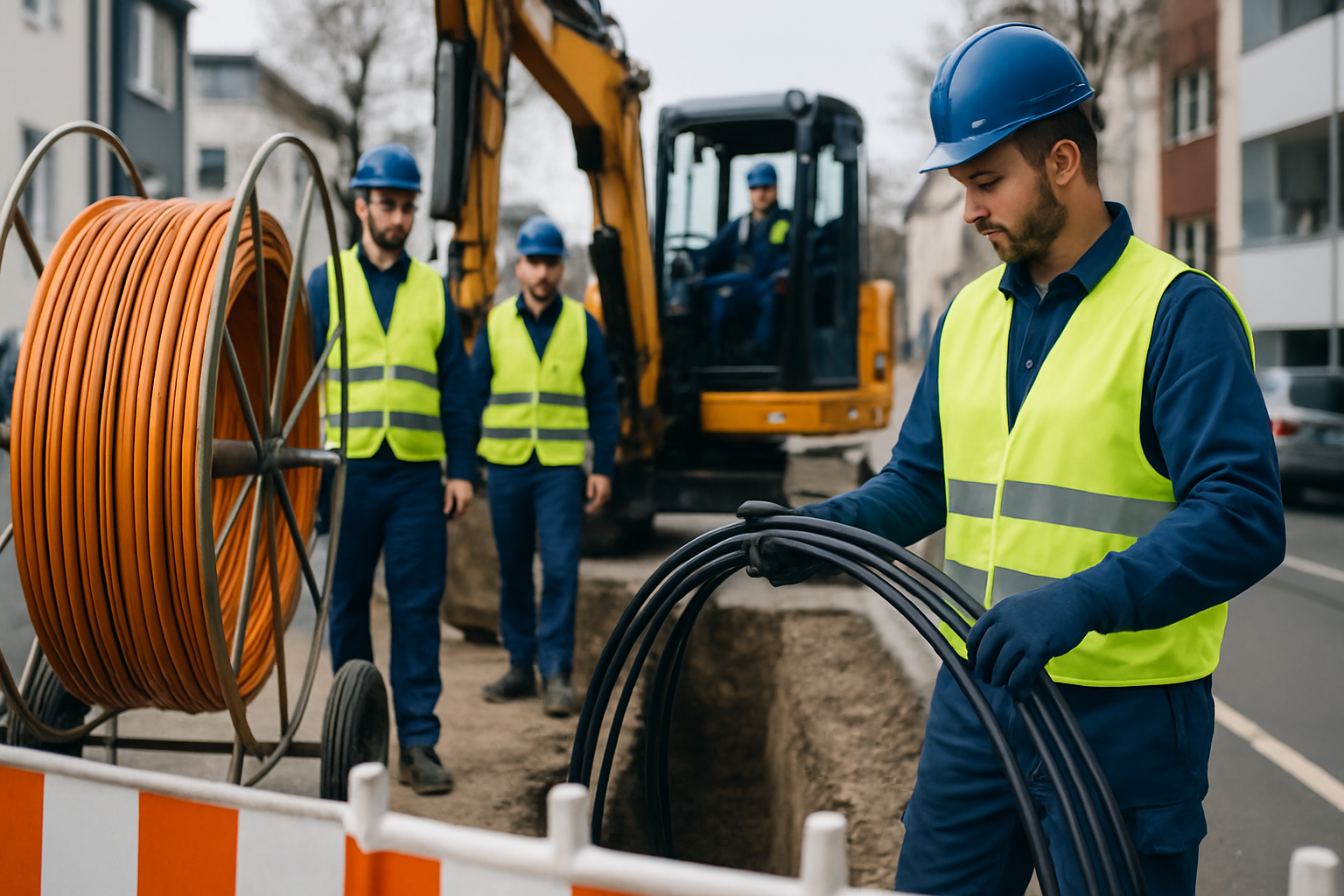
The challenge for civil works contractors lies in meeting these massive deployment targets with limited personnel and plant resources. Particularly in northern Lower Saxony, where rural structures dominate, fibre civil works in Eastern Germany requires specialised solutions.
Capacity Bottlenecks and Solution Strategies for Civil Works Contractors
Fibre civil works in Lower Saxony faces three central challenges: skilled labour shortage, lengthy approval procedures and simultaneous handling of multiple large-scale projects. Municipalities such as Lehrte with 105 kilometres of local network or Ettringen with construction start in April 2026 compete for the same civil works capacity.
| Region | Planned Connections 2026 | Civil Works Status | Challenge |
|---|---|---|---|
| Celle | 5,300 | Under construction until September 2026 | City centre densification |
| Merzen | 900 | Completed | Rural structure |
| Lehrte | 12,000 | 105 km local network planned | Large-scale deployment |
| Ettringen | 1,200 | Start April 2026 | Capacity bottleneck |
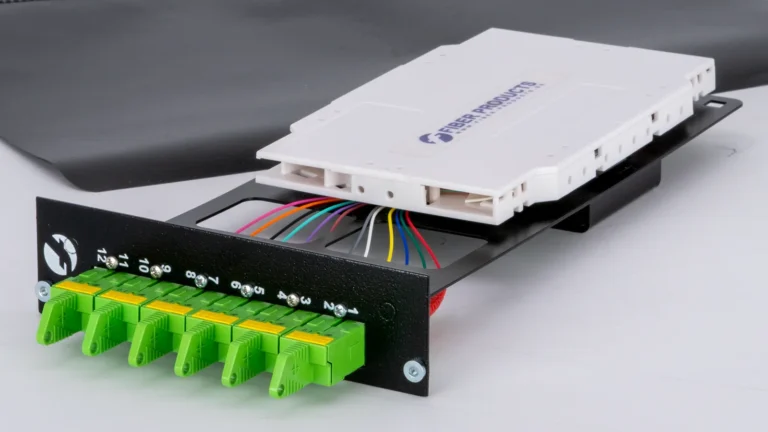
The solution lies in standardising construction procedures and deploying pre-terminated systems. Modern splice boxes with modular design reduce installation time and minimise disruptions in ongoing civil works operations.
Technical Requirements for Splice Systems in Civil Works
For efficient fibre civil works deployment in the north, splice systems must meet specific requirements. Extreme conditions in civil works – from vibrations caused by heavy machinery to moisture and temperature fluctuations – require robust, standards-compliant solutions conforming to IEC 61754-15 and IP65 protection class.
- Vibration-resistant design
- Temperature range: -40°C to +70°C
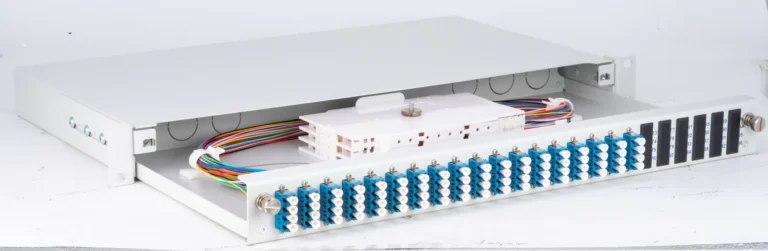
- Port density: up to 96 fibres in 1U
- Modular design for flexible expansion
- Pre-terminated cassettes for rapid installation
Fiber Products Quality Promise: As official Diamond partner and manufacturer, we produce modular splice systems in Europe. Benefit from Swiss precision and in-house manufacturing.
Modular Systems as Key to Capacity Optimisation
The modularity of modern splice systems transforms fibre civil works in Lower Saxony. Instead of rigid configurations, interchangeable modules enable demand-driven adaptation during construction phases. The SlimConnect system achieves 96 fibres in just 1U, doubling the packing density of conventional solutions.
This high packing density is particularly relevant for municipal utilities and local network operators who must optimally utilise limited space in distribution cabinets. The VarioConnect series offers larger installations up to 288 fibres in 3U whilst remaining fully modular and expandable.
| System Type | Rack Units | Max. Fibres | Application | Time Saving |
|---|---|---|---|---|
| SlimConnect | 1U | 96 | Distribution cabinets | 30% |
| VarioConnect | 3U | 288 | Main distribution frame | 25% |
| DIN Rail | Variable | 48 | Industrial equipment | 35% |
Connector Types and Standards Compliance for FTTH Deployment
Fibre civil works deployment in the north requires various connector types for different network levels. Whilst the backbone area frequently uses E2000-APC connectors with their high return loss of over 65 dB, LC-duplex and SC-simplex connections dominate at the subscriber access level.
- E2000 connector: Swiss precision, Diamond quality, ideal for main distribution frames
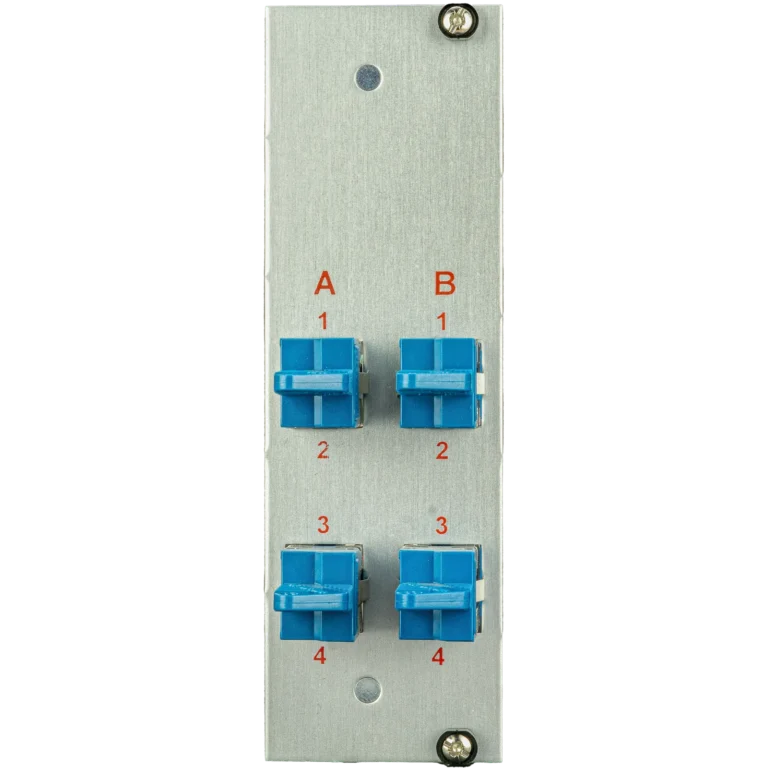
- LC-duplex: Space-saving, markedly less space requirement than SC
- SC-simplex: Robust standard solution, easy handling
- MPO/MTP: High-density cabling, 12/24 fibres per connector
- FC connector: Screw locking for vibration-stressed environments
The choice of the correct connector type directly impacts installation speed and therefore civil works capacity. Pre-terminated patch cables and factory-equipped modules significantly reduce on-site assembly time.
Cooperation Models between Municipalities and Network Operators
Successful fibre civil works in Lower Saxony is based on strategic partnerships. Lower Saxony has created a cooperation model through the “Gigapact” that brings together municipalities, network operators and civil works contractors. This pooling of resources and expertise is essential for achieving ambitious deployment targets.
Andreas Pfisterer, CEO of Deutsche Glasfaser, emphasises: “We stand by Lower Saxony and strengthen our close partnership with the Letter of Intent covering deployment to 950,000 households by end of 2027.” This long-term planning certainty enables civil works contractors to better plan capacity and invest in specialised equipment.
- Joint tenders by multiple municipalities
- Framework contracts with guaranteed minimum volumes
- Coordinated construction phases for resource optimisation
- Open-access models for multiple providers
- Standardised approval procedures
Quality Assurance and Documentation in Fibre Civil Works
Documentation during fibre civil works deployment in the north is critical for later maintenance and expansion. Modern splice systems with integrated labelling fields and QR-code-based documentation significantly simplify asset management. Each fibre is colour-coded per DIN VDE 0888 and recorded in digital asset plans.
Quality measurements per IEC 61280-4-1 ensure required transmission parameters. Attenuation values of under 0.25 dB per splice and connectors with less than 0.5 dB insertion loss are standard. Continuous documentation of these values is a prerequisite for acceptance by network operators.
Timeline and Milestones for 2026
Fibre civil works in Lower Saxony follows a tight schedule in 2026. The summer months are particularly critical, as optimal weather conditions enable maximum construction output. Civil works contractors must plan their capacity accordingly and order pre-terminated systems in good time.
| Quarter 2026 | Planned Connections | Focus Regions | Critical Factors |
|---|---|---|---|
| Q1 | 45,000 | Celle, Lehrte | Winter conditions |
| Q2 | 85,000 | Ettringen, North | Ettringen construction start |
| Q3 | 95,000 | Rural areas | Main construction phase |
| Q4 | 75,000 | Densified areas | Completion works |
Investment Calculation and Economic Viability of Modular Systems
Economic viability in fibre civil works deployment in the north depends substantially on system choice. Modular splice systems with 5-year warranty offer clear advantages over conventional solutions. The higher initial investment pays for itself through reduced installation times and lower operating costs within 18 to 24 months.
- Installation time reduction
- Space saving for the same fibre count
- Flexibility through subsequent expandability
- Reduced downtime through robust design
- Simplified inventory management through modular components
For smaller civil works contractors specialising in fibre deployment, investment in high-quality, modular systems represents a decisive competitive advantage. The ability to serve various projects with the same base system reduces capital tie-up and storage costs.
Future Perspectives for Fibre Civil Works in Lower Saxony
Forecasts for fibre deployment in Lower Saxony are promising. With planned 950,000 new connections by 2027 and investments exceeding €1.3 billion, a stable market emerges for specialised civil works contractors. Standardisation of procedures and deployment of modular splice systems will become the decisive success factor.
Michael Jungwirth from Vodafone emphasises: “The deployment partnership with Lower Saxony is unique. Together, we are firmly convinced that digitalisation will succeed swiftly and comprehensively.” This confidence is reflected in the ambitious deployment plans, which cannot be realised without optimised civil works capacity.
FAQ: Frequently Asked Questions on Fibre Civil Works Deployment in the North
What civil works capacity is needed in Lower Saxony in 2026?
For the planned 300,000 new FTTH connections, approximately 250 civil works crews with 4-6 staff each are required. Per crew, on average 50 metres of trench daily is realistic, whilst modern installation techniques such as trenching can increase performance to 150 metres.
How do modular splice systems reduce construction time?
Pre-terminated modules save installation time. Instead of splicing individual fibres on-site, finished cassettes are inserted. With modular systems, a technician manages 96 fibres in a fraction of the time required conventionally.
Which standards apply to splicing work in the FTTH sector?
Key standards are DIN VDE V 0888-100-1-1 for fibre colour coding, IEC 61073-1 for mechanical splices and fusion splice protectors, IEC 61300-3-4 for attenuation measurement, IEC 61300-3-35 for endface inspection and IEC 61754 for connector interfaces. Under IEC 61753-1, Grade 1 connectors (typically APC) require at least 60 dB return loss when mated.
How does skilled labour shortage impact civil works capacity?
The shortage of qualified fibre technicians delays projects by an average of 3–6 months. Solution approaches include training programmes, simplified installation systems and outsourcing termination work to workshops.
Which funding programmes support fibre deployment?
Lower Saxony invests €1 billion through the “Gigapact”. Additionally, federal funding from the Grey-Spot Programme offers up to 50 per cent subsidy rate. Municipalities can apply for supplementary EU funding.
How do E2000 and LC connectors differ in civil works deployment?
DIAMOND specifies the E-2000 with a return loss of at least 50 dB for PC and at least 70 dB for APC, and with a spring-loaded metal shutter for dust and laser-eye protection — the classic indoor central-office distribution frame connector. LC uses a 1.25 mm ferrule instead of the E-2000’s 2.5 mm, so it packs into a smaller footprint per port, which is what makes it the choice for high density in distribution cabinets. Note that the high return loss comes from the APC polish, not from the connector family.
Conclusion: Strategic Planning Secures Deployment Capacity
Fibre civil works in Lower Saxony and fibre deployment in the north face enormous challenges in 2026, which can only be overcome through intelligent solution approaches. The combination of standardised procedures, modular splice systems and strategic partnerships forms the foundation for successful implementation of ambitious deployment targets.
Civil works contractors who invest early in high-quality, modular systems and optimise their processes will benefit from the deployment boom. With the right technical equipment – from vibration-resistant splice boxes to pre-terminated Diamond-quality E2000 modules – projects can be delivered more efficiently and economically.
Request a Quote
Do you have questions about our fibre optic solutions? Our expert team is happy to advise you – free and without obligation.