Fibre Optic Smart Buildings: FTTH and Building Automation
Fibre Optic Smart Buildings, FTTH Buildings and KNX LAN Networking: The Technical Foundation of Intelligent Building Infrastructure
Smart building fibre optic systems, FTTH buildings and KNX LAN networking form the backbone of modern building automation through highly available optical fibre infrastructure with bandwidth up to 10 Gbit/s per fibre. Integration of fibre optic technology directly to individual floors enables, for the first time, complete convergence of building systems, security systems and communication networks on a unified optical platform.
The convergence of FTTH infrastructure with KNX building automation is transforming planning approaches for intelligent buildings across the DACH region. With 120,000 new fibre connections in January 2026 alone, rollout is accelerating rapidly – growth of 40 percent year-on-year.
Technical Architecture: From Building Entry to Floor Distribution
Structured fibre optic cabling in smart buildings follows a hierarchical design from central building entry through vertical conduits to floor distribution points. In the main distribution room, up to 288 fibres from different building areas converge, terminated via modular splice systems.
Modern splice boxes in 1U form factor enable packing densities of 96 fibres per rack unit – double conventional systems. This space efficiency is achieved through innovative cassette design with staggered splice trays, with each cassette accommodating 12 or 24 fibres.
- Central building entry with OS2 singlemode fibres for long-distance connection
- Vertical rise cables with universal cables up to 144 fibres
- Horizontal floor distribution via pre-terminated MPO/MTP connectors
- Tertiary cabling to end devices with LC-duplex or SC-simplex
- Redundant fibre routing for critical systems per DIN EN 50173-1
KNX Integration via Media Converters and Gateway Systems
Connection of KNX building automation to fibre optic infrastructure is achieved through specialized media converters that transparently transport the KNXnet/IP protocol over optical fibre. These converters operate with latencies below 1 ms, ensuring real-time capability for critical control functions.
| Converter Type | Data Rate | Range | Fibre Type |
|---|---|---|---|
| KNX-Fibre Basic | 9.6 kbit/s | up to 2 km | Multimode OM3 |
| KNX-Fibre Professional | 100 Mbit/s | up to 10 km | Singlemode OS2 |
| KNX-IP Gateway | 1 Gbit/s | up to 40 km | Singlemode OS2 |
Particularly in large building complexes, fibre optic connection overcomes the 1000-metre limitation of conventional KNX twisted-pair installations. Additionally, the need for line repeaters every 64 nodes is eliminated through the higher bandwidth of optical transmission.
Standards-Compliant Planning per DIN EN 50173 and ISO/IEC 11801
Planning of smart building fibre optic systems, FTTH buildings and KNX LAN networking is subject to strict regulatory requirements. DIN EN 50173-1 defines application-neutral cabling structure, whilst ISO/IEC 11801-6 establishes specific requirements for distributed building services.
Central planning parameters include optical attenuation calculation with maximum 0.35 dB/km for OS2 fibres at 1310 nm wavelength. Each connector adds a further 0.3 dB insertion loss, whilst splice connections exhibit less than 0.1 dB attenuation.
- Minimum bend radius 30 mm for standard cables per IEC 60794
- Tensile strength minimum 1000 N for installation cables
- Fire classification Cca-s1a,d1,a1 per Construction Products Regulation
- Service life minimum 25 years with proper installation
Fiber Products Quality Commitment: As an official Diamond Partner and manufacturer, we produce modular splice systems in Europe. Benefit from Swiss precision engineering and in-house manufacturing.
Splicing Technology and Termination in Building Applications
Proper termination of optical fibres in building applications requires precise splicing technology with attenuation values below 0.05 dB per connection. Modern fusion splicers with active core alignment achieve these values reproducibly even under construction site conditions.
For building automation, pre-terminated MPO connectors with 12 or 24 fibres have become standard. These enable tool-free plug-and-play installation with defined polarities per TIA-568-C.0. Termination occurs in modular splice cassettes that slide tool-free into 19-inch systems.
| Connector Type | Application | Attenuation | Return Loss |
|---|---|---|---|
| LC-APC | Building systems | < 0.25 dB | > 60 dB |
| SC-PC | Industrial environment | < 0.30 dB | > 50 dB |
| E2000-APC | High availability | < 0.20 dB | > 65 dB |
Redundancy and Fault Tolerance via Ring Topologies
Smart buildings require highly available network architectures with 99.999 percent availability for critical systems. Fibre optic ring topologies with automatic failover on fibre break ensure uninterrupted operation of security systems, access control and emergency lighting.
Implementation is achieved through self-healing rings per ITU-T G.8032 with switchover times below 50 ms. Each network node receives two counter-directional fibre paths that automatically reroute upon interruption. Modern Ethernet switches with integrated SFP modules natively support this topology.
- Primary ring for real-time building automation data
- Secondary ring for office communication and internet connectivity
- Physical separation of fibre routes across different fire compartments
- Monitoring of attenuation values with OTDR test instruments
- Automatic alerting on threshold exceedance
Energy Efficiency and Sustainability of Optical Networks
Fibre optic networks in smart buildings reduce building systems energy consumption significantly compared to copper-based systems. Passive optical signal transmission requires no amplification over distances to 20 kilometres, eliminating active network components.
Integration of power-over-fibre technology additionally enables sensor and actuator supply with up to 1 watt power over the optical fibre itself. This eliminates separate power supplies in hard-to-reach areas such as façades or roof structures.
Industrial Applications with DIN Rail Splice Boxes
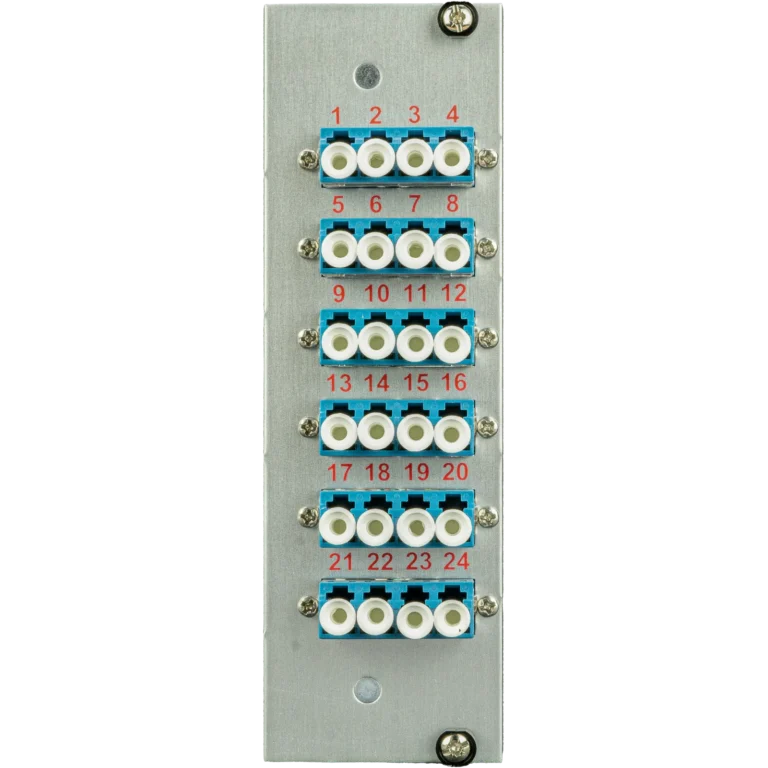
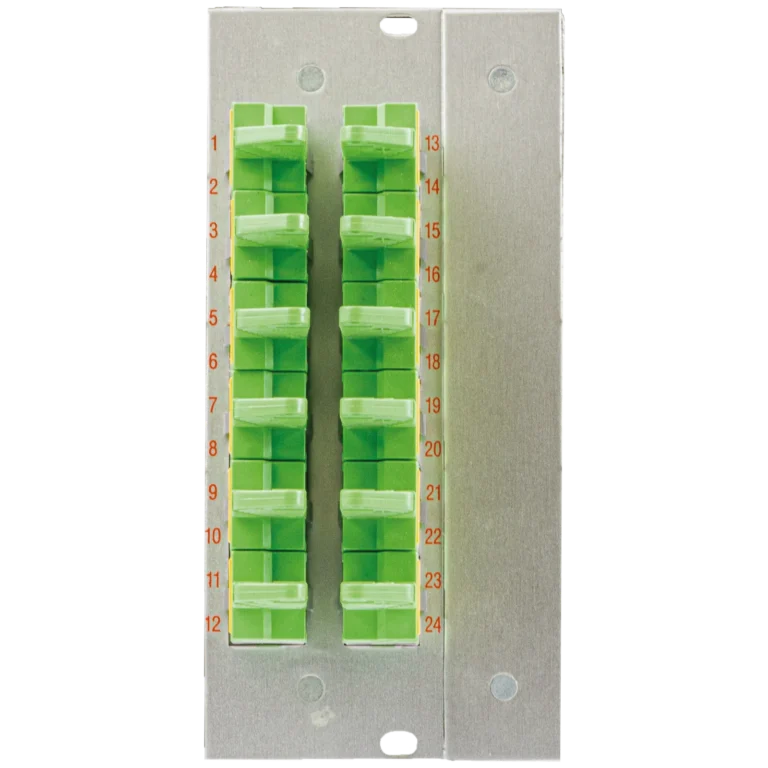
In industrially intensive building areas such as technical rooms or production halls, specialised DIN rail splice boxes per DIN EN 60715 are deployed. These compact housings with IP65 rating integrate seamlessly into existing control cabinets and withstand vibration to 5G acceleration.
Termination uses robust E2000 connectors with bayonet lock, maintaining stable attenuation values below 0.2 dB even under mechanical load. The metallic housings additionally provide electromagnetic shielding per IEC 61000-6-2 for interference-free operation in industrial environments.
- Compact form factor with 6 to 24 fibre outlets
- Integrated strain relief for cables up to 16 mm diameter
- Maintenance-free operation for minimum 20 years
- Temperature range -40°C to +85°C for extreme conditions
Documentation and Certification per Industry Standards
Comprehensive documentation of fibre optic infrastructure forms the foundation for efficient facility management. Each fibre is labelled with unique identification and recorded in digital asset databases. OTDR measurement records document the optical parameters of each route.
Acceptance testing is performed per IEC 61280-4-2 with attenuation and return loss measurements at 1310 nm and 1550 nm wavelengths. Modern test instruments generate automated test reports that can be directly imported into Building Information Modelling (BIM) systems.
| Measurement Parameter | Limit Value | Test Method | Standard |
|---|---|---|---|
| Insertion Loss | < 3.5 dB | LSPM | IEC 61280-4-2 |
| Return Loss | > 35 dB | OCWR | IEC 61300-3-6 |
| Chromatic Dispersion | < 17 ps/nm/km | Phase Measurement | ITU-T G.652 |
Cost-Effectiveness and Investment Security
Investment in smart building fibre optic systems, FTTH buildings and KNX LAN networking amortises through reduced operating costs within 5 to 7 years. The service life of passive infrastructure of minimum 25 years significantly exceeds the useful life of active components.
Modern buildings with comprehensive fibre optic infrastructure achieve 15 to 20 percent higher rental income in the commercial sector. Scalability to future bandwidth requirements without recabling ensures long-term competitive advantage in the property market.
Future Perspectives and Technological Development
Evolution to 400 Gbit/s and terabit-rate Ethernet will be achievable exclusively via fibre optic infrastructure. Wavelength division multiplexing (WDM) already enables transmission of 80 channels over a single fibre, allowing existing infrastructure to scale without physical expansion.
Integration of quantum communication for tamper-proof data transmission in critical infrastructure will likewise utilise existing singlemode fibres. Smart buildings with comprehensive fibre optic cabling are thus optimally prepared for future security requirements.
Practical Implementation: From Planning to Commissioning
Successful implementation of smart building fibre optic systems, FTTH buildings and KNX LAN networking requires systematic project management. Following detailed requirements analysis and dimensioning comes selection of appropriate system components. Modular splice systems such as SlimConnect enable flexible adaptation to specific building requirements with up to 96 fibres per rack unit.
- Requirements assessment and bandwidth planning with 30 percent reserve
- Route planning considering fire compartments
- Selection of standards-compliant components per CPR classification
- Professional installation by certified technicians
- Measurement-based acceptance testing and documentation
- Training of operational staff for maintenance and troubleshooting
FAQ: Frequently Asked Questions on Fibre Optics in Smart Buildings
How many fibres does a modern office building require per floor?
Dimensioning depends on workstations and building systems. As a guideline, 4 fibres per workstation plus 24 to 48 fibres for building automation, security systems and redundancy apply per floor.
What advantages does the E2000 connector offer compared to LC?
E2000 connectors achieve attenuation values below 0.2 dB with return loss above 65 dB through integrated dust cap and precision ferrule. The bayonet lock prevents accidental disconnection in vibration-prone environments.
Can existing KNX installations be migrated to fibre optic?
Yes, KNX media converters allow existing twisted-pair segments to be coupled via fibre optic. Migration occurs incrementally, with critical routes prioritised. Coexistence of both media is possible long-term.
How are active components powered in fibre optic networks?
Beyond conventional 230V supply, power-over-fibre is established for small consumers up to 1 watt. Alternatively, hybrid cables with optical fibres and copper conductors provide power up to 60 watts per IEEE 802.3bt.
What is the service life of splice connections in buildings?
Properly executed fusion splices show no measurable ageing over 25 years. Hermetic merging of fibre cores prevents moisture ingress and mechanical degradation. Regular OTDR measurements monitor long-term stability.
How are optical fibres protected from rodent damage?
Specialised rodent-protection cables with steel armour or glass yarn sheathing prevent damage. In critical areas, additional cable ducts of polyamide 12 with wall thicknesses above 3 mm are deployed.
Consistent implementation of smart building fibre optic systems, FTTH buildings and KNX LAN networking creates the technological foundation for buildings of the future. With modular splice systems in Swiss precision quality and the expertise of a Diamond Partner, demanding projects can be realised efficiently. Investment in high-quality fibre optic infrastructure pays dividends through future-proofing, energy efficiency and increased property values.
Order directly from shop: fiber-products.com
Request a Quote Today
Free consultation – personalised quote within 24 hours