SC/APC vs. SC/UPC: Which Connector is Right for Your FTTH Network
SC/APC vs. SC/UPC: Which Connector is Right for Your FTTH Network
When planning FTTH networks, the central question becomes: SC/APC connectors with their characteristic green colour and 8-degree angled polish are ideal for high-performance PON networks with splitters, while SC/UPC connectors (blue, flat polish) offer a cost-effective solution for short distances and indoor applications. The choice between these two connector types significantly impacts signal quality, maintenance requirements, and overall operating costs of your fibre-optic network.
In German FTTH deployments, SC/APC connectors with a return loss of at least 60 dB are increasingly dominant, whilst SC/UPC variants typically achieve around 50 dB. These technical differences directly affect network performance – particularly in the currently funded municipal deployment projects with high splitter ratios.
Technical Differences between SC/APC and SC/UPC
The fundamental difference lies in the ferrule polish: SC/UPC connectors feature a flat, right-angled end face, whilst SC/APC connectors incorporate an 8-degree angled polish. This seemingly small variation has substantial impacts on optical performance.
- Return loss SC/APC: Minimum 60 dB (Grade 1 per IEC 61755-1), often up to 65 dB; the SC interface itself is defined in IEC 61754-4
- Return loss SC/UPC: Typically 50 dB, maximum 55 dB
- Insertion loss: Both types achieve less than 0.3 dB with correct installation
- Repeatability: SC/APC demonstrates superior long-term stability through multiple mating cycles
The angled polish of SC/APC deflects reflected light away from the fibre core, minimising signal disturbances. For video transmission or high-bitrate applications over 10 Gbit/s, this advantage becomes particularly noticeable.
Applications and Use Cases in German FTTH Networks
In German PON-based FTTH deployments, SC/APC has become the de facto standard. In practice, clear usage patterns have emerged:
| Network Segment | Recommended Connector | Rationale | Typical Loss Values |
|---|---|---|---|
| Feeder Cable (Central Office to Distribution Point) | SC/APC | Long distances, high splitter ratios | < 0.25 dB |
| Drop Cable (Distribution Point to Customer) | SC/APC | Low-reflection transmission | < 0.3 dB |
| In-building Cabling | SC/UPC possible | Short distances, cost advantage | < 0.5 dB |
| Patch Panels in Distribution Cabinets | SC/APC | Modular systems, high density | < 0.2 dB |
Municipal utilities consistently implement SC/APC in their FTTH projects combined with modular splice modules. The higher initial investment compared to SC/UPC is recovered through reduced maintenance costs.
SC/APC vs. SC/UPC Connectors: Cost Factors and Economics
Compare real prices instead of list prices: 1U splice boxes with SC/APC or SC/UPC ports are available directly from us as the manufacturer – project pricing and volume discounts on request. → See SC splice boxes in the store · For a realistic budget per port, see our splice box cost guide
The total cost of ownership (TCO) of an FTTH network depends significantly on connector choice. Whilst SC/UPC appears cheaper initially, practical experience shows different results:
- Acquisition costs: SC/APC runs higher than SC/UPC
- Maintenance intervals: SC/APC requires fewer cleaning cycles
- Downtime: Reflection-related faults in SC/UPC systems incur higher service costs
- Lifespan: SC/APC connectors withstand up to 1000 mating cycles
Fiber Products Quality Commitment: As an official Diamond Partner and manufacturer, we produce modular splice modules in Europe. Benefit from Swiss precision and personal project consultation from our team.
Standards and Specifications for FTTH Connectors
German FTTH infrastructure follows international and European standards. The following standards apply to SC connectors:
IEC 61754-4 defines the mechanical interfaces for SC connectors, whilst IEC 61755-3-1 describes the optical interface for PC/UPC ferrules and IEC 61755-3-2 the interface for 8-degree angled APC ferrules; the associated performance grades are specified in IEC 61755-1 and the IEC 61755-2-x series.
- Mechanical durability: Minimum 500 mating cycles per IEC 61753-1
- Environmental conditions: −40°C to +75°C operating temperature
- Vibration resistance: Tested per IEC 61300-2-1
- Cable tensile strength: 100 N for standard patch cables
Installation and Handling: Practical Differences
Correct assembly determines the performance of both connector types. SC/APC requires particular care:
With SC/APC connectors, the orientation of the angled surface must be observed. Installation time for trained technicians is short per port, whilst SC/UPC takes slightly longer – paradoxically due to higher tolerances in end-face preparation.
| Work Step | SC/APC | SC/UPC |
|---|---|---|
| Fibre Preparation | 3 min | 4 min |
| Connector Assembly | 1.5 min | 2 min |
| Quality Control | 0.5 min | 1 min |
| Documentation | Identical | Identical |
Compatibility and Mixed Operation: Critical Error Sources
A common and costly mistake is mixing SC/APC and SC/UPC in a single network. Different end faces lead to direct pairing causing:
- Air gaps — insertion loss rises unpredictably and return loss collapses towards the glass-air Fresnel level
- Mechanical damage to ferrules
- Irreversible scratches on end faces
- Complete failure of the affected connection
Modern splice modules therefore feature colour-coded adapter housings: green for APC, blue for UPC. This prevents confusion during installation and subsequent maintenance.
FTTH Connectors in Modular Systems
The trend towards higher port densities makes modular systems essential. SC connectors are ideally suited to these requirements:
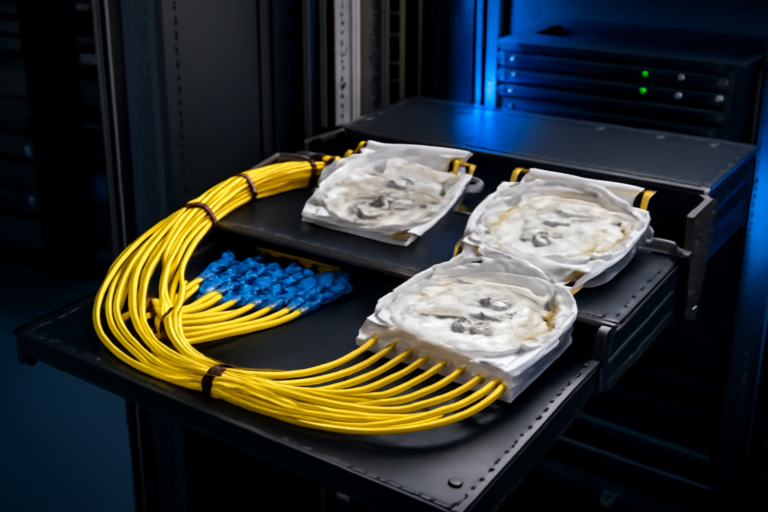
The SlimConnect series achieves up to 96 fibres in 1U – double the capacity of conventional systems. Through modular design, SC/APC and SC/UPC areas can be clearly separated and labelled. The 1U Splice Box offers complete flexibility for both connector types.
- Port density: 48 SC duplex or 96 SC simplex per 1U
- Module replacement: Tool-free in under 30 seconds
- Colour coding: Clear APC/UPC separation
- Cable management: Integrated strain relief for all fibre types
Quality Assurance and Measurement Technology
Connector verification uses different measurement methods. SC/APC requires specialist reference cables with matching angled polish.
Standard OTDR measurements show SC/APC typically at reflection values below −60 dB, whilst SC/UPC ranges from −45 to −50 dB. For acceptance testing per DIN EN 50173-1, both connector types are suitable provided limit values are met.
Future Perspectives for SC/APC and SC/UPC Connectors
The EU's Gigabit Strategy demands comprehensive fibre-optic coverage by 2030. For the German market, this means:
- The vast majority of new FTTH connections will use SC/APC
- Funding guidelines favour future-proof APC technology
- Modular systems are becoming the standard
- Integration of Diamond E2000 connectors for industrial applications
Municipal utilities and network operators increasingly implement SC/APC combined with pre-terminated solutions. Higher initial investment is offset by subsidy programmes and justified through lower operating costs.
Practical Tips for Optimal Connector Selection
The choice between SC/APC and SC/UPC depends on several factors. Based on experience from numerous FTTH projects, we recommend:
For PON networks with splitters, SC/APC is mandatory. Superior return loss prevents signal disturbances and ensures stable transmission rates. For point-to-point connections without active components, SC/UPC may be adequate.
| Application | Recommendation | Critical Parameters |
|---|---|---|
| GPON/XGS-PON | SC/APC mandatory | Return loss >60 dB |
| Point-to-Point Ethernet | SC/UPC possible | Distance <2 km |
| Broadcast/CATV | SC/APC required | Analogue signals sensitive |
| Industrial Networks | SC/APC recommended | Vibration resistance |
Integration into Existing Infrastructure
Migrating from SC/UPC to SC/APC in existing networks requires systematic planning. Transition points between standards are critical.
Hybrid adapters enable temporary solutions but introduce additional loss of 0.5 to 1 dB. Long-term, segment-by-segment conversion of complete network sections is recommended. Modern VarioConnect systems support both standards in parallel within separate modules.
Frequently Asked Questions about FTTH Connectors
Can I directly connect SC/APC and SC/UPC?
No. The 8° angled APC endface cannot make physical contact with a flat UPC endface, so an air gap forms: insertion loss rises unpredictably and return loss collapses towards the glass-air Fresnel level, and the point contact can scratch both endfaces. Note that standard SC adapter interfaces to IEC 61754-4 accept PC and APC plugs alike, so nothing mechanically prevents the mistake. Where a transition is unavoidable, use a hybrid patch cord with APC on one end and UPC on the other — an adapter cannot compensate for the polish geometry.
What cleaning agents are suitable for SC/APC connectors?
Use isopropanol-saturated cleaning sticks and lint-free cloths. The angled surface requires specialist cleaning cassettes with adjusted contact pressure. Automatic cleaning devices save time and guarantee consistent quality.
How do I identify defective SC connectors?
Visual inspection at 200× magnification reveals scratches, contamination or damage. Optical measurement detects elevated loss values. SC/APC connectors often show defects through sudden reflection increases.
What is the lifespan of SC connector pairs?
With proper handling, high-quality SC connectors achieve 500 to 1000 mating cycles. Lifespan depends on environmental conditions, cleaning intervals and mechanical stress.
Are SC connectors future-proof for 100 Gbit/s?
SC/APC connectors readily support transmission rates up to 100 Gbit/s with singlemode fibres. The physical connector properties are not the limiting factor for future bandwidth requirements.
How do I document SC connectors to meet standards?
Documentation and administration of cabling are covered by EN 50174-1, not by EN 50173. Its scope names installation specification, quality assurance documentation and procedures, documentation and administration, and operation and maintenance. In practice: record what identifies each connection — connector type and polish, the acceptance measurement and when it was installed — and keep the records current for the life of the installation. The standard sets out what has to be recorded, not which system you keep it in.
Related product
F4P Splice Box 1 U
LC, SC, E-2000 and ST adapters · as an empty housing, equipped or ready to splice · housing in RAL 7035 grey or RAL 9005 black · Made in Europe
Conclusion: The Right Choice for Your FTTH Project
The SC/APC vs. SC/UPC comparison demonstrates clear advantages for FTTH connectors with angled polish in modern fibre-optic networks. The higher initial investment is recovered through superior signal quality and reduced maintenance costs.
For future-proof FTTH infrastructure, there is no alternative to SC/APC. Combined with modular splice systems such as SlimConnect or VarioConnect, flexibility and port density are maximised. As a manufacturer and Diamond Partner, Fiber Products supplies the complete system solution for your FTTH project.
Contact our fibre-optic experts for individual consultation on your FTTH project and benefit from our extensive experience in the German market.
Request a Quote
Do you have questions about our fibre-optic solutions? Our expert team is happy to advise you – free and without obligation.