Port density fiber optics vs. ease of maintenance: The optimal compromise for professional systems
Maximizing port density fiber is often in direct conflict with practical maintenance requirements. While data center planners want to use every available millimeter for additional connections, technicians must be able to maintain, expand and repair these systems on a daily basis in the event of faults. This fundamental trade-off between theoretical capacity and practical manageability determines the success or failure of high-density projects.
Modern modular systems such as VarioConnect and SlimConnect show that intelligent design can successfully master this balancing act: 288 fibers on 3U with simultaneous tool-free maintenance are not mutually exclusive opposites, but the result of well thought-out system architecture. The art of optimum fiber optic port density lies in achieving maximum packing density without sacrificing accessibility, clarity and service-friendliness.
For operators of critical infrastructures, the right compromise between port density fiber optics and ease of maintenance means the difference between predictable maintenance windows and costly emergency deployments. Fiber optic solutions for data centers require this balance in particular.
The conflict of objectives: space saving vs. accessibility
Maximum port density fiber optics aims to use every available cubic centimeter of rack space for fiber optic connections. This approach inevitably leads to extremely compact designs with minimal distances between components, dense cable bundles and multi-layer arrangements. The benefits are obvious: reduced rack costs, reduced space requirements and maximum capacity utilization.
Maintenance reality vs. design philosophy
The reality of maintenance confronts this design philosophy with practical challenges: Individual fibers must be able to be identified, reached and worked on without disturbing other connections. Technicians need sufficient space for tools, measuring devices and hand movements. Lack of accessibility leads to extended service times and increased risk of errors.
Time pressure exacerbates this conflict considerably: in critical fault situations, it must be possible to carry out repairs quickly and safely. Complex disassembly sequences or hard-to-reach components can turn a simple fiber problem into a breakdown lasting hours. The apparent space saving then turns into significantly higher operating costs.
Personnel qualification as a factor
Personnel qualifications influence the ease of maintenance requirements: While experienced specialists can also work in complex environments, standardized maintenance procedures require intuitive operating concepts. Increasing staff turnover reinforces the importance of self-explanatory system architectures for optimum fiber optic port density.
Fiber optic solutions for installers must take these realities into particular account.
Effects of high port density on maintenance processes
Extended access times are the direct result of overly dense installations: What can be done in minutes in conventional systems can take hours with extremely high port density fiber. Access to a single fiber may require the removal of multiple cassettes or the temporary rerouting of other connections.
Disproportionately increasing error risks
The risk of errors increases disproportionately with the packing density: dense cable bundles increase the likelihood of mix-ups, while tight working conditions can lead to mechanical damage. An accidentally pulled cable can affect dozens of other connections in high-density environments.
Statistical evaluations show that the error rate for maintenance work increases exponentially from a certain fiber optic port density. This data must be taken into account when planning the system.
Documentation and identification problems
Documentation problems are dramatically exacerbated with high port densities: identifying individual connections becomes a time-consuming puzzle when hundreds of similar cables are routed in a confined space. Incomplete or outdated documentation leads to considerable problems in high-density installations.
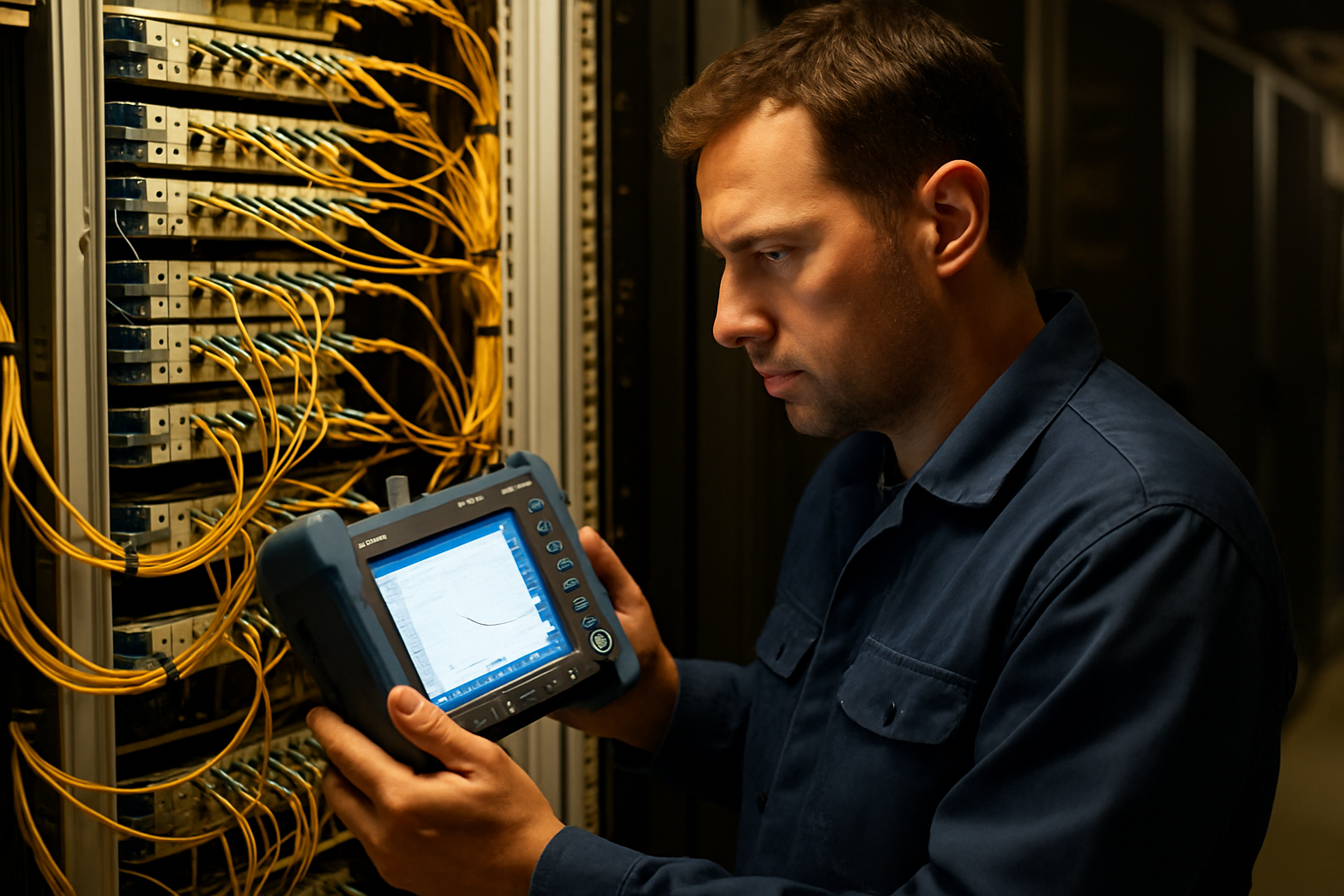
Tool accessibility significantly limits maintenance options: Measuring devices, cleaning utensils and assembly tools require sufficient space for proper use. OTDR measurements or end face inspections can become impossible in extremely dense environments.
Modular approaches as a compromise solution
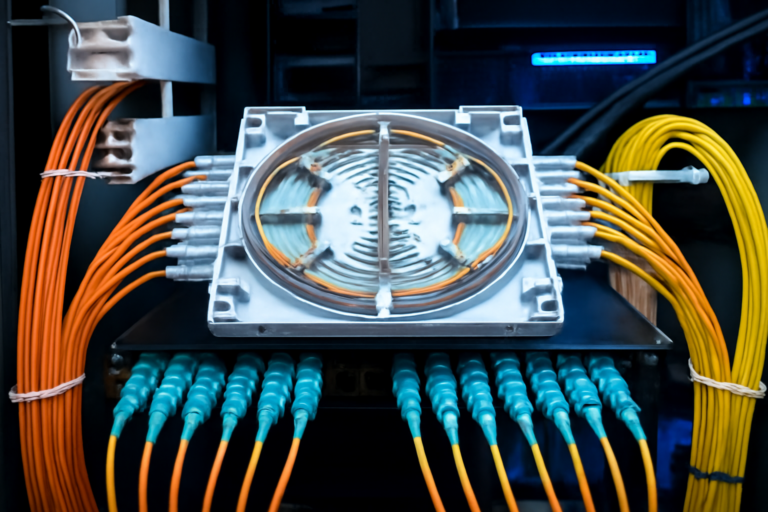
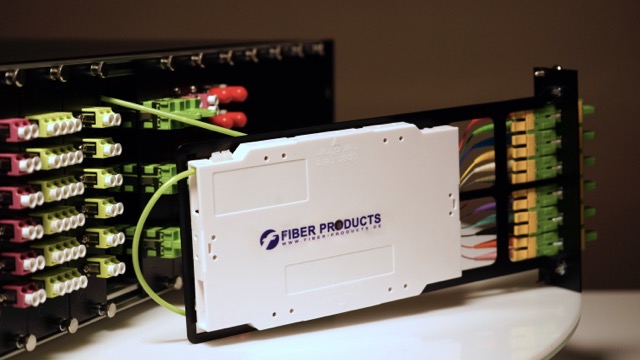
Modular system architectures offer elegant solutions to the conflicting goals of port density fiber optics and ease of maintenance. The VarioConnect 3U system demonstrates this principle: twelve individual 7TE splice modules can be removed, maintained and reinserted independently of each other without affecting other modules.
Service-friendly module design
Service-friendly module design takes ergonomic requirements into account: Recessed grips, intuitive latches and color-coded markings make handling easier, even under time pressure. The 7TE format offers the optimum compromise between packing density and manageability – large enough for ergonomic operation, small enough for large numbers of modules per height unit.
Staged maintenance concepts use modularity for low-risk maintenance: critical modules can be removed for processing while the system continues to operate. This flexibility enables maintenance work to be carried out with no or minimal service interruptions.
Standardized interfaces
Standardized interfaces between modules and carrier systems ensure compatibility and flexibility: different module types can be combined in one system, which offers advantages both during initial installation and for subsequent adjustments. This standardization also reduces the complexity of stocking spare parts.
The extendable design of the modules supports optimum fiber optic port density without maintenance disadvantages. Fiber optic solutions for industry benefit particularly from this modularity.
Ergonomic design principles
Anthropometric factors determine the practical limits of port density fiber optics: Human hands have defined dimensions and movement radii that must be taken into account when designing the system. Too small distances between components make precise work impossible and increase the risk of injury.
Lines of sight and lighting
Lines of sight and lighting have a significant impact on the quality of work: areas located in deep housings or behind other components are difficult to see and therefore prone to errors. Modern system designs take visibility into account, even with high port density fiber optics. The color scheme supports visual orientation with high-contrast markings.
Effort and leverage must be minimized for frequently operated components: Sluggish interlocks or operating elements that are difficult to access lead to fatigue and increase the risk of errors. Intelligent mechanisms use leverage and spring force for convenient operation.
Workplace and stress reduction
Workplace design influences the efficiency of maintenance work: Adequate floor space in front of the systems, appropriate working heights and space for tools are essential. Mobile workstations can improve ergonomic conditions in confined spaces.
Stress reduction through intuitive operating concepts has a direct impact on the quality of work: Self-explanatory labels, logical arrangements and fail-safe mechanisms reduce mental stress. These factors can be decisive for the success of repairs, especially in fault situations.
Maintenance-optimized design principles
Service-friendly cable routing organizes high fibre counts without hindering maintenance: structured guide paths with defined levels prevent tangles and enable systematic work with optimum fibre optic port density. Color-coded guide rails and numbered areas support orientation even in complex installations.
Accessibility optimization
Accessibility optimization prioritizes frequently serviced components: Active connectors and measuring points are arranged for easy access, while passive through-connections can be placed in less accessible areas. This hierarchization significantly reduces the effort required for routine maintenance.
Disassembly sequences are logical and kept to a minimum: Critical connections should be accessible without dismantling other components. Where this is not possible, disassembly sequences should be clearly defined and documented for optimal fiber optic port density.
Fault tolerance and ease of cleaning
Fault tolerance thanks to robust design reduces maintenance requirements: Oversized fixings, generous bending radii and mechanical buffers also tolerate improper handling without damage. This robustness is particularly important in environments with changing personnel.
Ease of cleaning takes dust generation and contamination into account: smooth surfaces, avoided dead spaces and accessible areas make regular cleaning easier. Dust protection flaps further reduce the cleaning effort.
Fiber optic solutions for network operators require particularly maintenance-optimized designs.
Documentation and labeling strategies
Hierarchical labeling systems structure complex installations with high fiber optic port density: Superordinate areas, subgroups and individual connections are given systematic designations that enable logical navigation. This hierarchy should be reflected in the physical layout and supported by appropriate color coding.
Redundant documentation
Redundant documentation ensures availability of critical information: Physical labels, digital plans and photographic documentation complement each other and provide different access routes to the required information. This redundancy is particularly important for high-density installations.
Real-time documentation keeps information up to date: Changes to the installation must be updated immediately in all levels of documentation. Modern asset management systems can automate this synchronization and avoid inconsistencies with high fiber optic port density.
Visualization and version control
Visualization of complex relationships through graphics and diagrams supplements textual descriptions: Cable route diagrams, block diagrams and 3D representations make it easier to understand complex installations. These aids are particularly valuable for high port density fiber optics.
Version control documents change history and enables rollback scenarios: Every documentation change is logged with a timestamp and editor. This history supports error analysis and enables the reconstruction of previous configurations.
Automation and intelligent systems
Automated monitoring reduces maintenance costs through preventive detection of problems: Continuous performance monitoring identifies degrading links before they fail. Intelligent algorithms can detect trends and predict maintenance needs, which is especially valuable in high port density fiber optics.
Remote diagnostics and documentation
Remote diagnostics enable problem analysis without on-site presence: Remote measurements and tests can identify and localize many problems without the need for technicians to be physically present. This capability is particularly valuable for geographically dispersed installations.
Automatic documentation updates through intelligent systems: sensors can detect configuration changes and trigger corresponding documentation updates. This automation reduces manual documentation errors in complex port density fiber optics.
Digital twins and AI support
Digital twins enable virtual maintenance planning: 3D models of the installation can simulate and optimize maintenance processes. Collision detection prevents planning errors, while time estimates enable realistic maintenance windows.
AI-supported decision support optimizes maintenance strategies: Machine learning algorithms analyse historical maintenance data and identify optimization potential for the ideal port density of fibre optics. Recommendations for maintenance sequences can significantly increase efficiency.
Smart City fiber optic projects benefit in particular from intelligent monitoring systems.
Economic evaluation of the compromise
Total cost of ownership considerations must take into account all aspects of port density fiber and serviceability balance: While higher port density initially saves space costs, increased maintenance times and risks can overcompensate for these savings. A realistic TCO analysis considers the entire life cycle.
Downtime costs and personnel efficiency
Failure cost calculations illustrate the importance of maintenance-friendly designs: in critical environments, hourly failures can cost tens of thousands of euros. Investments in maintenance-optimized systems with a balanced port density of fibre optics often pay for themselves after just a few avoided failures.
Personnel efficiency is significantly increased by maintenance-optimized systems: Reduced maintenance times enable more efficient personnel deployment and reduce overtime costs. Simplified maintenance processes also reduce qualification requirements and expand the available personnel pool.
Risk minimization and scaling efficiency
Risk minimization through maintenance-friendly designs reduces insurance costs and liability risks: Lower accident probabilities during maintenance work reduce insurance premiums, while reduced downtime risks improve business continuity.
The scaling efficiency of modular systems is particularly evident when it comes to expansions: Maintenance-friendly designs enable expansions without disrupting existing systems. This feature reduces migration projects and supports optimum port density fiber optics.
Fiber optic solutions for municipal utilities require particularly careful TCO considerations.
Industry-specific requirements
Data center environments often prioritize maximum port density over fiber optics due to high space costs: Hyperscale operators accept higher maintenance complexity in favor of maximum capacity. However, automated maintenance concepts are also increasingly being used here to compensate for the disadvantages of high port density.
Telecommunications and industry
Telecommunications networks require high availability and fast repair times: Outages can have regulatory consequences and result in customer losses. Ease of maintenance often takes priority over maximum fiber optic port density. Redundant systems are standard requirements.
Industrial environments place special demands on robustness and maintainability: controlled environmental conditions and limited specialist personnel on site require particularly maintenance-friendly designs. Self-diagnostic capabilities are particularly valuable here.
Critical infrastructures
Critical infrastructures practically cannot afford outages: here, ease of maintenance clearly dominates over port density fiber optics. Extensive redundancy, simple maintenance processes and 24/7 service availability are essential requirements.
Fiber optic solutions for educational institutions often have limited IT budgets and staff: serviceability enables maintenance by less specialized staff and reduces external service costs.
Future trends and developments
Automated maintenance systems will make more complex port densities more manageable: Robotic systems can work in environments that would be difficult for humans to access. These technologies may enable higher port density fiber optics without maintainability drawbacks. However, these systems are not yet ready for the market and are cost-intensive.
Improved diagnostics and modularization
Improved diagnostic options reduce maintenance costs: Better sensor technology and analysis methods can localize problems more precisely and often solve them remotely. Artificial intelligence supports fault analysis and maintenance planning. These developments are shifting the balance in favor of higher port densities.
Modularization concepts are being further refined: even smaller, specialized modules enable more granular maintenance with a high overall fibre optic port density. Standardized interfaces and plug-and-play concepts simplify installation and maintenance.
Digitalization and sustainability
Digitalization of maintenance through AR/VR technologies: Augmented reality can display maintenance instructions directly in the field of vision and simplify complex processes. Virtual reality enables realistic maintenance training without risk to production systems.
Sustainability will promote maintenance-friendly designs: Longer product life cycles require maintainable systems. Repairability is becoming more important than maximum initial capacity. This trend supports modular, maintenance-friendly concepts with optimum fiber optic port density.
Practical recommendations for optimum balance
Planning phase
Demand analysis before port density maximization:
- Realistic capacity forecasts over 5-10 years
- Estimate maintenance frequency and complexity
- Consider staff qualification and availability
- TCO consideration over the entire life cycle
Risk assessment:
- Calculate downtime costs vs. space savings
- Simulate maintenance times in different scenarios
- Define scalability requirements
- Develop redundancy concepts
Implementation
Modular system selection:
- 7TE modules for optimum balance
- Pull-out components for service-friendly maintenance
- Standardized interfaces for flexibility
- Establish a documentation system right from the start
Quality assurance:
- Test maintenance processes before going live
- Train staff accordingly
- Continuously update documentation
- Conduct regular efficiency reviews
Conclusion and recommendations for action
The compromise between fibre optic port density and ease of maintenance is not a one-off design decision, but a continuous optimization process. Modern modular systems such as VarioConnect with 288 fibers on 3U or SlimConnect with 72 fibers on 1U show that high port densities and practical maintainability are perfectly compatible.
Successful balance through intelligent architecture
The art lies in intelligent system architecture that takes both requirements equally seriously. Successful high-density projects take maintenance requirements into account as early as the planning phase and not just when the first malfunction occurs. The investment in maintenance-optimized designs pays for itself through reduced operating costs, higher availability and improved personnel efficiency.
Modular concepts offer the best balance between theoretical capacity and practical manageability. The extendable 7TE modular architecture has proven to be optimal: large enough for ergonomic handling, small enough for high packing density.
Future-oriented solutions
The future belongs to intelligent systems that combine high port density fiber optics with automated maintenance. Until these technologies are available and economical, sophisticated modular designs remain the best compromise for optimal port density fiber optics.
At Fiber Products, we develop modular fiber optic systems for the optimal balance between port density and serviceability. Our VarioConnect solutions and SlimConnect systems are designed for maximum efficiency and serviceability.
With a 5-year guarantee and European production to German quality standards, we offer optimum value for money for professional fiber optic networks. Discover our complete product range or visit our online store.
Talk to us – together we will develop the optimum balance between port density fiber optics and ease of maintenance for your project and benefit from proven modular concepts. Contact us for an individual consultation or find out about further system optimizations in our fibre optic knowledge blog.