Fibre Optic Polish Quality: PC UPC APC Connectors Technical Comparison
Fibre Optic Polish Quality: PC UPC APC Connectors Technical Comparison
The choice between APC polishing, UPC connectors and PC finish fibre optics fundamentally determines return loss and therefore signal quality in modern fibre optic networks. PC connectors achieve return loss of -40 dB, UPC variants up to -55 dB, while APC polishing delivers -60 dB to -65 dB – the highest attenuation available. These technical differences determine which connector type is optimal for your specific application – whether FTTH rollout, data centre or industrial networking.
For planners, technicians and systems integrators in the DACH market, these polish grades are critical for system design. The right choice affects not only transmission quality but also long-term stability of the entire fibre optic infrastructure.
Technical Fundamentals of Fibre Optic Polish Methods
The polish of the fibre optic face determines physical contact quality between two fibres. During signal transmission, reflections occur at every connection point, measured as return loss. The higher the dB value, the lower the disturbing reflections in the system.
The three main methods differ in polish angle and surface geometry:
- PC (Physical Contact): Flat polish with slight convexity, direct physical contact of fibre cores
- UPC (Ultra Physical Contact): Enhanced PC polish with finer surface quality
- APC (Angled Physical Contact): 8-degree angled finish for directed reflection deflection
These different polish grades are standardised in the IEC 61754 family and precisely define geometric requirements for each connector type.
PC Finish: The Industry Standard for Multimode Applications
PC finish (Physical Contact) has formed the basis of modern fibre optic connections for decades. The convex face with a radius of curvature of 10–25 mm ensures direct contact of fibre cores without air gaps. This geometry significantly reduces reflections compared to older flat-polish methods.
| Parameter | PC Finish Specification | Typical Application |
|---|---|---|
| Return Loss | ≥ 40 dB | Multimode Networks |
| Insertion Loss | < 0.3 dB | LAN Cabling |
| Radius of Curvature | 10–25 mm | Building Networks |
| Connector Types | LC, SC, FC, ST | Industry Standard |
In the German market, PC-polished connectors are primarily used in structured cabling and multimode applications. Cost-effective manufacturing and wide availability make them the first choice for less critical transmission routes.
UPC Connectors: Optimised Attenuation for Singlemode Networks
UPC-polished connectors (Ultra Physical Contact) represent an evolution of PC technology. Through an enhanced polishing process with finer abrasives, they achieve surface roughness below 5 nm. This extreme smoothness minimises scattering effects at the interface.
- Return Loss: Typically -50 dB to -55 dB
- Insertion Loss: Below 0.2 dB with optimal pairing
- Primary Use: Singlemode networks
- Available Formats: LC-UPC, SC-UPC, FC-UPC
- Standard Reference: IEC 61754-20 for LC connectors
German network operators preferentially deploy UPC connectors in metropolitan ring structures and backbone links. The improved signal quality justifies the extra polishing effort for transmission rates above 10 Gbit/s.
Fiber Products Quality Pledge: As an official Diamond Partner and European manufacturer, we produce modular splice systems in-house. Benefit from Swiss precision and in-house manufacturing.
APC Polishing: Maximum Return Loss for Critical Applications
APC polishing (Angled Physical Contact) with its characteristic 8-degree angle directs reflected light away from the fibre core. This technology achieves return loss of -60 dB to -65 dB and significantly exceeds PC and UPC variants.
The angled finish prevents reflected signals from returning to the fibre core. Instead, they are directed into the fibre cladding where they are absorbed. This physical property makes APC connectors essential for:
- CATV and HFC networks: Disturbance-free video transmission
- PON systems: GPON/XGS-PON with high split ratios
- Test equipment: OTDR measurements without dead zones
- Sensor networks: Precise reflection measurements
- FTTH rollout: Future-proof fibre optic networks
Direct Performance Comparison: PC vs. UPC vs. APC in Detail
| Property | PC Finish | UPC Polish | APC Finish |
|---|---|---|---|
| Return Loss | -40 dB | -50 to -55 dB | -60 to -65 dB |
| Insertion Loss | < 0.3 dB | < 0.2 dB | < 0.25 dB |
| Polish Angle | 0° | 0° | 8° |
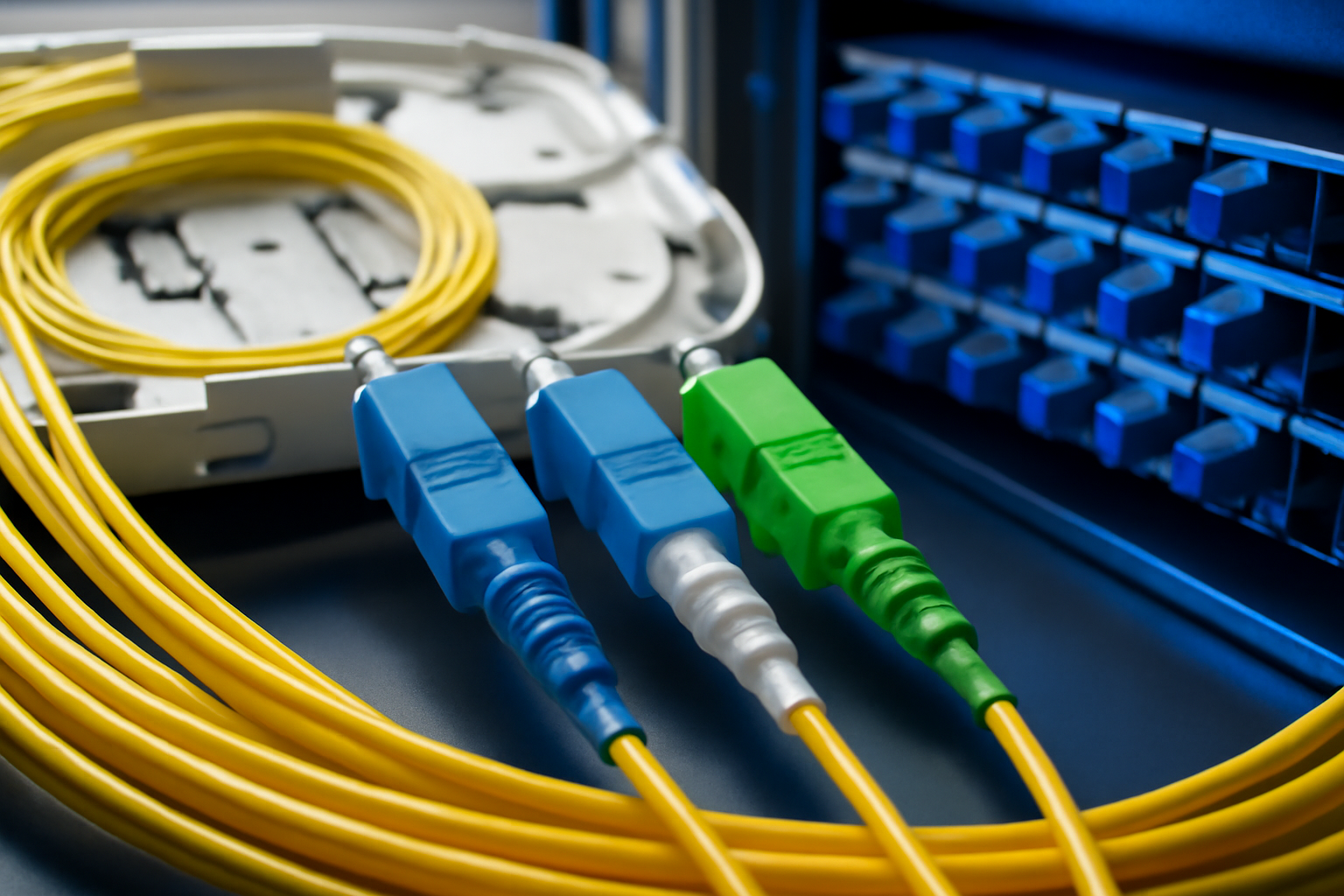
| Connector Colour | Blue/Beige | Blue | Green |
| Cost | Low | Medium | Higher |
| Primary Application | LAN/Multimode | Backbone | FTTH/CATV |
Colour coding per IEC 61754 enables immediate identification: green connectors signal APC polishing, while blue connectors denote PC/UPC. This standardisation prevents misconnections in complex installations.
Compatibility and Connection Rules in Practice
Combining different polish grades results in significant performance loss or even physical damage. APC connectors must never be connected to PC/UPC connectors – the angle difference prevents correct fibre contact and can damage the faces.
Permissible connections and their effects:
- PC with PC: Standard connection, full performance
- UPC with UPC: Optimal attenuation values
- PC with UPC: Functional, slightly increased loss
- APC with APC: Best reflection attenuation
- APC with PC/UPC: Not permitted, air gap and damage risk
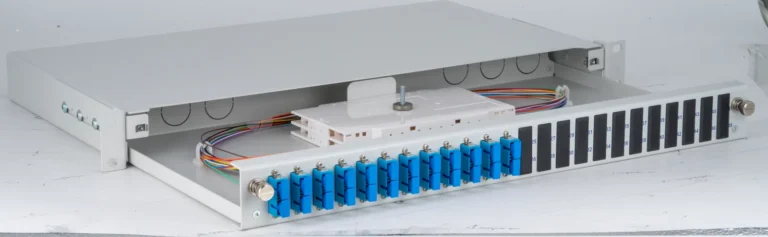
Modern splice modules from Fiber Products feature colour-coded couplers and labelling fields for unambiguous identification of polish grade. The modular design enables flexible adaptation to project-specific requirements.
Selection Criteria for Systems Integrators and Planners
The decision between PC, UPC and APC depends on several technical and economic factors. Systems integrators must consider not only raw transmission quality but also factors such as availability, inventory and training requirements.
For typical application scenarios in the DACH market, the following recommendations apply:
| Application | Recommended Polish | Rationale |
|---|---|---|
| Data Centre LAN | PC/UPC | Cost efficiency with high port density |
| FTTH Networks | APC | Future-proofing for higher data rates |
| Industrial Networking | PC | Robustness and availability |
| Cable Television | APC | Minimal reflections for analogue signals |
| Test Equipment | APC | Precise OTDR measurements |
Total Cost of Ownership should include factors beyond connector cost, such as downtime, maintenance effort and future upgrades.
Metrological Verification of Polish Quality
Quality assurance of polished connectors follows standardised measurement procedures per IEC 61300-3-6 for return loss and IEC 61300-3-4 for insertion loss. Modern instruments enable on-site verification.
- Interferometry: Face geometry and radius of curvature verification
- OTDR Measurements: Localisation of reflection points along the route
- Optical Power Meters: Insertion loss determination
- Video Microscopes: Visual inspection for contamination or scratches
- Return Loss Meters: Direct reflection measurement
Regular measurements ensure network quality and document compliance with agreed specifications. Fiber Products integrates measurement ports into its modular systems for easy verification without service interruption.
Standards and Regulations in the German Market
Fibre optic technology is subject to strict international and national standardisation. For the German market, DIN EN standards are particularly relevant, based on international IEC norms.
Key standards for polish grades:
- IEC 61754 Series: Connector interfaces for all common formats
- IEC 61755-3 Series: Optical interfaces for singlemode applications
- DIN EN 50377: Connector set requirements
- ITU-T G.671: Transmission characteristics of passive components
- VDE 0888: German application rules for fibre optic cable
Compliance with these standards ensures interoperability between manufacturers and long-term investment security. As a European manufacturer, Fiber Products consistently produces to these standards and offers 5 years’ warranty on all system components.
Future Perspective: Polish Quality at Rising Data Rates
As FTTH rollout accelerates in Germany and transmission rates exceed 400 Gbit/s, polish quality becomes increasingly important. New transmission methods such as coherent optics are particularly sensitive to reflections.
Current developments in polishing technology:
- Automated Polish Processes: Consistent quality through robotics
- New Abrasives: Nanomaterials for even smoother surfaces
- Advanced Metrology: 3D surface analysis at nanometre resolution
- Hybrid Polish Methods: Combination of various techniques
For planners, this means adopting APC technology in new installations today to avoid costly retrofits later. The additional investment pays for itself through higher future-proofing.
Practical Implementation in Modular Splice Systems
Integrating different polish grades in one distribution system requires thoughtful design. Modular splice systems such as SlimConnect and VarioConnect provide the flexibility needed for mixed installations.
Advantages of modular systems with mixed polish grades:
- Separate Cartridges: Clear separation of APC and UPC areas
- Colour-Coded Modules: Immediate visual identification
- Flexible Loading: Adaptation to changing requirements
- Documentation Fields: Unambiguous labelling of all connections
- Interchangeable Couplers: Simple retrofitting when needed
Port density of up to 96 fibres in 1 rack unit enables efficient space usage even with separate APC/UPC management. This flexibility is especially important for municipal utilities and network operators delivering multiple services over shared infrastructure.
Economic Evaluation: ROI of Different Polish Grades
Investment decisions between PC, UPC and APC should always consider total operating costs. While PC connectors are initially cheaper, APC’s superior transmission properties can reduce costs long-term.
| Cost Factor | PC Finish | UPC Polish | APC Polish |
|---|---|---|---|
| Connector Price (relative) | 100% | 120% | 150% |
| Failure Probability | Medium | Low | Very Low |
| Future-Proofing | Limited | Good | Excellent |
| Maintenance Effort | Standard | Reduced | Minimal |
For critical infrastructure with high availability requirements, the additional investment in APC technology is justified through reduced downtime and better scalability.
FAQ: Common Questions on Fibre Optic Polish Grades
Can I mix APC and UPC connectors in one system?
Yes, but never directly connect them. Use separate cartridges or modules for APC and UPC connections. Colour coding (green for APC, blue for UPC) prevents misconnections.
Which polish is suitable for 10-gigabit Ethernet?
For 10GbE links, both UPC and APC are suitable. UPC is sufficient for short distances, while APC offers advantages over longer distances or high connector density.
How do I identify the polish grade of existing connectors?
Primarily by colour coding: Green = APC, Blue = PC/UPC.
Order directly from the shop: fiber-products.de
Request a Quote
Free consultation – personalised quote within 24 hours