Security-Critical Fibre-Optic Networks: E2000 Connectors for Emergency Services and Government Agencies
Emergency services fibre networks, police fibre-optic infrastructure, security-critical network systems – these terms define the highest performance standards for modern communications networks in government and organisations with security responsibilities (BOS). The choice of the correct fibre-optic technology determines the resilience, eavesdropping protection and reliability of critical infrastructure. E2000 connectors have become the preferred standard for security-critical applications, as their unique design with integrated protective shutter and attenuation values below 0.15 dB ensure maximum operational safety.
Why E2000 Connectors Are Essential for Emergency Services Networks
Emergency services and critical infrastructure organisations operate communications networks that must function even in extreme situations. The requirements for emergency services fibre networks differ fundamentally from commercial networks. While outages in the private sector are inconvenient, they can cost lives in police, fire and rescue operations.
E2000 connectors meet the strict requirements of IEC 61754-15 and offer three decisive advantages for security-critical network infrastructure:
- Automatic laser protection: The spring-loaded protective shutter prevents eye damage and protects against contamination
- Maximum precision: Return loss of over 60 dB with APC finish
- Tamper protection: Locking mechanism prevents unauthorised disconnection
- Long-term stability: Guaranteed performance over 1000 mating cycles without quality degradation
Technical Requirements for Police Fibre Networks and Government Agency Infrastructure
Technical specifications for police fibre networks go far beyond standard office cabling. Government networks must be built with redundancy and meet the strictest security requirements. The German Federal Office for Information Security (BSI) defines clear guidelines for physical security of critical infrastructure.
| Requirement | Standard Network | Emergency Services Fibre | E2000 Solution |
|---|---|---|---|
| Attenuation per connector | < 0.5 dB | < 0.25 dB | < 0.15 dB |
| Return loss | > 35 dB | > 50 dB | > 60 dB (APC) |
| Laser safety class | Optional | Mandatory | Integrated (Class 1) |
| Tamper protection | No | Required | Locking mechanism |
| Dust protection | Dust cap | Permanent | Automatic shutter |
These specifications clearly demonstrate why E2000 connectors are the first choice for security-critical network infrastructure. Integrated safety functions significantly reduce the risk of network outages caused by human error or environmental factors.
Building Redundant Emergency Services Fibre Networks with Modular Splice Systems
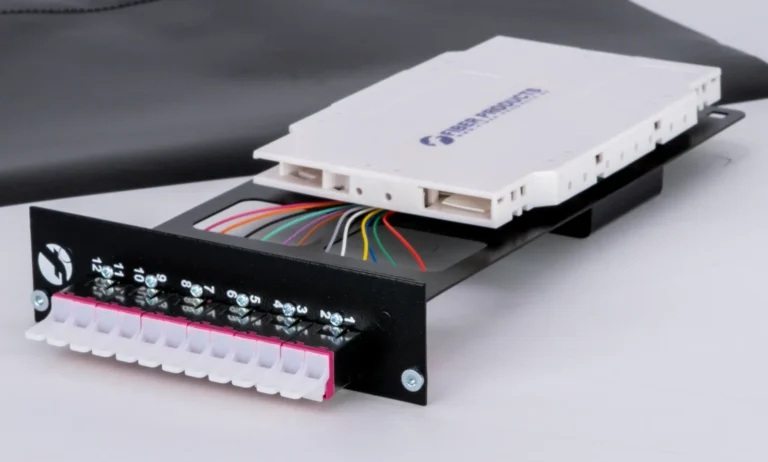
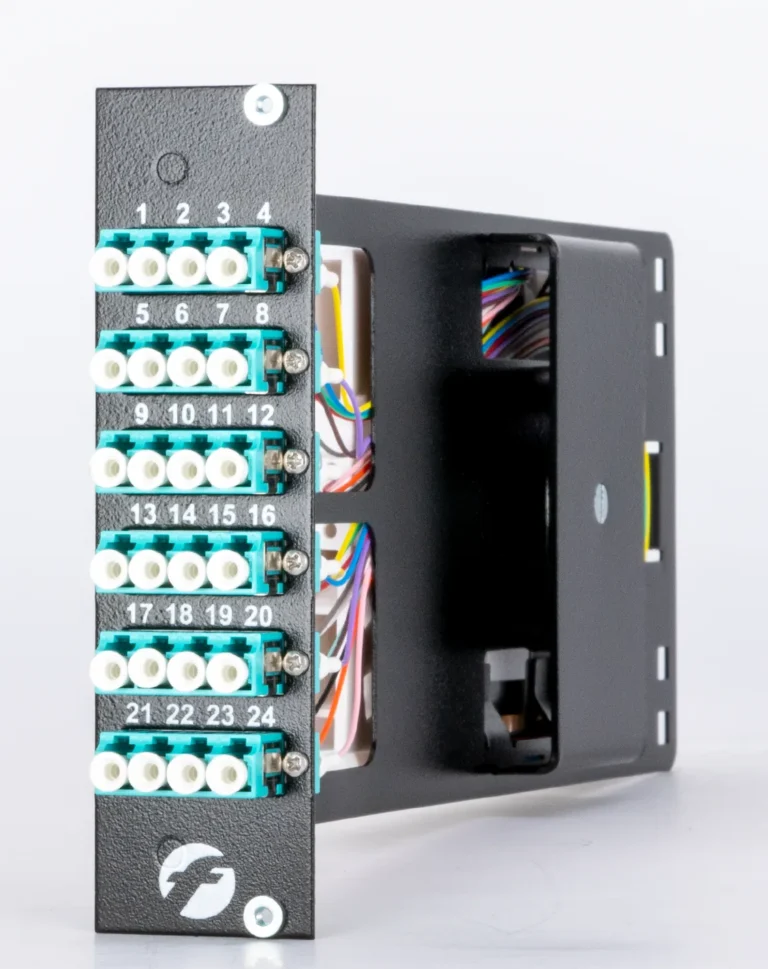
Redundancy is the primary principle when building emergency services fibre networks. Every critical connection must be dual-routed. Modern splice modules enable structured management of primary and backup paths in compact form factors.
Planning a redundant police fibre network follows the principle of physical separation:
- Geographical redundancy: Primary and backup routes run via different cable paths
- Structural separation: Separate fire compartments for critical distribution points
- Modular architecture: 1U systems with up to 96 fibres for flexible expansion
- Documentation: Complete traceability of all connections per DIN EN 50173-1
Fibre Products Quality Promise: As official Diamond partner and manufacturer, we produce modular splice systems in Europe. Benefit from Swiss precision and in-house manufacturing.
Security Concepts for Security-Critical Network Infrastructure
Securing emergency services fibre networks extends beyond pure technology. A comprehensive security concept encompasses physical, technical and organisational measures. The BSI baseline protection handbook defines clear requirements for protecting critical infrastructure.
Physical security measures begin with selecting the right components. E2000 connectors with their robust metal construction and locking mechanism provide a high level of basic protection. Integration into secure distribution cabinets with protection class IP65 prevents unauthorised access.
Technical security aspects include monitoring optical power levels. Modern monitoring systems detect tampering attempts through continuous measurement of attenuation values. With E2000 connections, tolerance is maximum 0.1 dB deviation.
Integrating E2000 into Existing Government Agency Networks
Migration of existing police fibre networks to E2000 technology occurs in stages. Critical connections take priority. The modular design of modern splice systems allows parallel use of different connector types during the transition phase.
| Migration Phase | Action | Timeframe | Priority |
|---|---|---|---|
| Phase 1 | Backbone connections to E2000 | 3–6 months | Critical |
| Phase 2 | Data centre connectivity | 6–9 months | High |
| Phase 3 | Site interconnection | 9–12 months | Medium |
| Phase 4 | End-device connections | 12–18 months | Standard |
The Diamond product line offers specialised migration cartridges that combine different connector types in one system. This minimises downtime during the transition to E2000.
Standards Compliance and Certifications for Emergency Services Fibre Networks
Security-critical network infrastructure is subject to strict standards and certification requirements. Emergency services networks must comply with additional safety standards beyond general fibre-optic norms.
- IEC 61754-15: International standard for E2000 connectors
- DIN EN 50173: Application-neutral communications cabling systems
- ISO/IEC 11801: International cabling standard
- BSI IT Baseline Protection: Specific requirements for critical infrastructure (KRITIS)
- VDE 0888: German standard for fibre-optic cables
Compliance with these standards is mandatory for public procurement. Products manufactured in Europe with 5-year manufacturer warranty meet the stringent requirements of German government agencies.
Case Studies: Successful Emergency Services Fibre Projects
In recent years, numerous police fibre networks have been modernised. Migration to E2000 technology followed uniform standards. Typical project sizes cover 500 to 2000 kilometres of fibre route.
A state police authority in southern Germany deployed fibre networks connecting 120 police stations using E2000-based systems. Modular splice boxes in 1U form factor accommodated up to 96 fibres per rack unit – double the capacity of conventional systems.
A major German city’s fire department modernised its dispatch centre with redundant E2000 connections. Automatic protective shutters prevented port contamination during a three-year construction phase.
Maintenance and Servicing of Security-Critical Fibre Networks
Maintaining emergency services fibre networks requires specially trained personnel and appropriate measuring equipment. E2000 connectors simplify maintenance through self-cleaning features. The integrated protective shutter keeps dust and moisture away.
- Quarterly visual inspection: Check mechanical integrity
- Semi-annual attenuation measurement: Documentation with OTDR test equipment
- Annual cleaning: Only when necessary, using specialised cleaning pens
- Documentation: Complete traceability per DIN EN 50174-1
The robust design of E2000 connectors significantly reduces maintenance effort. Compared to standard LC connectors, failure rates drop.
Future-Proofing Through Scalable System Architecture
Security-critical network infrastructure must be ready for future demands. Data volumes in police fibre networks are rising continuously due to video surveillance, drone operations and mobile data capture.
Modern fibre-optic solutions for government agencies account for this evolution through modular expandability. Splice systems with 3U or 4U configurations provide capacity for up to 288 fibres and enable stepwise capacity expansion without service interruption.
Investment in E2000-based systems secures long-term infrastructure capability. The technology supports current transmission rates of 100 gigabits per second and is ready for future terabit applications.
Cost Efficiency Through Standardised E2000 Components
Despite higher initial investment, E2000 systems for emergency services fibre networks prove cost-effective through lower operating costs. Standardisation on a single connector type simplifies inventory management and staff training.
| Cost Factor | Conventional Solution | E2000 System | Saving |
|---|---|---|---|
| Maintenance intervals | Quarterly | Semi-annually | 50% |
| Downtime per year | 24 hours | 6 hours | significant |
| Spare parts inventory | 5 types | 1 type | 80% |
| Training effort | 40 hours | 16 hours | 60% |
Total cost of ownership over ten years for E2000 systems runs lower than comparable solutions with standard connectors, despite higher capital expenditure.
FAQ: Common Questions on Emergency Services Fibre Networks and E2000 Connectors
Why are E2000 connectors better suited for police fibre networks than LC connectors?
E2000 connectors provide automatic laser protection and dust protection through their integrated shutter. The locking mechanism prevents accidental disconnection of critical connections. With attenuation values below 0.15 dB, they significantly outperform LC connectors in optical performance.
What standards must emergency services fibre networks comply with?
Security-critical network infrastructure must meet IEC 61754-15 for E2000 connectors, DIN EN 50173 for cabling, and BSI baseline protection requirements for critical infrastructure (KRITIS). State-specific guidelines from interior ministries also apply.
How is migration of existing networks to E2000 conducted?
Migration occurs in phases, starting with critical backbone connections. Modular splice systems enable parallel use of different connector types. Complete migration typically takes 12 to 18 months.
What capacities do modern splice systems for government agencies offer?
Current systems support up to 96 fibres in 1U or up to 288 fibres in 3U configurations. This high fibre density saves valuable floor space and reduces cooling costs.
Are E2000 connectors compatible with future transmission technologies?
Yes, E2000 connectors support all current and foreseeable transmission methods. Low attenuation and high return loss enable data rates of 100 gigabits and beyond without limitations.
What warranty levels are required for emergency services networks?
Government agencies typically require minimum 5-year manufacturer warranty and spare parts availability on request. European manufacturers with in-house production can reliably meet these requirements.
Conclusion: E2000 as the Standard for Security-Critical Network Infrastructure
Emergency services fibre networks, police fibre-optic systems and security-critical network infrastructure demand maximum reliability and safety. E2000 connectors meet these requirements through their unique combination of automatic laser protection, minimal attenuation and robust construction. Investment in E2000-based systems with modular splice boxes secures the long-term performance of critical communications networks.
For government agencies and organisations with security responsibilities modernising their fibre infrastructure, Fibre Products as manufacturer and official Diamond partner offers the right system solutions. From the compact 1U splice box with 96 fibres to the expandable VarioConnect system – all products are manufactured in Europe and meet the highest quality standards. Contact our specialists for customised advice on your emergency services fibre project.
Interested in Modular Fibre-Optic Solutions?
Fibre Products GmbH – official DIAMOND SA partner. Made in EU, 5-year warranty.