BOS Networks Fibre Optic – Critical Infrastructure for Emergency Services
BOS network fibre optic, public authorities, organisations with security responsibilities and blue-light networks form the backbone of critical communication infrastructure for police, fire, rescue services and disaster management in Germany. These highly available fibre optic networks guarantee uninterrupted data transmission in emergency situations with bandwidths from 10 Gbit/s to 100 Gbit/s and latencies below 1 ms. Modern BOS fibre optic infrastructure uses redundant ring architectures with DWDM technology and specialised splice modules that guarantee maximum reliability even under extreme conditions.
Technical Requirements for BOS Fibre Optic Networks in Security Services
Fibre optic infrastructure for authorities and organisations with security responsibilities is subject to the strictest technical specifications according to BSI baseline protection and DIN EN 50173. Unlike commercial networks, BOS systems must guarantee availability of 99.999 percent (5 minutes downtime per year). The physical network architecture is based on fully redundant fibre optic rings with automatic switchover within 50 milliseconds in case of line interruptions.
| Parameter | BOS Network Requirement | Standard Network |
|---|---|---|
| Availability | 99.999% | 99.9% |
| Switchover Time | < 50 ms | < 5 s |
| Attenuation Margin | 6 dB | 3 dB |
| Redundancy | N+2 | N+1 |
| Monitoring | 24/7 OTDR | Optional |
Splice modules in BOS networks must additionally meet protection class IP65 and cover temperature ranges from -40°C to +85°C. Critical nodes such as control centres and data centres of security authorities deploy high-density fibre optic systems with up to 96 fibres per rack unit to optimally utilise space in secure server rooms.
Modular Splice Systems for Highly Available Blue-Light Networks
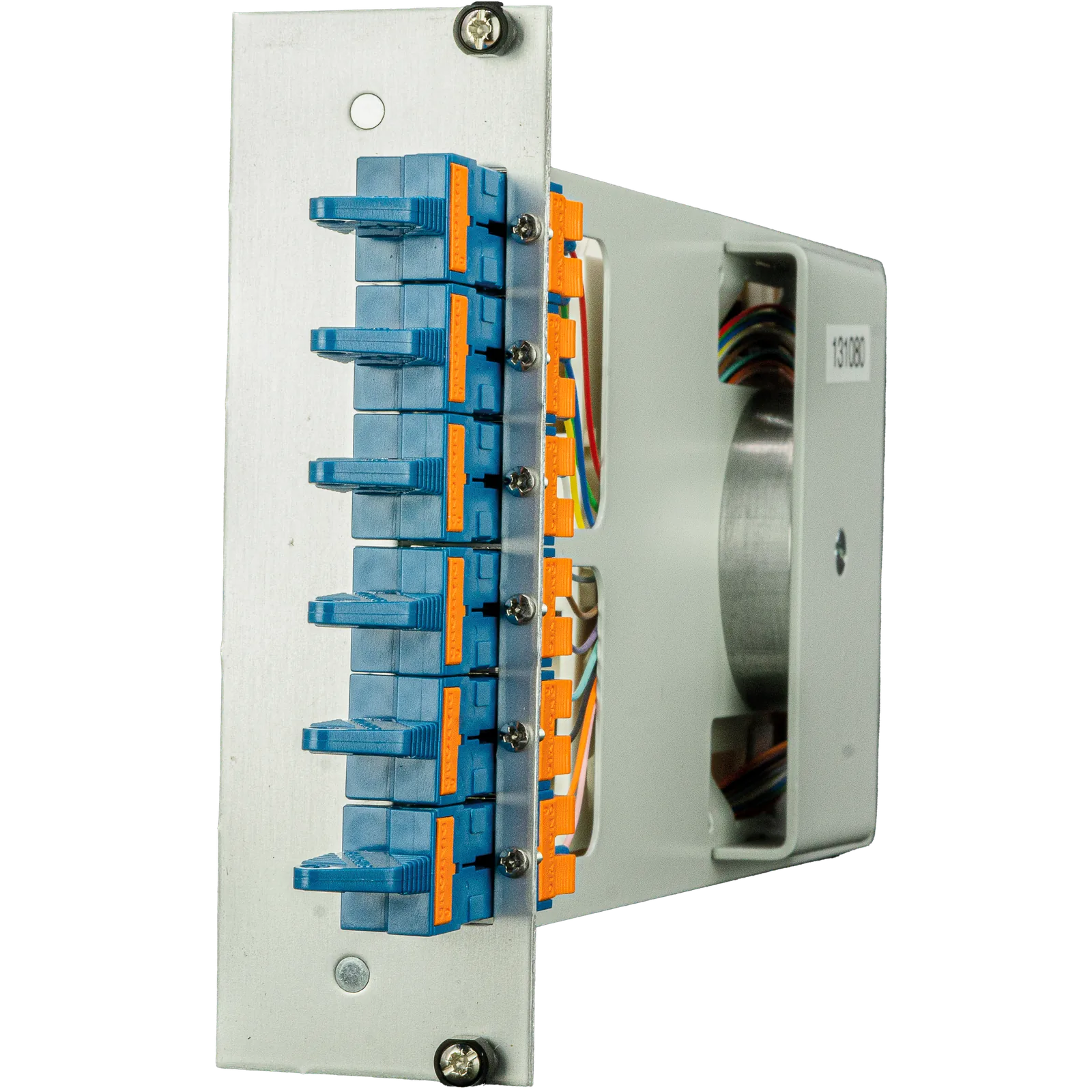
Implementation of BOS network fibre optic and blue-light network infrastructure requires specialised modular splice systems that enable fast maintenance and expansion. Modern splice modules for security authorities use pre-terminated cassettes with 12 or 24 fibres that can be exchanged during operation without network interruption.
- Front modules with LC-APC or E2000-APC connectors for minimal return loss
- Integrated fibre management systems with bend radius protection > 30 mm
- Colour coding according to DIN VDE 0888 for unambiguous fibre identification
- Documentation areas for complete traceability according to BSI requirements
- Mechanical locking against unauthorised access
The splice cassettes feature 48 splice storage plates and enable safe accommodation of excess fibre lengths up to 2 metres. Thanks to the modular design, defective components can be replaced within a short time – a critical factor for maintaining communications in emergency situations.
Fibre Optic Connectors and Attenuation Values in BOS Infrastructure
Selecting the right fibre optic connectors is crucial for the performance of authorities, organisations with security responsibilities networks. BOS systems primarily employ APC-polished connectors (Angled Physical Contact) with a return loss of at least 60 dB. The insertion loss must not exceed 0.25 dB according to IEC 61300-3-4.
Fiber Products Quality Promise: As official Diamond Partner and manufacturer, we produce modular splice systems in Europe. Benefit from Swiss precision and in-house manufacturing – ideal for critical BOS infrastructure.
The E2000 connector has become the standard for high-security BOS networks. With its integrated protective shutter and mechanical locking, it provides optimal protection against contamination and unauthorised access. Typical insertion loss is < 0.15 dB, with return loss reaching values of > 65 dB.
Redundancy Concepts and Failsafe Design for Security Authorities
BOS network fibre optic infrastructure uses multi-layer redundancy concepts to protect against total failure. The physical layer operates with geographically separated routing at minimum distances of 500 metres. Critical links between control centres are implemented with triple redundancy – two active fibre routes plus a microwave link as fallback.
| Redundancy Layer | Technology | Switchover Time | Availability |
|---|---|---|---|
| Primary Ring | DWDM 40 Channels | < 50 ms | 99.999% |
| Secondary Ring | CWDM 18 Channels | < 100 ms | 99.99% |
| Backup | Microwave 80 GHz | < 1 s | 99.9% |
Splice boxes at network nodes are equipped with OTDR monitoring systems (Optical Time Domain Reflectometer) that continuously measure attenuation values of each individual fibre. If deviations exceed 0.1 dB, automatic alerting to the network operations centre is triggered.
- Continuous fibre condition monitoring with 1550 nm test wavelength
- Automatic switchover to backup fibres when thresholds are exceeded
- Geographically redundant data storage in at least three data centres
- Emergency power supply for at least 72 hours of operation
- Climatised technical rooms with N+1 cooling
Integration of BOS Fibre Optic Networks into Existing Infrastructure
Migration of existing copper and radio networks to modern fibre optic infrastructure for authorities, organisations with security responsibilities proceeds in stages. Municipal utilities and network operators frequently provide dark fibre for dedicated BOS connections. Technical connection takes place via defined handover points with special security measures.
In practice, 19-inch splice boxes with 3 or 4 rack units are installed in secured collocation rooms. These provide space for up to 288 fibres and enable structured separation of BOS traffic and other services. Access control takes place in multiple stages via biometric systems and is fully logged.
Pre-termination of splice modules reduces installation time. Pre-terminated MPO/MTP cassettes enable rapid provisioning of 12, 24 or 48 fibres per module. This is particularly advantageous during time-critical expansions of blue-light networks.
Standards Compliance and Certification for BOS Fibre Optic Components
All components in BOS network fibre optic installations must meet strict standards. Relevant standards include DIN EN 50173-1 for structured cabling, IEC 61754 for fibre optic connectors and DIN VDE 0888 for colour coding. Additionally, BSI baseline protection requirements and specific requirements of individual regional authorities apply.
- CE marking and RoHS compliance for all components
- CPR classification Dca for installation cables in buildings
- IEC 61300-2 family for optical test procedures
- ISO 9001:2015 manufacturer certification
- NATO approval for cross-border security networks
Quality assurance is performed by accredited test laboratories with measurement reports for each individual route. Attenuation, return loss, chromatic dispersion and polarisation mode dispersion are documented. Measurement reports must be archived for 10 years.
Scalability and Future-Proofing of Blue-Light Networks
Sizing of fibre optic infrastructure for authorities and organisations with security responsibilities must account for future requirements. With the emergence of 5G mobile, IoT sensor networks and AI-driven analysis systems, bandwidth demands are increasing exponentially. Modern BOS networks are therefore built with singlemode OS2 fibres, enabling transmission rates up to 400 Gbit/s per wavelength.
The modular architecture of splice systems permits stepwise expansion without operational interruption. SlimConnect systems with 96 fibres per rack unit maximise port density in existing server rooms. For larger installations, VarioConnect solutions with 288 fibres per 3 rack units offer optimal scalability.
The planned copper phase-out by 2040 makes timely migration to fibre optic inevitable for all security authorities. The TKG amendment 2026 creates improved legal framework conditions for accelerated critical infrastructure deployment.
Maintenance and Operation of BOS Fibre Optic Networks
Operation of BOS network fibre optic infrastructure requires specialised personnel and defined maintenance processes. Preventive maintenance includes half-yearly cleaning of all connectors with isopropanol and lint-free cleaning cloths. Connector cycles of 1000 matings for LC connectors must be documented and monitored.
- Quarterly OTDR measurements for early degradation detection
- Annual thermography to identify hotspots
- Continuous monitoring of climate parameters (temperature, humidity)
- Regular training of maintenance personnel according to VDE 0885
- 24/7 standby service with response time on request
Spare parts provisioning follows the N+1 principle – at least one spare part must be stocked for each critical component. For modular splice systems, this means storing complete spare cassettes and front modules at strategic locations.
Cost Efficiency Through Standardised BOS Fibre Optic Solutions
Standardisation of fibre optic components in blue-light networks significantly reduces both capital and operating costs. By using uniform splice modules and connector types, inventory holding costs decrease. Training requirements for technicians are reduced through standardised installation processes.
Modular systems with 5 years manufacturer warranty offer planning certainty for authorities and organisations with security responsibilities. Total Cost of Ownership (TCO) over 10 years for high-quality systems is lower than proprietary solutions. The ability to renew individual modules without complete replacement proves cost-effective in long-term consideration.
FAQ: Frequently Asked Questions about BOS Fibre Optic Networks
Which fibre optic connectors are suitable for BOS networks?
For BOS network fibre optic installations, E2000-APC and LC-APC connectors are primarily recommended. E2000 offers additional security through its protective shutter, while LC connectors enable higher packing densities. Both variants must provide return loss of at least 60 dB.
How many fibres are required for a typical BOS connection?
A standard control centre requires minimum 48 fibres for basic provision. Of these, 24 are allocated to active connections, 12 to redundancy and 12 as reserve. Large control centres with data centres may require up to 288 fibres.
What distances are achievable in BOS fibre optic networks?
With singlemode OS2 fibres and appropriate transceivers, distances up to 80 kilometres are possible without intermediate amplification. Using DWDM systems with optical amplifiers, distances exceeding 200 kilometres can be bridged.
How is protection against sabotage ensured?
BOS fibre optic networks use multiple security layers: physical route separation, encrypted transmission, continuous OTDR monitoring and alerting for unauthorised access. Critical splice points are located in secured areas.
What bandwidths are required for modern BOS applications?
Current BOS applications require minimum 10 Gbit/s symmetrical bandwidth. For 4K video transmission, drone control and AI analysis, 100 Gbit/s will prospectively be required. Infrastructure should be expandable to 400 Gbit/s.
Can existing municipal utility networks be used for BOS?
Yes, municipal fibre optic networks can provide dedicated fibres for BOS purposes. Physical separation occurs at fibre level, logical separation through VLAN or separate wavelengths. Compliance with BSI baseline protection requirements is essential.
Summary and Outlook
BOS network fibre optic and blue-light network infrastructure forms the indispensable backbone for security in Germany. With modern modular splice systems, highly available redundancy concepts and standardised components, future-proof networks for authorities and organisations with security responsibilities can be realised. Consistent use of fibre optic technology with bandwidths up to 400 Gbit/s ensures that future requirements such as 5G integration, IoT networking and AI-driven operations management can be met.
For practical implementation of BOS fibre optic projects, high-quality, standards-compliant components with long-term availability are essential. As a manufacturer of modular fibre optic solutions with in-house production in Europe, Fiber Products provides the complete system range from splice box to E2000 connector. With unique 5-year warranty and expertise as official Diamond Partner, we support authorities and system integrators in realising highly available security networks. Contact our experts for individual advice on your BOS project.
Request a Quote
Do you have questions about our fibre optic solutions? Our expert team is happy to advise you – free and without obligation.