Fibre Rollout Wiesbaden 2026: ESWE Supply and Broadband Strategy
Fibre Rollout Wiesbaden, ESWE Supply, FTTH Hesse: Municipal Infrastructure Strategy and Technical Implementation 2026
The fibre rollout Wiesbaden, ESWE supply, FTTH Hesse is shaping the digital transformation of Hesse’s state capital through a multi-layered deployment model featuring 600 kilometres of existing fibre-optic infrastructure operated by ESWE subsidiary WiTCOM, alongside parallel rollout projects from Vodafone, Deutsche Glasfaser, Telekom and OXG Glasfaser. Wiesbaden deliberately pursues a decentralised strategy without direct municipal market intervention, while WiTCOM, a wholly-owned subsidiary of ESWE Versorgung AG, focuses on serving business customers, public authorities and service providers across the greater Wiesbaden-Mainz-Frankfurt region.
As a founding member of the Gigabit Region FrankfurtRheinMain GmbH, Wiesbaden coordinates regional partners in the deployment of 25,000 kilometres of fibre-optic cable to connect 1.5 million households by 2030. Technical implementation requires state-of-the-art splice systems and modular distribution solutions that meet rising demands for port density and operational resilience.
ESWE Supply and WiTCOM: Fibre-Optic Infrastructure for Wiesbaden
ESWE Supply positions itself through subsidiary WiTCOM as a regional infrastructure provider with an established service area covering 1.2 million residents and 130,000 businesses. The existing broadband network with 600 kilometres of fibre-optic cable and over 1,000 kilometres of copper cable forms the backbone of the region’s business communications infrastructure.
- Focus on B2B customers: business clients, public authorities, service providers
- Service area: Wiesbaden, Mainz, Frankfurt and adjacent districts
- Infrastructure: 600 km fibre optics, 1,000 km copper
- Coverage area: 1.2 million residents
- Business customer potential: 130,000 connections
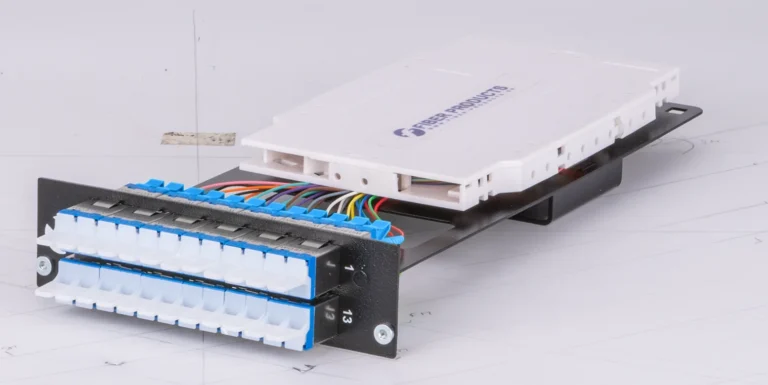
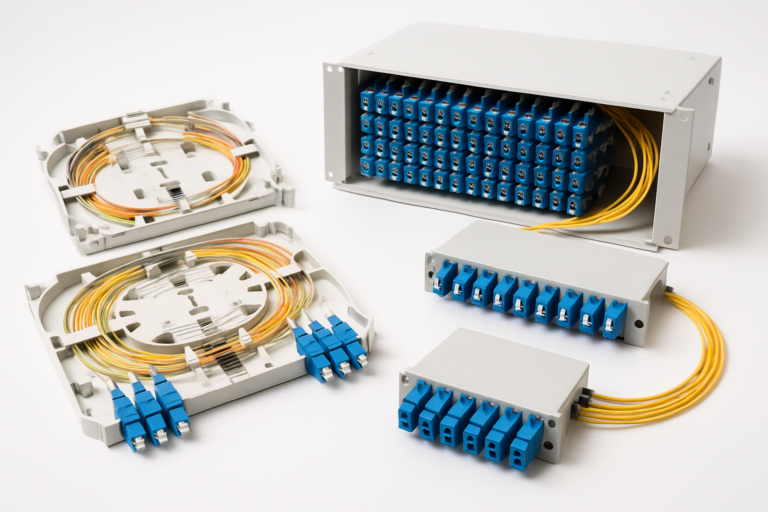
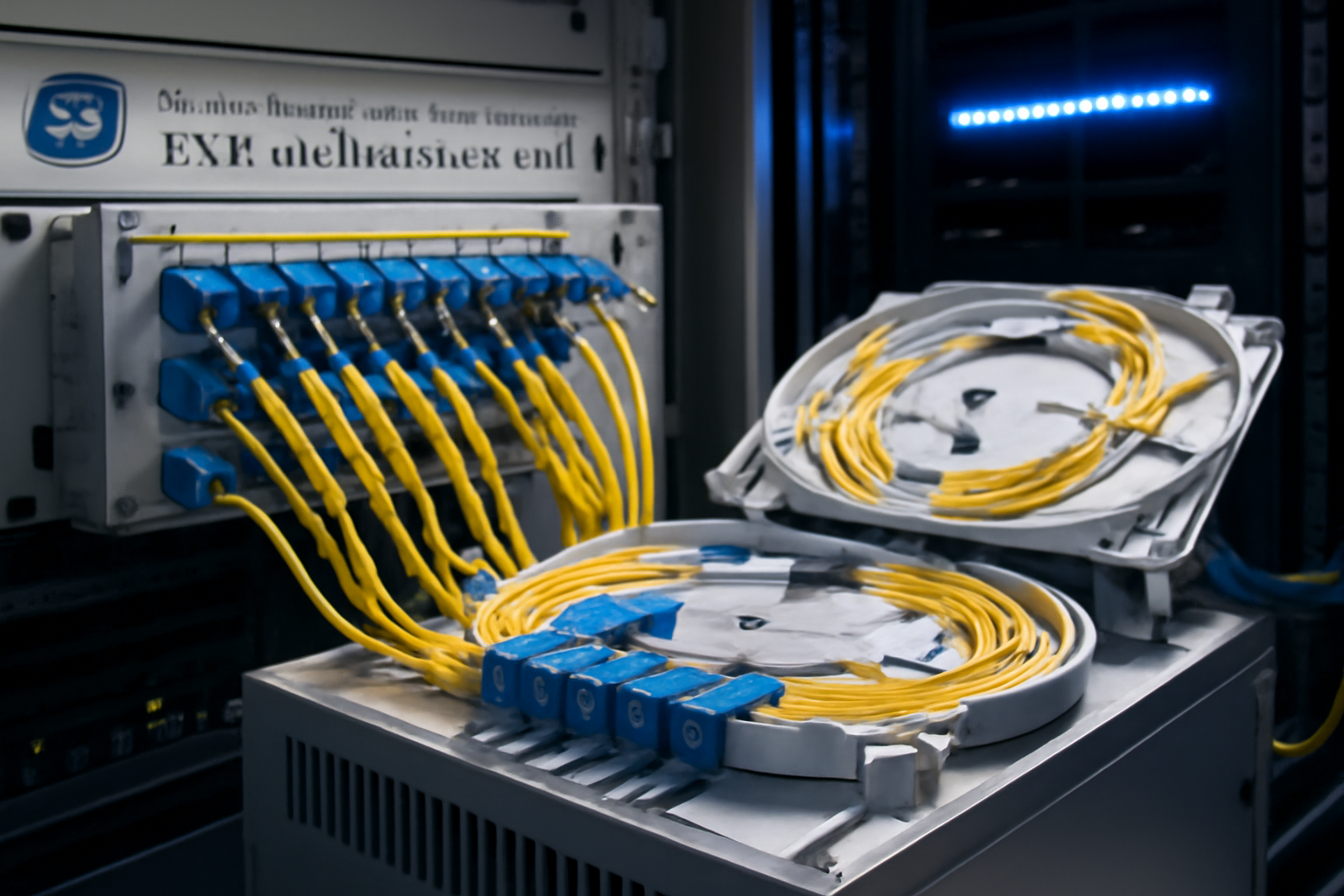
Technical connection is achieved through modern splice boxes in 1U form factor, enabling maximum packing density with minimal space requirements. Professional network infrastructure demands systems capable of terminating up to 96 fibres in a single rack unit – a requirement optimally met by modular splice systems.
Technical Standards for FTTH Deployment in Hesse
The fibre rollout Wiesbaden, ESWE supply, FTTH Hesse follows strict technical specifications according to VDE 0800-730 and requirements of the European Gigabit Infrastructure Regulation. The new VDE guideline, published in February 2026, significantly simplifies building installation by eliminating the classification of optical fibres as electrical cables with fire hazard.
| Technical Parameter | Standard Requirement | Wiesbaden Requirement |
|---|---|---|
| Fibre Type | ITU-T G.657.A2 | Bend-insensitive for buildings |
| Connector Standard | IEC 61754-15 | E2000 APC for FTTH |
| Attenuation Budget | < 0.35 dB/km | Maximum range 20 km |
| Return Loss | > 60 dB (APC) | Critical for transmission quality |
| Port Density | Min. 48 Ports/U | Optimal: 96 Ports/U |
Modern splice systems must not only meet these standards but also account for practical installer requirements. Pre-terminated solutions reduce installation time compared to traditional splicing methods.
Deployment Strategies and Co-operation Models in Wiesbaden
Wiesbaden pursues a market-driven approach to fibre rollout—fibre deployment, ESWE supply, FTTH Hesse—without direct municipal intervention. Four major players drive deployment in parallel: Vodafone has already modernised 3,100 cable households with new fibre nodes, while Deutsche Glasfaser, Telekom and OXG Glasfaser execute independent rollout projects.
Fiber Products Quality Commitment: As an official Diamond Partner and manufacturer, we produce modular splice systems in Europe. Benefit from Swiss precision and in-house manufacturing.
The Gigabit Region FrankfurtRheinMain through framework contracts with major network operators. This model enables competition whilst capturing economies of scale – a decisive advantage for rapid realisation of ambitious deployment targets.
- Decentralised deployment model without municipal market intervention
- Parallel rollout by four major actors
- Coordination through Gigabit Region FrankfurtRheinMain GmbH
- Target: 90 percent household coverage by 2030
- Investment volume: hundreds of millions of euros
Modular Splice Systems for Municipal Network Operators
For municipal utilities and network operators, modular splice systems are key to efficient network organisation. The SlimConnect series enables 96 fibres in 1U, doubling port density compared to conventional 48-port systems. In a typical municipal project with 10,000 fibres, space requirements shrink from 105 to just 55 rack units.
Technical benefits are particularly evident in confined equipment rooms at municipal facilities. Compact design allows continued use of existing distribution cabinets while modular architecture enables phased expansion without service interruption.
| System Type | Fibre Count | Height | Application |
|---|---|---|---|
| SlimConnect | up to 96 | 1U | Distribution points, PoP |
| VarioConnect | up to 288 | 3U | Main distribution, data centres |
| DIN Rail Splice Box | up to 24 | DIN Rail | Industrial facilities, switch cabinets |
Timeline and Milestones for FTTH Deployment 2026–2030
The fibre rollout Wiesbaden, ESWE supply, FTTH Hesse follows a structured schedule with clear milestones. From November 2025, accelerated approval procedures under the EU Gigabit Infrastructure Regulation take effect with maximum four-month processing time. This significantly accelerates deployment compared to previous procedures, which sometimes exceeded one year.
- Q1 2026: Start of accelerated approval procedures
- Q2 2026: Central Information Point (ZIS) operational
- 2026–2027: Business area deployment (640 locations regionally)
- 2028–2029: Comprehensive residential area coverage
- 2030: Target 90% household coverage achieved
From February 2026, all new buildings and substantially renovated structures must be equipped with fibre-ready infrastructure – a requirement further driving demand for professional distribution systems.
Technical Challenges in Urban Fibre Deployment
Dense urban development in Wiesbaden presents particular demands on fibre infrastructure. Existing buildings often require creative fibre routing solutions, whilst historic structures impose special protection requirements. Bend-insensitive fibres to ITU-T G.657.A2 enable bend radii of just 7.5 mm without significant attenuation increase.
Connector selection is critical for long-term network stability. E2000 connectors with integrated dust caps and APC polish (8°) achieve return loss exceeding 60 dB – essential for distortion-free transmission at high data rates. Higher acquisition costs compared to PC variants are offset through reduced failure rates and lower maintenance costs.
Quality Assurance and Documentation in FTTH Networks
The fibre rollout Wiesbaden, ESWE supply, FTTH Hesse demands comprehensive documentation of all network components. Modern splice systems therefore integrate RFID tags and QR codes for automatic connection path logging. Measurement of each segment with OTDR equipment documents attenuation values below 0.25 dB per splice point as quality assurance proof.
- Automatic documentation via RFID/QR code
- OTDR measurement record for each fibre
- Georeferenced route mapping
- Digital twin of the fibre-optic network
- 5 years’ warranty on certified systems
Systematic quality assurance reduces operating costs and simplifies future network expansions. For municipal operators this is particularly important, as public networks often operate for decades.
Integration into Existing Supply Infrastructure
ESWE Supply leverages synergies between electricity, gas and fibre-optic infrastructure. When civil works are already scheduled, empty conduits for fibre are installed concurrently – a cost saving of up to 80 percent compared to separate construction. Shared use of equipment rooms and distribution cabinets further optimises operating costs.
Modular DIN rail systems enable direct integration of fibre distributors into existing electrical utility switch cabinets. With IP65 rating, these systems suit harsh environments in transformer stations or access chambers.
Economics and Financing Models
The fibre rollout Wiesbaden, ESWE supply, FTTH Hesse is based on a mix of commercially viable and subsidised projects. Investment costs averaging €2,000 to €3,000 per building connection typically amortise within 12–15 years for municipal operators. High-density splice systems with up to 96 fibres per rack unit reduce equipment room infrastructure costs.
| Cost Item | Conventional | High-Density System | Saving |
|---|---|---|---|
| Cabinets (10,000 fibres) | 3 × 42U | 2 × 42U | Reduced |
| Cooling | 15 kW | 10 kW | Reduced |
| Floor Space | 6 m² | 4 m² | Reduced |
| Installation Time | 120 hrs | 80 hrs | Reduced |
Future Outlook for Fibre in Wiesbaden
The fibre rollout Wiesbaden, ESWE supply, FTTH Hesse establishes the foundation for the region’s digital transformation. With planned 90 percent coverage by 2030, Wiesbaden positions itself as an attractive business location. Consistent deployment of modular splice systems and professional distribution technology ensures long-term infrastructure scalability.
As a manufacturer of modular fibre-optic solutions and official Diamond Partner, Fiber Products delivers the complete system solution – from splice boxes to E2000 connectors in Swiss precision quality. The 5 years’ warranty on all systems underlines confidence in manufacturing excellence.
FAQ: Technical Questions on Fibre Rollout Wiesbaden
Which splice systems suit ESWE infrastructure projects?
Which splice system fits follows from the interface and the density the project asks for, not from a single product line. Each interface is standardised separately — E-2000/LSH under IEC 61754-15, SC under IEC 61754-4 and LC under its own part of the IEC 61754 series — so specify the coupling type per port instead of assuming one part number covers all three. Our splice modules arrive fully assembled and splice-ready and are available with E-2000, LC or SC couplings in APC and PC.
How do APC and PC connectors differ in FTTH deployment?
APC connectors (angled physical contact) deliver the highest return loss – DIAMOND specifies min. 70 dB for single-mode APC – and are widely used in FTTH/PON, where back-reflection must be kept low. PC/UPC is also a single-mode polish (min. 50 dB), not a multimode-only option. Insertion loss is identical for both (max. 0.3 dB), so choose APC by reflectance requirement, not by default.
Which standards apply to fibre installations in Wiesbaden?
Since February 2026 the VDE guideline VDE 0800-730 has covered material requirements for FTTH in-building fibre networks – a guideline, not a binding standard. Under the EU Gigabit Infrastructure Regulation (EU) 2024/1309, new buildings need fibre-ready in-building infrastructure; the fibre type is left to national specifications. Generic cabling follows DIN EN 50173 / ISO/IEC 11801, Part 3 for industrial premises.
How many fibres should a modern municipal network plan for?
Minimum 2 fibres per residential unit and 4–8 fibres per commercial unit should be provisioned. Backbone connections between distribution points require 48–144 fibres. Modular systems enable phased expansion without service interruption.
What attenuation values are acceptable in professional FTTH networks?
Attenuation is wavelength-dependent: ITU-T G.652.D permits max. 0.40 dB/km from 1310-1625 nm and max. 0.30 dB/km at 1530-1565 nm. G.652 does not specify splice or connector loss – those come from the project link budget, and quality connectors stay below 0.3 dB. In FTTH the decisive limit is the PON optical path budget, including splitter loss, not a per-kilometre rule.
How do pre-terminated systems reduce installation time?
Pre-terminated splice cassettes and factory-equipped modules reduce installation time. Instead of labour-intensive field splicing, only connector installation is required. Two technicians can fully terminate 3,456 fibres in an 8-hour shift.
Order directly from the shop: fiber-products.de
Request a Quote Today
Free consultation – personalised offer within 24 hours