CE Marking for Fibre Optic Components: What is Required?
CE Marking for Fibre Optic Components: What is Required?
CE marking for fibre optic products, declaration of conformity for optical fibre, and product certification are mandatory for all fibre optic components distributed in the EU, provided they fall under one of the applicable EU directives — particularly the Low Voltage Directive 2014/35/EU for active components and the RoHS Directive 2011/65/EU for electronic parts. Passive fibre optic components such as splice boxes, patch cables or connectors do not require CE marking, as they do not fall under the harmonised directives. As of 2026, the declaration of conformity must be made digitally available in accordance with the Omnibus IV package.
This distinction between active and passive components frequently causes confusion in procurement. Whilst an optical distribution frame or splice cassette is legally compliant without a CE mark, media converters, optical amplifiers or active network components must bear the CE marking. The new Market Surveillance Regulation (EU) 2019/1020 also tightens documentation requirements.
Legal Basis for Fibre Optic CE Compliance in the DACH Region
CE marking for fibre optic components is based on the New Legislative Framework (NLF) of the EU, which has harmonised product safety since 2008. For Germany, the Product Safety Act (ProdSG) additionally applies; in Austria, the Product Safety Act 2004; and in Switzerland, the technical standards of the Product Safety Ordinance. CE fibre optic compliance, declaration of conformity for optical fibre, and product certification follow a standardised assessment procedure.
The following EU directives are relevant for fibre optic components:
- Low Voltage Directive 2014/35/EU: Applies to electrical equipment between 50–1000V AC and 75–1500V DC
- EMC Directive 2014/30/EU: Electromagnetic compatibility for all electrical/electronic devices
- RoHS Directive 2011/65/EU: Restriction of hazardous substances in electrical and electronic equipment
- REACH Regulation (EC) No 1907/2006: Chemical registration for all products
- Radio Equipment Directive 2014/53/EU: For radio-based fibre optic components
As of 12 February 2026, the EU Gigabit Infrastructure Act (GIA) also applies, which mandates fibre-optic-ready building infrastructure in new buildings. Although this primarily affects installation, it increases demand for standards-compliant components with demonstrable quality.
Which Fibre Optic Components Require CE Marking?
The obligation to apply CE marking depends on the technical classification of the component. Here is a clear overview of common fibre optic products:
| Component | CE Required | Relevant Directive | Reason |
|---|---|---|---|
| Media converter | Yes | 2014/35/EU, 2014/30/EU | Active electronic component |
| Optical amplifier | Yes | 2014/35/EU, 2014/30/EU | Contains active electronics |
| Splice boxes (passive) | No | — | Purely mechanical product |
| Patch cables | No | — | Passive transmission |
| Connectors (LC, SC) | No | — | Mechanical connection |
| ODF with power supply | Yes | 2014/35/EU | Electrical components integrated |
| Splice modules (passive) | No | — | No electrical components |
| Network cabinets with PDU | Yes | 2014/35/EU | Power distribution integrated |
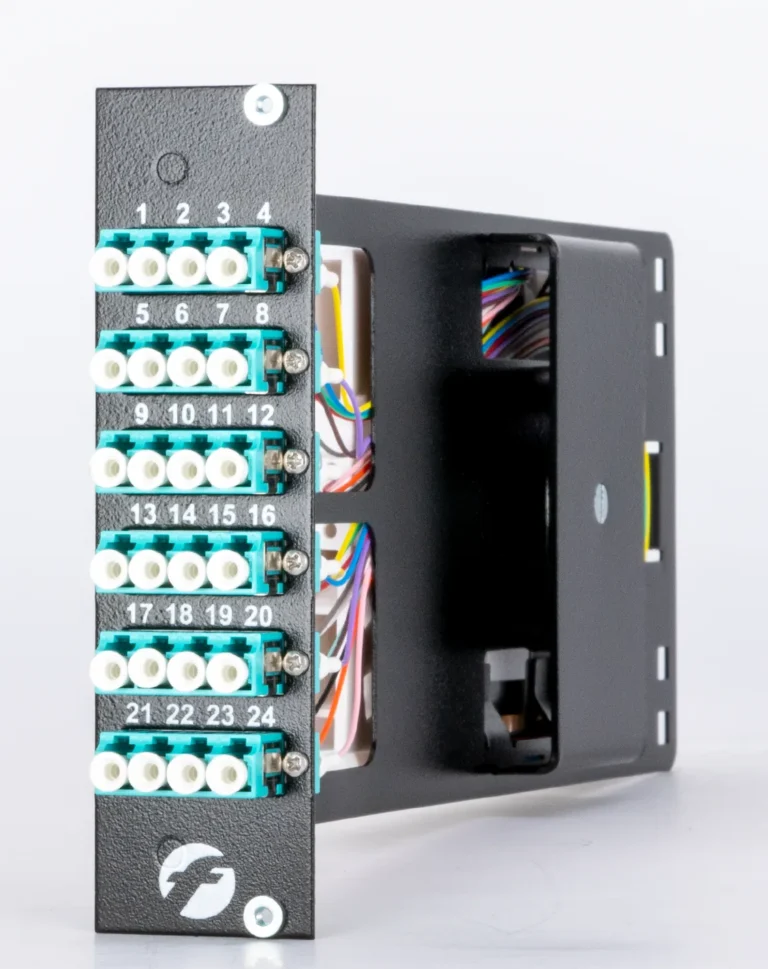
This distinction is essential for procurement and quality assurance teams: whilst our SlimConnect 1HE splice modules with up to 96 fibres are passive components that do not require CE marking, integrated systems with power supply must be fully compliant.
Declaration of Conformity for Optical Fibre: Content and Requirements 2026
CE fibre optic compliance, declaration of conformity for optical fibre, and product certification requires, as of 2026 under the Omnibus IV package, digital provision of the declaration of conformity. This must be available for 10 years after being placed on the market and must contain the following mandatory information:
- Unique product identification (serial number, type, batch)
- Name and address of the manufacturer and any authorised representative
- Confirmation of conformity with all relevant EU directives
- Reference to applied harmonised standards (e.g. IEC 61754-15 for LC connectors)
- Name and identification number of the notified body (if involved)
- Date and signature of the responsible person
The digital declaration of conformity must be accessible via a QR code or URL on the product or packaging. This also applies to imported fibre optic components from East Asia.
Fiber Products Quality Promise: As an official Diamond Partner and manufacturer, we produce modular splice systems in Europe. Benefit from Swiss precision and 5 years warranty on our systems.
Harmonised Standards for Fibre Optic Products in Detail
Compliance with harmonised standards establishes a presumption of conformity — a legal advantage in CE marking. The following standards are essential for fibre optic components:
- EN 61300 series: Basic test and measurement methods for optical fibre connector elements
- EN 61753 series: Operating performance of optical fibre connector elements (Category C for controlled environment, Category I for industrial)
- EN 61754 series: Interfaces for optical fibre connectors (e.g. -15 for LC, -4 for SC)
- EN 60825-1: Safety of laser equipment (for active components)
- EN 50173 structured cabling standards: Information technology — Generic cabling systems for customer premises
The new VDE Guideline 0800-730 (2026) further simplifies building installation and reduces fire safety requirements through optimised routing. This noticeably reduces installation costs with consistent safety levels.
Test Procedures and Documentation for CE Fibre Optic Components
The conformity assessment procedure for active fibre optic components typically follows Module A (internal production control) of Decision 768/2008/EC. For safety-critical applications, Module B (EU type-examination) may be required.
| Test Step | Requirement | Documentation | Frequency |
|---|---|---|---|
| Applicable EU directives (alt auf ‘EN ISO 12100’ kuerzen, damit nur die Requirement-Zelle ersetzt wird und | unangetastet bleibt) | Risk analysis document | On design change |
| EMC testing | EN 61000-6-2/-4 | Test report from accredited laboratory | Type testing |
| Electrical safety | EN IEC 62368-1 | Test protocol | Serial inspection |
| Optical power | EN 61300-3-4 | Attenuation measurement < 0.25 dB | Sample 1% |
| Environmental testing | EN 61300-2 series | Climate test protocol | Type testing |
Technical documentation must include all test reports, design drawings and bills of materials. As a European manufacturer, we routinely conduct these tests for our active components.
Market Surveillance and Consequences of Missing CE Marking
The Market Surveillance Regulation (EU) 2019/1020 has significantly tightened controls since July 2021. Market surveillance authorities conduct more frequent spot checks, particularly for imports from third countries. Where CE fibre optic marking, declaration of conformity for optical fibre, or product certification is absent or incorrect, the following penalties apply:
- Sales ban and recall of already delivered products
- Fines up to €100,000 under § 39 ProdSG
- Criminal prosecution in case of personal injury
- Civil liability to injured parties
- Entry in the European RAPEX rapid alert system
For procurement teams, this means: always verify the completeness of CE documentation for active components. Request the declaration of conformity proactively and archive it digitally.
Special Case: E2000 Connectors and Industrial Applications with IP65
Fibre optic components for industrial environments are subject to special requirements. The E2000 connector with its spring-loaded protective shutter achieves IP65 protection class, making it suitable for dusty and humid environments. As a Diamond Partner, we offer the complete E2000 product range in Swiss quality.
For DIN rail-mounted applications, the following additional requirements apply:
- Vibration resistance to IEC 61373 (railway applications)
- Temperature range -40°C to +85°C under Category I
- EMC immunity to EN 61000-6-2 for industrial environments
- Flammability to UL94 V-0 for enclosure material
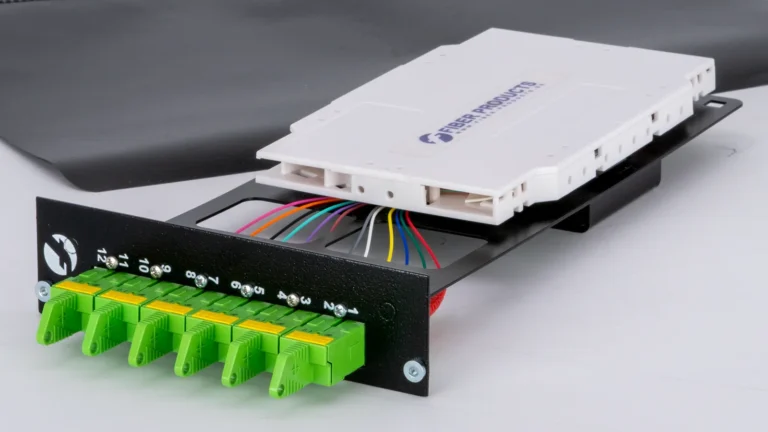
Our DIN rail-mounted boxes meet these requirements and provide space for up to 24 fibres in compact form — ideal for automation control cabinets.
MPO/MTP Connectors and High-Density Requirements
Data centres increasingly use MPO/MTP connectors for high-density cabling. These multi-fibre connectors carry 12, 24 or 72 fibres in a single mating cycle. CE relevance often arises indirectly through integration into active components.
Key standards for MPO/MTP:
- IEC 61754-7: Mechanical interface for MPO connectors
- IEC 61300-3-35: Attenuation measurement for multi-fibre connectors
- TIA-604-5: FOCIS-5 for MPO connector geometry
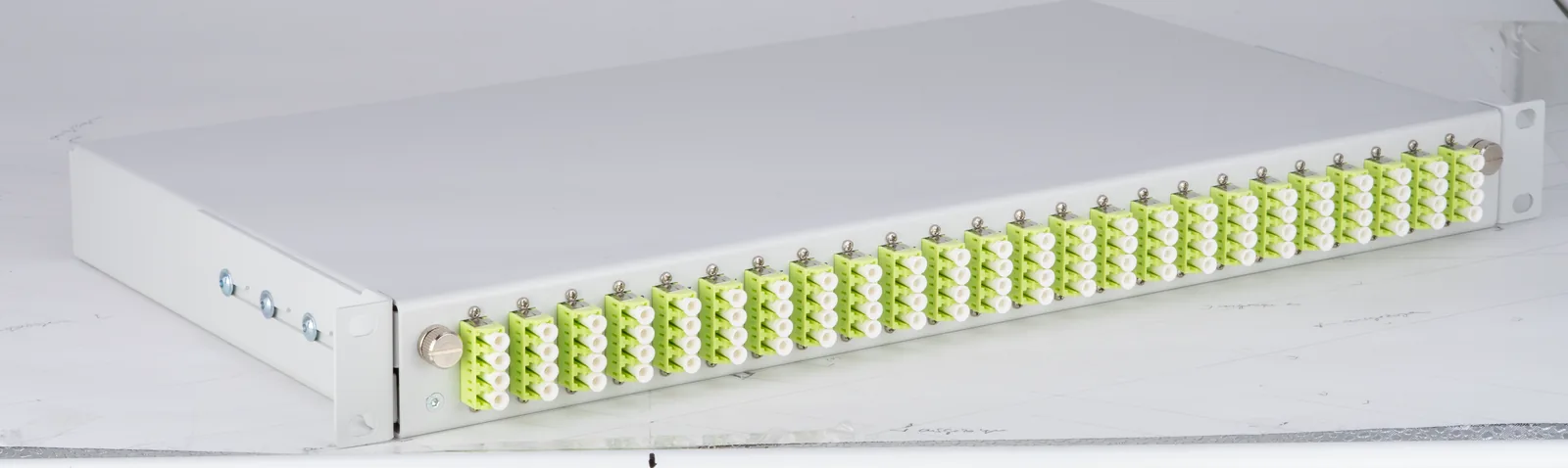
Our VarioConnect 3HE systems support MPO breakout modules and enable up to 288 fibres in a 19-inch enclosure — the highest packing density on the market with full modularity.
Practical Implementation: Procurement and Quality Assurance Checklist
For legally secure procurement of fibre optic components, we recommend the following approach:
- Classification: Active or passive? Electrical components present?
- For active components: verify CE mark on product or packaging
- Request declaration of conformity (from 2026, digitally via QR code)
- Request test reports for relevant standards (EMC, safety)
- Demand technical documentation in English or German
- Inquire about the EU authorised representative (for third-country imports)
- Request supplier declaration for RoHS and REACH compliance
- In case of uncertainty: consult an accredited test laboratory
This systematic review protects against costly recalls and legal consequences. The investment in verified quality pays dividends in the long term.
Future Development: Digital Product Passports and GIA Requirements
From 2026, the EU Gigabit Infrastructure Act introduces new documentation requirements for in-building fibre optic infrastructure. Every residential unit must be equipped with at least 4 fibres and their installation must be digitally documented. This increases demand for pre-terminated, modular solutions.
The Digital Product Passport (DPP) is expected to become mandatory from 2027 for all products subject to CE marking:
- Unique product ID via blockchain technology
- Complete material declaration for circular economy
- Production CO₂ footprint
- Repair and recycling information
- Real-time availability of all conformity documents
As a European manufacturer, we are prepared for these requirements and already provide the transparency demanded by our modular systems.
FAQ: Common Questions on CE Fibre Optic Marking, Declaration of Conformity and Product Certification
Do passive splice boxes require CE marking?
No. Splice boxes are not covered by any EU legislation or harmonised standard that triggers CE marking — the decisive test is the applicable legislation, not whether a product is passive. They should be built to IEC 61756-1 (interface standard for fibre management systems) and IEC 61753-1 (performance standard for passive components).
How long must the declaration of conformity be retained?
Technical documentation including the declaration of conformity must be retained for 10 years after the last product of the series is placed on the market. From 2026, digital provision is mandatory.
Does CE marking apply to Switzerland?
Switzerland generally recognises CE marking but has its own regulations. The Mutual Recognition Agreement (MRA) governs the details. For fibre optic components, comparable technical requirements apply.
What happens with incorrect CE marking?
Incorrect or missing CE marking results in sales bans, product recalls and fines up to €100,000. The manufacturer or importer is also civilly liable for all resulting damages.
Do pre-terminated patch cables require CE marking?
It depends on the legislation, not on passivity. Optical fibre cables intended for permanent installation in construction works are covered by EN 50575 under the CPR (EU) 305/2011 and need CE marking, a Declaration of Performance and a reaction-to-fire Euroclass; movable equipment cords are not. Performance follows IEC 61753-1, cable design IEC 60794.
How do I verify the authenticity of CE marking?
Request the declaration of conformity and verify its completeness. Check for the correct CE mark size (minimum 5 mm), the mention of harmonised standards and the identification of a notified body for safety-critical products.
Conclusion: Legal Security Through Systematic Review
CE fibre optic marking, declaration of conformity for optical fibre, and product certification are essential for active fibre optic components and are being further tightened by new EU requirements such as the Omnibus IV package and the digital product passport. Whilst passive components such as splice boxes or patch cables do not require CE marking
Request a Quote
Do you have questions about our fibre optic solutions? Our expert team is happy to advise you — free of charge and without obligation.