Fibre Optic & Splice Technology 2026: Key Trends for Network Operators and Telcos
Fibre rollout in Germany is accelerating in 2026 — and with it, requirements for passive network components are changing fundamentally. Higher fibre densities, new standards, XGS-PON deployment and increasing automation in the splicing process: for telecommunications providers and network operators, it pays to examine the developments that will shape the market in the next 12–18 months.
Telecommunications providers in the DACH region are investing heavily in expanding their fibre optic networks. The German government is pushing comprehensive gigabit expansion by 2030, while technical requirements for splicing systems are rising exponentially. Modern carriers need flexible solutions that support both point-to-point and PON architectures.
High-density systems revolutionise distribution technology
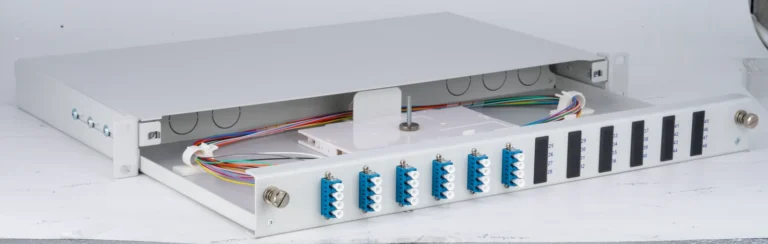
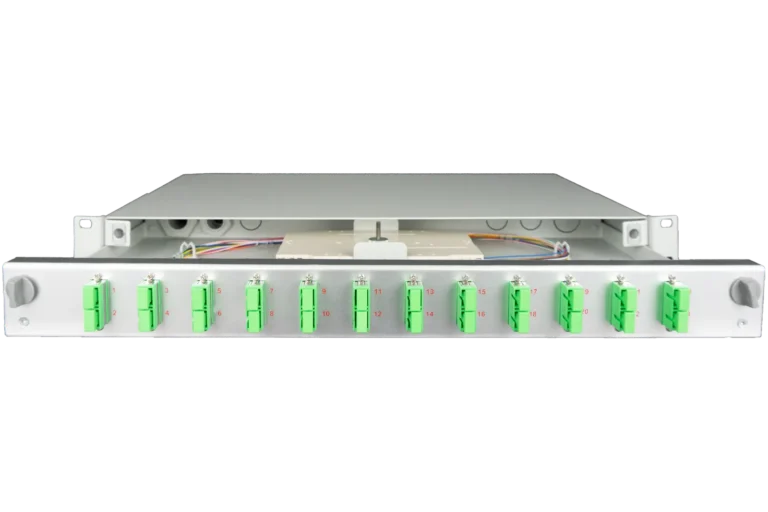
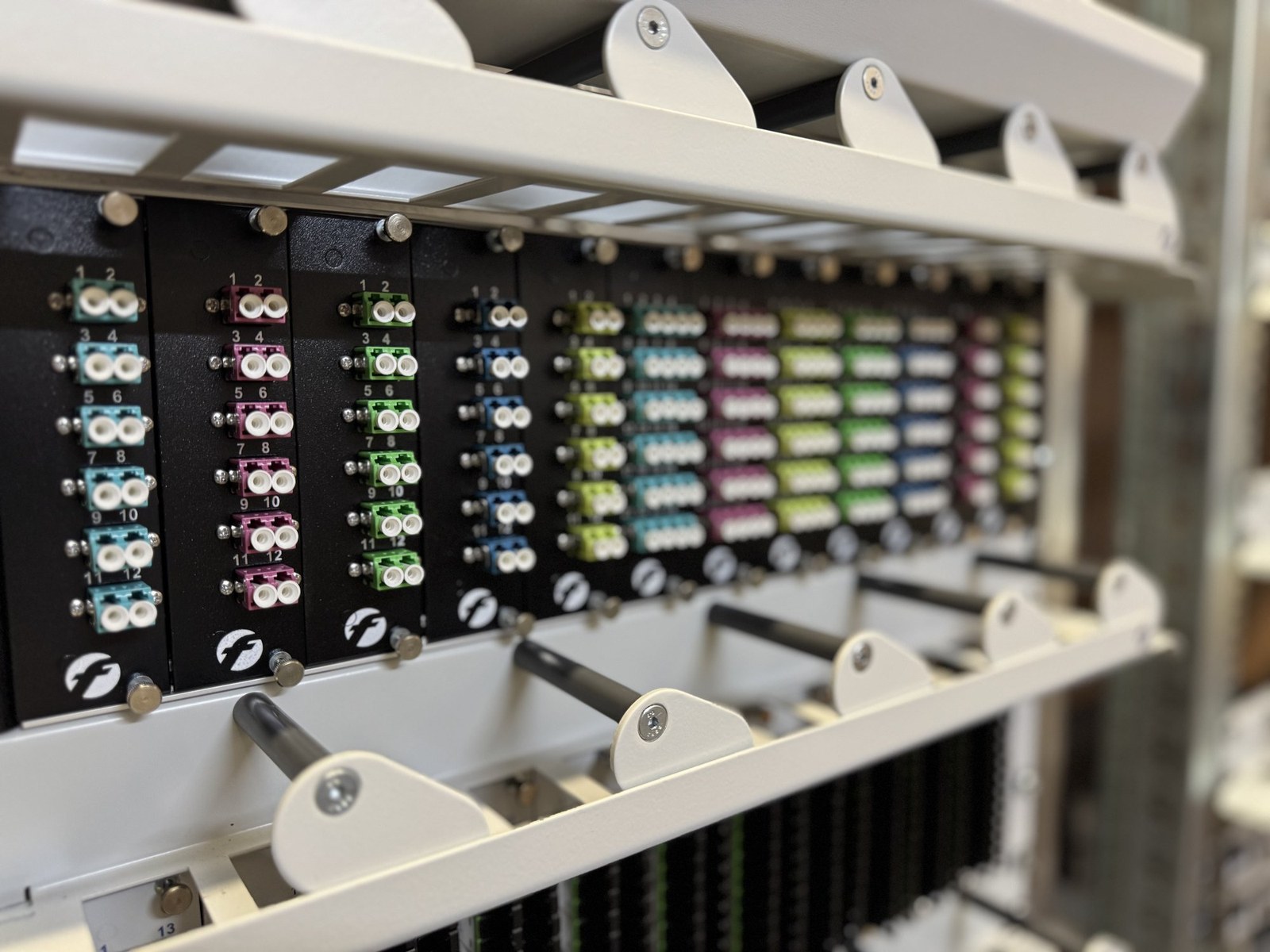
Fibre optic trends for 2026 clearly point towards maximum port density. While conventional splice boxes accommodate a maximum of 48 fibres in 1U, modern modular systems enable double the capacity. This consolidation is essential for telecommunications providers working within existing distribution cabinets and colocation space.
- Rack footprint reduction with the same fibre count
- Modular expandability without operational interruption
- Integrated cable management for bend radii per IEC 60794
- Front access for simplified maintenance
- Colour coding per DIN VDE 0888 for quick identification
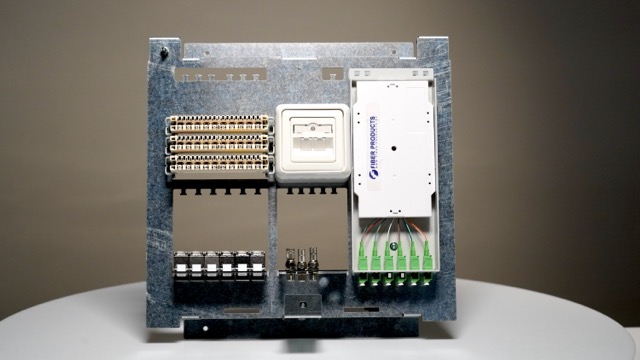
The new high-density systems use innovative splice cassettes with 12 or 24 fibres per unit. These can be installed and removed without tools, significantly reducing maintenance windows. As an official Diamond Partner and manufacturer, Fiber Products offers exactly these high-density solutions in European production with the SlimConnect series.
MPO/MTP connectors accelerate FTTH rollout
A central aspect of future splicing technology is the increased use of multi-fibre connectors. MPO/MTP connectors with 12, 24 or even 72 fibres enable rapid connection of entire fibre bundles. For telecommunications providers, this means significant time savings during network expansion.
| Connector type | Fibre count | Insertion loss | Application |
|---|---|---|---|
| LC-Duplex | 2 fibres | < 0.25 dB | End-user connection |
| MPO-12 | 12 fibres | < 0.35 dB | Backbone links |
| MPO-24 | 24 fibres | < 0.35 dB | Data centre connection |
| E2000-APC | 1 fibre | < 0.20 dB | Test equipment/Premium |
Pre-connectorised MPO cables manufactured in the factory reduce on-site installation times. At the same time, error rates fall significantly thanks to standardised manufacturing processes.
Automated splicing processes increase efficiency
FTTH market Germany shows a clear trend towards automation. Modern splicing devices with active core alignment achieve attenuation values below 0.02 dB for single-mode fibres. Telecommunications providers benefit from integrated documentation systems that automatically record every splice operation.
- Automatic fibre identification via OTDR integration
- Cloud-based documentation per ISO/IEC 14763-3
- Splice time under 6 seconds per fibre
- Integrated quality control with threshold monitoring
- Remote maintenance and software updates via mobile network
These technological advances enable a single technician to perform up to 200 splices per day – double compared to conventional methods.
Fiber Products Quality Promise: As an official Diamond Partner and manufacturer, we produce modular splicing systems in Europe. Benefit from Swiss precision and in-house manufacturing.
Sustainability and circular economy in focus
Fibre optic trends for 2026 increasingly include sustainability aspects. Telecommunications providers must meet ESG criteria and are increasingly turning to recyclable materials. Modern splice boxes are made from halogen-free plastics.
The modular design allows reuse of individual components. Defective modules can be replaced without replacing the entire system. This repairability extends service life to over 25 years and significantly reduces environmental impact.
- Use of 70% recycled aluminium in housings
- Modular design for easy repair and upgrade
- Energy-efficient production in Europe
- Take-back systems for end-of-life equipment
- Carbon-neutral logistics for regional deliveries
Intelligent monitoring systems for proactive maintenance
Future splicing technology increasingly integrates intelligent monitoring functions. RFID tags on splice cassettes enable automatic inventory tracking. Sensors continuously monitor temperature, humidity and mechanical stress.
| Monitoring parameter | Measurement range | Alerting | Standard |
|---|---|---|---|
| Temperature | -40°C to +85°C | SMS/Email | IEC 61300-2-22 |
| Humidity | 0–95% RH | SNMP trap | IEC 61300-2-19 |
| Vibration | 5–500 Hz | Dashboard | IEC 61300-2-1 |
| Access control | 24/7 | Real-time | ISO/IEC 27001 |
This real-time monitoring enables proactive maintenance and reduces unplanned downtime. Telecommunications providers can resolve issues before they impact customers.
Standardisation and regulatory compliance as success factors
FTTH news emphasises the importance of uniform standards. The new IEC 61756 series defines precise requirements for optical interfaces. Telecommunications providers demand seamless compatibility between different manufacturers.
As a manufacturer, Fiber Products meets all relevant standards and offers maximum flexibility with its modular system approach. The splice modules are compatible with standard housings per IEC 60297 and support all common connector types.
- Certification per ISO 9001:2015 for quality management
- Compliance with RoHS 3 and REACH
- CE marking for the European market
- Compliance with the Construction Products Regulation (CPR)
- Interoperability per IEC 61755 guaranteed
Hybrid network architectures require flexible splicing solutions
Fibre optic trends for 2026 show increasing convergence of different network topologies. Telecommunications providers operate parallel infrastructures for GPON, XGS-PON and point-to-point Ethernet. This diversity requires universal splicing systems.
Modern distribution systems must accommodate different splitter stages, wavelength multiplexers and active components. The modular design enables integration of 1:32 or 1:64 splitters directly in the splice box. Additional slots for SFP transceivers create space for active network components.
Security aspects gain importance
As fibre optic infrastructure becomes critical, security requirements increase. Future splicing technology integrates multi-layered protection concepts. Electronic locks log every access, while alarm sensors detect unauthorised manipulation.
- Access control via RFID card or biometrics
- Encrypted logging per BSI baseline protection
- Tamper detection for mechanical interference
- Integration with network operator SIEM systems
- Redundant alerting via multiple channels
These security features are particularly relevant for critical infrastructure operators under KRITIS regulations. Comprehensive documentation meets regulatory requirements and compliance obligations.
Cost optimisation through intelligent inventory management
FTTH news increasingly reports efficiency gains in inventory management. Digital twins of splicing infrastructure enable precise capacity planning. AI-supported forecasting models optimise spare parts provisioning.
Integration of splice documentation into GIS systems greatly simplifies network management. Every fibre is uniquely identifiable and its routing is fully traceable. This reduces troubleshooting time.
| Optimisation area | Traditional | Digitally optimised | Savings |
|---|---|---|---|
| Inventory stock | Manual | RFID-automated | Reduced |
| Troubleshooting | 2–4 hours | < 1 hour | Reduced |
| Documentation | Paper-based | Cloud-digital | Reduced |
| Maintenance planning | Reactive | Predictive | Improved |
Future-proof investments through scalability
Fibre optic trends for 2026 and future splicing technology demand scalable systems. Telecommunications providers must build infrastructure today that will support 400G and 800G Ethernet tomorrow. Modular splicing systems provide this future-proofing.
Investment in high-quality splicing infrastructure with 5 years warranty quickly pays for itself through reduced operating costs. Fiber Products offers this extended warranty on all modular systems.
FAQ: Common Questions About Fibre Optic Trends and Splicing Technology
What port density is standard for splice boxes in 2026?
The emerging standard is 96 fibres per 1U. High-density systems like the SlimConnect series achieve this capacity through optimised cassette geometry and are available today.
Are MPO connectors more reliable than classic LC connections?
MPO connectors achieve insertion loss values below 0.35 dB and return loss above 60 dB with professional termination. Reliability matches that of LC connectors with correct handling.
How important is backward compatibility in splicing systems?
Backward compatibility is essential. Modern systems must complement existing infrastructure. All Fiber Products modules are compatible with standard 19-inch housings per IEC 60297.
What role do AI and machine learning play in splicing technology?
AI already optimises splice parameters in real-time and identifies fibre types automatically. In future, AI systems will also handle preventive maintenance and network optimisation.
How are splice work costs evolving?
Despite rising technician hourly rates, total cost per splice is decreasing through automation. Modern equipment reduces work time per splice.
Which standards are relevant for telecommunications providers in 2026?
Key standards remain IEC 61300 for test methods, IEC 61755 for connectors and ISO/IEC 11801 for structured cabling. New additions mainly address sustainability aspects.
Conclusion: Fibre Optic Trends 2026 Require Modular Approaches
FTTH news and developments in future splicing technology clearly show: telecommunications providers need flexible, scalable and future-proof solutions. Modular high-density systems with up to 96 fibres per 1U, automated documentation and predictive maintenance will become standard.
As a manufacturer and official Diamond Partner, Fiber Products offers the right solutions for these requirements. From the compact SlimConnect series to scalable VarioConnect systems, we cover all needs of modern telecommunications networks. With 5 years warranty and European manufacturing, we set standards in quality and reliability.
Investment in modern splicing technology is not an option, but a necessity for competitive network operators. Contact our experts for individual advice on your network modernisation and benefit from our decades of experience in the fibre optic sector.
All modular fibre optic components are available directly in the Fiber Products Shop – with 5 years manufacturer warranty.
Request a consultation
Our experts will advise you on modular fibre optic solutions for your specific application – quickly, personally and without obligation.