Splice Box Maintenance and Cleaning: Checklist for Fibre Optic Technicians
Splice Box Maintenance, Fibre Optic Cleaning, Connector Inspection: Checklist for Fibre Optic Technicians
Regular splice box maintenance, fibre optic cleaning, and connector inspection reduce signal loss by up to 0.5 dB and prevent costly network outages caused by contaminated connectors. A single dust particle on the ferrule can increase attenuation of a fibre optic connection from 0.25 dB to over 1.0 dB. This systematic checklist shows technicians and installers the correct maintenance steps according to IEC 61300-3-35 for maximum network stability.
Maintenance Intervals for Splice Boxes in FTTH Rollout
In FTTH deployments, IEC 61300-3-35 recommends semi-annual inspections for splice boxes in critical network sections. Municipal utilities and network operators schedule maintenance windows of 8 hours for comprehensive cleaning work. Practice shows: modular splice systems with up to 96 fibres per 1U reduce maintenance time per port.
- Distribution points (PoP): Quarterly inspection
- Customer connection points (APL): Annual visual inspection
- Industrial environments: Monthly cleaning under dust load
- Data centres: Semi-annual deep cleaning
Major fibre operators document their maintenance windows transparently – as demonstrated in February 2024 with scheduled work from 09:00 to 17:00. These structured intervals minimise unplanned outages across service areas.
Basic Equipment for Professional Fibre Optic Cleaning
Correct cleaning of fibre optic connectors requires specialist cleaning tools. A fibre microscope with 200x magnification makes scratches, pits and contamination on APC and PC ferrules visible.
| Tool | Application | Standard |
|---|---|---|
| Fibre microscope | Inspection before/after cleaning | IEC 61300-3-35 |
| Click cleaner | Dry cleaning LC/SC/E2000 | IEC 61300-3-35 |
| Isopropanol 99% | Wet cleaning for oils | 99% purity grade |
| Lint-free wipes | Manual cleaning MPO/MTP | Lint-free standard |
| Oil-free compressed air | Dust removal from adapters | ISO 8573-1 |
Modern test equipment such as OTDR systems integrate inspection tools directly. These allow immediate documentation of cleaning results with timestamp and GPS coordinates for complete maintenance records.
Step-by-Step Guide: Performing Splice Box Maintenance
The systematic splice box maintenance, fibre optic cleaning, and connector inspection follows a standardised procedure. Each work step is documented and attenuation values are measured before and after maintenance.
Phase 1: Preparation and Safety
- Register maintenance window with network operator
- Notify affected customers (minimum 48 hours in advance)
- Have laser safety glasses Class 1M ready
- Ensure ESD protection for sensitive components
- Create measurement log with baseline values
Phase 2: Inspection of Splice Modules
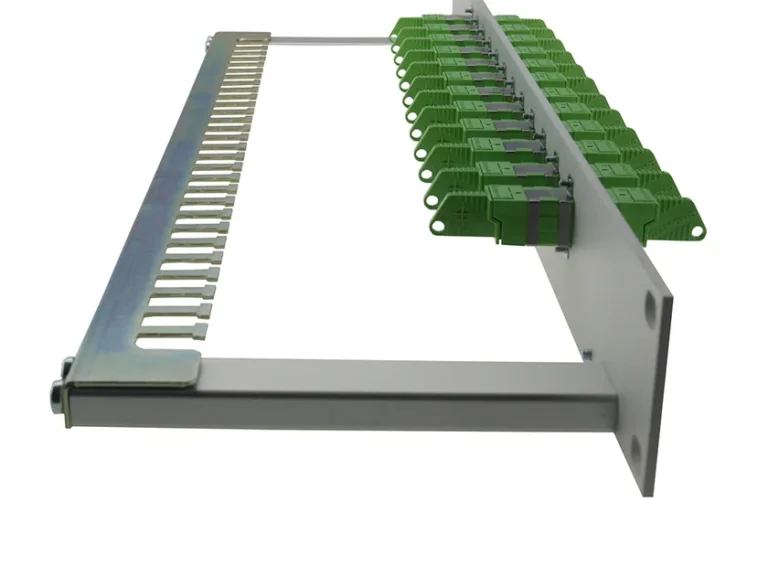
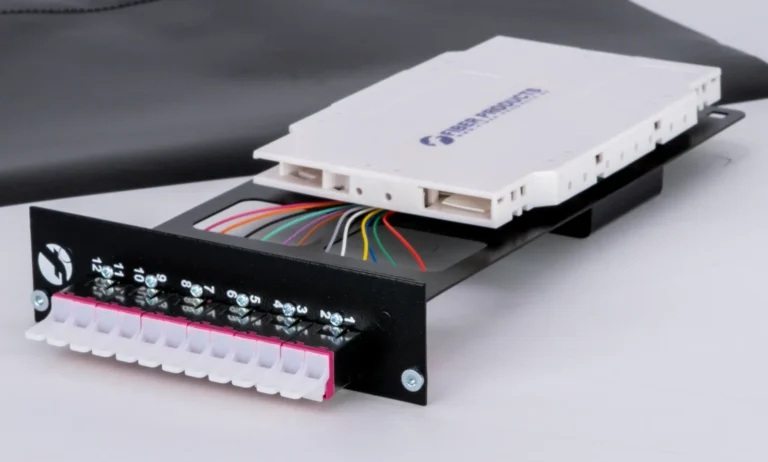
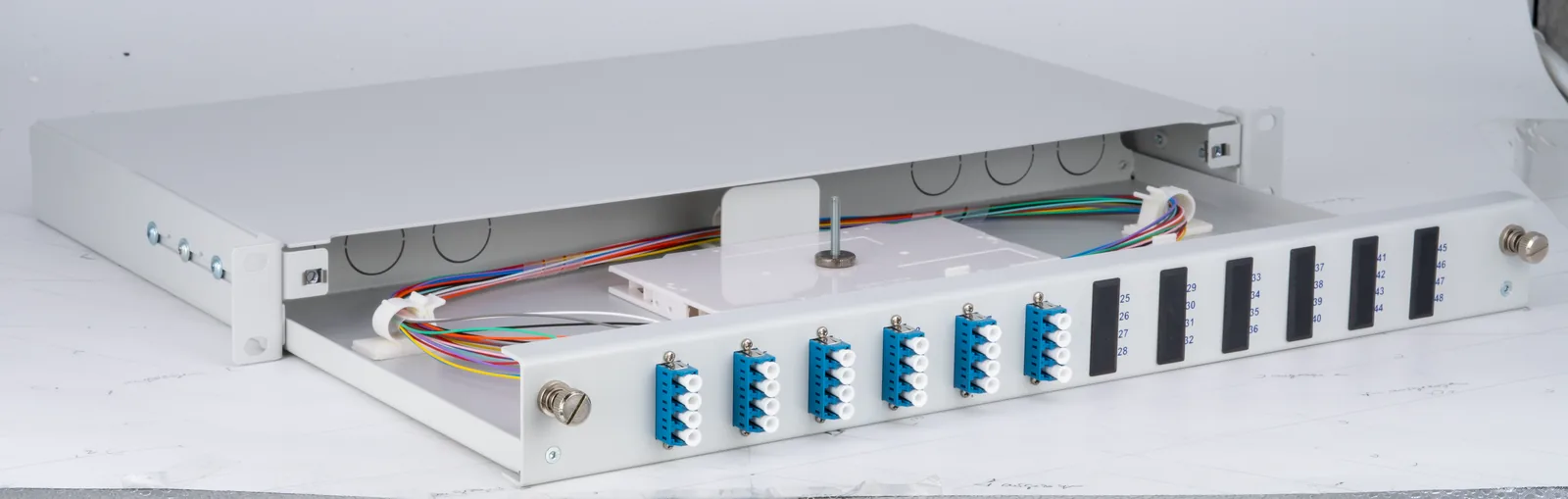
Visual inspection begins with the splice modules in the 19-inch rack. Modern modular systems enable quick access to individual cassettes without interrupting adjacent fibres.
Visual inspection checkpoints include splice protection holders for correct fixation, fibre routing for compliance with 30 mm bend radius requirements, and labelling for readability. Damaged labels are replaced immediately.
Fibre Products Quality Promise: As an official partner and manufacturer, we produce modular splice systems in Europe. Benefit from precision engineering and in-house manufacturing.
Phase 3: Cleaning of Connectors
Cleaning follows the proven principle: Inspect – Clean – Inspect Again. Studies show that network faults are attributable to contaminated connectors.
- Check connectors with fibre microscope for contamination
- Operate click cleaner for LC/SC/E2000 at least 5 times
- Use isopropanol for stubborn contamination
- Clean MPO connectors with specialist cassette cleaner
- Clean adapter interior with stick cleaner
- Final inspection and photo documentation
Specialised Cleaning Procedures for Different Connector Types
Each connector type requires adapted cleaning methods. E2000 connectors with metallic ferrule and integrated protective shutter provide inherent better protection against contamination.
| Connector Type | Cleaning Method | Specification | Typical Attenuation |
|---|---|---|---|
| LC-APC | Click cleaner 8° | Observe angled polish | < 0.25 dB |
| SC-PC | Dry/wet | Larger ferrule | < 0.30 dB |
| E2000-APC | Automatic shutter | Self-protecting | < 0.20 dB |
| MPO-12 | Cassette cleaner | Inspect all 12 fibres | < 0.35 dB |
Premium E2000 technology reduces cleaning effort through its protective shutter. These connectors are particularly suitable for industrial environments with high dust load.
Measurement Log and Documentation According to IEC 61300
Standards-compliant documentation of splice box maintenance, fibre optic cleaning, and connector inspection satisfies client verification requirements. Each measurement receives a unique timestamp and GPS reference.
The log captures attenuation values before and after cleaning, cleaning agents used with batch numbers, and work steps performed with technician identification. Modern OTDR equipment stores this data automatically in SOR format for later analysis.
- Baseline measurement: attenuation, return loss, OTDR curve
- Photo documentation: microscope images of ferrules
- Cleaning record: method, cycles, materials used
- Final measurement: document improvement in dB
- Approval: signature of responsible technician
Fault Diagnosis: Recognising Typical Contamination
Microscopic analysis reveals characteristic contamination patterns. Fingerprints appear as oily films with >1.0 dB additional attenuation. Alcohol residues leave crystalline structures that can only be removed through repeated wet cleaning.
Metallic wear from adapters creates scratches on the ferrule with irreversible attenuation increase. Such connectors must be replaced. Modular systems with replaceable front modules enable quick replacement of faulty components.
Critical Contamination Levels According to IEC 61300-3-35
- Zone A (fibre core): No particles >5 μm acceptable
- Zone B (cladding): Maximum 5 particles between 5–10 μm
- Zone C (ferrule): Scratches <3 μm width acceptable
- Zone D (contact ring): Cosmetic defects without impact
Maintenance of Modular Splice Systems vs. Conventional Sleeves
Modular splice boxes in 1U form factor revolutionise maintenance efficiency. While conventional sleeves require complete disassembly, modular modules allow targeted access to individual cassettes.
Time savings on a 96-fibre installation are substantial. Tool-free removal of splice cassettes reduces the risk of fibre damage during maintenance to nearly zero.
| Criterion | Modular Systems | Conventional Sleeves |
|---|---|---|
| Maintenance time 48 fibres | Low | 120 minutes |
| Operational interruption | Only affected cassette | Entire system |
| Packing density | 96 fibres/1U | 48 fibres/1U |
| Scalability | During operation | Complete rebuild required |
Preventive Measures to Reduce Contamination
The best maintenance is the kind you never need. Dust caps must consistently remain on all unused ports. IP65-certified enclosures provide additional protection in dust-laden industrial environments.
Conditioned equipment rooms with F7 filter class reduce dust load. Relative humidity should be maintained between 40 and 60 percent to minimise electrostatic charge.
- Fit protective caps immediately after disconnection
- Use adapters with integrated shutters
- Prefer E2000 connectors with automatic protective shutter
- Strengthen access control to equipment rooms
- Conduct quarterly air quality measurements
- Train cleaning personnel in fibre optic handling
Special Case: MPO/MTP Connectors in High-Density Environments
Data centres with 400G Ethernet increasingly use MPO-24 and MPO-32 connectors. Cleaning these multi-fibre connectors requires specialist cassette cleaners with automatic feed for up to 500 cleaning cycles.
Each individual fibre among 12, 24 or 32 must be separately inspected. One contaminated channel in an MPO-12 can affect the overall performance of a 100G connection. The splice box maintenance, fibre optic cleaning, and connector inspection takes correspondingly longer here.
Training and Certification of Maintenance Personnel
Correct implementation of splice box maintenance, fibre optic cleaning, and connector inspection requires trained personnel. Certifications according to recognised standards or equivalent qualifications ensure competent execution.
Practical workshops cover correct fibre strip-back, handling of sensitive splice protection elements, and documentation according to operator requirements. Investment in regular training reduces maintenance errors.
ROI Calculation: Investment in High-Quality Splice Systems
Modular splice systems with 5 years warranty amortise themselves through reduced maintenance costs within 24 months. The higher packing density of 96 fibres per 1U halves the required rack space and thus rental costs in data centres.
- Time savings: 3 hours per quarter
- Reduced downtime: fewer unplanned faults
- Space savings: with doubled packing density
- Material costs: less cleaning material with premium connectors
- Warranty benefits: 5 years instead of typical 2 years
As a manufacturer of modular fibre optic solutions, Fibre Products offers the complete system solution from one source. The combination of premium quality, European manufacturing and modular flexibility sets the standard for future-proof fibre optic infrastructure.
FAQ: Frequently Asked Questions on Fibre Optic Maintenance
How often should a splice box be cleaned?
Cleaning intervals depend on environment: data centres require semi-annual maintenance, industrial environments with dust load require monthly inspection. IEC 61300-3-35 recommends at minimum annual inspection of all connectors.
What attenuation values are normal after cleaning?
After professional cleaning, LC/SC connectors should show <0.3 dB and E2000 connectors <0.2 dB attenuation. MPO connectors typically measure <0.35 dB. Higher values indicate damage.
Can I clean fibre optic connectors with pharmacy alcohol?
No, only use 99% purity isopropanol. Pharmacy alcohol often contains additives that leave residues. These crystallise on the ferrule and increase attenuation.
Why are E2000 connectors lower-maintenance?
The E2000’s integrated protective shutter closes automatically on disconnection, protecting the ferrule from contamination. The metallic ferrule is also more robust against scratches than ceramic ferrules.
What does professional splice box maintenance cost?
Costs range from £500 to £2,000 per splice box, depending on fibre count and accessibility. Modular systems reduce these costs through faster access.
How do I document maintenance legally?
Use OTDR equipment with timestamp and GPS function. Document before/after values, cleaning agents used, and technician ID. Store all data in SOR format for 10 years.
Summary and Recommended Actions
Professional splice box maintenance, fibre optic cleaning, and connector inspection ensures network stability in FTTH deployments. With the right equipment, trained personnel and modular splice systems, you sustainably reduce downtime and maintenance costs.
Invest in future-proof fibre optic infrastructure with 5 years warranty. Modular splice solutions combine precision engineering with dependable design – developed for the requirements of municipal utilities, installers and network operators across Europe.
Contact our fibre optic experts for individual consultation on your maintenance concept. Together we optimise your network infrastructure for maximum availability and minimum operating costs.
Order directly from our shop: fiber-products.com
Request a Quote
Free consultation – personalised quote within 24 hours