Special fiber optic applications: Individual solutions for complex network requirements
Special fiber optic applications arise where standard solutions reach their limits and creative approaches are required. With over 30 years of development experience, we have learned that the most interesting projects are often the ones where customers say: “This is not available on the market.” Our router box for the home and the tenant box are perfect examples of how innovative product solutions are created from tailor-made fiber optic projects and are widely used today.
The range of special fiber optic applications is almost unlimited: from organized router cabling in private households to complex tenant distribution systems and completely new approaches for special industries. Our modular system at fiber-products.de forms the proven basis, which can be creatively adapted to create unique solutions.
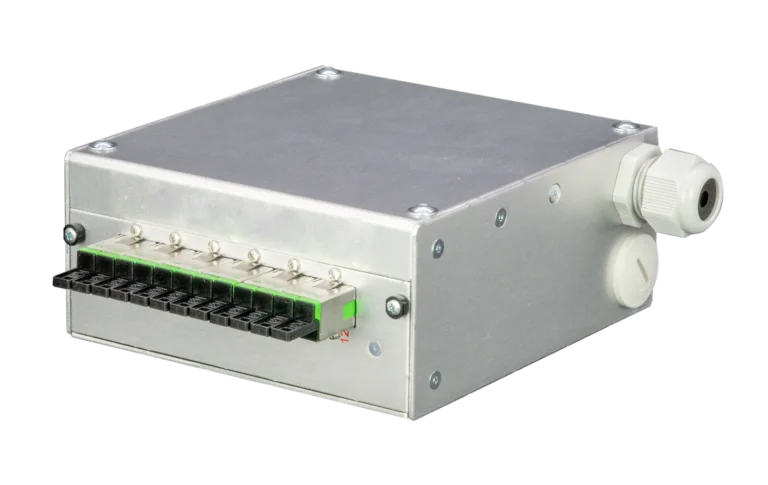
Routerbox: Organization for the digital home
The router box is an example of how special applications can enable innovative fiber optic solutions in the home. What began as a customer request for “neat router organization” has developed into a sophisticated system for modern home installations.
Problems in the modern household
Modern households are more digitally networked than ever before. Routers, switches, media converters and various connection boxes are often gathered in corners or cupboards in a disorganized manner. Cables are criss-crossed, software updates are complicated and expansions require improvised solutions.
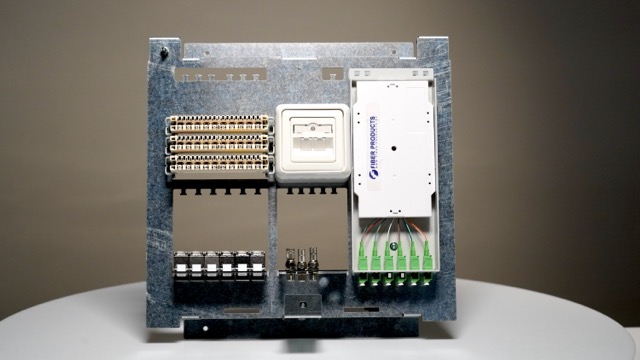
The router box solves these problems by cleverly organizing all connections in a compact system. Router, fiber optic termination, Ethernet distribution and even power supply are housed in a clear and service-friendly way.
The system is based on proven 19″ components, but is specially adapted for domestic use. Complicated technical terms are avoided and the installation is understandable even for technical laymen.
Technical implementation and components
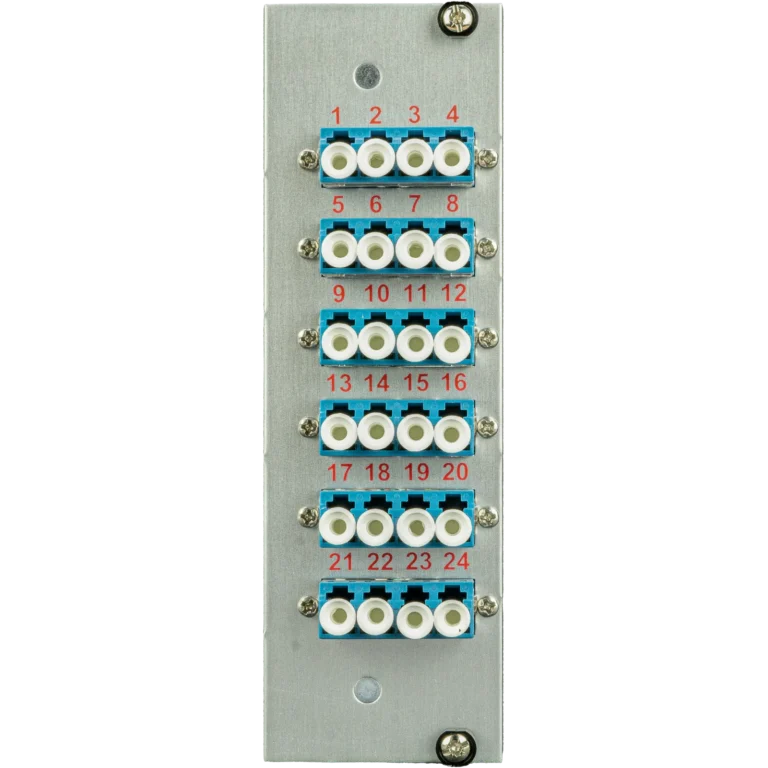
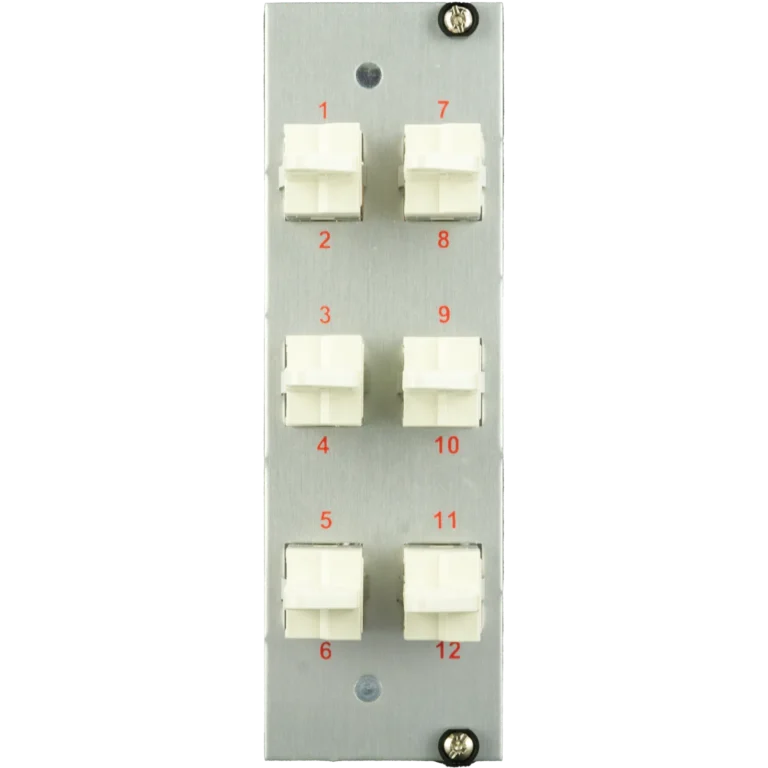
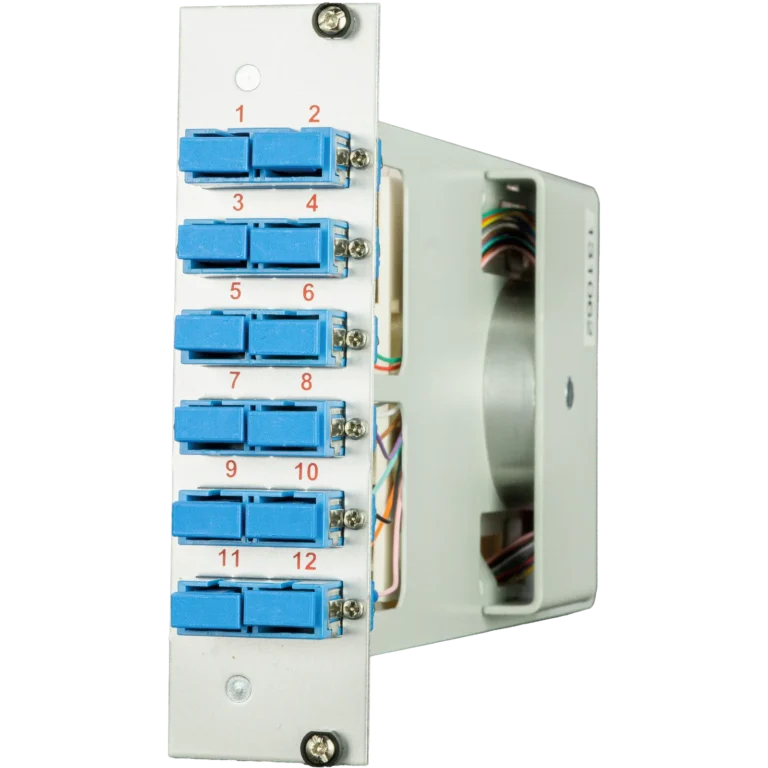
The router box uses BasicConnect front modules for flexible connection configuration. Different connector types can be combined depending on requirements: Fiber optic connections for the provider, Ethernet ports for local devices and even coax connections for TV distribution.
The compact format fits into standard cabinets or can be wall-mounted. The cable routing is designed in such a way that everything remains clearly arranged even if changes are made at a later date.
The integration of the power supply is particularly well thought out. Routers and other active components receive a clean 230V supply, while the fiber optic components do not require any power.
Practical advantages in everyday life
The router box makes home installations service-friendly and future-proof. Software updates, provider changes or expansions become simple plug-and-play processes.
Family men appreciate the tidiness and clarity. No more cables lying around, no more improvised solutions and in the event of problems, it is immediately clear where what is connected.
Organized installations are also a blessing for service technicians. Troubleshooting is easier, updates are quicker and extensions can be neatly integrated.
Tenant box: Fiber optic distribution for residential buildings
The tenant box addresses the special requirements of apartment buildings and residential complexes. This is where technical necessities meet the practical challenges of the housing market.
Challenges in residential buildings
Apartment buildings have complex requirements for fiber optic distribution. Each apartment needs an individual connection, but the installation must be cost-efficient and service-friendly. At the same time, data protection and tenant protection must be taken into account.
Conventional distribution systems are often oversized or difficult to access. Janitors should be able to carry out simple maintenance without specialist knowledge or expensive service calls.
The tenant box solves these challenges with its modular design and well thought-out labeling. Each apartment has clear connections and changes can be made without affecting other tenants.
Modular configuration for different building sizes
Special fiber optic applications must be scalable. The tenant box can be used from small apartment buildings with 4 apartments to large residential complexes with 100+ units.
The VarioConnect modular system enables needs-based configuration. Small buildings use 1U modules, while large complexes rely on 3U or 4U systems.
Extensions are possible at any time. If new apartments are built or tenants require additional connections, modules can be added without disturbing existing installations.
Service and administration
The tenant box makes fiber optic management transparent and simple for property managers and landlords. Clear labeling shows which connection belongs to which apartment.
Insertions and withdrawals become simple reconnection actions. The EasyConnect splice modules enable tool-free configuration, even by less experienced personnel.
Troubleshooting is simplified as each apartment can be tested individually. Provider changes or different tariffs per apartment are possible without any problems.
Industrial special applications
Special industrial fiber optic applications often arise due to special environmental conditions or special production processes. Every industry has its own challenges.
Food industry and hygiene requirements
Food producers have strict hygiene requirements. Special fiberglass applications for this industry use easy-to-clean materials and designs without gaps or hard-to-reach areas.
Stainless steel housing and smooth surfaces allow easy cleaning with high-pressure cleaners. All components are designed so that no dirt particles or bacteria can accumulate.
The IP protection class is selected according to the cleaning process. The glass fiber components must be able to withstand steam cleaning, chemical disinfectants and high temperatures without damage.
Chemical industry and corrosion protection
Chemical production plants place extreme demands on material resistance. Special fiberglass applications for these environments use corrosion-resistant materials and special surface treatments.
Acid vapors, alkaline solutions and organic solvents must not attack the glass fiber components. Special polymers or metal alloys guarantee long-term resistance.
The seals and cable entries must also be resistant to chemicals. Standard rubber seals often fail after a short time, while special compounds last for years.
Automotive and vibration resistance
The automotive industry requires particularly robust special fiberglass applications. Production facilities generate continuous vibrations that can loosen standard fiberglass connections.
Reinforced housings and special fastenings ensure long-term stability. All connections are designed to remain firm even under constant vibration.
Welding robots and painting systems also generate electromagnetic interference and flying sparks. The fiber optic components must be protected and shielded accordingly.
Research and science
Special fiber optic applications in research and science are often unique and require completely new approaches. Educational institutions and research institutes often have experimental requirements.
Optical measurement technology and sensors
Scientific measurement setups often require special fiber optic components with special optical properties. Standard telecom fibers are not always suitable for scientific applications.
Special fibers for UV transmission, infrared spectroscopy or high-power lasers require adapted splicing technology and housings. The BasicConnect front modules can integrate various special fibers in one system.
Measurement accuracy often requires temperature-stable designs and vibration-insulated mounting. Research set-ups must deliver reproducible results, which requires maximum mechanical stability.
Particle accelerators and large-scale research
Particle accelerators have extreme requirements in terms of radiation resistance and precision. Special fiber optic applications for such facilities must function in radiation fields.
Special radiation-resistant fibers and materials ensure function even under extreme conditions. The design takes thermal expansion and mechanical precision into account.
Maintenance work often has to be carried out remotely, as radiation protection prevents direct access. Robot-compatible connectors and remote-controlled modules are required.
Space research and satellite technology
Space applications place the highest demands on weight, reliability and environmental resistance. Special fiberglass applications for space travel use lightweight materials and redundant designs.
The components must be able to withstand vacuum, temperature changes from -200°C to +150°C and cosmic radiation for years. Repairs are impossible, so absolute reliability is required.
Weight optimization leads to miniaturized designs and the use of titanium or carbon reinforcements. Every gram counts during rocket launches.
Creative problem solving through modular flexibility
The greatest strength of special fiber optic applications lies in the creative combination of proven modules to create new solutions. This often results in approaches that no one had previously considered.
Unconventional combinations
Sometimes special fiber optic applications result from unconventional combinations of different technologies. The router box, for example, combines telecom and IT technology with home installation.
The SlimConnect 1U system was originally developed for data centers, but is also used in mobile measuring stations or temporary installations. The compact design is versatile.
Approaches from outside the industry can also work. Automotive industry solutions sometimes inspire medical technology applications or vice versa.
Rapid prototyping and fast iteration
Special fiber optic applications benefit from rapid prototyping and iterative improvement. It is often only in practice that it becomes clear which approaches really work.
3D printing and modern manufacturing processes enable fast prototypes for housings and brackets. Functional tests can be carried out immediately and improvements can be incorporated.
The modular architecture speeds up prototyping considerably. Proven components are combined with experimental elements, which reduces risks and shortens development time.
Customer feedback as a driver of innovation
The best special fiber optic applications are the result of intensive collaboration with demanding customers. Practical experience is often more valuable than theoretical considerations.
Pilot installations and field tests show which features are really needed and which are superfluous. Customer feedback leads to continuous improvements.
Successful special applications are often developed into standard products. The router box and tenant box are examples of this evolutionary process.
Economic considerations
Special fiber optic applications must also make economic sense. Niche solutions can also be realized profitably through intelligent development strategies.
From niche to mass market
Many of today’s standard products began as special fiber optic applications for individual customers. If niche solutions prove successful, they can be developed into broader markets.
The tenant box was originally developed for a housing association, but is now used by many property management companies and landlords. Special requirements turned out to be general needs.
Scaling effects reduce costs and make special applications accessible to a wider range of customers. What began as an expensive special solution is becoming an economical standard product.
Development costs and amortization
Special fiber optic applications typically have higher development costs than standard products. This investment must be amortized through sales prices or quantities.
Intelligent reuse of development results reduces costs for similar projects. Solutions developed once can be adapted for related applications.
Long-term partnerships with innovative customers enable shared development costs. Both sides benefit from innovative solutions and reduced individual costs.
Market potential and scaling
Successful specialty fiber optic applications often have greater market potential than originally realized. Thorough market analysis can uncover hidden opportunities.
The router box, for example, addresses not only tech-savvy households, but all homeowners with a fiber optic connection. The market potential is considerably greater than initially thought.
International markets offer additional scaling opportunities. What began as a niche solution in Germany can become a mass product in other countries.
Service and support for special applications
Special fiber optic applications often require special support and long-term care. Standardized service processes must be adapted to unique requirements.
Tailor-made support
Special fiber optic applications often require individual support that goes beyond standard hotlines. Our developers are available to answer technical questions directly.
Installation and commissioning may require on-site support. Personal support is essential, especially for complex or critical applications.
Documentation and training are tailored specifically to the application. Standard manuals are often not sufficient and application-specific instructions are required.
Long-term availability
Special fiber optic applications are often expected to function for decades. Long-term spare parts supply and compatibility are therefore particularly important.
We archive all design documents and production parameters permanently. Even years later, identical components can be reproduced or functionally equivalent spare parts can be developed.
Technology evolution is pursued proactively. If base materials or components become obsolete, we develop compatible successors in good time.
Community and knowledge exchange
Users of special fiber optic applications often benefit from sharing experiences with each other. We facilitate such communities and promote knowledge transfer.
Best practices and troubleshooting tips are collected and made available to all users. Collective Intelligence improves the application for everyone.
Feedback from various installations is incorporated into further developments. Continuous improvement makes special applications even more special.
Future prospects
Special fiber optic applications are becoming increasingly important as digitalization progresses. New technologies are creating new niche markets and special requirements.
Internet of Things and edge computing
IoT and edge computing create new requirements for fiber optic infrastructures. Many small, distributed nodes need to be connected cost-effectively.
Special applications Fibre optics for IoT often have to be miniaturized and cost-effective. At the same time, the requirements for reliability and ease of maintenance are increasing.
Edge servers often require fiber optic connections in unusual locations. Mobile phone masts, industrial plants or even vehicles become network nodes.
Artificial intelligence and high-performance computing
AI applications and supercomputing place extreme demands on data transmission. Special fiber optic applications must enable ever higher bandwidths and lower latencies.
Quantum computing requires completely new approaches for fiber optic connections. Quantum states are extremely sensitive to interference, which requires new types of shielding and insulation.
Neuromorphic chips and biologically inspired computers could require completely new connection concepts. Special applications Fiber optics must remain flexible for unknown future technologies.
Sustainability and circular economy
Environmental protection and sustainability also influence specialty fiberglass applications. Recyclable materials, energy-efficient production and a long service life are increasingly in demand.
Repairability and upgradability are becoming increasingly important. Modular systems have natural advantages here, as defective parts can be replaced and functions expanded.
Local production and short transportation routes reduce CO2 footprint. Special applications benefit from flexible, regional production concepts.
Conclusion: Innovation through specialization
Special fiber optic applications are the driving force behind innovation in our industry. They reveal new possibilities, open up new markets and improve existing solutions. Our router box and tenant box demonstrate how marketable products can be created from customer-specific requirements.
The combination of 30 years of experience, modular flexibility and creative problem solving enables us to meet even the most unusual requirements. Customers receive not just a product, but a partnership for innovative fiber optic solutions.
At Fiber Products, we develop modular fiber optic systems for the highest quality requirements. Our modular systems combine proven technology with innovative features.
With a 5-year guarantee and European production according to German quality standards, we offer competitive conditions with professional quality for successful fiber optic networks.
Discover our complete product range or visit our online store. Talk to us – together we will develop the optimum solution for your project. Contact us for an individual consultation or find out about other specialist topics in our fiber optic knowledge blog.