Fibre Optic Cleaning and Inspection: Tools and Best Practices for Installers
Fibre Optic Cleaning and Inspection: Tools and Best Practices for Installers
Precise fibre optic cleaning, optical fibre inspection tools and connector cleaning are fundamental steps for every professional installer in modern FTTH deployment. Contamination on connector endfaces causes up to 85% of all attenuation problems in fibre networks and leads to costly rework. With the right cleaning tools and systematic inspection procedures following IEC 14763-3, you ensure flawless connections from the first operation.
Why fibre optic cleaning is critical for network quality
Even microscopically small particles of 1-5 micrometres on the connector endface can significantly impair signal transmission. With single-mode fibres having a core diameter of only 9 µm, a single dust particle blocks most of the light transmission. The consequences range from increased attenuation and return loss to complete signal failure.
Cleaning becomes particularly critical with modern APC connectors (Angled Physical Contact), which require the highest precision due to their 8-degree angled geometry. Gel residues from protective caps, fingerprints or fibre fragments from the splicing process are among the most common contamination sources in daily installation work.
- Dust particles and environmental contamination during installation
- Oil and grease residues from improper handling
- Alcohol residues from incorrect cleaning agents
- Static charge attracts microparticles magnetically
- Damage caused by unsuitable cleaning tools
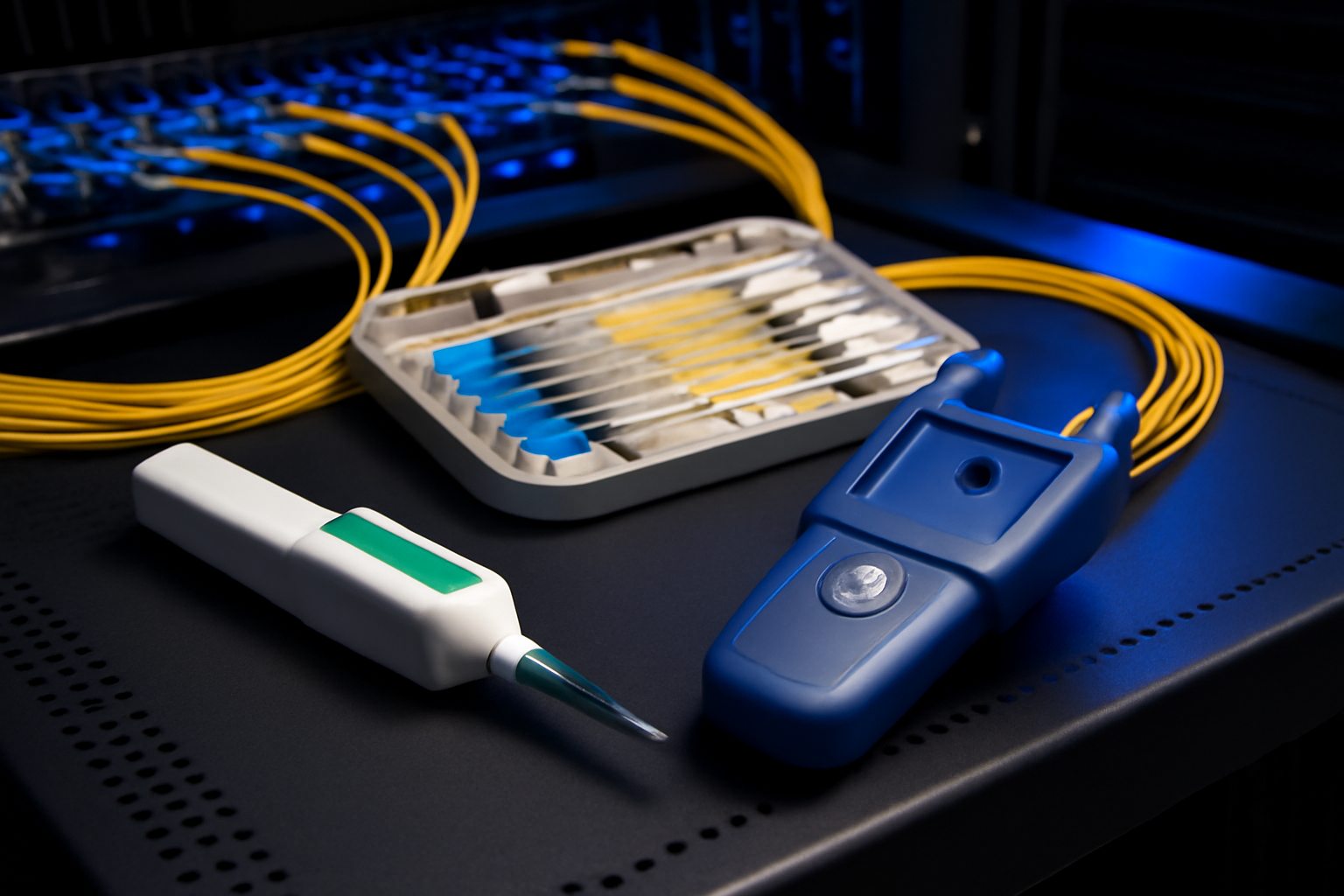
Professional optical fibre inspection tool sets at a glance
Modern inspection microscopes with 400x magnification and automatic pass/fail analysis according to IEC 61300-3-35 are now standard in professional tool sets. The devices automatically detect scratches, contamination and defects and document each test for acceptance reports.
| Microscope Type | Magnification | Connector Compatibility | Special Features |
|---|---|---|---|
| Handheld Basic | 200x | SC, LC, FC | Manual focus, LED illumination |
| Digital Standard | 400x | All common + MPO | USB connection, software analysis |
| Automatic Premium | 400x | Universal adapter | Auto-focus, pass/fail, WLAN |
Integration of inspection microscopes into the workflow demonstrably reduces error rates significantly. The automatic centering and evaluation function in particular significantly accelerates quality control.
Connector cleaning for fibre optics: the right tools for every connector type
Selection of the appropriate cleaning tool depends on connector design and contamination level. For LC and MU connectors (1.25 mm ferrule), special cleaning pens with precise guidance are suitable. For SC, ST and FC connectors (2.5 mm), larger cleaning adapters are used.
- Cleaning pens: Over 500 cleanings per pen, residue-free fibres
- Cleaning cassettes: Automatic tape advance, for couplers and connectors
- Alcohol wipes: Lint-free only, optical quality with 99% isopropanol
- Compressed air adapters: Controlled cleaning without contact
- MPO cleaners: Specialist tools for multi-fibre connectors
Fiber Products Quality Promise: As an official Diamond Partner and manufacturer, we produce modular splice systems in Europe. Benefit from Swiss precision and in-house manufacturing.
Step-by-step cleaning process according to IEC standards
Standards-compliant cleaning follows a defined procedure that guarantees reproducible results. Each connector goes through the sequence inspection – cleaning – verification before the connection is made.
Phase 1: Initial Inspection
Examine the connector endface with the inspection microscope for visible contamination. Document the initial condition for later verification. For new connectors, first remove the protective cap carefully without touching the ferrule.
Phase 2: Dry Cleaning
Always start with dry cleaning using a cleaning pen or cassette. Perform at least 5 cleaning strokes in one direction. For stubborn contamination, switch to wet cleaning.
Phase 3: Wet Cleaning if Required
Apply a drop of 99% isopropanol to a lint-free cleaning cloth. Wipe the ferrule in circular motions and dry immediately with a clean cloth section.
- Never soak connectors in alcohol
- Do not use acetone-based cleaners
- Do not touch ferrule with bare fingers
- Use cleaning cloths only once
- Connect immediately after cleaning or seal the connector
Specialised cleaning techniques for splice modules
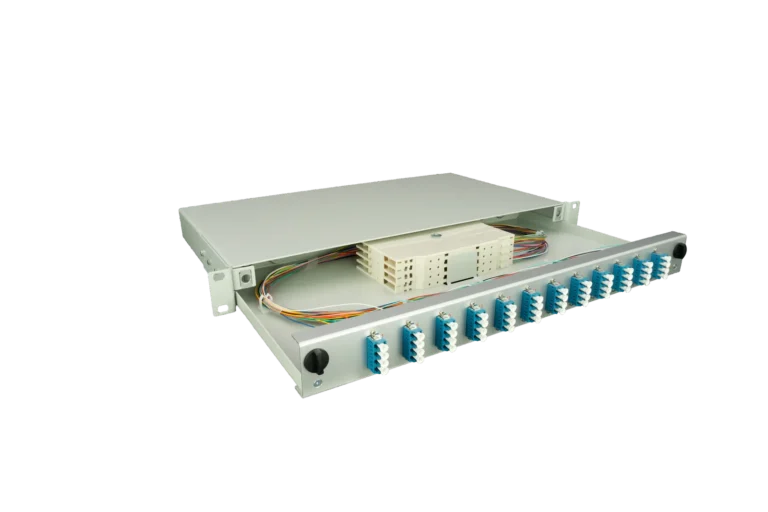
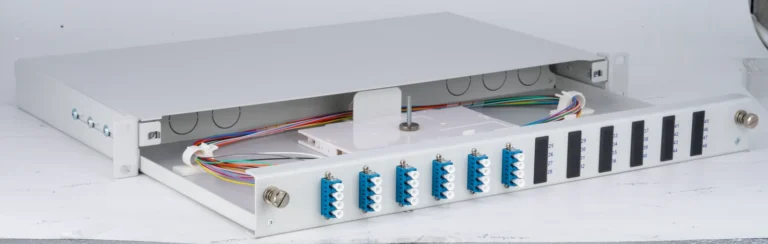
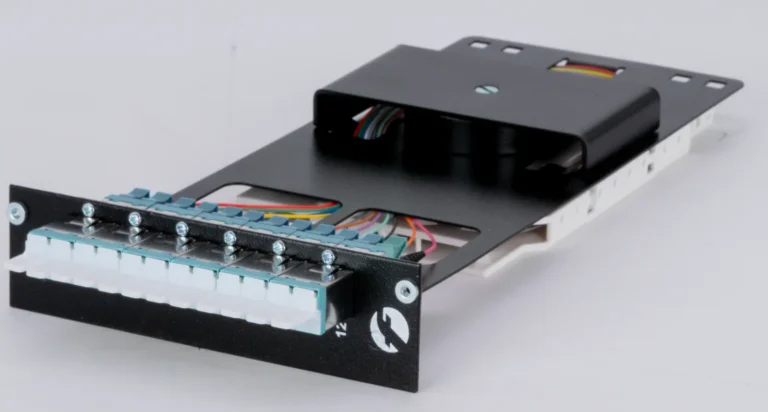
When installing high-quality splice modules such as SlimConnect systems with up to 96 fibres in 1U, special care is required. The high packing density requires absolutely clean connections to minimise crosstalk and attenuation.
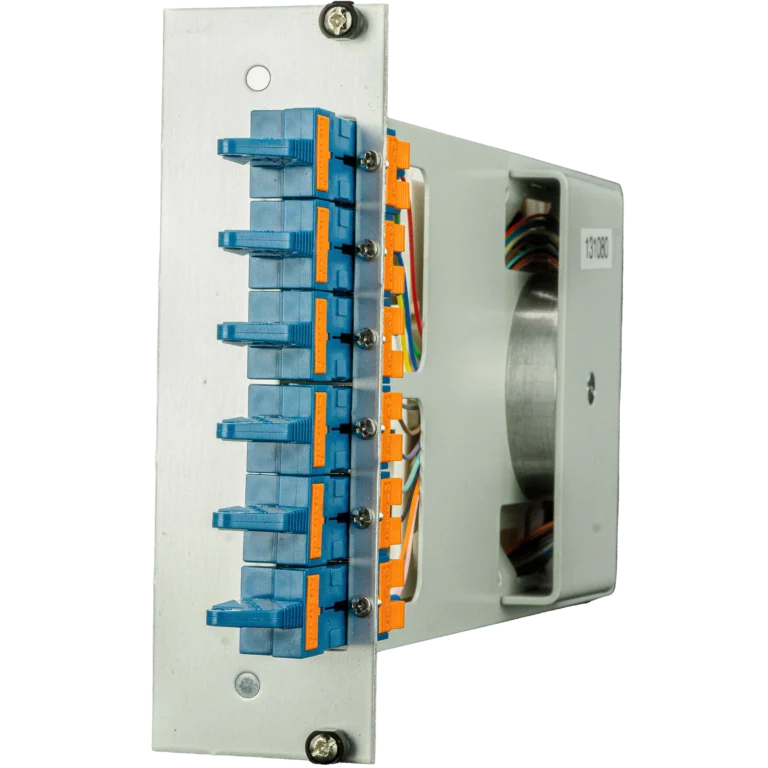
Integration of E2000 connectors in modular systems places additional demands on cleaning. The spring-loaded protective shutter must be completely opened before each cleaning and cleaned separately. For this, use special E2000 cleaning adapters with integrated opening mechanism.
Tool sets for different installation scenarios
Professional installation firms require different tool configurations depending on their field of application. A well-thought-out tool set contains all necessary components for fibre optic cleaning, optical fibre inspection tools and connector cleaning in robust case design.
| Application Area | Recommended Tools | Special Requirements |
|---|---|---|
| FTTH Installation | Basic microscope, LC/SC cleaner, stripper | Compact, quick handling |
| Data Centre | Digital microscope, MPO cleaner, cassettes | Documentation, high density |
| Industrial | Robust tools, E2000 adapter, IP65 case | Vibration-resistant, dust-protected |
Avoiding common fibre optic cleaning mistakes
Despite available quality tools, application errors repeatedly lead to poor connections. The most common error source is the use of contaminated cleaning materials. An already-used cleaning cloth merely redistributes dirt on the surface.
Another critical issue is over-cleaning connectors. Excessive pressure or excessive cleaning cycles can damage the polished endface. Modern cleaning cassettes with defined contact pressure reliably prevent this problem.
- Wrong cleaning agents: use only optical-grade cleaning alcohol
- Time pressure: never skip cleaning, even on connectors that appear clean
- Storage: keep tools dust-free and dry
- Maintenance: have microscopes calibrated regularly
- Training: continuously instruct personnel in new techniques
ROI through professional cleaning and inspection
Investment in high-quality cleaning tools pays for itself through reduced rework and avoided network outages within a few projects. For a typical FTTH project with 500 connections, consistent cleaning can avoid follow-up costs of several thousand euros.
Particularly when installing premium systems such as VarioConnect 3U modules with up to 288 fibres, professional cleaning proves worthwhile. A single contaminated connector in a high-density system can impair dozens of connections.
Future trends in optical fibre cleaning technologies
Development is clearly moving towards automated inspection systems with AI-powered defect detection. New microscopes learn from millions of inspection images and reliably detect even subtle defects. Integration into documentation systems occurs seamlessly via cloud platforms.
For fibre optic cleaning, optical fibre inspection tools and connector cleaning, sustainable materials are increasingly being used. Biodegradable cleaning cloths and refillable cleaning cassettes reduce the ecological footprint while maintaining cleaning quality.
FAQ: Frequently asked questions about fibre optic cleaning
How often must I clean fibre optic connectors?
Each connector must be cleaned and inspected before every connection, including factory-new components. The IEC 14763-3 standard mandates this.
What cleaning agent is suitable for MPO connectors?
Use special MPO cleaning cassettes with automatic tape advance and 99% isopropanol for stubborn contamination. Compressed air alone is insufficient.
Can I use regular spectacle cleaning cloths?
No, only lint-free optical cleaning cloths are suitable. Spectacle cloths leave fibres and residues on the ferrule.
How can I identify a damaged ferrule?
With an inspection microscope at 200x magnification or higher, scratches, chips and cracks are clearly visible. Modern device software automatically marks defects.
What does a professional tool kit cost?
A complete basic set for FTTH installers costs 800–1,500 euros. For data centres with MPO requirements, budget 2,500–5,000 euros.
How should I store cleaning tools correctly?
In closed, dust-tight cases at room temperature. Store alcohol separately from tools and protect microscopes from impacts.
Conclusion: clean connections as a quality hallmark
Professional fibre optic cleaning, optical fibre inspection tools and connector cleaning are not optional work steps but essential quality assurance in modern fibre deployment. With the right tools and standardised processes, installers achieve reproducible top-quality results on every installation.
Integration of high-quality components such as Fiber Products’ modular splice systems combined with professional cleaning ensures durable, low-maintenance fibre networks. As a manufacturer with 5 years warranty on all systems, we know: clean connections are the foundation for future-proof networks.
Request a Quote
Do you have questions about our fibre optic solutions? Our expert team is happy to advise you – free of charge and without obligation.