Berlin Fibre Optic Rollout 2026: FTTH Infrastructure and Splice Technology for the Digital Capital
The Berlin fibre optic rollout reaches a historic milestone in 2026 with a coverage rate of 53.4 percent, while the FTTH Berlin project connects over 1.2 million households and businesses to the Berlin fibre network, significantly exceeding the national average of 42.9 percent. This impressive development is based on three success factors: fully digitalised approval procedures, strategic partnerships between the Senate and network operators, and the use of splice technology trends 2026 with up to 96 fibres per 1RU. For municipal utilities and communal providers, Berlin demonstrates impressively how administrative efficiency and high-density distribution systems accelerate rollout.
Berlin Fibre Network 2026: From Vision to Comprehensive Reality
The Berlin fibre network recorded record rollout in the first quarter of 2026 with 120,000 new fibre connections in January alone – a growth of over 40 percent compared to the previous year. The success formula lies in consistent digitalisation of all administrative processes by the Senate administrations for transport and economic affairs. Approval times for civil works were reduced from an average of 12 weeks to under 4 weeks.
The Berlin fibre optic rollout benefits from the new European Gigabit Infrastructure Regulation (GIA), which has classified network expansion as “outstanding public interest” since November 2025. This means automatic approval by operation of law after four months – a breakthrough for planning certainty.
- Full 5G coverage of 99.97 percent already achieved in 2024
- Gigabit provision at 96.2 percent through combination of fibre optic and HFC networks
- Target of full coverage by 2028 with clear rollout roadmap
- Digital application procedures as a blueprint for other federal states
Technical Requirements for Mass Rollout: From Splice Box to Modular System Solution
Successful FTTH Berlin rollout requires standardised, high-density distribution systems that go far beyond conventional splice boxes. Modern requirements demand up to 288 fibres in compact 3RU systems with complete modularity. The choice of the right splice technology determines rollout speed and long-term operating costs.
| System Type | Rack Height | Fibre Capacity | Application |
|---|---|---|---|
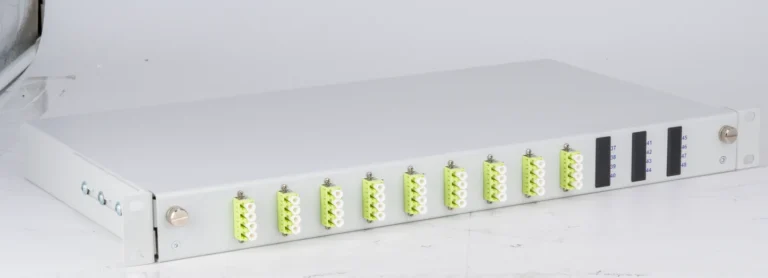
| SlimConnect | 1RU | Up to 96 fibres | Field distribution, NE3/NE4 |
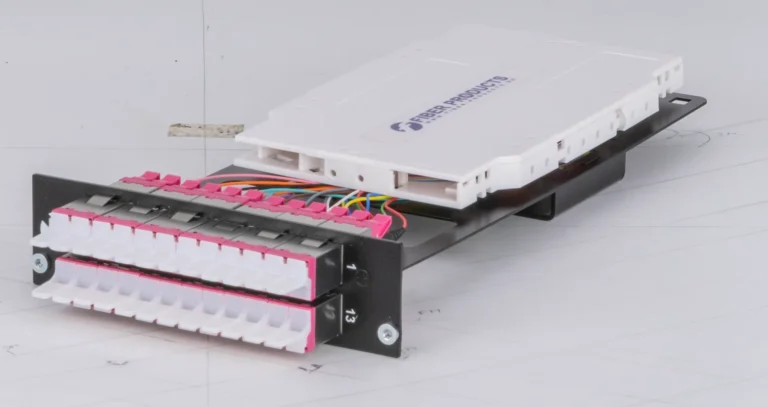
| VarioConnect | 3RU | Up to 288 fibres | Backbone, data centres |
| DIN Rail | Variable | 12–48 fibres | Industrial systems |
Standardisation follows IEC 61754 for connectors and IEC 60297 for 19-inch systems. Particularly relevant for the Berlin fibre network is compatibility of various connector types: E2000, LC, SC and increasingly MPO for high-speed connections.
Connector Technology in FTTH Rollout: APC versus PC and E2000 Dominance
In the Berlin fibre optic rollout, E2000 connectors with APC angled physical contact (8 degree) dominate, guaranteeing optical return loss of at least 60 dB – significantly superior to LC/SC connectors with only 50 dB. This technical superiority is essential for PON systems (Passive Optical Networks) that form the backbone of the FTTH Berlin network.
- E2000/APC: Standard for external systems and backbone connections
- LC/UPC: Dominant in data centres and indoor cabling
- MPO/MTP: Multi-fibre quick couplings for up to 24 fibres
- SC/APC: Legacy systems in existing networks
- Note incompatibility between APC and PC – avoid mixed installations
Fiber Products Quality Promise: As an official Diamond Partner and manufacturer, we produce modular splice systems in Europe. Benefit from Swiss precision and in-house manufacturing.
VDE 0800-730: New Installation Guidelines Transform Building Deployment
The VDE guideline 0800-730 published in February 2026 removes a key barrier for the Berlin fibre network: fibre optic cable is no longer classified as a fire risk. Since optical fibres carry no voltage and do not burn, expensive fire protection ducts in escape routes are no longer required.
This regulatory simplification enables 80 percent more cost-effective installations in existing buildings. Metal ducts or self-adhesive attachment systems replace elaborate fire protection installations. For the FTTH Berlin rollout, this means significantly reduced installation times and higher connection rates in multi-family buildings.
| Installation Method | Before VDE 0800-730 | After VDE 0800-730 | Cost Savings |
|---|---|---|---|
| Escape routes | Fire protection duct required | Metal duct sufficient | up to 70% |
| Building feed | Riser shaft mandatory | Adhesion fibre possible | up to 80% |
| Basement areas | Separate routes | Bundle installation permitted | up to 60% |
Cooperation Models in Fibre Rollout: Municipal Utilities as Strategic Players
The Berlin fibre optic rollout demonstrates successful cooperation models between communal providers and private network operators. Municipal utilities bring local expertise, existing infrastructure and customer access, while technology partners provide specialised splice technology and system solutions.
- Open-access models enable multiple use of infrastructure
- Municipal coordination reduces civil works costs noticeably
- Synergies with power and water supply through shared routes
- Long-term maintenance contracts with 5 years warranty secure investments
The modular design of modern splice boxes enables phased expansion without complete replacement – a decisive cost-effectiveness factor for communal operators.
Density and Scalability: 96 Fibres in One Rack Unit
Requirements for the Berlin fibre network are growing exponentially: bandwidths of 1.6 terabits per second become standard in backbone connections by 2026. This requires maximum port density with optimal accessibility. Modern 1RU systems with 96 fibres double capacity compared to conventional solutions.
The challenge lies in balancing density with handleability. Excessive fibre density complicates maintenance work and increases failure risk from mishandling. The solution: modular systems with removable splice cassettes and colour-coded fibre routing to DIN VDE 0888.
Quality Assurance and Test Equipment: OTDR Measurement as Standard
Every installation in the FTTH Berlin network requires complete documentation and quality assurance. OTDR measurements (Optical Time Domain Reflectometry) to IEC 61280-4-2 are mandatory for acceptance. Attenuation limits are maximum 0.25 dB per splice point and 0.35 dB/km for single-mode fibres at 1550 nm.
- Bidirectional OTDR measurements for precise fault location
- Documentation of all splice points with GPS coordinates
- Optical return loss minimum 50 dB for PC, 60 dB for APC
- Chromatic dispersion below 17 ps/(nm·km) for high-speed networks
- Polarisation mode dispersion (PMD) below 0.2 ps/√km
Future Outlook 2027: Full Rollout and New Technologies
The Berlin fibre optic rollout targets full coverage by 2028 – an ambitious goal requiring innovative approaches. Multicore fibres with multiple light-conducting cores in a single physical fibre could multiply capacity without additional cables. Space Division Multiplexing (SDM) promises up to 10-fold capacity increase in existing routes.
At the same time, advancing pre-connectorisation simplifies installation. Plug-and-play systems with factory-terminated fibres reduce on-site splicing work. This addresses skilled labour shortages and significantly accelerates rollout.
Economics and ROI: Investment Protection Through Modular Systems
The economics of the Berlin fibre network are based on long-term planning with 25–30 years service life. Modular splice systems with expansion options from 1RU to 4RU protect investments against technological obsolescence. Selecting high-quality components with 5 years manufacturer warranty reduces total cost of ownership despite higher initial investment.
| Cost Item | Standard Solution | Modular System | Savings over 10 Years |
|---|---|---|---|
| Initial investment | Lower | Higher | – |
| Expansion costs | Higher | Lower | Significant |
| Maintenance effort | Higher | Lower | Significant |
| Total cost | Higher | Lower | Savings |
Frequently Asked Questions on Berlin Fibre Optic Rollout
Which splice technology is optimal for municipal FTTH projects?
For municipal FTTH projects, modular 1RU systems with 48 to 96 fibres that can be incrementally expanded are recommended. The combination of pre-connectorised pigtails and fusion splice technology offers optimal flexibility at reasonable cost.
How do E2000/APC and LC/UPC connectors differ in practical use?
E-2000/APC connectors use an 8 degree angled endface (IEC 61755-3-2) and meet return loss grade 1, i.e. ≥ 60 dB — DIAMOND specifies ≥ 70 dB — which suits outside plant and PON. LC/UPC dominates data centres through its 1.25 mm ferrule and the density that allows; non-angled PC endfaces are graded ≥ 45 dB, ≥ 35 dB or ≥ 26 dB under IEC 61755-2-1. The difference in return loss comes from the polish, not from the connector family.
What fibre density makes sense for municipal utility backbone networks?
Municipal utility backbones should be planned with 144 to 288 fibres, with initially often only 20–30% occupied. Reserve capacity enables expansion without reburial and recoups itself through avoided civil works costs.
How does the GIA regulation affect approval procedures?
The Gigabit Infrastructure Regulation limits approval periods to maximum 4 months with automatic approval by operation of law on deadline expiry. This creates planning certainty and significantly accelerates rollout.
What test equipment is required for FTTH network acceptance?
OTDR and light-source/power-meter tests follow IEC 61280-4-2 for installed single-mode plant; the standard defines the procedure, not pass/fail values. Loss limits per splice and connector come from the cabling standard or project spec, fibre attenuation from ITU-T G.652.D (max 0.40 dB/km at 1310 nm, 0.30 dB/km at 1550 nm). Bidirectional measurement improves accuracy.
What advantages do modular splice boxes offer over fixed designs?
Modular systems enable phased expansion from 1RU to 4RU without complete replacement, reduce inventory through standardised components and deliver total cost savings over 10 years in professional use.
Conclusion: Berlin as Blueprint for German Fibre Optic Rollout
The Berlin fibre optic rollout with its impressive 53.4 percent coverage demonstrates how digitalised administrative processes, modern splice technology and strategic partnerships accelerate FTTH deployment. The Berlin fibre network benefits from high-density distribution systems with up to 96 fibres per 1RU, simplified installation guidelines under VDE 0800-730 and consistent use of modular system solutions. For municipal utilities and communal network operators, the Berlin strategy offers a transferable blueprint: investments in scalable, modular splice systems with extended warranty periods pay off through reduced operating costs and future-proofing. The key to success lies in combining administrative efficiency, technical excellence and strategic partnerships with experienced system providers.
Interested in modular fibre optic solutions?
Fiber Products GmbH – official DIAMOND SA Partner. Made in EU, 5 years warranty.