Fibre Optic Solutions for Chemical Industry – ATEX-Compliant Networks
Fibre optic chemistry, explosion protection networks, and ATEX fibre enable safe digital connectivity in explosive atmospheres within the chemical industry through intrinsically safe optical fibre technology without electrical spark generation. Data transmission via light pulses through fibre optic cables supports compliance with the ATEX Directive 2014/34/EU and enables high-speed data transmission at up to 100 Gbit/s in Zone 0, Zone 1, and Zone 2 areas.
In the chemical industry, explosive atmospheres caused by flammable gases, vapours, or dusts are commonplace. Conventional copper cables present a significant safety risk, as electrical currents can generate sparks. Fibre optic technology eliminates this risk entirely whilst simultaneously enabling the Industry 4.0 initiatives.
Technical Foundations: Fibre Optics in ATEX Environments
The intrinsic safety of fibre optic cables is based on purely optical signal transmission. Unlike copper cables, no electrical current flows through the fibre – instead, data is transmitted as light pulses with wavelengths of 1310 nm or 1550 nm. This physical property makes fibre optics the ideal solution for explosive atmospheres.
- No electrical energy in the transmission medium
- Immunity to electromagnetic interference (EMI)
- No grounding or equipotential bonding requirements
- Transmission distances up to 40 km without amplification
- Bandwidths from 10 Gbit/s to 400 Gbit/s possible
Because the transmission medium carries no electrical energy, installation in industrial environments is considerably simpler than with copper cabling – no spark-protection measures are required along the fibre route itself.
Zone Classification and Fibre Optic Application Areas
The ATEX Directive defines various explosion protection zones where fibre optic technology offers specific advantages:
| Zone | Hazard | Fibre Suitability | Typical Application |
|---|---|---|---|
| Zone 0 | Continuously explosive atmosphere | Fully suitable | Tank storage, reactors |
| Zone 1 | Occasionally explosive atmosphere | Fully suitable | Filling plants, pumps |
| Zone 2 | Rarely explosive atmosphere | Fully suitable | Storage areas, pipelines |
In all three zones, fibre optic cables can be installed without additional protective measures. IEC 60079-28 (Explosive atmospheres — Part 28: Protection of equipment and transmission systems using optical radiation) defines the types of protection for optical radiation in hazardous areas, among them “op is” for inherently safe optical radiation, and tabulates safe optical power and irradiance values by equipment group and temperature class. Edition 3.0 (2025-11) cancels and replaces the 2015 edition. It is not a blanket clearance for every fibre link: the standard does exclude certain cases — laser equipment meeting the Class 1 limits of IEC 60825-1, and optical fibre cables that are not part of optical fibre equipment where they comply with the relevant cable standards, for EPL Gb, Db and Mb only together with additional protective means such as conduit or raceway — but neither exclusion covers EPL Ga, Da or Ma. The optical power of the specific system and the required EPL therefore have to be assessed, verified and marked. In the EU the legal obligation itself comes from Directive 2014/34/EU (ATEX); the version currently listed there is EN 60079-28:2015.
Modular Splice Systems for the Chemical Industry
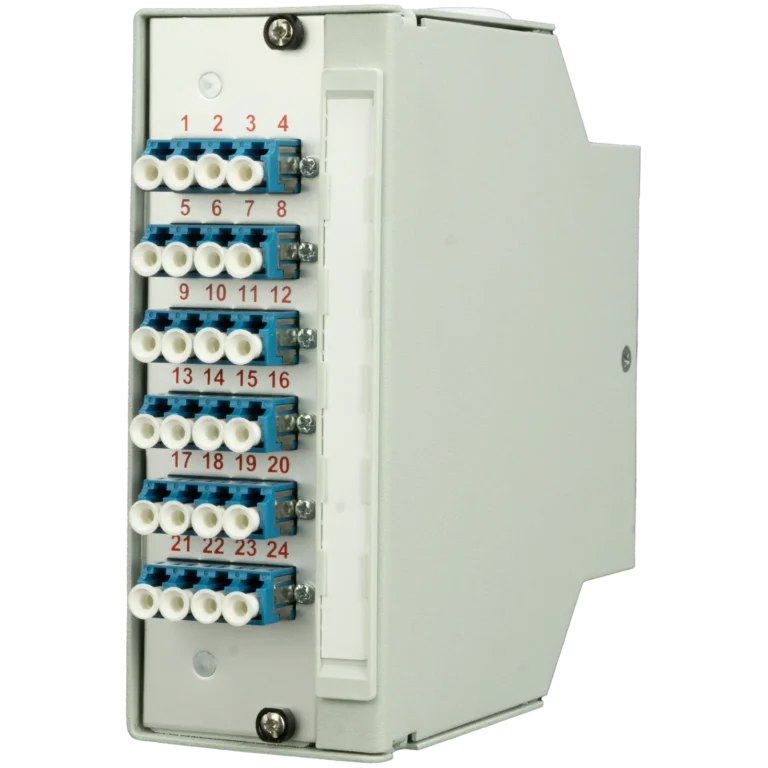
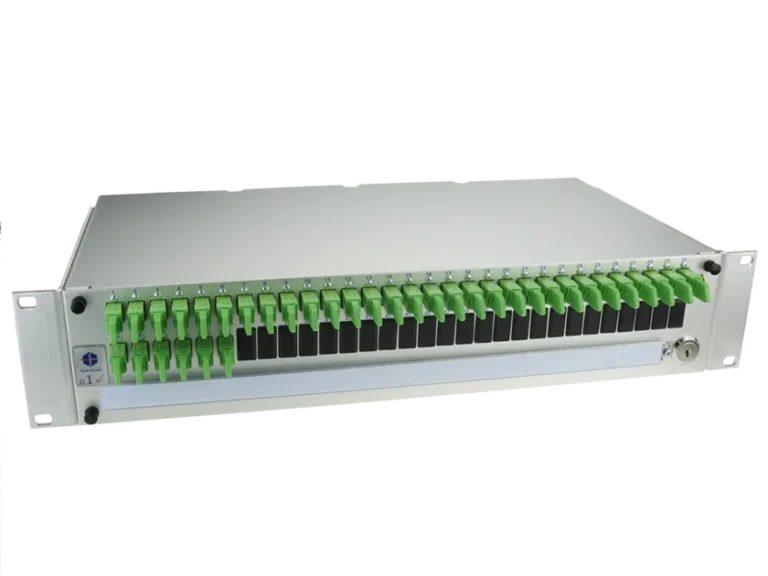
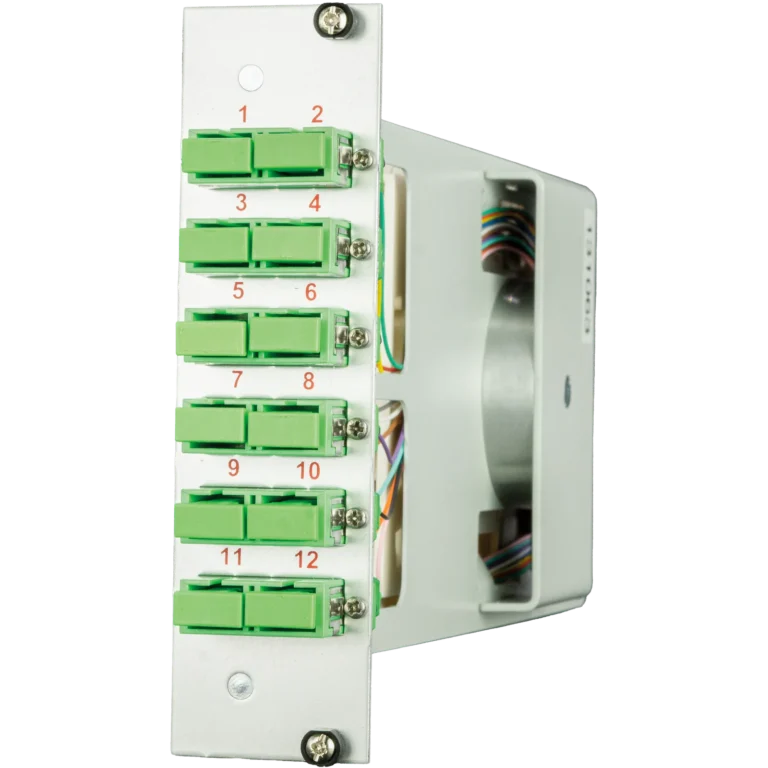
Modern fibre optic networks in the chemical industry require flexible and robust distribution systems. Modular splice systems offer decisive advantages over conventional fixed installations. With a packing density of up to 96 fibres per 1RU, they enable space-saving installations in patch panels.
Fiber Products Quality Promise: We manufacture our modular splice systems in Europe and complement our range with Swiss-made DIAMOND components. Personal project consultation by our team – project pricing and volume discounts on request.
Integration into existing automation environments is achieved via standardised interfaces. DIN rail boxes enable direct mounting in industrial control cabinets alongside PLC controllers and safety relays.
- Vibration-resistant design
- Temperature range from -40°C to +70°C
- Chemical-resistant housing materials
- Tool-free front panels for quick access
- Colour-coded identification by system area
E2000 Connectors: The Standard for ATEX Applications
In explosive atmospheres, E2000 connectors have become the preferred solution. Their spring-loaded protective shutter reliably prevents dust and moisture ingress. With insertion loss of < 0.25 dB and return loss of > 55 dB with APC polish, they meet the highest optical requirements.
Mechanical robustness is demonstrated by up to 1,000 mating cycles without performance degradation. The push-pull mechanism enables secure connection even under vibration up to 10 Hz to 500 Hz per IEC 61300-2-1. Suitable E2000 connectors are available directly from Fiber Products.
| Connector Type | ATEX Suitability | Special Feature |
|---|---|---|
| E2000 APC | Zone 0-2 | Automatic protective shutter |
| LC Duplex | Zone 1-2 | High packing density |
| SC Simplex | Zone 2 | Cost-effective |
Hydrogen Applications and Fibre Optic Sensing
With the expansion of the hydrogen economy, new demands are placed on explosion-proof networks. Fibre optic chemistry and explosion protection networks play a dual role here: in addition to data transmission, fibre optic sensors enable continuous monitoring of hydrogen concentrations.
Fraunhofer Institute has developed fibre optic sensors that detect hydrogen leaks with an accuracy of < 100 ppm. Integration into existing ATEX fibre optic infrastructure is achieved via wavelength multiplexing, allowing sensor and data signals to travel on the same fibre.
- Response time under 1 second for leaks
- Temperature measurement from -200°C to +800°C
- Pressure monitoring up to 700 bar
- Distributed sensing over distances up to 50 km
Standards Compliance and Certifications
Installation of fibre optic networks in the chemical industry is subject to strict regulations. The ATEX Directive 2014/34/EU and the associated European guidelines require comprehensive documentation of all installed components.
Relevant standards for fibre optics in explosive atmospheres include the IEC 60079 Series for explosion protection, IEC 61754-15 for E2000 connectors, and the EN 50173 Series for structured cabling. The German technical rules for operational safety (TRBS) additionally govern maintenance work in potentially explosive atmospheres.
Practical Implementation: Installation and Maintenance
Installation of ATEX fibre optic systems requires qualified personnel trained for work in potentially explosive atmospheres. However, the installation process differs little from standard fibre optic installations, as no electrical safety measures are required.
- Cable installation in Ex-approved conduits
- Splicing work performed outside the Ex zone
- Pre-terminated trunk cables for rapid installation
- Attenuation measurement with OTDR at 1310/1550 nm
- Documentation per DIN EN 61355
Maintenance is limited to regular visual inspections and connector cleaning. With an average lifespan of 25 years, fibre optic cables are considerably more durable than copper installations.
Economic Viability and Investment Protection
Initial costs for fibre optic chemistry and explosion protection networks are offset by lower operating costs and higher availability. Lower maintenance requirements and high availability reduce the total cost of ownership significantly compared with copper installations.
With modular systems such as SlimConnect, expansions can be performed without operational downtime. Due to the future-proofing of the technology with bandwidth reserves up to 400 Gbit/s, no re-cabling is required for the next 20 years.
For realistic budget planning, see our current overviews of splice box costs and the comparison of loaded vs. empty splice boxes.
Integration into Existing Process Control Systems
Seamless integration of ATEX fibre optics into existing automation environments is achieved via Ex-certified media converters. These convert optical signals into electrical protocols such as PROFINET, EtherNet/IP, or Modbus TCP.
| Protocol | Data Rate | Fibre Compatibility | Typical Application |
|---|---|---|---|
| PROFINET IRT | 100 Mbit/s | Full compatibility | Real-time control |
| EtherNet/IP | 1 Gbit/s | Full compatibility | Process visualisation |
| OPC UA TSN | 10 Gbit/s | Full compatibility | Industry 4.0 |
Frequently Asked Questions on Fibre Optics in Chemistry
How are splices performed in explosive atmospheres?
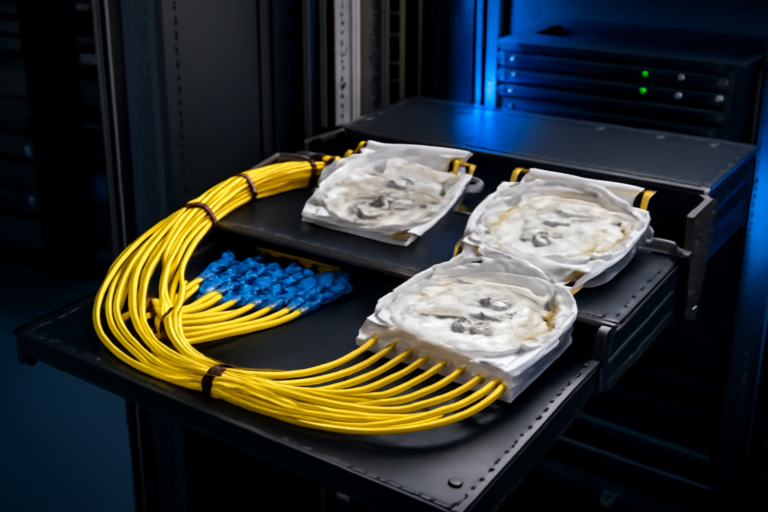
Splicing work is generally carried out outside the Ex zone. Pre-terminated modules with E2000 connectors enable installation without on-site splicing. When work in Ex areas is unavoidable, spark-free methods such as mechanical splices are required.
What funding is available for ATEX-compliant fibre optic networks?
Funding programmes for digital infrastructure exist at national and EU level, but eligibility for industrial ATEX projects depends on the specific programme and changes regularly. We are happy to review suitable options as part of a personal project consultation.
Are MPO/MTP connectors suitable for Ex zones?
MPO/MTP connectors are suitable for Zone 2; however, for Zone 0 and 1, more robust single-fibre connectors such as E2000 connectors with their spring-loaded protective shutter are recommended. The higher packing density of 96 fibres per 1RU can also be achieved with E2000 modules.
How is redundancy ensured in critical processes?
Ring topologies with automatic failover upon fibre break ensure fault tolerance. The ITU-T G.8032 protocol enables switchover times under 50 ms. Modular systems allow rapid replacement of faulty modules without operational interruption.
What is the lifespan of fibre optic cables in aggressive environments?
Specialist cables with FRNC sheaths and chemical-resistant coverings achieve lifespans exceeding 25 years. Optical properties remain stable throughout the service life, provided that minimum bend radii of 30 mm are maintained.
How are fibre optic installations maintained and tested?
Annual visual inspections and attenuation measurements with OTDR instruments document system condition. Maintenance intervals and logs should follow the operator’s explosion protection document. With an average failure rate below 0.1% per year, fibre optic networks require minimal maintenance.
Implementation of fibre optic chemistry, explosion protection networks, and ATEX fibre optic solutions transforms safe data transmission in the chemical industry. With the right combination of robust components, professional installation, and regular maintenance, future-proof networks are created that meet Industry 4.0 requirements and the strictest safety regulations. Modular systems made in Europe provide maximum investment protection for critical infrastructure.
Request a Quote
Do you have questions about our fibre optic solutions? Our expert team is happy to advise you – free of charge and without obligation.