


Bending radius calculation: Systematic methods for fiber optic installations

The correct bend radius calculation is a fundamental prerequisite for high-quality fiber optic installations and is decisive for long-term network performance and reliability. While installers are aware of the fundamental importance of minimum bend radii, they often lack the practical know-how to systematically calculate bend radii under real installation conditions.
Different fiber types, cable designs and load conditions each require specific bending radii calculations that go beyond rules of thumb. Particularly with modular systems such as VarioConnect and SlimConnect bending radii must be precisely dimensioned for different guide levels and cable types.
Incorrect bending radius calculations lead to micro-bends, increased attenuation losses or mechanical damage, which often only become apparent years later as costly failures. Systematic calculation methods, standard-compliant safety factors and tried-and-tested inspection techniques are the tools of the trade for competent fiber optic installers.
Modern fiber guiding systems in 7TE modules are designed in such a way that they automatically guarantee standard-compliant bending radii when bending radii are calculated correctly. Investing in sound expertise in bend radius calculation pays off many times over thanks to reduced reworking, improved installation quality and increased customer satisfaction.
Physical principles of glass fiber bending
Glass fibers transmit light by total reflection at the interface between the fiber core and cladding. If the bending radius falls below a critical value, this physical principle is disturbed: light can escape from the core and is lost as transmission loss. This effect, known as macrobending, increases exponentially with smaller radii and can lead to attenuation losses of several decibels.
Fiber type-specific properties
The critical bending radii depend on the wavelength and differ considerably between fiber types: standard single-mode fibers (G.652) show significantly higher bending losses at a wavelength of 1550 nm than at 1310 nm. Bend-optimized fibres (G.657.A1/A2/B3) tolerate smaller radii due to modified refractive index profiles. These physical differences must be taken into account when calculating bending radii.
Mechanical stresses caused by bending can cause microcracks in the glass structure. Silicon dioxide glass fibers have a theoretical tensile strength of 14 GPa, practical values are 3-5 GPa due to surface defects. Bending stresses add up to tensile stresses and can exceed the material strength.
Time-dependent effects
Time-dependent degradation (stress corrosion cracking) increases mechanical stress: Water molecules from the environment react with silicon-oxygen bonds under mechanical stress. This reaction leads to slowly growing cracks, which can lead to delayed fiber breakage after months or years.
Temperature effects influence critical bending radii: At low temperatures, glass becomes more brittle and tolerates smaller bending radii less well. At the same time, shrinkage of the cable sheaths can cause additional mechanical stresses. Bend radii are not covered by DIN EN 50173 — that standard deals with the design and performance of generic cabling. The binding figures come from the cable manufacturer’s data sheet, together with the permissible temperature range, and from the fibre category per ITU-T G.652 or G.657..
Norms and standards for bending radii Calculation
European standards
Minimum bend radii are specified by the cable and fibre manufacturer, not by DIN EN 50173-1. What holds generally is the distinction itself: under tensile load during installation a larger radius applies than in the load-free operating state. For standard single-mode fibers, the minimum radius is 20x the cable diameter under load or 10x in the load-free state, but at least 30 mm or 15 mm.
IEC 60794 specifies mechanical properties of fiber optic cables: Part 1-2 defines bending radii for different cable types and test conditions. This standard distinguishes between short-term installation loads and long-term operating conditions. Cable-specific data sheets must specify the standard values for the respective cable type.
International standards
ITU-T recommendations G.652 to G.657 define fibre properties including bending sensitivity: G.652 standard single-mode fibres have higher minimum bending radii than G.657 bend-optimized variants. These differences can vary for the same cables depending on the fiber type and must be included in the bending radius calculation.
Manufacturer specifications supplement standard requirements: Cable and component manufacturers often define stricter limit values than the minimum requirements of the standards. These specifications take into account product-specific properties and should be treated as decisive for the bending radius calculation.
Calculation formulas and methods
Basic formula for bending radius calculation
Basic formula for minimum bending radius: R_min = n × D, where R_min is the minimum bending radius, n is the standard-specific factor (10-20) and D is the cable diameter. This rule of thumb provides initial orientation values for calculating bending radii, but is not sufficient for precise calculations.
Extended calculation takes into account fiber type and application: R_min = max(n × D, R_fiber), where R_fiber is the fiber-specific minimum radius. For G.652 fibers, R_fiber is typically 30 mm under load and 15 mm load-free. For G.657 fibers, the ITU-T design radii apply without a load/load-free distinction: G.657.A1 at least 10 mm, G.657.A2 at least 7.5 mm, G.657.B3 at least 5 mm.
Safety factor integration
Safety factor calculation: R_practical = SF × R_min, where SF is the safety factor (typically 1.5-2.0). This factor takes into account manufacturing tolerances, installation inaccuracies and long-term effects when calculating bending radii. Higher safety factors reduce the risk of failure, but require larger guide radii.
Cable bundle corrections take mutual influences into account: The effective bending resistance increases for cables routed in parallel. Correction factors of 1.1-1.3 depending on the bundle configuration are common when calculating bending radii.
Practical calculation examples
Example 1: Standard indoor cable
Standard 8-fiber indoor cable for data centers:
- Cable diameter: 6 mm
- Fiber type: G.652.D
- Application: Indoor installation, load-free
- Bending radii calculation: R_min = max(10 × 6 mm, 15 mm) = 60 mm
- With safety factor 1.5: R_practical = 90 mm
Example 2: Outdoor cable with strain relief
144-fiber outdoor cable for public utilities:
- Cable diameter: 18 mm
- Fiber type: G.652.D
- Application: Installation under tensile load
- Bending radii calculation: R_min = max(20 × 18 mm, 30 mm) = 360 mm
- With safety factor 1.5: R_practical = 540 mm
Example 3: Bend-optimized drop cable
Drop cable for telecommunications providers:
- Cable diameter: 4 mm
- Fiber type: G.657.A1
- Application: House entry, load-free
- Bending radii calculation: R_min = max(10 × 4 mm, 10 mm) = 40 mm
- With safety factor 1.5: R_practical = 60 mm
Example 4: MTP patch cable in the data center
MTP patch cable for high-density applications:
- Cable diameter: 3 mm
- Fiber type: G.657.A2
- Application: patch panel, frequent handling
- Bending radii calculation: R_min = max(10 × 3 mm, 7.5 mm) = 30 mm
- With safety factor 2.0: R_practical = 60 mm
Example 5: Cable bundle in distribution cabinet
Cable bundles for industrial applications:
- 5 cables, each 8 mm in diameter, routed in parallel
- Fiber type: G.652.D, load-free
- Bundle factor: 1.2
- Bending radii calculation: R_min = max(10 × 8 mm, 15 mm) = 80 mm
- Bundle correction: R_bundle = 80 mm × 1.2 = 96 mm
- With safety factor 1.5: R_practical = 144 mm
Fiber guiding systems and dimensioning
Bend-radius-compliant routing, built in
Bend-radius-compliant routing is built into our modular VarioConnect and SlimConnect systems — the guide radii covered in this section are engineered into every module. See both system ranges in the store.
VarioConnect systems
VarioConnect 7TE modules use standardized fibre guide rings with defined radii: standard rings have diameters of 40 mm, 60 mm or 90 mm and therefore cover most bending radius calculation requirements. These rings are dimensioned in such a way that they automatically guarantee standard-compliant bending radii if selected correctly.
Multi-level routing systems use different radii depending on the function: main distribution level with large radii (90-120 mm) for backbone cables, sub-distribution with medium radii (40-60 mm) for branches and connection level with minimum radii (25-40 mm) for patch cables.
SlimConnect compact systems
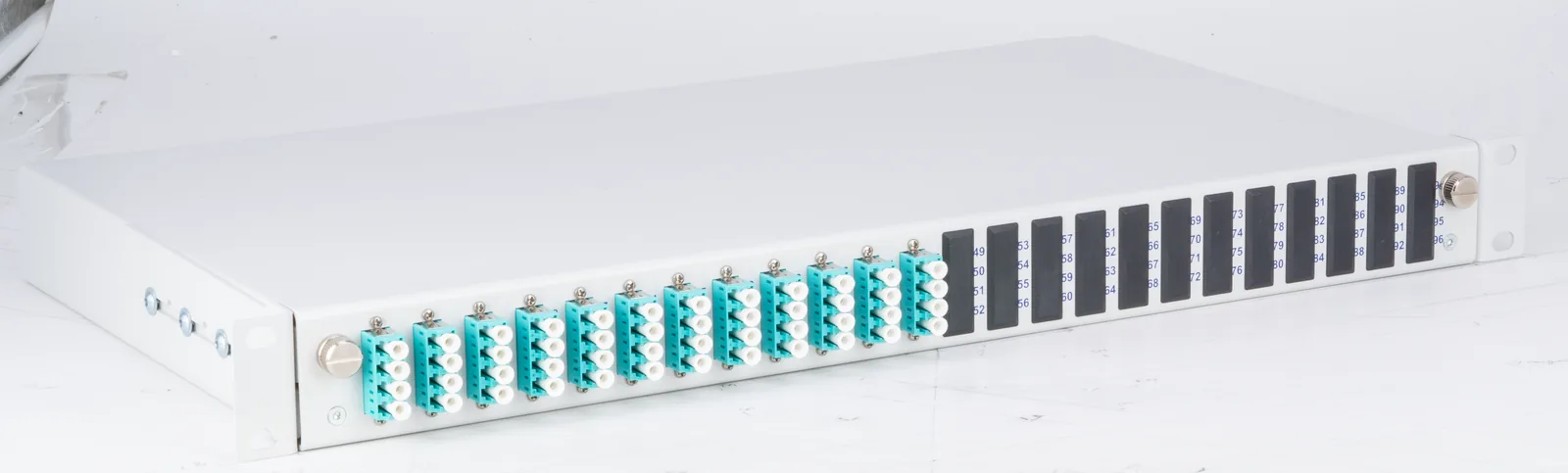
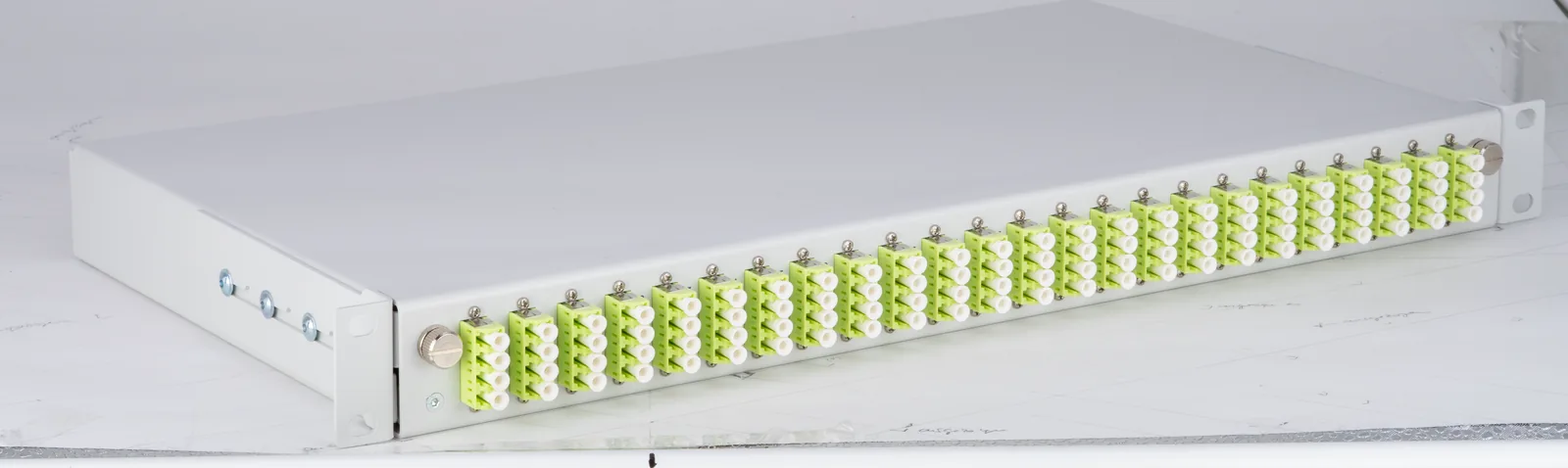
SlimConnect 1U systems optimize space utilization with minimal bending radii: Compact guide structures with a minimum radius of 30 mm enable high port density without compromising the bending radius calculation. The integrated fibre guide is factory-matched to bend-optimized G.657 fibres.
Adaptive guide elements adapt to different cable types: Variable guide rings or rails allow adaptation to different cable diameters. This flexibility is particularly valuable for mixed-media installations or subsequent extensions.
Metrological control and verification
OTDR measurement method
OTDR measurements detect macrobending through characteristic increases in attenuation: bending losses appear as localizable events with wavelength-dependent losses. Measurements at 1310 nm and 1550 nm make it possible to differentiate between bending losses and other causes of attenuation.
Visual inspection identifies obvious bending radius violations: Kinked cables, loops that are too tight or mechanical damage are visually recognizable. Systematic inspections during and after installation prevent gross errors in the bending radius calculation.
Standardized test procedures
Macrobending Loss Test according to IEC 60793-1-47 (Method A, fiber winding): Standardized measurement methods quantify bending losses under defined conditions. These tests are typically carried out during cable testing or product qualification, but are also useful for critical installations with precise bending radius calculations.
Long-term measurements monitor degradation: Repeated OTDR measurements over months or years show gradual deterioration due to stress corrosion cracking. Trend analyses enable proactive maintenance before total failure.
Common calculation errors and how to avoid them
Typical sources of error
Confusion of cable and fiber diameter: The bending radius calculation must refer to the total cable diameter, not the diameter of the glass fiber (125 µm). This error leads to drastically underestimated minimum radii and can cause serious damage.
Neglect of safety factors: Standard values define absolute minimum limits, practical bending radius calculations should allow for a 50-100% safety margin. This buffer compensates for manufacturing tolerances, installation inaccuracies and ageing effects.
Ambient conditions
Incorrect assignment of load conditions: Tensile loads prevailing during installation require larger bending radii than subsequent load-free operation. The bending radius calculation must take the most critical load situation into account.
Insufficient consideration of temperature conditions: Outdoor installations or industrial environments can have extreme temperatures. Low temperatures increase the brittleness of glass fibers and require adapted bending radii calculation.
Tools and aids for practical use
Mechanical aids
Bend radius gauges enable quick on-site checks: templates with different radii show permissible minimum bends for common cable types. These tools reduce the effort required to calculate bending radii and the risk of errors during installation.
Calibrated bending gauges for precise measurements: Mechanical measuring devices with defined radii enable objective control of the bending radius calculation. These instruments are particularly suitable for acceptance tests or quality controls.
Digital tools
Mobile apps for calculating bending radii: Smartphone applications with cable databases automate calculations and take current standards into account. Barcode scanners can automatically identify cable types. These tools reduce calculation errors and speed up installations.
CAD-based planning tools simulate cable routing: 3D planning software can automatically check bend radii and report limit violations during the bend radius calculation. These tools are particularly valuable for complex installations.
Integration into modular fiber optic systems
Standardized management concepts
VarioConnect modules use factory-optimized fibre routing: the integrated guide rings are matched to standard cables and ensure standard-compliant bending radii when bending radii are calculated correctly. Modular arrangement enables systematic cable routing without crossings.
7TE module format optimizes space-to-bend radius ratio: The standardized module width of 7 TE (35.5 mm) enables fibre guide rings with a diameter of 30-40 mm in a compact design. This dimension is ideal for bend-optimized fibres and standard patch cables.
Hierarchical management concepts
Multi-level systems use different radii: backbone cables use large guide radii in rear module areas, while connection cables are routed with smaller radii in areas close to the front. This zoning optimizes both space utilization and bending radius calculation.
Flexible expansion options take future requirements into account: Modular systems can be supplemented with additional guide levels or radii as required. This scalability enables adaptation to changing bending radius calculation requirements without complete conversion.
Quality assurance and documentation
Systematic control
Multi-stage control in all project phases: Planning phase with theoretical bending radius calculation, installation phase with ongoing monitoring and acceptance phase with final verification. This multi-stage control minimizes the risk of errors and ensures standard-compliant implementation.
Documentation of all calculation parameters used: Cable types, fiber types, applied standards and safety factors of the bending radius calculation must be fully documented. This information is essential for subsequent maintenance work or extensions.
Continuous Improvement
Lessons learned from installation experience: Systematic evaluation of installation experience and measurement results identifies potential for improvement in the calculation of bending radii. These findings are incorporated into future projects and continuously improve planning and installation quality.
Correlation analysis between bending radius calculation and failures: Statistical evaluation of failure patterns can identify systematic problems. These analyses support preventive maintenance strategies and improvement of installation quality.
Troubleshooting for bending radius problems
Diagnosis and solutions
Increased attenuation due to macrobends: OTDR measurements show localizable attenuation increases that correlate with bends. Solutions include increasing the guide radii or replacing them with bend-optimized fibres based on new bend radius calculations.
Mechanical damage due to overbending: Visible kinks or breaks require cable replacement or re-termination. Preventive measures include better strain relief and systematic training in correct bending radius calculation.
Performance optimization
Intermittent failures due to mechanical stresses: Temperature cycling or vibration can activate latent bend radius issues. Long-term measurements identify such problems. Solutions usually require new installation with revised bending radius calculations and larger safety margins.
Performance degradation in high bit-rate applications: PMD increase or other dispersion problems can be caused by mechanical stresses. These problems are particularly critical in 10G+ applications and require precise bend radius calculations.
Conclusion and best practice recommendations
The systematic calculation of bending radii is an indispensable basis for high-quality fiber optic installations. Modern modular systems such as VarioConnect and SlimConnect with their standardized 7TE modules facilitate standard-compliant implementation through factory-optimized fibre routing. Nevertheless, these systems do not replace the need for well-founded bending radius calculations and careful planning.
If you are also planning the enclosures in which these bending radii have to be maintained, our guides on splice box costs and loaded vs. empty splice boxes show current price ranges and configuration trade-offs.
Successful implementation of bending radius calculation utilizes systematic calculation methods, sufficient safety factors and continuous quality control. The investment in bending radius calculation expertise and suitable tools pays off many times over through reduced rework and increased customer satisfaction.
The future belongs to intelligent fibre routing systems that automatically create standard-compliant conditions through optimized design. Until then, well-founded bending radius calculations and careful checks will continue to guarantee high-quality installations that meet the increasing requirements of modern fiber optic networks.
Contact us to jointly develop optimized fibre routing solutions for your installation projects and benefit from proven calculation methods. Project pricing and volume discounts are available on request.
Related topics:
- VarioConnect 3U systems
- SlimConnect 1U solutions
- 7TE splice modules
- DIN rail boxes for industry
- Store
Related product
Modular 3U/4U System
19-inch subrack with 12 slots of 7 TE · fibre count depends on the modules: 144 with 12-fibre modules, 288 with 24-fibre modules · modules also fit subracks from other manufacturers
Request a Consultation
Our experts will advise you on modular fiber optic solutions for your specific application — fast, personal and non-binding.