Fibre Optics for Research Facilities: High-Speed Networks for Universities
Fibre Optics for Research: University Networks, DFN GÉANT Infrastructure – Modern High-Speed Networks for Science and Education
Fibre optic research networks, university network infrastructure, and DFN GÉANT systems form the technological backbone of modern scientific institutions across the German-speaking region. With the recent upgrade of DFN connections to 800 Gbit/s total capacity, German universities and research facilities are achieving new dimensions in data transmission – a development requiring specialised fibre optic infrastructure with high port density and modularity.
Requirements for university networks differ fundamentally from standard corporate networks. While data centres prioritise redundancy, research institutions need maximum bandwidth for international collaboration, scientific simulations, and the exchange of massive datasets between departments.
DFN and GÉANT: The Backbone Infrastructure of German Research
The German Research Network (DFN) connects over 700 universities and research facilities with the European GÉANT network. The current upgrade of X-WiN interconnection points in Frankfurt and Hamburg from 300 to 400 Gbit/s per location marks a milestone for the German scientific landscape.
These high-speed connections enable:
- Real-time transmission of research data between international partners
- Access to European supercomputers and databases
- Collaborative projects in particle physics and climate research
- Remote access to scientific instruments and telescopes
- Transfer of petabyte-scale datasets without delay
Technical implementation is based on redundant fibre-optic rings with DWDM technology (Dense Wavelength Division Multiplexing), utilising multiple wavelengths in parallel. For universities, this means: internal campus networking must keep pace with this backbone speed.
Technical Requirements for Fibre Optics Research, University Networks, DFN GÉANT Infrastructure
Modern research networks require specific technical parameters beyond standard office cabling. The standard ISO/IEC 11801-1:2017 defines minimum requirements for structured cabling systems in data centres and research facilities.
| Parameter | Standard Network | Research Network | DFN Requirement |
|---|---|---|---|
| Bandwidth | 1–10 Gbit/s | 100 Gbit/s | 400 Gbit/s |
| Latency | < 10 ms | < 1 ms | < 0.5 ms |
| Attenuation | < 3.5 dB/km | < 0.35 dB/km | < 0.25 dB/km |
| Fibre Type | OM3/OM4 | OS2 | OS2 Low-Loss |
| Port Density | 24–48 fibres | 96 fibres | up to 288 fibres |
Meeting these requirements is achieved through modular splice systems enabling flexible expansion and rapid reconfiguration. Port density up to 96 fibres in 1U becomes the decisive factor for modern campus networks.
Modular Splice Systems: Key Technology for Scalable Research Networks
The complexity of university networks with hundreds of buildings and thousands of workstations requires well-designed distribution systems. Modular splice boxes offer decisive advantages over fixed installations.
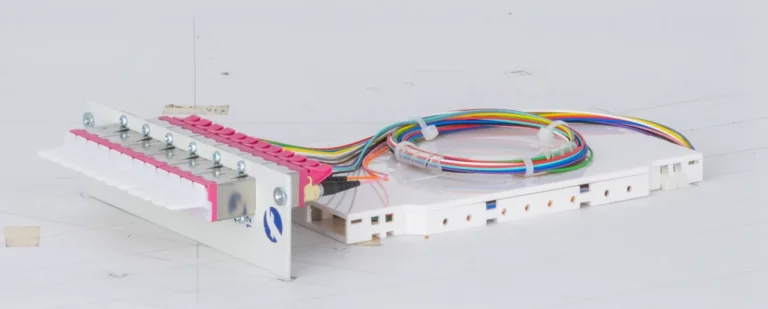
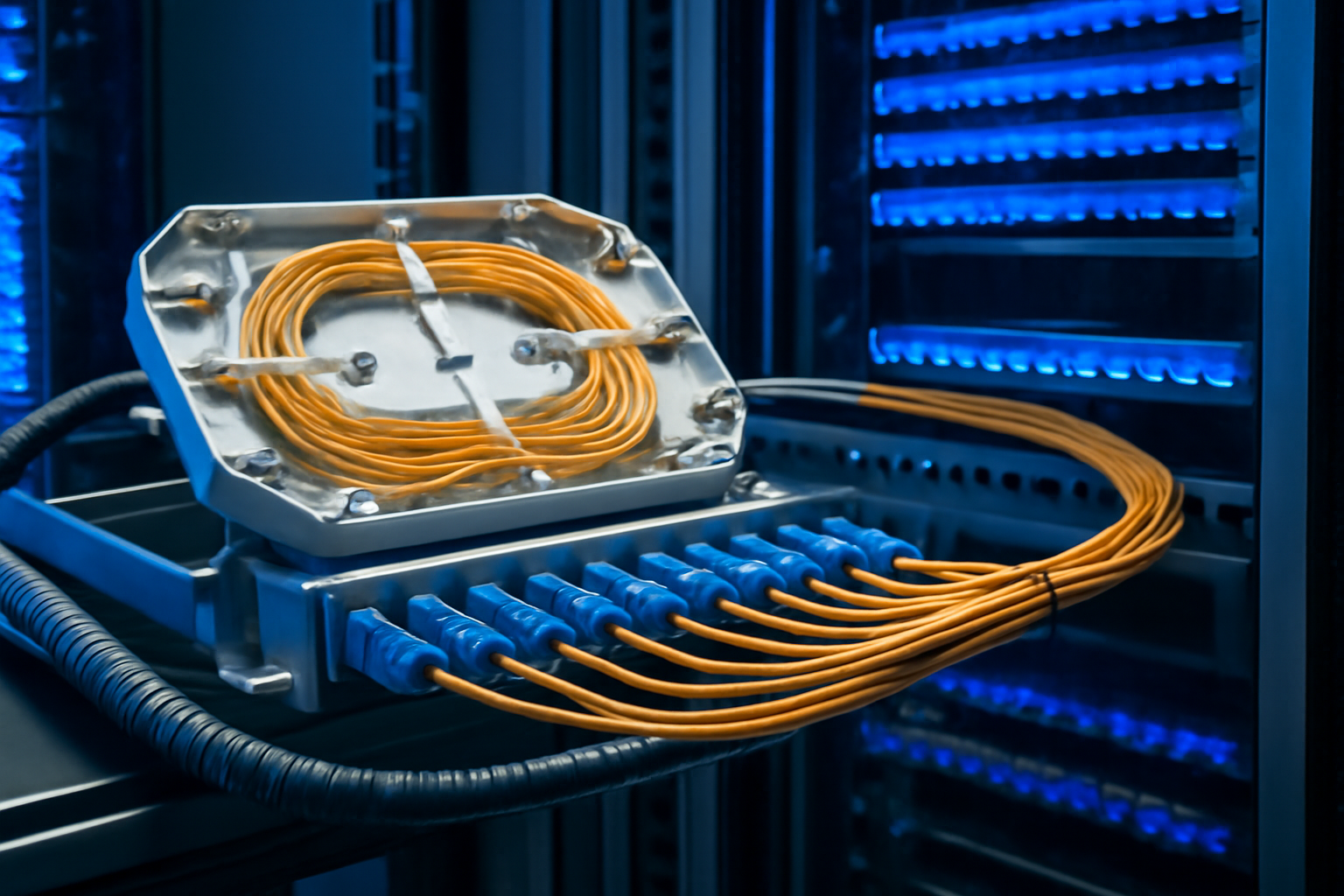
A modern 1U splice module combines several technical innovations:
- Pre-terminated splice cassettes for 12 or 24 fibres
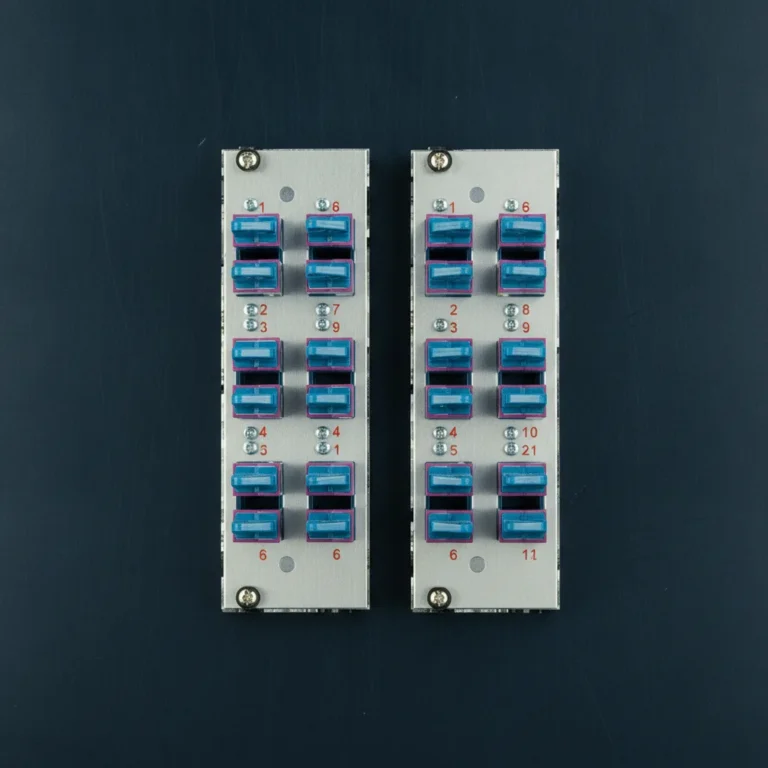
- Interchangeable front panels for LC, SC, E2000 or MPO connectors
- Integrated cable management with defined bend radius > 30 mm
- Colour coding per DIN EN 50173-1 for unambiguous identification
- Documentation system with QR codes for digital network management
Fiber Products Quality Promise: As an official Diamond partner and manufacturer, we produce modular splice systems in Europe. Benefit from Swiss precision and 5 years’ manufacturer warranty on our systems.
Connector Types for Fibre Optics Research, University Networks, DFN GÉANT Infrastructure
Choice of the right connector system significantly influences overall network performance and maintainability. Research facilities employ different standards depending on application area.
| Connector Type | Application Area | Attenuation | Characteristic |
|---|---|---|---|
| LC-APC | Labs, offices | < 0.3 dB | High packing density |
| SC-APC | Backbone | < 0.2 dB | Robust design |
| E2000-APC | Test and measurement | < 0.1 dB | Integrated protective shutter |
| MPO/MTP | Data centre | < 0.35 dB | 12/24 fibres in parallel |
Particularly the E2000 connector per IEC 61754-15 gains importance in scientific environments. Its integrated protective shutter prevents ferrule contamination – a critical factor in high-precision measurements.
Practical Implementation: Campus Networking with Modular Fibre-Optic Systems
Modernisation of existing university networks typically occurs in multiple phases. Using a medium-sized university with 15,000 students as an example illustrates structured deployment.
Phase 1: Backbone Modernisation
- Installation of central distribution rooms with 3U/4U splice systems
- Deployment of OS2 single-mode cables between buildings
- Redundant ring topology with automatic failover
- Capacity for at least 288 fibres per distribution point
Phase 2: Building Connection
- Floor-level distribution with 1U splice boxes for up to 96 fibres
- Pre-terminated MPO trunk cables for rapid installation
- Colour coding by faculty and department
The modular design enables incremental expansion without service interruption – a decisive advantage during ongoing academic operations.
Integration into Existing DFN Infrastructure
Connection to the German Research Network requires specific technical prerequisites. Universities must align their local networks to DFN handover points, which operate at 100 Gbit/s or 400 Gbit/s as standard.
Technical minimum requirements for DFN connection:
- Single-mode fibre OS2 per ITU-T G.652.D
- Maximum attenuation < 0.25 dB/km at 1550 nm
- Chromatic dispersion < 18 ps/(nm·km)
- Return loss > 50 dB with APC connectors
- Documentation per DIN EN 50174-1
Modern 1U-form splice boxes meet these requirements and additionally provide space for reserve fibres and measurement access points.
Scalability and Future-Proofing of Scientific Fibre Networks
Research data volumes double approximately every 18 months. Projects like the Square Kilometre Array or the Large Hadron Collider already generate data streams in the exabyte range. University networks must anticipate this development.
Strategic planning considerations include:
- Reserve capacity of at least 50% unused fibres
- Preparation for 800 Gbit/s and 1.6 Tbit/s transmission rates
- Migration from multimode to single-mode across all areas
- Implementation of coherent optics for long-distance transmission
Investment in modular systems with 5 years’ manufacturer warranty secures cost-effectiveness across the entire lifecycle.
Maintenance and Operation of Fibre Optics Research, University Networks, DFN GÉANT Infrastructure
Uninterrupted operation of scientific networks requires systematic maintenance concepts. The standard IEC 61300-3-35 defines test procedures for optical connectors.
Essential maintenance measures:
- Quarterly attenuation measurements using OTDR per IEC 61280-4-2
- Connector cleaning with 99% IPA and lint-free cloths
- Thermographic inspection of distribution points for hotspots
- Documentation of all measurements in the digital network plan
- Provision of spare modules for critical connections
Modular splice systems reduce mean time to repair (MTTR) substantially through tool-free replacement of faulty components.
Specialist Applications in Research: From Quantum Communication to Radio Astronomy
Beyond standard data transmission, research facilities use fibre-optic networks for highly specialised applications. Quantum communication, for example, requires polarisation-maintaining fibres with extremely low attenuation values.
In radio astronomy, fibre optics connect individual telescopes into continent-spanning arrays. The Event Horizon Telescope, which provided the first images of black holes, synchronises its locations via atomic clocks and dedicated fibre-optic links with picosecond precision.
For such specialist applications, customised distribution systems with special properties are beneficial:
- Temperature-stabilised enclosures for ±0.1°C stability
- Vibration damping per IEC 61373 for seismic measurements
- EMC shielding per IEC 61000-6-2 for electromagnetic immunity
Cost-Benefit Analysis for University Fibre-Optic Infrastructure
Investment in modern fibre networks pays for itself for universities through multiple factors. Beyond obvious performance gains, operating costs and funding opportunities play a central role.
| Cost Item | Fixed System | Modular System | Saving |
|---|---|---|---|
| Installation | €120/port | €85/port | 29% |
| Maintenance p.a. | €15/port | €8/port | 47% |
| Expansion | €150/port | €60/port | 60% |
| Downtime | 8 h/year | 2 h/year | 75% |
EU funding through programmes like Horizon Europe and national initiatives such as the Gigabit Strategy 2030 support investment in future-proof infrastructure with subsidy rates up to 50%.
Best Practices for Implementing Fibre Optics Research, University Networks, DFN GÉANT Infrastructure
Successful network modernisations follow proven implementation strategies. Experience from leading technical universities demonstrates clear success factors.
Project phases for optimal implementation:
- Baseline Assessment: Documentation of all existing connections and utilisation levels
- Needs Analysis: Survey of bandwidth requirements across all departments
- Design: Development of redundant topologies with growth reserves
- Procurement: Emphasis on modularity and manufacturer warranties
- Migration: Gradual transition without service interruption
- Documentation: Digital recording of all components and connections
As a manufacturer of modular fibre-optic solutions, Fiber Products supports universities with pre-terminated systems enabling installation in less than half the typical time.
FAQ: Frequently Asked Questions on Fibre Optics Research, University Networks, DFN GÉANT Infrastructure
Which fibre types are suitable for DFN connections?
Connections to research networks such as the DFN X-WiN run on single-mode fibre, typically ITU-T G.652.D (OS2 class). G.652.D permits up to 0.30 dB/km in the C band (1530–1565 nm), and IEEE 802.3 specifies 400 Gbit/s links over 2 km and 10 km of single-mode fibre.
How many fibres should future-proof campus networking provide?
Modern campus networks plan with minimum 96 fibres per main distribution point and 50% reserve. For central backbone connections, 288-fibre systems in modular design are recommended.
What advantages do modular systems offer over fixed splice systems?
Modular systems enable tool-free replacement of faulty components in a short time, flexible expansion without service interruption, and connector-type adaptation without re-splicing. Total operating costs decrease.
How is migration from copper to fibre implemented in operational networks?
Migration typically occurs building-by-building with parallel operation of both systems. Through pre-terminated trunk cables and modular distribution, conversion of a single building can be completed within one weekend.
Which funding programmes support fibre deployment at universities?
EU programmes such as Horizon Europe fund research infrastructure with up to 25 million euros annually. Nationally, the Gigabit Strategy 2030 supports deployment with subsidy rates up to 50% of investment costs.
How are 800 Gbit/s and higher transmission rates technically achieved?
Highest transmission rates employ DWDM technology with up to 96 wavelengths in parallel on a single fibre. Coherent modulation and digital signal processing enable 400 Gbit/s per wavelength.
Future Outlook: Fibre Optics Research, University Networks, DFN GÉANT Infrastructure 2030
Development of scientific networks accelerates continuously. By 2030, experts expect
Order directly from the shop: fiber-products.de
Request a Quote Today
Free consultation – personalised quote within 24 hours