Fibre Optic for Energy Providers: Smart Grid and SCADA Networks
Smart Grid fibre optic, SCADA networks and energy provider optical fibre form the digital backbone of the energy transition, enabling optical fibre infrastructure to deliver real-time monitoring and control of decentralised power networks with latencies below 5 ms and availability exceeding 99.99%. The integration of fibre optic technology into power supply networks transforms traditional grids into intelligent sensor networks that capture mechanical loads, grid frequencies and load distribution in real time via SCADA protocols conforming to IEC 60870-5-104.
For network operators and municipal utilities in the DACH region, this means concretely: the convergence of energy and data infrastructure creates new synergies in trenching work and simultaneously enables implementation of the EU Directive 2019/944 on digitalisation of energy networks.
Technical Fundamentals: Why Fibre Optic is Essential for Smart Grids
The electromagnetic immunity of optical fibre cables makes them the only reliable transmission technology in high-voltage environments. While copper cables are affected by EMC interference up to 100 kV/m, optical fibre systems guarantee interference-free data transmission even directly inside substations.
- Complete galvanic isolation between measurement points
- Transmission distances up to 80 km without repeaters (Singlemode OS2)
- Bandwidth from 10 Gbit/s to 400 Gbit/s for parallel data streams
- Temperature resistance -40°C to +85°C per IEC 60794
- No ground loops or potential equalisation issues
VDE guidelines explicitly call for the dual function of modern optical fibre networks: alongside pure data transport, integrated sensor fibres should capture mechanical loads and temperature profiles via Distributed Acoustic Sensing (DAS).
| Parameter | Copper Cable | Optical Fibre (OS2) | Fibre Advantage |
|---|---|---|---|
| EMC Immunity | Vulnerable above 10 kV/m | Completely immune | 100% interference safety |
| Range | Max. 100 m (Ethernet) | Up to 80 km | 800-fold |
| Bandwidth | 1 Gbit/s | 400 Gbit/s | 400-fold |
| Latency | 5–10 ms | < 1 ms | 10-fold better |
SCADA Network Architecture with Modular Fibre Optic Systems
SCADA networks for energy providers require a hierarchical optical fibre architecture with redundant ring structures. The main control centre connects to regional substations via backbone rings with 10–100 Gbit/s, which in turn link local sensor networks at 1–10 Gbit/s.
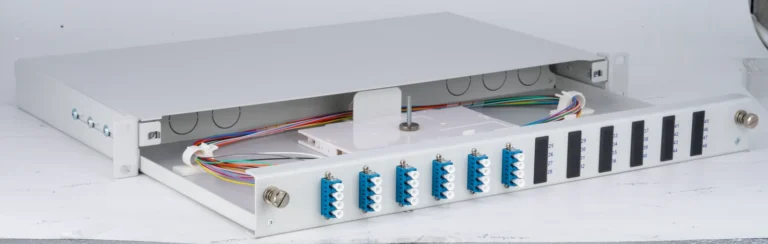
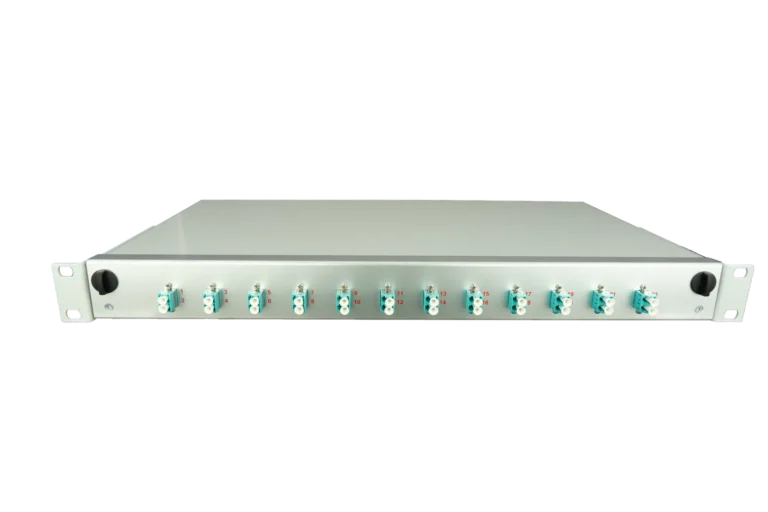
In practice, modular splice systems based on 19-inch technology per DIN 41494 have proven their worth. These enable flexible adaptation of fibre capacity from an initial 24 fibres up to 96 fibres per rack unit – a packing density that exceeds conventional systems by a factor of two.
- Central control centre: 288–576 fibres in 3HE systems
- Substations: 48–96 fibres in 1HE modules
- Local distribution stations: 12–24 fibres in DIN rail boxes
- Sensor networks: 4–8 fibres per measurement point
Practical Implementation: Smart Grid Fibre Optic in German Distribution Networks
German network operators are increasingly installing optical fibre cables alongside planned trenching work. The Gigabit Infrastructure Act (GIA) has reduced bureaucratic obstacles since 2024 and enables synergies between energy and telecommunications infrastructure.
Fiber Products Quality Promise: As an official Diamond Partner and manufacturer, we produce modular splice systems in Europe. Benefit from Swiss precision and in-house manufacturing.
A typical medium-voltage network with 50 local distribution stations requires approximately 75–100 km of optical fibre cable for complete SCADA connectivity. The investment pays back through reduced transmission losses and optimised network utilisation within 3–5 years.
Connector Types and Connectors for Harsh Industrial Environments
Smart Grid fibre optic, SCADA networks and energy provider optical fibre impose special demands on the mechanical robustness of plug connections. While LC connectors dominate in climate-controlled data centres, energy applications require vibration-resistant systems per IEC 61753-1 Category I.
| Connector Type | Attenuation | Vibration-Resistant | Application Area |
|---|---|---|---|
| E2000 APC | < 0.1 dB | Yes (IEC 61300-2-1) | Substations |
| LC Duplex | < 0.25 dB | Limited | Control centres |
| SC APC | < 0.3 dB | Yes | External installations |
| MPO/MTP | < 0.35 dB | No | Backbone |
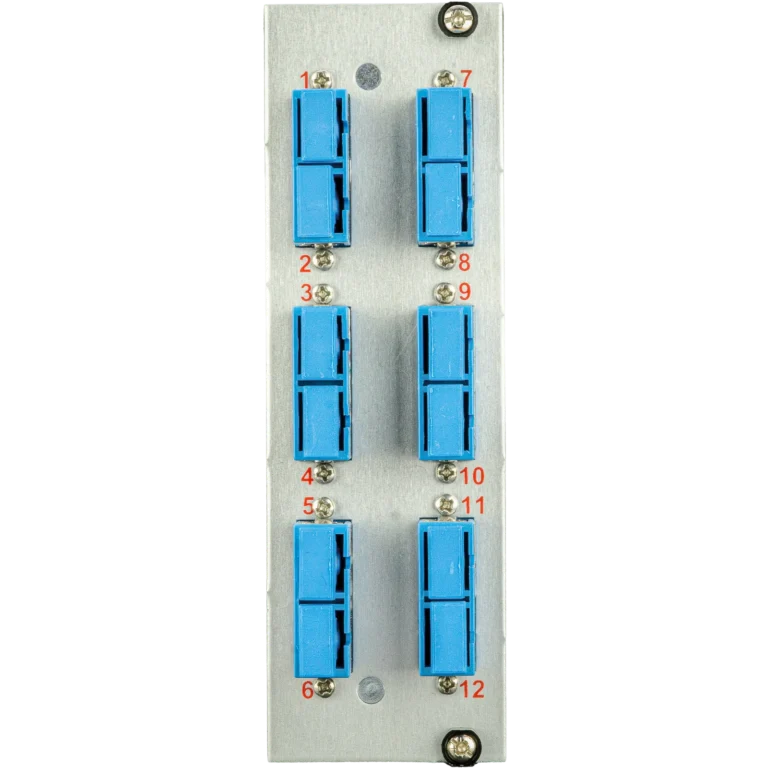
E2000 connectors with integrated protective shutters perform particularly well in dust-laden substations. Their return loss greater than 65 dB with APC finish prevents signal reflections that could disrupt SCADA protocols.
Integration of Existing Infrastructure: Migration to Smart Grid Fibre Optic
Many energy providers already operate older optical fibre infrastructure with OPGW cables (Optical Ground Wire) in high-voltage lines. These existing networks can be expanded for Smart Grid applications through modern multiplexers and CWDM/DWDM technology.
- Capacity expansion from 1 to 40 channels without new cables
- Parallel operation of old and new SCADA systems during migration
- Utilisation of spare fibres for Distributed Temperature Sensing
- Integration of 5G mobile networks for mobile maintenance teams
- Connection of decentralised storage with Modbus TCP/IP
Gradual migration enables modernisation of critical infrastructure without operational disruption. DIN rail boxes are ideal for retrofit installations in existing control cabinets.
Standards and Regulations for SCADA Fibre Optic Networks
Smart Grid fibre optic, SCADA networks and energy provider optical fibre are subject to strict regulatory requirements. IEC 61850 defines communication in switchgear, while IEC 60870-5 standardises SCADA protocols.
For physical infrastructure, standards DIN EN 50173-1 for structured cabling and DIN EN 50174 for installation additionally apply. Particularly critical is compliance with fire class B2ca per the Building Products Regulation for cable installations in buildings.
- IEC 61850: Communication standard for switchgear
- IEC 60870-5-104: TCP/IP-based SCADA protocol
- IEC 61754: Interfaces for optical fibre plug connectors
- EN 50173-1: Application-neutral cabling
- VDE-AR-N 4131: Technical connection rules medium voltage
Redundancy and Fault Tolerance in Critical Infrastructure
Supply security requires Smart Grid fibre optic, SCADA networks and energy provider optical fibre to achieve the highest availability levels. Ring structures with automatic switchover within < 50 ms per ITU-T G.8032 guarantee uninterrupted operation even in the event of cable damage.
Modular splice systems enable physical separation of working and protection fibres in separate cassettes. In case of failure, the system automatically switches to redundant fibres whilst defective modules can be replaced during live operation.
| Redundancy Level | Technology | Switchover Time | Availability |
|---|---|---|---|
| Fibre Level | 1+1 Protection | < 50 ms | 99.999% |
| Path Level | Ring Topology | < 200 ms | 99.99% |
| System Level | Dual-Homing | < 1 s | 99.95% |
Economic Viability and Investment Protection for Municipal Utilities
Investment in Smart Grid fibre optic pays back through multiple benefit factors. Beyond the primary SCADA function, the infrastructure enables additional business models such as dark fibre leasing or backhaul for 5G networks.
A medium-sized municipal utility serving 100,000 residents typically invests €3–5 million in fibre optic base infrastructure. Annual savings from optimised network operation, reduced losses and avoided disruptions total €800,000–1,200,000.
- Reduction of network losses
- Reduction of disruption duration
- Prevention of demand peaks through intelligent control
- Additional revenue from fibre optic leasing: €200–400/km/month
- Subsidy rates up to 50% through broadband funding
Future-Proofing Through Modular System Architecture
Smart Grid fibre optic, SCADA networks and energy provider optical fibre continue to evolve. Integration of AI-powered network analysis and edge computing directly in substations requires scalable optical fibre infrastructure.
Modular splice systems with up to 96 fibres in 1HE provide the necessary flexibility for future expansions. Tool-free assembly and modular design enable modifications without operational disruption – a decisive advantage in the stepwise digitalisation of critical infrastructure.
Case Study: SCADA Modernisation at a Regional Network Operator
A southern German network operator modernised its SCADA system in 2024 with modular fibre optic solutions. The project encompassed 45 substations, 180 local distribution stations and 12 generation facilities over an area of 850 km².
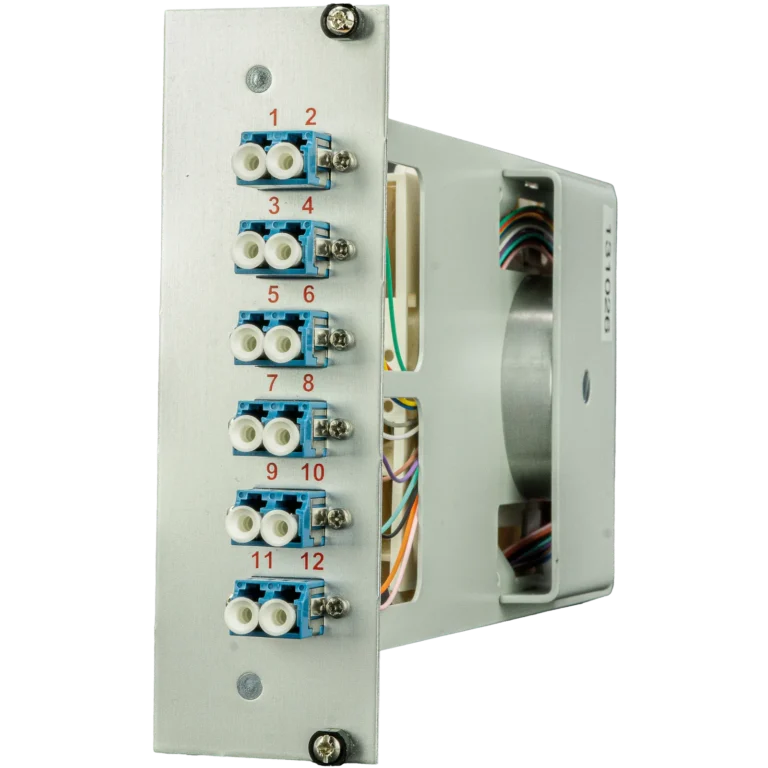
Through deployment of pre-configured modules with E2000 connectors, installation time per station was reduced substantially. Standardised 19-inch modules enabled uniform documentation and significantly simplified maintenance.
- Total investment: €4.2 million
- Installed fibres: 2,400 individual fibres
- Modules deployed: 85 SlimConnect 1HE
- Project duration: 14 months
- ROI period: 3.5 years
FAQ: Frequently Asked Questions on Fibre Optic in Smart Grids
Which fibre types are suitable for Smart Grid fibre optic and SCADA networks?
For Smart Grid applications, OS2 singlemode fibre to ITU-T G.652.D is recommended. The standard caps cabled attenuation at 0.40 dB/km from 1310 to 1625 nm and at 0.30 dB/km in the 1530-1565 nm band. Reach is set by the transceiver, not the fibre: ITU-T G.957 classifies long-haul links at roughly 40 km at 1310 nm and roughly 80 km at 1550 nm without optical amplifiers. Because the fibre is protocol-transparent, any common SCADA protocol can be carried over it with suitable transmission equipment.
How is Distributed Acoustic Sensing integrated into existing optical fibre infrastructure?
DAS systems use a dedicated fibre or DWDM channel to transmit laser pulses. The backscatter is analysed and enables detection of vibrations, temperature changes or mechanical loads with spatial resolution of < 10 metres over distances up to 50 km.
What standards apply to vibration-resistant E2000 connectors in substations?
The test procedures sit in the IEC 61300 series: IEC 61300-2-1 for vibration (sinusoidal), IEC 61300-2-9 for shock and IEC 61300-2-12 for impact. IEC 61753-1 provides the performance framework and defines the environmental categories a connector is qualified against. DIAMOND specifies the E-2000 for an operating temperature range of −40 °C to +85 °C. Which category and which severity apply in a substation is set by the operator’s specification.
How is the optimal number of fibres calculated for a medium-voltage network?
A minimum of 4 fibres (2 active, 2 reserve) should be planned per local distribution station. With 50 stations and ring topology, a total requirement of 200 fibres plus 30% future reserve emerges. Backbone connections require additional 24–48 fibres for parallel services.
What funding options exist in 2024/2025 for Smart Grid fibre optic rollout?
Municipal utilities can access federal grants via the Grey Spots Programme with subsidy rates up to 50%. Additionally, states such as Bavaria and North Rhine-Westphalia support municipal fibre optic projects with 40–90% subsidy when installed alongside energy infrastructure.
How is data security ensured in SCADA fibre optic networks?
SCADA networks are kept apart from IT either physically, via dedicated fibres or dark fibre, or logically, via VLANs – a VLAN is segmentation, not physical separation. Communications security for power system protocols is standardised in the IEC 62351 series, with TLS-based protection specified in IEC 62351-3. OTDR monitoring can reveal tap attempts through attenuation changes, but the practical detection limit of conventional OTDR equipment is around 0.1 dB (ITU-T G.650.3, Appendix III), not 0.01 dB.
Conclusion: Smart Grid Fibre Optic as Foundation of the Energy Transition
Smart Grid fibre optic, SCADA networks and energy provider optical fibre form the indispensable nervous system of modern power grids. The combination of electromagnetic immunity, enormous bandwidth and integrated sensor functions makes optical fibre the only future-proof technology for digitalising critical infrastructure.
For network operators and municipal utilities in the DACH region, investment in modular optical fibre systems represents not only technological future-proofing but also economic benefits through synergies and new business models. With standardised components offering 5 years’ warranty and manufactured in Europe, energy providers create resilient networks for the decades ahead.
Successful implementation requires systematic planning, standards-compliant components and partnership with reliable providers with proven expertise.
Order directly in our shop: fiber-products.com
Request a Quote Today
Free consultation – personalised quote within 24 hours