Fibre Optic Accessories: How to Choose Adapters, Splice Boxes and Cable Management
Fibre Optic Accessories: How to Choose Adapters, Splice Boxes and Cable Management
Professional fibre optic installations succeed or fail based on the quality of their accessories: splice boxes, adapters and cable management systems determine attenuation values, installation time and the flexibility for future network infrastructure expansion.
With Germany’s accelerated fibre rollout – 24.8 million households to be reached by end of 2025 – the demands on professional fibre optic accessories continue to rise. Technicians and procurement managers face the challenge of selecting the right components for their specific applications from an increasingly complex market.
The three pillars of professional fibre optic installations
Every high-quality optical fibre installation rests on three central accessory categories that must be perfectly coordinated. The splice box forms the core for safe fibre storage, whilst LC SC adapters and other connector types ensure flexible connectivity.
- Splice boxes: Protection and organisation of sensitive fibre splices with a defined bend radius of at least 30 mm
- Adapters and couplings: Standards-compliant connection elements per IEC 61754</strong> for lossless signal transmission
- Cable management systems: Structured routing with strain relief and bend protection for sustained operational reliability
Cable management is often underestimated, yet it is critical to installation longevity. Modern systems already integrate strain relief and predefined routing paths that can reduce installation times.
Splice boxes: technical requirements and selection criteria
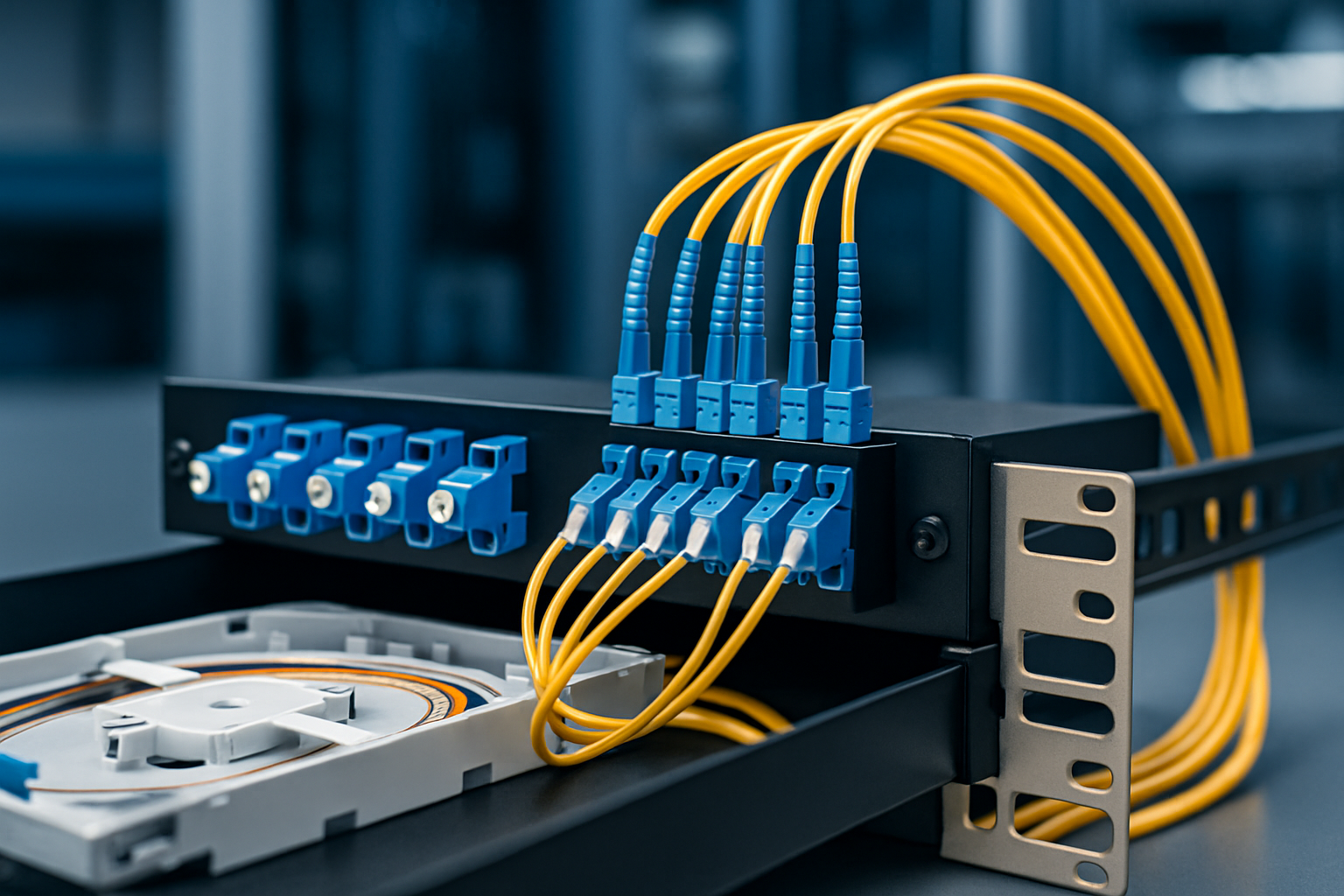
The splice box is more than just storage for fibre splices. It must provide mechanical protection, compensate for thermal expansion and simultaneously enable maximum packing density. Modern cassettes now accommodate up to 24 individual fibre splices in minimal space.
| Cassette type | Capacity | Dimensions (mm) | Application |
|---|---|---|---|
| Compact cassette | 12 splices | 95 x 85 x 8 | Wall-mounted distributors, FTTH |
| Standard cassette | 24 splices | 125 x 105 x 10 | 19-inch systems |
| High-density cassette | 48 splices | 160 x 130 x 12 | Data centres |
| Industrial cassette | 12–24 splices | 120 x 100 x 15 | DIN rail, IP65 |
When selecting the right splice box, technicians must consider three key factors: the number of fibres to splice, available space and environmental conditions. For industrial applications, for example, cassettes with enhanced IP65 protection rating are required.
LC SC adapters and other connector types compared
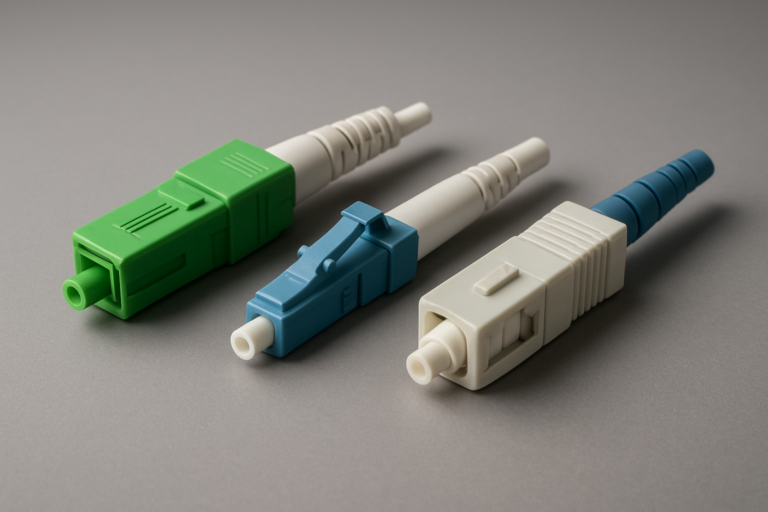
The choice of the right adapter significantly determines attenuation values and reflective losses in the fibre connection. LC SC adapters rank among the most widely used transition elements, as they connect the two most common connector types.
- LC adapters: Small form factor (SFF), ideal for high port density with < 0.2 dB insertion loss
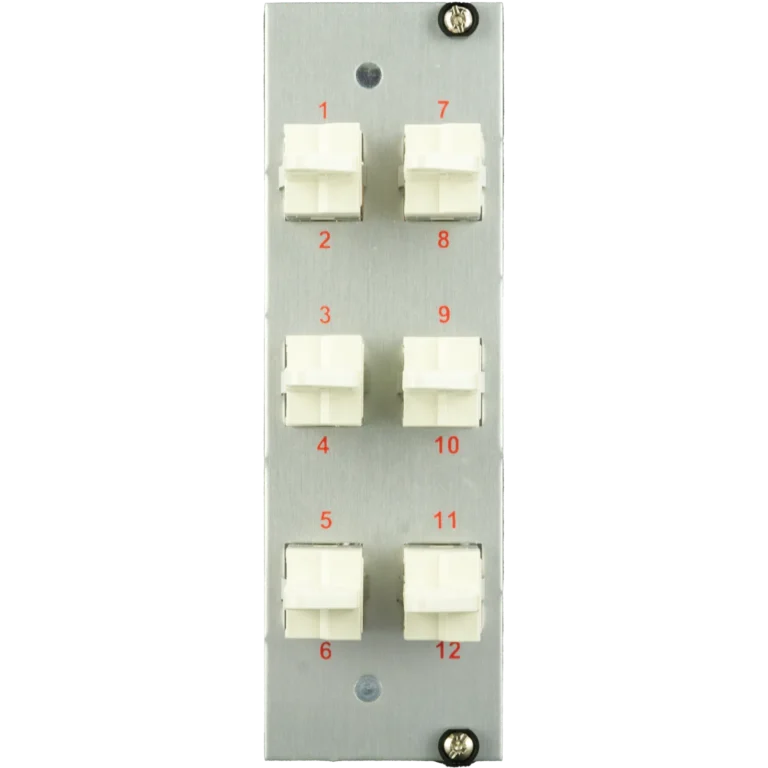
- SC adapters: Robust push-pull mechanism, standard in FTTH networks with < 0.3 dB attenuation
- E2000 adapters: Integrated protective shutter, vibration-resistant for industrial applications per IEC 61754-15
- MPO/MTP adapters: Multi-fibre connections for data centres accommodating up to 72 fibres per connector
The trend clearly points to higher packing densities. Whilst traditional SC adapters enable roughly 24 ports per rack unit, LC-based systems now achieve up to 96 ports in 1U – doubling capacity in the same footprint.
Fiber Products quality promise: As an official Diamond Partner and manufacturer, we produce modular splice systems in Europe. Benefit from Swiss precision engineering and in-house manufacturing.
Cable management: systematic design for sustained operational safety
Professional cable management begins at the entry point to the enclosure. Modern systems use staggered entries with integrated strain relief, protecting sensitive fibre optic accessories from mechanical stress.
Routing within the system follows defined radii to never fall below the critical 30 mm bend radius threshold for singlemode fibres. Modular guide elements enable flexible adaptation to various cable types and diameters.
| Guide element | Capacity | Bend radius | Material |
|---|---|---|---|
| Standard cable entry | 4–48 fibres | ≥ 30 mm | Polyamide/Metal |
| 19-inch cable duct | up to 144 fibres | ≥ 40 mm | Painted steel sheet |
| Flexible spiral sheath | 2–24 fibres | ≥ 35 mm | Polyethylene |
| DIN rail cable management | 12–48 fibres | ≥ 30 mm | Polycarbonate IP65 |
Standards-compliant installation: IEC and DIN standards overview
The installation of fibre optic accessories is subject to strict standards ensuring quality and interoperability. For the German market, DIN EN 50173 for structured cabling and IEC 61300 series for test methods are particularly relevant.
Each LC SC adapter must, for example, meet the requirements of IEC 61754-20 for LC connectors and IEC 61754-4 for SC connectors. Attenuation values must not exceed 0.5 dB for standard connections.
- IEC 61754: Defines mechanical interfaces for all common connector types
- IEC 61300-3-34: Tests attenuation under random mating conditions
- DIN EN 50173-1: Requirements for structured cabling
- ISO/IEC 11801: International standard for generic cabling systems
Modular systems versus conventional splice boxes
The market clearly develops towards modular systems that offer substantial advantages over conventional splice boxes. A modern splice cassette in modular design enables retrofitting without service interruption.
Modular splice modules such as the SlimConnect system achieve 96 fibres in 1U – double the packing density of conventional solutions. Pre-termination also reduces installation times.
- Scalability: Expansion from 12 to 288 fibres without system change
- Serviceability: Individual modules replaceable without affecting active connections
- Investment protection: Incremental deployment matching actual demand
- Standardisation: Uniform cassettes for various enclosure sizes
Specialist applications: industrial environments and data centres
In industrial settings, vibration, temperature fluctuations and electromagnetic interference impose special demands on fibre optic accessories. Robust E2000 connectors with integrated protective shutter and enhanced vibration resistance prove their worth here.
Data centres, by contrast, prioritise maximum port density and rapid reconfiguration. MPO-based systems with pre-terminated cable assemblies enable simultaneous connection of 12, 24 or 72 fibres with a single mating action.
| Application | Recommended connector type | Protection rating | Special features |
|---|---|---|---|
| Mechanical engineering | E2000-LSH | IP65 | Vibration-resistant, protective shutter |
| Data centre | MPO/LC | IP20 | High density, 96 ports/1U |
| FTTH distributor | SC-APC | IP54 | Low reflection < -60 dB |
| DIN rail | LC/E2000 | IP65 | DIN-mounted, compact |
Quality criteria: what technicians and procurement managers should consider
When procuring fibre optic accessories, measurable quality criteria determine long-term installation viability. A high-quality splice box stands out through precise manufacturing tolerances and thoughtful design details.
The LC SC adapter should guarantee attenuation values of no more than 0.25 dB and withstand at least 1000 mating cycles without performance loss. Cable management must absorb tensile forces up to 100 N without damaging the fibre.
- Manufacturing quality: Precise tolerances < 0.01 mm on ferrules
- Material durability: Halogen-free plastics per IEC 60754
- Documentation: Complete test records and declarations of conformity
- Warranty: Minimum 3 years, ideally 5 years manufacturer warranty
- Availability: Stock held in Germany for rapid delivery
Economical analysis: investment versus operating costs
The acquisition costs for high-quality fibre optic accessories amortise through reduced maintenance and higher system availability. A professional splice box with optimised fibre routing minimises micro-bends and thus creeping attenuation increases.
Modular systems such as the SlimConnect 1U splice box offer additional cost-saving potential through their flexibility. Demand-driven expansion avoids over-investment whilst tool-free assembly reduces labour hours.
In a typical 48-fibre installation, modular systems can reduce total costs over 5 years – whilst simultaneously offering greater flexibility for future expansion.
Future-proofing through correct component selection
With advancing FTTH deployment and rising bandwidth requirements, the importance of scalable infrastructure grows. The choice of the right fibre optic accessories today determines tomorrow’s expansion potential.
- Reserve capacity: Plan for at least 30% spare ports for future expansion
- Migration-friendly: Select systems supporting multiple connector types
- Documentation standards: Structured labelling per DIN EN 50174-1
- Modularity: Upgradeable systems for phased network expansion
The integration of E2000 connectors in Swiss precision quality, available through the Diamond Partnership, secures the highest quality standards for critical applications. With attenuation below 0.1 dB, these components set transmission quality benchmarks.
Practical installation tips for optimal results
Expert installation of LC SC adapters and cable management requires systematic approach. Before assembly, a thorough inventory of existing infrastructure should be completed.
When installing the splice box, ensure adequate slack – at least 1.5 metres per fibre permits later rework. Labelling should begin during installation following a consistent scheme.
- Cleanliness: Clean all connector faces with specialist wipes and isopropanol
- Testing: Test every connection with OTDR or light source/power meter
- Documentation: Record attenuation values and reflections
- Strain relief: Never attach cables directly to connectors
- Climate control: Maintain temperature and humidity within standard ranges
FAQ: Common questions about fibre optic accessories
Which splice box suits 19-inch racks?
For 19-inch installations, modular cassettes with standard dimensions of 125 x 105 mm accommodating up to 24 splices are recommended. These fit optimally in 1U splice boxes and, if required, permit mounting up to 4 cassettes per rack unit.
When should LC SC adapters be deployed?
LC SC adapters are used where existing SC infrastructure must connect to modern LC-based components. This frequently occurs during FTTH network migration or integration of new data centre equipment.
What attenuation is acceptable for fibre adapters?
High-quality adapters should provide maximum insertion loss of 0.3 dB for multimode and 0.2 dB for singlemode. Premium components often achieve values below 0.15 dB.
Which cable management suits industrial applications?
Industrial environments require cable management with IP65 rating in robust polycarbonate or stainless steel. These must withstand vibration per IEC 61373 and temperature ranges from -40°C to +85°C.
How many fibres fit in a 1U splice box?
Modern modular systems like SlimConnect achieve up to 96 fibres in 1U with LC connectors or 48 fibres with SC connectors. This represents double the packing density of conventional systems.
What warranty periods are standard for professional fibre optic accessories?
Premium manufacturers like Fiber Products provide 5 years warranty on their modular systems – a unique selling point in the German market.
Conclusion: Quality pays
The choice of correct fibre optic accessories forms the foundation of reliable, future-proof network infrastructure.
Request a quote
Have questions about our fibre optic solutions? Our expert team is happy to advise you – free and without obligation.