Secure Fibre Optic Networks for Government Agencies – Made in Germany as a Procurement Standard
Secure Fibre Optic Networks for Government Agencies – Made in Europe as a Procurement Standard for Premium Optical Fibre Quality
Secure fibre optic networks for government agencies, Made in Europe procurement, and optical fibre quality are decisive criteria when selecting network components for public institutions. The procurement of fibre optic systems in Germany is subject to special requirements for security, reliability, and proof of origin. Government agencies increasingly rely on European manufacturing and certified quality standards according to IEC 61754 to safeguard critical infrastructure over the long term.
Regulatory conditions have been significantly tightened by the Telecommunications Act amendment 2025/2026 and the VDE Guideline 0800-730. These prioritise fibre optic rollout as a matter of overriding public interest and define binding quality criteria for government networks.
Why Made in Europe is Essential for Fibre Optic Components in Government Applications
Public procurement regulations demand verifiable quality standards and transparent supply chains. Made in Europe stands for three central security aspects:
- Comprehensive documentation of manufacturing processes according to ISO 9001:2015
- Spare parts availability on request
- Compliance with European data protection standards and security regulations
- No hidden backdoors or vulnerabilities in critical components
- Short delivery routes and rapid response times in case of disruptions
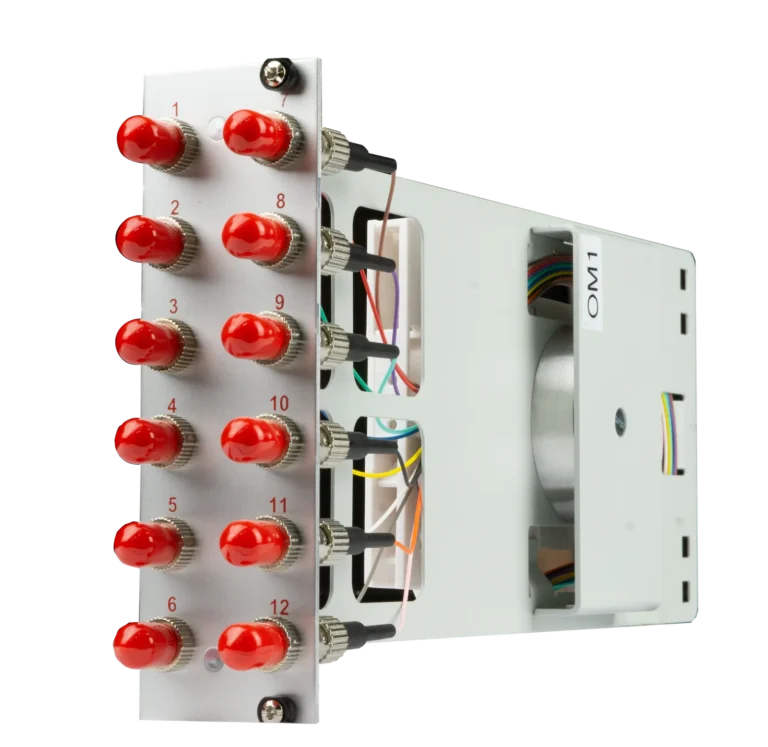
The quality difference is particularly evident in modular splice systems and E2000 Connectors für Government Networks. Our modular splice systems carry a 5-year manufacturer warranty.
Technical Requirements for Secure Fibre Optic Government Networks
Government networks require special technical specifications that exceed standard commercial customer requirements. Return loss must be at least 60 dB, while insertion loss must remain below 0.25 dB.
| Parameter | Government Requirement | Standard Application | Standard |
|---|---|---|---|
| Return Loss | > 60 dB | > 45 dB | IEC 61300-3-6 |
| Insertion Loss | < 0.25 dB | < 0.5 dB | IEC 61300-3-4 |
| Mating Cycles | > 1000 | > 500 | IEC 61300-2-2 |
| Temperature Range | -40°C to +85°C | -20°C to +70°C | IEC 61300-2-22 |
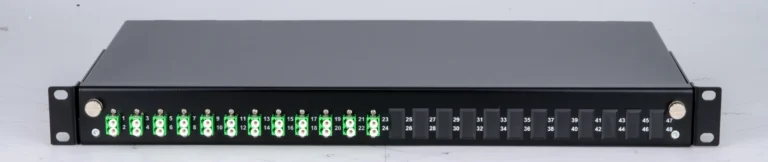
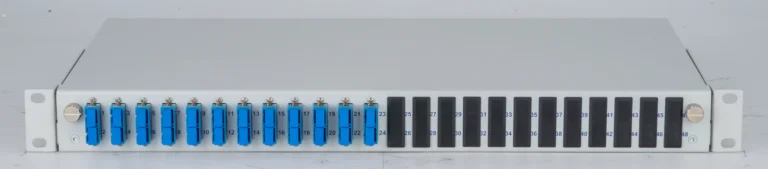
These enhanced requirements stem from the need to transmit sensitive data without interruption even under extreme conditions. Modular systems with up to 96 fibres per 1U enable maximum port density with minimal rack space.
Standards Compliance and Certifications for Public Procurement
The procurement of fibre optic components for government agencies is subject to strict procurement regulations. Secure fibre optic government systems must demonstrate the following certifications:
- CE marking according to Low Voltage Directive 2014/35/EU
- RoHS compliance in accordance with Directive 2011/65/EU
- REACH registration for all materials used
- ISO 14001 Environmental Management certification of the manufacturer
- Fire safety class B2ca according to EN 50575 for indoor cables
Test Protocols and Documentation
Each delivery must be accompanied by complete test protocols. This includes 100% final inspection of all connectors using interferometric measurement. Documentation is prepared according to IEC 61300-3-35 with individual records for each fibre.
Fiber Products Quality Promise: As an official Diamond partner and manufacturer, we produce modular splice systems in Europe. Benefit from Swiss precision and in-house manufacturing.
E2000 Connectors as the Security Standard for Critical Infrastructure
The E2000 connector has established itself as the preferred connector type for government applications. With its integrated protective shutter and push-pull locking mechanism, it offers maximum protection against contamination and accidental disconnection.
| Connector Type | Security Level | Protection Class | Government Use |
|---|---|---|---|
| E2000/APC | Very High | IP65 | Critical Infrastructure |
| LC/APC | Medium | IP20 | Office Environments |
| SC/APC | Medium | IP20 | Distribution Rooms |
| MPO/APC | High | IP50 | Data Centres |
The return loss of over 65 dB with E2000/APC connectors ensures interference-free transmission even in sensitive measurement applications. The mechanical coding also prevents incorrect insertions.
Modular Splice Systems for Flexible Government Networks
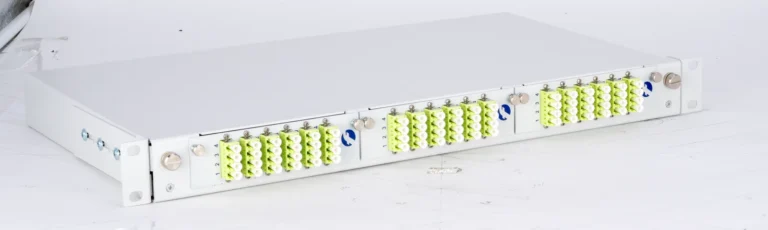
Made in Europe procurement means flexibility and future-proofing in splice systems. Modern 19-inch systems enable accommodation of various front modules and splice cassettes.
- SlimConnect systems with 1U height for up to 96 fibres
- VarioConnect solutions in 3U for up to 288 fibres
- Tool-free mounting of front modules in less than 30 seconds
- Colour-coded couplings
- Integrated cable management with bending radius > 30mm
Advantages of Modular Design for Government Agencies
Modularity enables subsequent expansions without operational interruption. During system upgrades, individual modules can be replaced while the rest of the network remains active. This minimises downtime.
Security Aspects in the Installation of Government-Grade Optical Fibre Networks
The installation of fibre optic networks in government buildings requires special safety precautions. All work must be performed by certified technicians according to VDE 0888 Standards.
Critical installation points include access control to distribution frames, documentation of all splice points, and audit-proof logging of changes. Tamper-proof locks and alarm systems protect against unauthorised access.
- Four-eyes principle for all work on active systems
- Encrypted documentation according to BSI baseline protection
- Regular attenuation measurements for early detection of tampering
- Redundant cable routing for critical connections
- Physical separation of classified and unclassified networks
Long-Term Availability and Spare Parts Warranty
Secure fibre optic government networks must remain functional for decades. Spare parts availability of identical components is available on request. This avoids costly system migrations.
The 5-year manufacturer warranty goes well beyond statutory requirements. It covers not only material defects but also guaranteed optical performance throughout the service life.
Economic Considerations Over the System Lifecycle
With a service life of 20 years, the premium for Made in Europe procurement amortises itself within 5 to 7 years through reduced downtime and lower maintenance costs. The Total Cost of Ownership (TCO) is lower than comparable imported products.
Practical Implementation: From Procurement to Installation
Procurement begins with a precise specification. Government-grade optical fibre quality must be formulated in a technology-neutral but requirements-specific manner. Specialised government solutions meet these criteria through modular configurability.
- Phase 1: Requirements assessment and network planning according to ITU-T G.671
- Phase 2: Preparation of the specification with minimum requirements
- Phase 3: Evaluation of offers based on quality criteria (60%) and price (40%)
- Phase 4: Sample testing and certificate validation
- Phase 5: Installation and acceptance testing according to IEC 61280
Future-Proofing Through Scalable System Architecture
The digital transformation of government administration requires networks that grow with increasing bandwidth requirements. Modular systems with single-mode OS2 fibres already support transmission rates of 400 Gbit/s today and are prepared for future terabit applications.
The combination of German engineering and Swiss precision in Diamond components creates a unique quality position in the European market. With manufacturing in Europe, we ensure short delivery routes and maximum supply security.
FAQ: Frequently Asked Questions About Secure Fibre Optic Networks for Government Agencies
Which standards apply to government procurement of fibre optic systems?
The relevant standards are the VDE 0888 series for installation, IEC 61754 for connectors, and the EN 50173 series for structured cabling. Additionally, components must comply with BSI baseline protection requirements.
How do APC and PC connectors differ in government applications?
APC connectors (Angled Physical Contact) offer return loss of over 60 dB with an 8° angled polish, while PC connectors achieve only about 45 dB. For secure government fibre optic networks, only APC variants are approved.
What port density is optimal for government data centres?
Modern government data centres use 96 fibres per 1U as standard. This enables theoretically over 4,000 fibres per 42U rack with full documentation capability.
How long does migration to Made in Europe components take?
With modular systems, migration can occur in phases. A short time window should be planned per distribution point for exchanging 96 fibres without interrupting active connections.
What warranty services are standard for government procurement?
Minimum 5 years manufacturer warranty with spare parts supply of identical components on request. Optical values must be maintained throughout the entire warranty period.
How is tamper security ensured in fibre optic networks?
Through continuous attenuation monitoring (OTDR), sealed joints, tamper-proof enclosures rated IK10, and comprehensive logging of all accesses. E2000 connectors additionally offer mechanical coding against incorrect mating.
Request a Quote
Have questions about our fibre optic solutions? Our expert team is happy to advise you – free of charge and without obligation.