The best splice modules for FTTH rollout 2026
Splice modules and professional fibre optic splicing form the technical foundation for successful broadband rollout in German municipalities – modern systems achieve packing densities of up to 96 fibres per rack unit with attenuation values below 0.1 dB per connection. The selecting splice modules technology directly determines installation speed, operating costs, and long-term network quality in municipal FTTH deployments. With Germany’s nationwide fibre deployment rate exceeding 52 percent and rising network capacity requirements, municipal utilities face the challenge of implementing future-proof and cost-effective splicing solutions.
Technical requirements for splice modules in municipal FTTH network deployment
Modern FTTH rollout in German cities and municipalities requires fibre optic splice technology trends that meet specific technical and commercial criteria. Packing density plays a central role – high-quality systems such as the SlimConnect series enable up to 96 fibres in just one rack unit (1RU), which represents double the density compared to standard solutions. This compactness is particularly essential in confined distribution racks and municipal equipment rooms.
The mechanical robustness of FTTH splice modules must comply with IEC 61300-2 requirements, withstanding temperature cycles from -40°C to +85°C and vibration loads according to IEC 61300-2-1. For municipal utilities, this concretely means: splice modules in outdoor distribution frames must function reliably for decades without additional air conditioning.
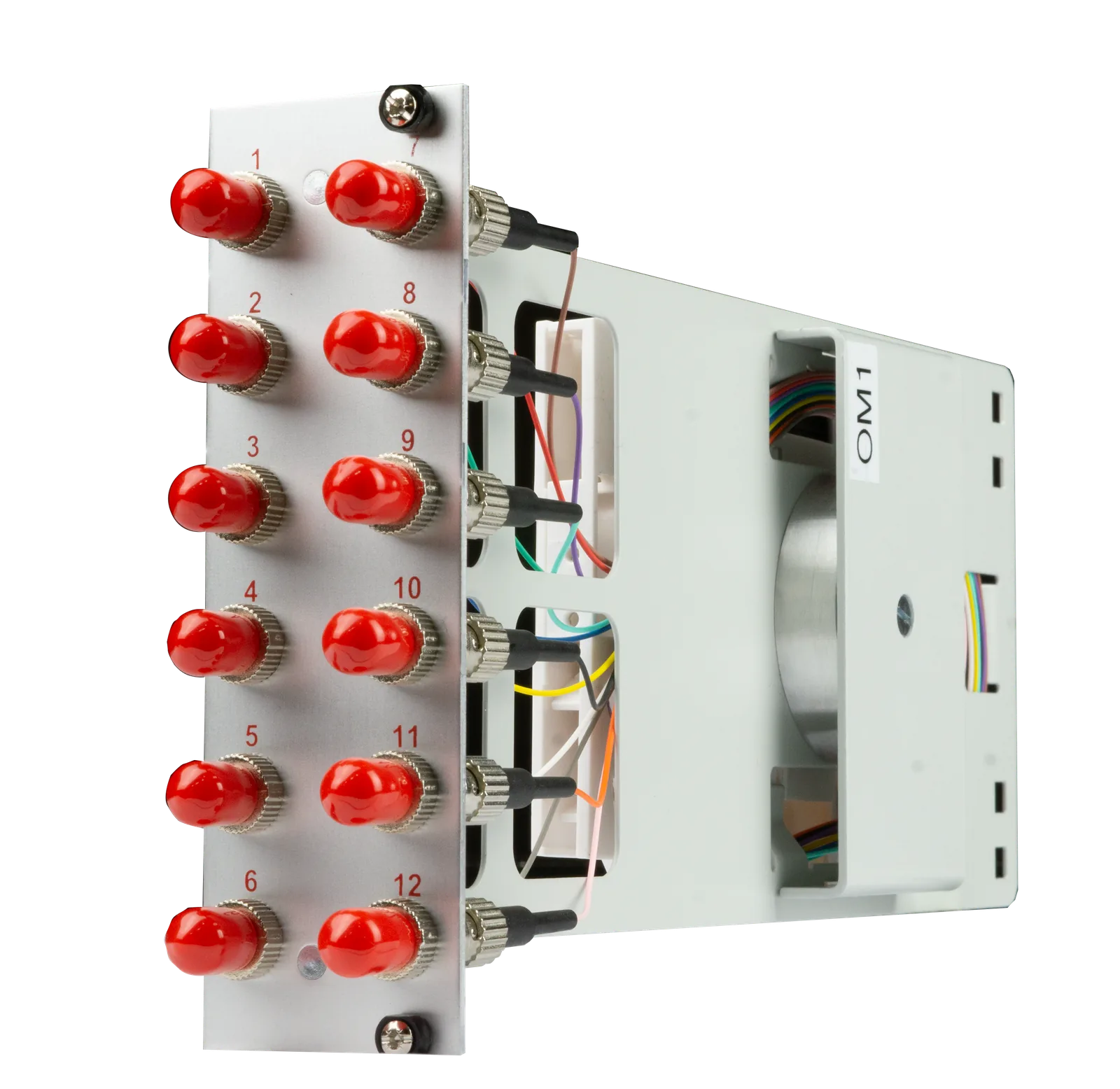
Another core criterion is system modularity. Interchangeable front modules for various connector types (LC, SC, E2000, ST, FC) enable flexible adaptation to changing network requirements without complete system replacement. This flexibility significantly reduces total cost of ownership in the long term.
Fusion splicing vs. mechanical splicing: Technology comparison for FTTH networks
In fibre optic splicing for municipal networks, the fusion splicing method dominates with typical attenuation values of 0.02 to 0.05 dB per connection. Modern fusion splicers such as the Fujikura 90S+ or FiberMASTER series achieve splicing times below seven seconds with automatic fibre type recognition for G.652 and G.657 fibre types. The investment in professional fusion splicing technology pays for itself in larger FTTH projects through lower operating costs of approximately €1.50 per splice compared to €25 for the mechanical method.
Mechanical splice connections find their primary justification in temporary installations and emergency repairs. With attenuation values between 0.2 and 0.75 dB, they are unsuitable for backbone connections, but can be economically sensible for end-customer connections with short distances. Fast installation without specialist equipment enables very short handling times per connection.
For municipal utilities, a hybrid approach is recommended: fusion splicing for all main distribution and network distribution frames, mechanical splices for flexible end-customer connections and emergency situations. This strategy optimises both network quality and cost-effectiveness.
Modular splice systems for scalable municipal utility infrastructure
The scalability of splice modules determines the future viability of municipal fibre optic networks. The VarioConnect system, for example, enables up to 288 fibres in a single housing with its 3RU format – ideal for central distribution points in municipal utility networks. The pull-out drawers with defined cable routing reduce installation time compared to conventional systems.
A decisive advantage of modular systems is the ability to expand without service interruption. New splice cassettes can be added during ongoing operation without compromising existing connections. This is particularly important for phased expansion into new districts. Documentation is carried out using standardised labelling systems according to DIN EN 50174-1, which significantly simplifies later maintenance work.
As an official Diamond partner, Fiber Products offers special expertise here: the acquisition of Swiss precision manufacturing guarantees the highest quality standards while maintaining production in Europe – an important criterion for public procurement.
FTTH network architecture and optimal placement of splice modules
The strategic positioning of FTTH splice modules in the network significantly influences operational resilience and maintenance efficiency. In typical PON network design (Passive Optical Network), splice modules are located at three critical points: the main distribution frame (MDF), the cable branch points (CBP), and the building distribution frames (BDF). Each position presents different requirements for splice module technology.
The main distribution frame often concentrates several hundred fibres, which is why high-density systems with structured cable routing are essential here. Splitter ratios of 1:32 or 1:64 require precise splice connections with minimal attenuation losses. With typical total attenuation of 28 dB in the PON budget, every tenth of a dB saved provides additional reach or higher splitting ratios.
Outdoor cable branch points require particularly robust splice modules with IP68 protection and extended temperature resistance. A typical service life of 25 years with minimal maintenance is standard. Modern systems already integrate provisions for future technologies such as XGS-PON with 10 Gbit/s symmetrical data rates.
Quality criteria and certifications for professional splice modules
The quality of splice modules is defined by measurable parameters and international certifications. Return loss should exceed 50 dB in high-quality systems, minimising signal reflections and optimising transmission quality. Insertion loss per connector must not exceed 0.3 dB according to IEC 61753-1 – premium systems achieve values below 0.1 dB.
Mechanical durability after at least 500 mating cycles according to IEC 61300-2-2 is essential for municipal utility applications, as switching and expansion regularly occur. Vibration resistance according to IEC 61300-2-1 (10-500 Hz, 10g acceleration) ensures trouble-free operation even near roads or railway lines.
CE marking and RoHS compliance hold particular significance for public contracting authorities. The 5-year warranty, offered by Fiber Products as the only supplier in the German market, significantly reduces economic risk and simplifies life-cycle cost calculations in municipal budgets.
Economic analysis: TCO analysis for municipal FTTH projects
Total Cost of Ownership (TCO) for fibre optic splicing in municipal networks encompasses far more than acquisition costs alone. A high-quality splice module with 48 ports costs between €800 and €1,500 initially but pays for itself through reduced maintenance costs and higher network availability within three to five years.
Installation costs vary significantly depending on the splicing method: whilst pre-terminated modules reduce assembly time, on-site splicing requires trained personnel and more time. At average hourly rates of €85 for fibre technicians, the savings quickly add up to five-figure amounts per project.
Maintenance and operating costs over the typical 20-year service life often account for 40 percent of total costs. Systems with tool-free assembly and self-documenting features significantly reduce these costs. Modular design also enables cost-effective capacity expansion without complete replacement.
Practical installation: Best practices for FTTH splice modules
Professional installation of FTTH splice modules follows established procedures that ensure quality and efficiency. Fibre preparation begins with correct stripping to exactly 125 micrometres diameter, followed by a precise 90-degree cut using a high-quality fibre cleaver. Contamination drastically reduces splice quality – cleaning with 99-percent isopropyl alcohol and lint-free wipes is mandatory.
The splicing sequence in multi-fibre cables follows colour coding according to DIN VDE 0888-2, with systematic documentation of each connection in digital network diagrams. Modern splicers automatically record GPS coordinates and measurement values, which greatly simplifies later fault finding.
Cable strain relief is critical for long-term stability. At least 100 Newtons of strain relief should be provided per 12 fibres. Bending radii must not be less than 30 mm for single-mode fibres – bend-optimised G.657 fibres allow 15 mm. The final OTDR measurement documents the quality of each individual splice connection and serves as the acceptance protocol.
Future trends: Next-generation splice technologies for 2026
The evolution of splice modules is driven by increasing bandwidth requirements and new transmission technologies. Multi-core fibres with up to 19 cores per fibre will revolutionise packing density – first compatible splice modules are already in development. Integration of monitoring functions directly into the modules enables permanent quality monitoring and predictive maintenance.
Artificial intelligence already optimises splicing processes today: automatic image recognition identifies fibre types and contamination, while machine learning algorithms adjust optimal splicing parameters in real-time. The next generation of splicers will achieve success rates exceeding 99.5 percent in fully automatic operation.
Future FTTH solutions increasingly integrate power-over-fibre technology, creating new requirements for splice modules. Simultaneous data and power transmission over a single fibre requires special protective measures and enhanced safety concepts in the modules.
Selecting the optimal splice module: Decision criteria for municipal utilities
Choosing the right FTTH splice module requires systematic evaluation of various factors. Expected connection density determines required port count – for typical municipal utility projects, 48 to 96-port systems have proven optimal. The geographical distribution of connections influences the choice between centralised high-density solutions or decentralised smaller units.
Compatibility with existing systems is essential for migration projects. Hybrid splice modules that support both old and new connector types enable smooth transitions without complete overhaul. The availability of local service partners and training offerings should also factor into the decision.
As a complete system provider in the DACH region, Fiber Products combines all relevant components – from splice modules to splice boxes to E2000 connectors in Diamond quality. European manufacturing guarantees short lead times and flexible support, whilst the 5-year warranty provides long-term investment security.
Frequently asked questions about splice modules in FTTH deployment
What packing density is optimal for municipal FTTH networks?
For municipal utility projects, 48 to 96 fibres per rack unit has established itself as the most economical format. This density enables efficient space utilisation while maintaining manageable complexity. Larger cities with over 50,000 residents benefit from 96-fibre systems, whilst smaller municipalities are optimally served with 48-port solutions.
What are the real attenuation losses of modern splice modules?
A splice module contributes its connector loss plus one internal fusion splice. DIAMOND specifies single-mode E-2000 connectors at typically 0.1 dB with a guaranteed maximum of 0.3 dB; Low-Loss/Ultra-Low-Loss versions reach about 0.02-0.1 dB. Reach is not set by this figure: ITU-T G.984.1/G.984.2 define 10 km and 20 km fibre distance for GPON within an ODN loss budget of 5-30 dB, dominated by splitter and fibre attenuation.
What is the service life of professional FTTH splice modules?
Industrial splice modules are designed for at least 25 years of continuous operation. The mechanical components withstand at least 500 mating cycles without quality loss. With proper maintenance, service lives exceeding 30 years are realistic.
Are pre-terminated or on-site splice connections more cost-effective?
Pre-terminated modules reduce installation time and minimise sources of error. For projects exceeding 100 connections, the higher material costs are offset by saved labour time within weeks. On-site splicing remains relevant for custom solutions and repairs.
How important is backwards compatibility with splice modules?
Backwards compatibility with existing network components is essential for cost-effective migration projects. Modern fibre optic splicing systems should support all common connector types (LC, SC, E2000, ST, FC) and integrate seamlessly into existing 19-inch racks.
What role does warranty duration play in economic calculations?
An extended 5-year warranty, as offered by Fiber Products, significantly reduces failure risk during the critical initial phase. In a TCO assessment over 10 years, this can save on total costs by eliminating unplanned replacement measures.
Conclusion: Professional splice modules as a success factor in FTTH rollout
Splice modules form the technical backbone of successful FTTH projects in German municipalities. The choice of high-quality, modular systems with low attenuation values and high packing density determines the cost-effectiveness and future viability of municipal fibre optic networks. With well-designed solutions that combine Swiss precision with German engineering expertise, the ambitious rollout targets through 2030 can be achieved.
For detailed technical advice on your FTTH project and custom-configured splice modules, the expert team at Fiber Products is at your service. As the only complete system provider in the DACH region with our own manufacturing and 5-year warranty, we support municipal utilities in realising future-proof fibre optic infrastructure.
Find all modular fibre optic components directly in the Fiber Products Shop – with 5 years manufacturer warranty.
Request expert advice
Our experts will advise you on modular fibre optic solutions for your specific application – quickly, personally, and without obligation.