VDE 0888 Fibre Optic: Standards-Compliant Installation in Germany
The VDE 0888 fibre optic standards Germany form the central regulatory framework for DIN VDE fibre installation standards and define mandatory standards for safe and future-proof deployment of optical fibres in buildings, industrial plants and municipal networks. With the introduction of revised VDE guidelines 0800-730 for building installations and 0800-720 for quality standards, Germany has created for the first time a complete normative framework covering the entire fibre value chain from material selection through installation to acceptance testing.
The VDE 0888 standards family addresses the critical challenges of German FTTH deployment: whilst 52.8 percent of all German households could theoretically access fibre, only 27.3 percent are actually connected. This gap results primarily from missing or unclear technical standards, which are now being closed by the new VDE standards.
Normative Foundations: VDE 0888 and Related Fibre Standards
The VDE 0888 fibre optic standards Germany comprise a complex framework of national and international standards. At the centre is VDE application rule 0888 for communication cable systems, which defines specific requirements for fibre installations. This standard particularly governs electrical safety, mechanical durability and fire protection requirements for optical fibre installations.
The key normative documents for DIN VDE fibre installation are:
- VDE 0888-1: Basic requirements for communication cable systems
- VDE 0800-730: Building installation of optical fibres (effective February 2026)
- VDE 0800-720: Quality criteria for fibre materials
- DIN EN 50173: Generic communication cable systems
- DIN EN 50174: Installation of communication cabling
The new VDE 0800-730 marks a turning point: optical fibre cables are now correctly classified as non-fire-hazardous for the first time, enabling installation in escape routes without costly fire protection ducts. This reduces installation costs whilst simultaneously improving safety.
Technical Requirements of VDE 0888 for Fibre Networks
The technical specifications of VDE 0888 define precise parameters for every component of a fibre installation. For singlemode fibres, according to ITU-T G.652.D, maximum attenuation of 0.35 dB/km at 1310 nm and 0.25 dB/km at 1550 nm applies. Return loss must be at least 60 dB for APC connectors.
| Parameter | Singlemode OS2 | Multimode OM4 | Standard Reference |
|---|---|---|---|
| Max. Attenuation @ 1310nm | 0.35 dB/km | 2.5 dB/km | IEC 60793-2 |
| Max. Attenuation @ 1550nm | 0.25 dB/km | – | IEC 60793-2 |
| Bend radius (installed) | 30 mm | 30 mm | VDE 0888 |
| Tensile strength | 1000 N | 1000 N | EN 50174 |
Splice connection requirements are particularly critical: maximum splice loss must not exceed 0.1 dB, with professional installations using modern fusion splicers routinely achieving values of 0.02–0.03 dB.
Fiber Products Quality Promise: As an official Diamond partner and manufacturer, we produce modular splice systems in Europe. Benefit from Swiss precision and in-house manufacturing.
Installation Methods under DIN VDE Fibre Installation
The DIN VDE fibre installation distinguishes four network levels, with critical network level 4 (NE4) extending from the building entry point to the subscriber access outlet. The new provisions of VDE 0800-730 apply particularly strongly here, as they define practical installation methods for existing buildings for the first time.
The permissible installation methods under VDE 0888 fibre optic standards Germany include:
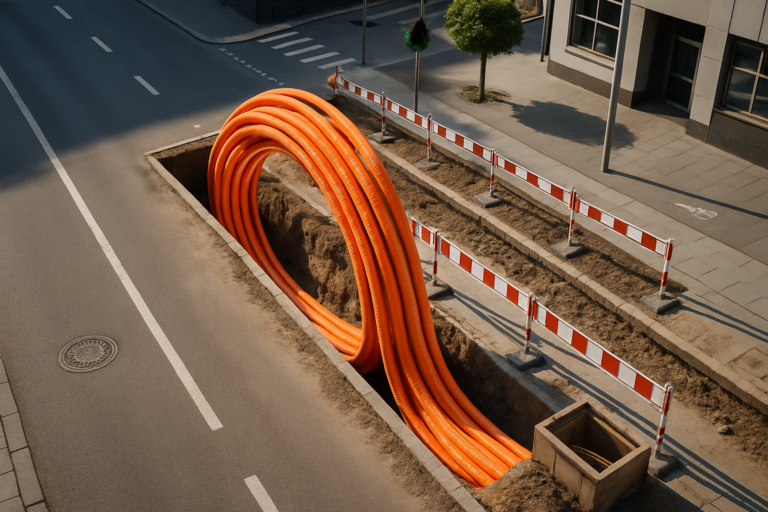
- Duct installation: In empty conduits with minimum 20 mm internal diameter
- Cable trays: Metal trays in escape routes without additional fire protection
- Adhesive fibre installation: Direct mounting with building classification
- Micro-duct systems: For retrofitted fibre blowing up to 2000 m length
- Under-floor installation: In raised floors with separators from power cables
A decisive advantage of the new standards is clarification on separation of power and fibre cables. Whilst costly shielding was previously often required, a minimum distance of 5 cm or continuous separation via metal dividers now suffices.
Fire Protection Requirements and MLAR Compliance
The revised Model Regulation on fire protection requirements for cable systems (MLAR) revolutionises fibre installation in Germany. Correct classification of optical fibres as non-fire-hazardous enables entirely new installation concepts, particularly in multi-family buildings and public facilities.
The following requirements apply to fire protection classification:
| Building Type | VDE 0888 Requirement | Cable Class | Installation Method |
|---|---|---|---|
| Residential buildings | Eca or better | EN 50575 | All methods |
| Public buildings | Cca-s1,d1,a1 | EN 13501-6 | Metal duct/conduit |
| Industrial plants | Dca-s2,d2,a2 | EN 50575 | Cable ladder |
| Data centres | B2ca-s1a,d1,a1 | EN 13501-6 | Raised floor |
Use of halogen-free flame-retardant cables (FRNC/LSZH) is mandatory in public buildings and escape routes. These cables comply with IEC 60332-3 requirements for bundle flame tests and emit less than 0.5% HCl in case of fire.
Test Equipment and Acceptance Testing under VDE 0888
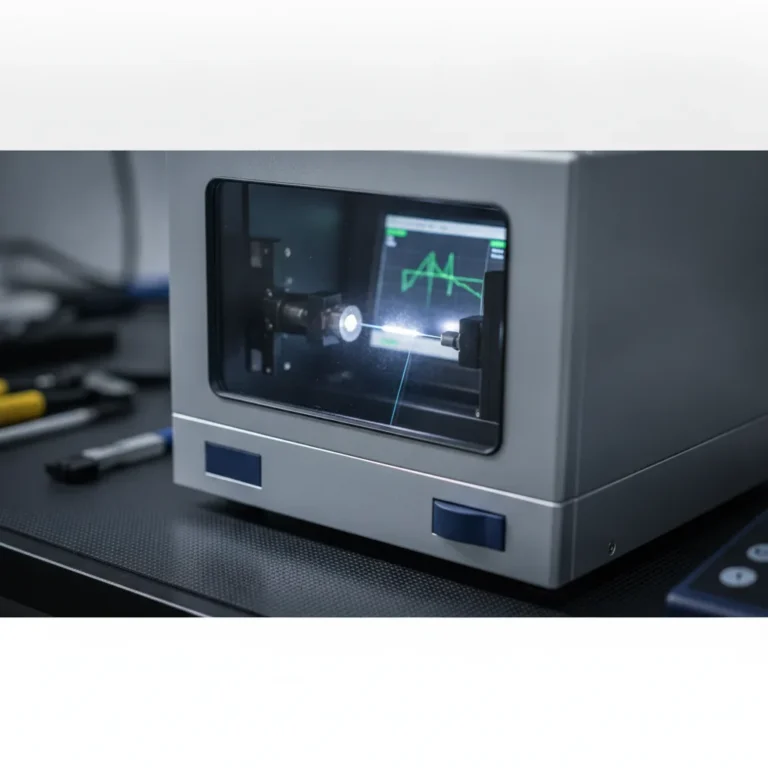
The VDE 0888 fibre optic standards Germany mandate comprehensive acceptance tests to be performed using calibrated equipment per IEC 61280. Every installed fibre route must be measured bidirectionally with an OTDR (Optical Time Domain Reflectometer) at minimum two wavelengths.
Minimum requirements for acceptance measurements include:
- Attenuation measurement: At 1310 nm and 1550 nm (singlemode)
- OTDR measurement: Bidirectional with launch fibre ≥ 500 m
- Connector loss: Maximum 0.5 dB per connection
- Overall link budget: Calculation per ISO/IEC 14763-3
- Chromatic dispersion: For routes > 10 km
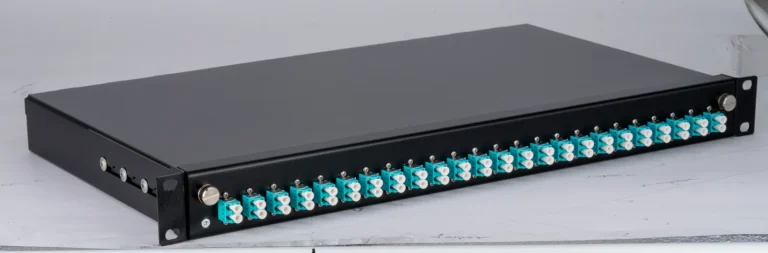
Modern splice systems such as the SlimConnect series from Fiber Products already integrate measurement protocols and enable complete documentation per DIN VDE fibre installation. The modular design with up to 96 fibres per 1U reduces space requirements compared to conventional systems.
Network Levels and Interface Points in German Fibre Architecture
Structured cabling per VDE 0888 defines clear responsibilities and technical interfaces between network levels. This systematic approach is essential for legally compliant installation and subsequent operation of FTTH networks.
The network level structure is organised as follows:
- Network Level 1 (NE1): Backbone/core network of the network operator
- Network Level 2 (NE2): Main distribution point to cable branch point
- Network Level 3 (NE3): Cable branch point to property boundary
- Network Level 4 (NE4): Building entry point to subscriber connection
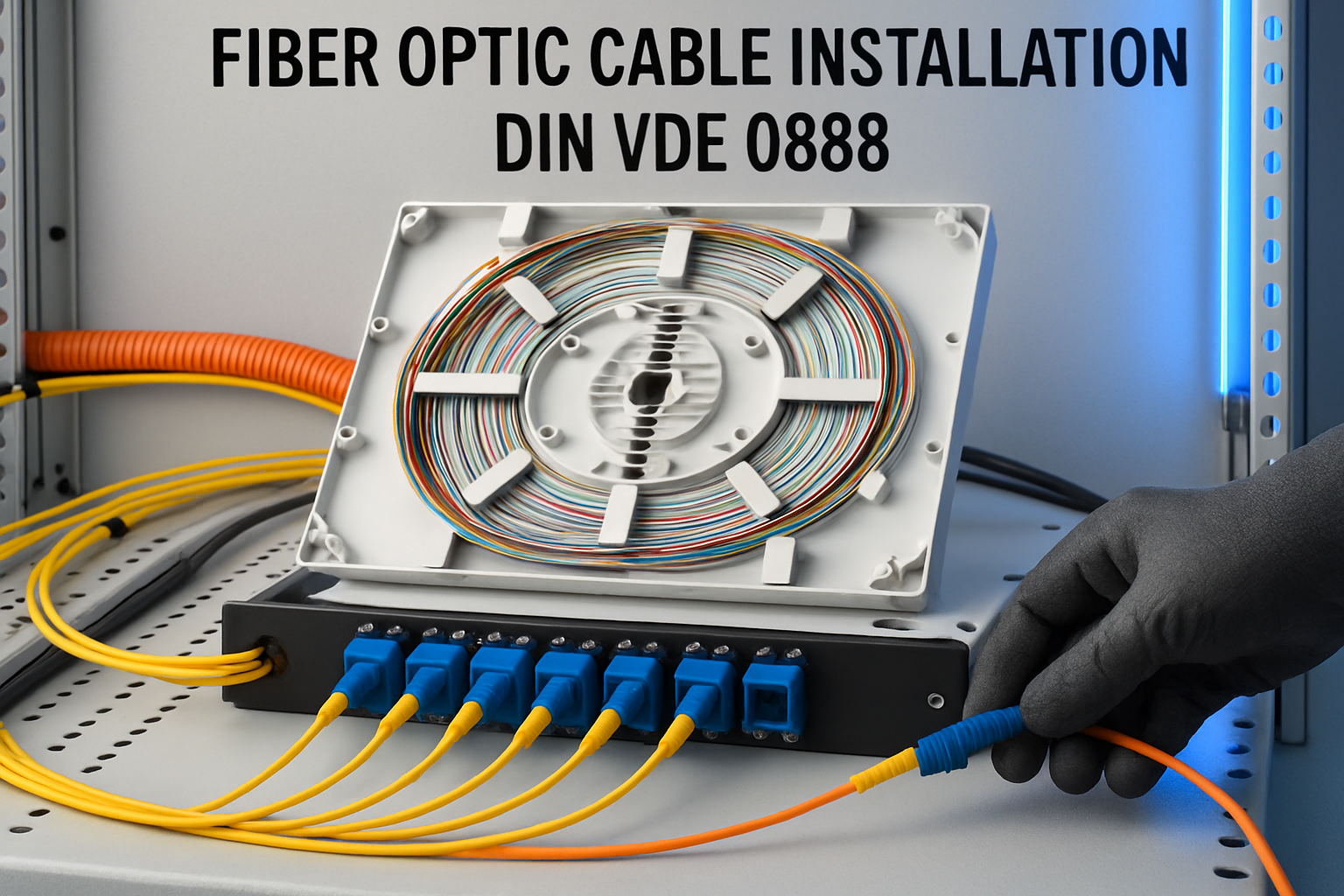
The building entry point (HÜP) marks the critical interface between network operator and building owner. Compact splice boxes are frequently used here to enable flexible fibre distribution. The VarioConnect systems offer maximum packing density with 288 fibres per 3U alongside modularity for future expansion.
Quality Assurance and Certification under German Standards
Compliance with VDE 0888 fibre optic standards Germany requires continuous quality management from planning through commissioning. Installers must be certified per VDE 0800-720 and demonstrate regular training.
Certification requirements include:
| Qualification | Validity | Examination Content | Standard |
|---|---|---|---|
| Optical fibre technician | 3 years | Splicing, measurement | VDE 0888 |
| FTTH project manager | 2 years | Planning, acceptance | VDE 0800 |
| Test technician | 2 years | OTDR, PMD, CD | IEC 61280 |
Strict requirements apply to product certification: all components must be CE-compliant and meet relevant IEC and EN standards. Diamond-certified components, such as those Fiber Products provides as an official partner, guarantee highest precision with tolerances of < 0.25 dB for connector loss.
Cost-Benefit of Standards-Compliant Fibre Installations
Strict compliance with DIN VDE fibre installation significantly reduces operating costs long-term. Standards-compliant installations show lower fault rates and substantially reduce unplanned maintenance visits.
Investment in high-quality, standards-compliant components typically amortises within 24–36 months through:
- Reduced downtime from improved system stability
- Lower maintenance costs via modular interchangeability
- Faster fault diagnosis through standardised measurement points
- Service life of at least 25 years
- Simplified expansion via modular systems
The advantage of standards-compliant systems is particularly evident in municipal networks and utility companies. The 5-year warranty on Fiber Products splice systems reduces investment risk further and enables reliable life-cycle cost calculation.
Practical Implementation: From Planning to Finished Installation
Successful implementation of VDE 0888 fibre optic standards Germany requires structured methodology. The planning process begins with detailed assessment of existing infrastructure and definition of performance requirements.
The typical project flow comprises the following phases:
- Phase 1 – Needs Assessment: Determination of required fibre count and transmission rates
- Phase 2 – Route Planning: Definition of cable paths considering fire protection requirements
- Phase 3 – Component Selection: Specification of cables, splice boxes and connector systems
- Phase 4 – Installation: Professional deployment and termination
- Phase 5 – Documentation: Creation of as-built drawings and test reports
For component selection, a modular system enabling future expansion without complete replacement is recommended. The SlimConnect and VarioConnect product lines offer maximum flexibility with continuous compatibility and support for all common connector types (LC, SC, E2000, ST, FC, MPO).
Future-Proof Fibre Networks through Standards Compliance
Consistent application of VDE 0888 and related standards creates the foundation for future-ready fibre networks. Given rising bandwidth requirements from 5G connectivity, edge computing and industrial IoT applications, standards-compliant installation is essential.
Current developments in standardisation include:
- Integration of 400G and 800G Ethernet standards
- Enhanced requirements for data centre cabling
- Specifications for industrial single-pair Ethernet applications
- Harmonisation with European EN 50173 standards
- Preparation for quantum communication via fibre
Investment in high-quality, standards-compliant infrastructure pays dividends long-term. Systems meeting the stringent requirements of DIN VDE fibre installation today are well positioned for future technology advances.
FAQ: Common Questions on VDE 0888 and Fibre Installation
What minimum bend radii apply under VDE 0888 for optical fibre cables?
VDE 0888 specifies a minimum bend radius of 30 mm for permanently installed singlemode cables, whilst during installation this may not fall below 60 mm temporarily. For bend-insensitive fibres per ITU-T G.657.A2, the radius reduces to 15 mm.
Must existing fibre installations be adapted to the new VDE 0888?
Grandfathering applies to properly installed systems. However, the new standard applies to material changes or expansions exceeding 30 percent of installation capacity. Retrofitting is recommended for critical infrastructure for security reasons.
What penalties threaten for non-compliance with VDE 0888?
Violations of DIN VDE fibre installation can result in fines up to €50,000. Personal injury from faulty installation incurs criminal liability and loss of insurance cover.
How do requirements differ between singlemode and multimode?
Singlemode installations per VDE 0888 require more precise splicing technique with maximum loss of 0.1 dB. Multimode tolerates 0.3 dB, requiring less specialised equipment.
Order directly from our shop: fiber-products.com
Request a Quote Today
Free consultation – personalised quote within 24 hours