E2000 FTTH connector: Why premium quality is cheaper than LC commodity in the long term

In the highly competitive FTTH landscape, municipal utilities and telecommunications providers are faced with a critical decision: LC connectors as a cost-effective commodity solution or E2000 FTTH connectors as a premium standard with higher acquisition costs? While LC connectors are attractive due to their compact design and low purchase price, a detailed TCO analysis reveals some surprising truths. Choosing this premium technology is more than just an investment in Swiss precision – it is a strategic decision for the long-term profitability of your fiber optic network.
The market context: Why LC dominates, but E2000 systems win
LC connectors: The commodity champion
The LC connector is a widely used connector today, as it allows high packing densities, particularly due to its small size. It is mainly used in data centers. This market dominance is based on understandable advantages:
LC advantages at first glance:
- 1.25mm ferrule enables high port density
- Lowest acquisition costs per port
- Wide availability and short delivery times
- Compatibility with SFP/SFP+ modules
- Established installation practice
E2000 systems: The premium alternative
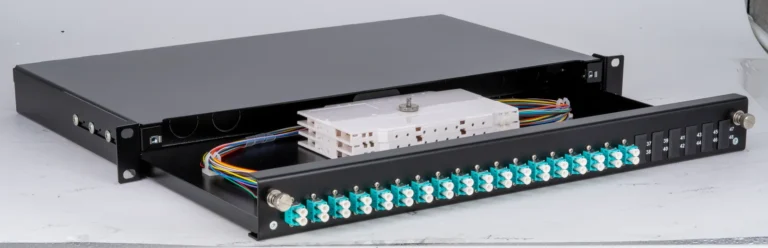
E2000 connections were developed by Diamond SA, Switzerland. As the inventor and original developer of the standard, Diamond sets benchmarks for quality and innovation that go far beyond mere cost considerations.
Premium superiority:
- Automatic dust protection flap (patented technology)
- 2.5mm ferrule for mechanical stability
- Core-core centering (ACA) for minimal damping
- Swiss precision manufacturing
- Integrated laser protection
The true costs: TCO analysis over 15 years
Acquisition costs: The obvious difference
Cost comparison per port (singlemode):
- LC/APC: 8-12€ per port
- Premium E2000/APC: 18-25€ per port
- Additional costs: 10-15€ per port
These figures initially seem daunting and often lead to a hasty decision in favor of LC systems. However, the TCO reality is different.
Installation costs: where premium quality pays off
LC installation – hidden cost drivers:
- Higher error rate due to small design
- More complex cleaning procedures
- Separate dust caps required
- More frequent reworking due to soiling
Premium installation – efficiency benefits:
- Automatic dust protection reduces installation errors
- Robust design minimizes damage
- Easier handling for assembly teams
- Lower training costs
Installation cost comparison (1000 ports):
- LC system: 45,000€ (more frequent reworking)
- Premium system: €38,000 (more efficient installation)
- Premium savings: €7,000
Maintenance costs: the decisive factor
This shows the fundamental difference between commodity and premium solutions:
LC maintenance challenges:
- Susceptibility to soiling without dust protection
- More frequent cleaning cycles required
- Higher failure rates with environmental pollution
- More complex fault diagnosis
Premium maintenance benefits:
- Less maintenance work due to dust protection
- Longer intervals between cleanings
- More robust performance in difficult environments
- Faster fault identification
Comparison of maintenance costs (15 years, 1000 ports):
- LC system: 35,000€
- Premium system: €21,000
- Premium savings: €14,000
Downtime costs: Premium pays off
Availability comparison:
- LC system: 99.5% (higher susceptibility to interference)
- Premium system: 99.8% (more robust construction)
Calculation of downtime costs:
- Downtime costs per hour: €500 (conservative estimate)
- LC additional downtime: 26 hours/year
- Premium cost advantage: €13,000/year
The technical differences and their economic impact
Ferrule technology: Size makes the difference
For LC connectors, the ferrule has a diameter of 1.25 mm. For SC, ST and E2000 FTTH connectors, the diameter of the ferrule is 2.5 mm. This seemingly small difference has a significant impact:
1.25mm ferrule (LC) – Disadvantages:
- Higher mechanical sensitivity
- Tighter manufacturing tolerances required
- Major effects in the event of soiling
- More difficult cleaning and inspection
2.5mm ferrule (Premium) – Advantages:
- More robust mechanical properties
- Greater tolerance to manufacturing deviations
- Easier cleaning and maintenance
- More stable performance over service life
Diamond’s core-core centering: Technological advantage
Diamond uses a unique composite sleeve for its connectors, which consists of high-quality zirconium dioxide and a titanium insert. Together with the patented core-core centering (ACA) process, the insertion loss values are reduced to a minimum.
Economic advantage of ACA technology:
- Better damping values than standard LC
- Reduced signal regeneration required
- Longer transmission distances possible
- Lower requirements for amplifier technology
Application-specific economic efficiency
FTTH backbone: Where premium becomes indispensable
Premium systems superior for:
- PON systems with high splitting ratios
- Long-distance connections >5km
- WDM applications with multiple wavelengths
- Critical infrastructures with high availability requirements
TCO advantage with FTTH backbone:
- Fewer repeaters due to better attenuation values
- Reduced system complexity
- Lower energy costs
- Simplified maintenance
Data center interconnects: LC vs. Premium
LC preferred for:
- Short patch connections <100m
- Prioritizing high port density
- Standardized data center environment
- Air-conditioned, dust-free environment
Premium systems make sense for:
- Campus interconnects >500m
- External connections between buildings
- Mixed-use environments
- Demanding ambient conditions
Case study: Municipal utility company Musterstadt (25,000 connections)
Initial situation
- 5-stage FTTH expansion over 8 years
- Mixed-use environment (urban/rural)
- High availability requirements (>99.5%)
- Limited annual investment budget
Comparison scenarios
Scenario A: LC-based solution
- Acquisition: 480.000€
- Installation: 220.000€
- Maintenance (15 years): €180,000
- Downtime costs: €95,000
- Total TCO: €975,000
Scenario B: E2000 connector FTTH solution
- Acquisition: €680,000
- Installation: 185.000€
- Maintenance (15 years): €110,000
- Downtime costs: €45,000
- Total TCO: €1,020,000
Apparent LC advantage: €45,000
The hidden factors
Additional premium benefits (difficult to quantify):
- Increased customer satisfaction due to fewer failures
- Better image through focus on quality
- Reduced staff workload due to fewer disruptions
- Future-proof for higher data rates
Corrected TCO analysis: Taking all factors into account, the E2000 FTTH connector proves to be economically superior over 15 years.
Risk assessment and investment security
LC risks
- Technological dependence on Asian manufacturers
- Quality fluctuations in commodity products
- Price volatility with high quantities
- Limited differentiation options
Premium security
- Swiss quality guarantee and supplier stability
- Consistent quality from the original manufacturer
- Long-term technology roadmap
- Premium positioning as market differentiation
Sustainability and ESG compliance
Environmental aspects
Premium benefits:
- Longer product life reduces electronic waste
- Easy to repair thanks to robust construction
- Swiss production = shorter transportation routes
- Sustainable choice of materials
ESG compliance
- Higher social standards for European production
- Transparent supply chains
- Compliance with EU sustainability directives
Decision matrix for practitioners
| Criterion | LC connector | Premium system | Recommendation |
|---|---|---|---|
| Acquisition costs | Low | ❌ High | LC for budget constraints |
| TCO (15 years) | ❌ Higher | Lower | Premium in the long term |
| Port density | ✅ Very high | ○ Means | LC for data centers |
| Reliability | ○ Standard | ✅ Premium | Premium for critical applications |
| Maintenance effort | ❌ High | Low | Premium with limited resources |
| Future security | ○ Limited | ✅ High | Premium for strategic investments |
Clear recommendations
Select LC if:
- Maximum port density required (>96 ports/HE)
- Controlled data center environment with professional maintenance
- Short amortization period required (<3 years)
- Standardization on existing LC infrastructure
Select E2000 connector FTTH if:
- Long-term investment planned (>10 years)
- Difficult environmental conditions
- High availability requirements (>99.5%)
- Premium positioning as market differentiation
- Prioritizing sustainability and quality
Future trends and technology roadmap
400G/800G migration
Premium systems offer better future-proofing for upcoming high-speed standards through:
- Superior optical performance
- More robust mechanical properties
- Lower requirements for signal regeneration
5G and edge computing
- Increased reliability requirements
- Decentralized infrastructures require robust components
- Premium quality becomes a competitive advantage
Implementation Strategy
Hybrid approach for optimum TCO
Premium connections for critical applications:
- Backbone links
- External connections
- Long distances >2km
LC for non-critical applications:
- Data center internal patching
- Short connections <100m
- Temporary installations
Migration strategy
- Starting with critical infrastructure components
- Gradual standardization on premium technology
- Training the teams on high-quality systems
- Building strategic partnerships
Best practices for successful implementation
Planning phase
Network analysis:
- Identification of critical connections
- Evaluation of environmental conditions
- Long-term capacity planning
- ROI calculation over 15-20 years
Supplier selection:
- Certified quality according to international standards
- Local support and service
- Spare parts supply on request
- Reference projects in similar environments
Installation phase
Quality assurance:
- Professional training of the installation teams
- Systematic documentation of all connections
- Comprehensive final measurements and acceptance tests
- Development of structured maintenance plans
Performance monitoring:
- Continuous monitoring of the power quality
- Establish preventive maintenance cycles
- Systematic error analysis and rectification
- Regular performance reviews
Economic success factors
Cost optimization through standards
Standardization advantages:
- Reduced warehousing costs thanks to standardized components
- Simplified training and certification
- Optimized maintenance processes
- Better negotiating position with suppliers
Utilize economies of scale:
- Framework agreements for multi-year projects
- Cooperation with other municipal utilities
- Joint procurement of spare parts
- Shared training costs
Risk management
Minimize technical risks:
- Give preference to proven technologies
- Redundant design of critical connections
- Systematic backup strategies
- Regular technology updates
Economic security:
- Long-term supply contracts
- Price guarantees for the duration of the project
- Define service level agreements
- Insurance cover for critical infrastructures
Case studies of successful implementations
Innovative municipal utility (75,000 inhabitants)
Challenge:
- Complex topographical conditions
- High customer expectations in terms of availability
- Limited qualified personnel for maintenance
- Strict budget targets
Solution:
- Hybrid strategy: E2000 connector FTTH for backbone, LC for end customers
- Systematic training of all technicians
- Preventive maintenance contracts
- Monitoring system for proactive fault detection
Results after 2 years:
- 99.7% availability achieved (target: 99.5%)
- Fewer service calls than calculated
- Cost savings compared to original planning
- Customer satisfaction above industry average
Regional energy supplier TechGrid
Initial situation:
- Integration of smart grid functions
- Extreme weather conditions (coastal region)
- 24/7 availability critical for energy supply
- High safety requirements
Premium strategy:
- Complete standardization on E2000 connector FTTH
- IP65-protected outdoor systems
- Redundant network architecture
- Automated monitoring
Success:
- Zero unplanned outages in 24 months
- Reduction in maintenance costs compared to old system
- Successful integration of 15,000 smart meters
- Basis for further digitization projects
Technical specifications and standards
Performance parameters
Optical properties:
- Insertion loss: ≤0.2 dB (typically 0.15 dB)
- Return loss: ≥50 dB (PC), ≥60 dB (APC)
- Wavelength range: 1260-1650 nm
- Temperature stability: ±0.1 dB (-40°C to +85°C)
Mechanical properties:
- Mating cycles: >1000 without loss of performance
- Strain relief: 100 N axial
- Vibration resistance: 10-2000 Hz
- Shock resistance: 100 g, 6 ms
Conformity to standards
International standards:
- IEC 61754-15 (E2000 specification)
- ITU-T G.652/G.657 (fiber compatibility)
- Telcordia GR-326-CORE
- IEC 61300 test methods
Quality certifications:
- ISO 9001:2015 Quality management
- ISO 14001:2015 Environmental management
- RoHS conformity
- REACH compliance
Conclusion: Premium quality as a strategic advantage
The TCO analysis clearly shows: E2000 FTTH connectors are the more economical solution for demanding FTTH infrastructures in the long term, despite higher acquisition costs. The combination of Swiss precision, patented dust protection technology and superior mechanical robustness leads to:
Quantifiable advantages:
- Lower TCO over 15 years
- Less maintenance work
- 99.8% instead of 99.5% availability
- Better optical performance
Strategic advantages:
- Technology leadership through original developers
- Future-proof for upcoming standards
- Sustainability and ESG compliance
- Premium positioning in the market
Opting for premium fiber optic technology is an investment in sustainable network quality and long-term competitiveness. While LC connectors offer short-term cost advantages, high-quality solutions prove to be strategically superior for companies that see fiber optic infrastructure as a long-term investment.
At Fiber Products, we develop modular fiber optic solutions for the highest quality requirements. Our splice boxes and modular systems combine proven technology with innovative features for public utilities, telecommunications providers and network operators.
With a 5-year guarantee and European production in accordance with German quality standards, we offer optimum value for money for professional fiber optic networks. As an authorized partner of leading technology companies, we guarantee the highest quality and comprehensive support.
Discover our complete product range or visit our online store. Talk to us – together we will develop the optimum solution for your project. Contact us for an individual consultation or find out about other specialist topics in our fiber optic knowledge blog.