E2000 vs. LC Connectors: Which Type Is Right for Your Fibre Optic Infrastructure?
E2000 vs. LC: Which Connector Is the Right Choice for Your Fibre Optic Infrastructure?
E2000 or LC — at first glance, both connector types appear interchangeable. In practice, however, they differ in critical ways: the E2000 offers laser safety protection and suits security-critical and high-performance applications, while the LC’s compact design enables maximum port density. Which type is the better choice — here’s the direct comparison.
For installation firms across DACH, the right connector choice is essential for efficient project delivery and customer satisfaction. As FTTH rollout accelerates, you as an installer must balance technical requirements with practical factors such as installation time and pre-terminated solutions.
Technical Fundamentals: E2000 and LC Head-to-Head
The E2000 connector was developed specifically for demanding environments and features a spring-loaded protective shutter that shields the ferrule from contamination and damage. With typical attenuation of < 0.25 dB on singlemode fibres, it meets IEC 61754-15 requirements.
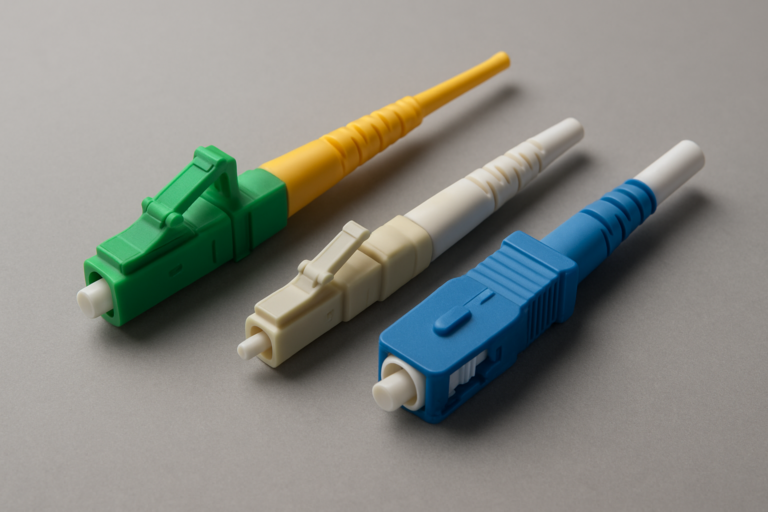
The LC connector uses a push-pull mechanism with a 1.25 mm ferrule and requires only about half the space of an SC connector. The compact design enables up to 96 fibres per 1U in modular splice systems.
| Feature | E2000 Connector | LC Connector |
|---|---|---|
| Ferrule Diameter | 2.5 mm | 1.25 mm |
| Protective Mechanism | Integrated Spring Shutter | Separate Dust Cap |
| Typical Attenuation | < 0.25 dB | < 0.30 dB |
| Port Density | Medium | Very High |
| Standard | IEC 61754-15 | IEC 61754-20 |
Use Cases and Application Scenarios for E2000 Connectors
E2000 connectors dominate security-critical areas and industrial environments. The automatic protective shutter prevents ferrule contamination during mating — a decisive advantage in dusty environments or during infrequent reconnections.
- Telecommunications backbone networks with high quality requirements
- Industrial installations with elevated dust and contamination levels
- FTTH distribution points in outdoor areas
- Test equipment and measurement devices for precise attenuation measurements
- Long-distance links with minimal loss budgets
As an installation firm, you benefit from E2000’s factory pre-termination and reduced cleaning effort. The robust design minimises failures from contaminated connectors — a common field service issue.
LC Connectors: Maximum Port Density for Modern Networks
LC connectors have become the standard in data centres and high-density cabling environments. The compact design enables double the port density compared to SC connectors while maintaining optical performance.
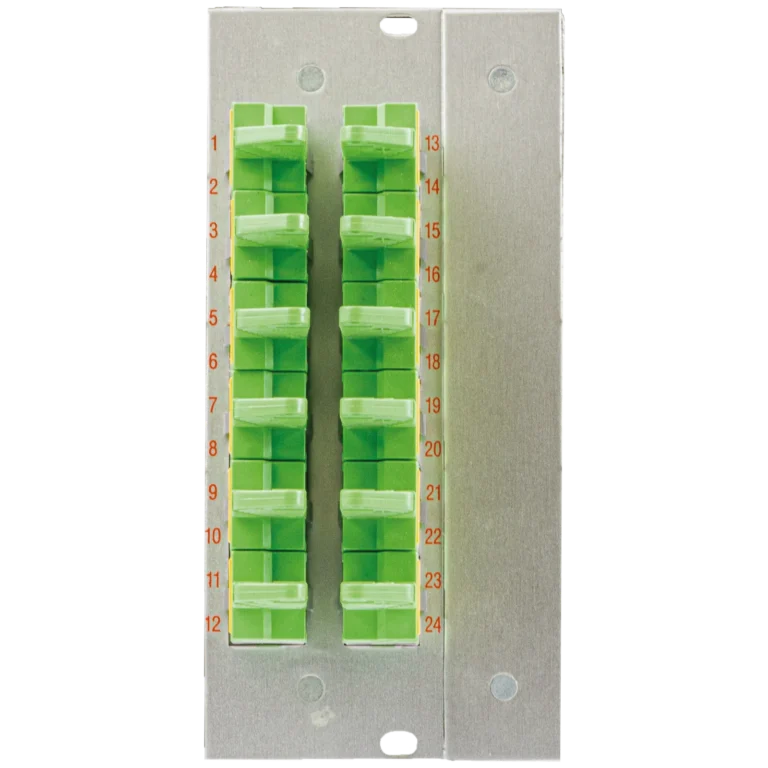
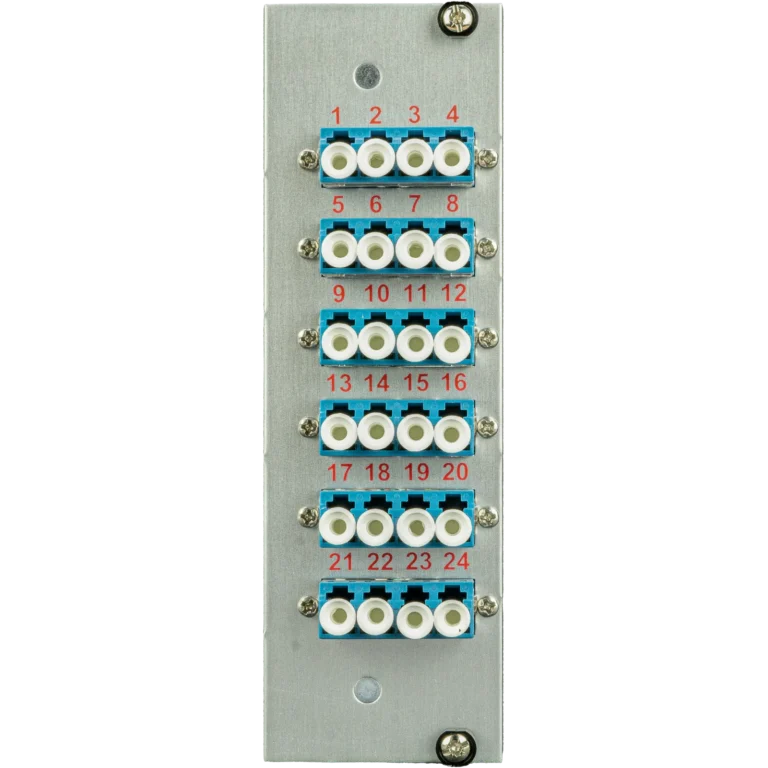
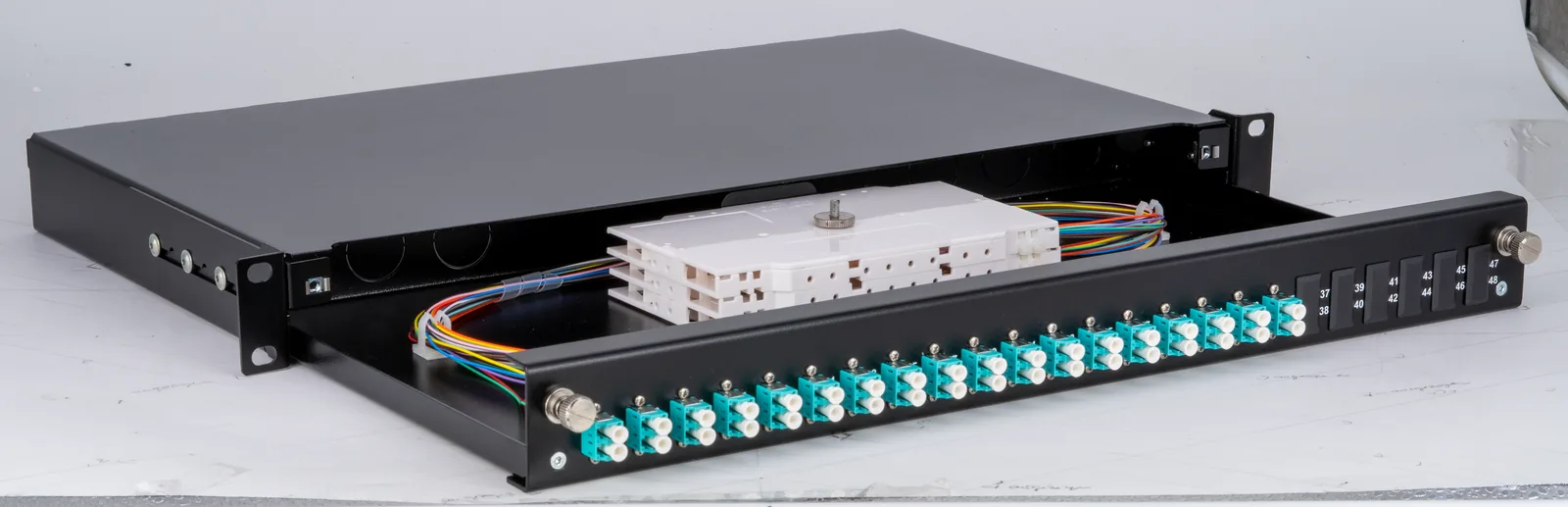
In modular splice systems such as the SlimConnect 1U system, LC termination achieves up to 96 fibres in just one rack unit. This packing density is crucial for efficient fibre network deployment in constrained distribution racks.
- Data centres with high port density requirements
- FTTH distribution points in multi-family buildings
- Campus networks with singlemode and multimode mixed cabling
- Active network components (switches, routers)
- High-speed links up to 400G
Fiber Products Quality Commitment: As an official Diamond partner and manufacturer, we produce modular splice systems in Europe. Benefit from Swiss precision engineering and in-house manufacturing.
Installation Time and Assembly Effort — Practical Comparison
For installation firms, assembly time is a critical cost factor. E2000 connectors require longer during initial installation due to their bayonet design, but offer lower maintenance costs long-term thanks to integrated protection.
LC connectors excel with fast push-pull installation and are ideal for projects requiring high port counts. Tool-free mating reduces installation time per port by an average of 30 seconds.
| Installation Aspect | E2000 | LC |
|---|---|---|
| Assembly Time per Connector | approx. 90 seconds | approx. 60 seconds |
| Tools Required | No | No |
| Cleaning Effort | Low | Medium to High |
| Assembly Error Rate | Very Low | Low |
Cost Analysis: TCO Perspective for E2000 vs. LC Installations
Total Cost of Ownership (TCO) differs significantly when comparing E2000 and LC connectors. E2000 components carry higher upfront costs than LC connectors — but pay for themselves in maintenance-intensive environments through reduced service costs.
- E2000: Higher initial investment, lower maintenance costs
- LC: Low acquisition cost, higher cleaning requirements
- Pre-terminated solutions reduce assembly time
- Modular systems allow future connector type changes
Standards Compliance and Certifications in the DACH Market
Both fibre optic connector types comply with relevant international standards. E2000 per IEC 61754-15 and LC per IEC 61754-20. For public tenders in Germany, compliance with DIN EN 50173-1 is also relevant.
The Diamond partnership guarantees the highest quality standards for E2000 connectors with Swiss precision manufacturing. This certification is a decisive quality credential, especially for municipal utilities and public procurement bodies.
Future-Proofing: Which Connector Type for FTTH Deployment?
Germany’s FTTH rollout requires flexible solutions across different network tiers. E2000 dominates in outdoor distribution frames and primary distribution points, while LC is preferred in building and customer premises installations.
- Backbone tier: E2000 for maximum reliability
- Distribution network: Mixed terminations based on environmental conditions
- Building cabling: LC for high port density
- Customer premise: LC or SC depending on end device
- Industrial connections: E2000 for robust links
Practical Decision Guide for Installation Firms
The choice between E2000, LC, and other fibre optic connector types depends on project-specific requirements. Modern modular splice systems offer the flexibility to combine both connector types within a single system.
For maximum flexibility, use modular systems with interchangeable front modules. This allows you to switch between E2000, LC, SC, or other connector types depending on customer needs — without replacing the entire splice module.
FAQ: Frequently Asked Questions About E2000 and LC Connectors
Can I mix E2000 and LC connectors in a single splice module?
Yes, modern modular splice systems such as VarioConnect allow mixed connector terminations through interchangeable front modules. This provides maximum flexibility as requirements change.
Which connector type is better suited for outdoor installations?
E2000 connectors are optimal for outdoor installations thanks to their integrated protective shutter. The automatic protection prevents contamination even under frequent weather exposure.
How do attenuation values differ between APC and PC versions?
The difference is in return loss, not insertion loss. IEC 61755-2-1 defines grade 1 as ≥ 60 dB and reserves it for angled, physically contacting fibres, while non-angled PC falls under grades 2 to 4 (≥ 45, ≥ 35, ≥ 26 dB). On the product side DIAMOND specifies at least 50 dB for PC and at least 70 dB for APC. Insertion loss is a separate parameter and is given per connector type in the manufacturer’s datasheet. Both polish types are available in E-2000 and LC designs.
What port density can I achieve with different connector types?
With LC connectors, you reach up to 96 fibres per 1U, with E2000 approximately 48 fibres per 1U. SC connectors allow a maximum of 48 fibres per 1U.
Are adapters available between E2000 and LC?
Not directly. Hybrid adapters mate connectors that share the 2.5 mm ferrule class, so E-2000 to SC, FC or ST is available; LC uses a 1.25 mm ferrule, which a passive sleeve cannot centre in the same bore. Towards LC you use a hybrid patch cord — E-2000 on one end, LC on the other — or DIAMOND’s LC-compatible F-3000. No manufacturer publishes a fixed extra attenuation for a hybrid mating point: budget it like any other mated pair, and keep the number of mating points low on permanent links.
What warranty period applies to professional fibre connectors?
Fiber Products is the only provider in the DACH market offering 5 years’ warranty on all splice modules and connectors — a unique competitive advantage for your project security.
Conclusion: Optimal Connector Selection for Your Project
The decision between E2000, LC, and other fibre optic connector types should always be project-specific. E2000 offers maximum protection for critical infrastructure, while LC enables the highest port density for modern networks. As an installation firm, you benefit from modular systems that combine both approaches.
Fiber Products, as manufacturer and official Diamond partner, delivers complete system solutions from a single source — from splice boxes to pre-terminated patch cables. With 5 years’ warranty on all systems and European manufacturing, we set the standard in quality and reliability. Contact our specialists for project-specific guidance on your optimal fibre optic solution.
All modular fibre optic components are available directly in the Fiber Products Shop — with 5 years’ manufacturer warranty.
Related product
E-2000 Connectivity
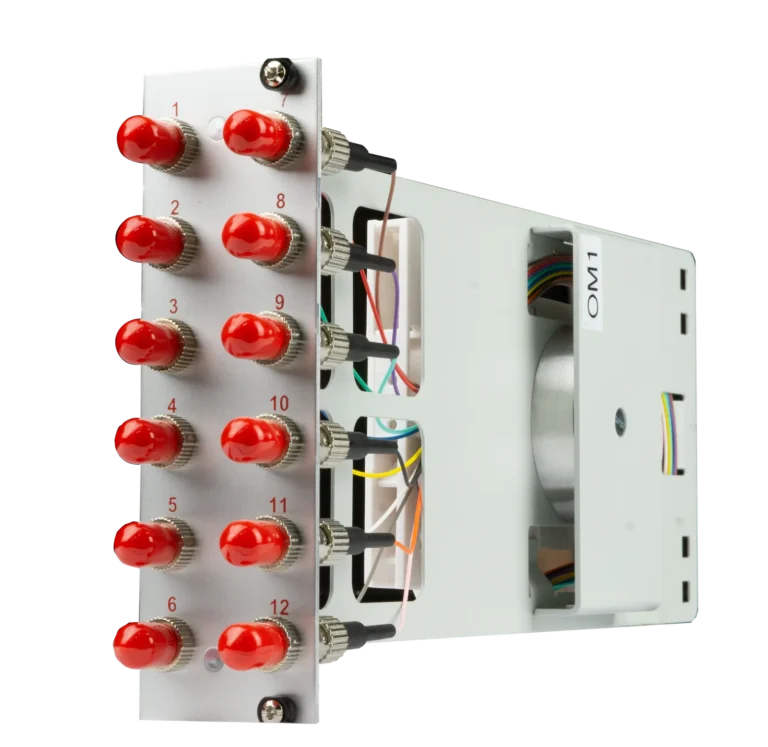
Connector face with protective shutter and push-pull latch, available in splice and front modules on the 7 TE grid and in splice boxes · APC and PC · production partner of DIAMOND SA
Request Expert Consultation
Our experts guide you through modular fibre optic solutions for your specific application — fast, personal, and without obligation.